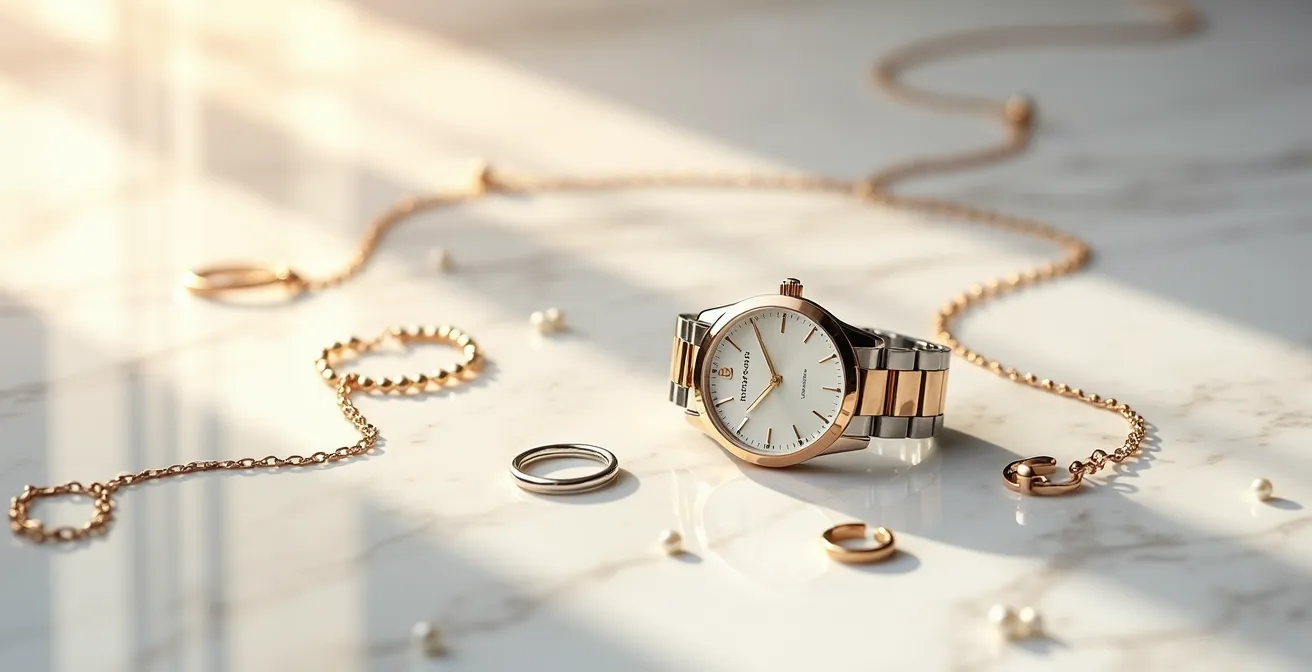
Contrary to the rigid doctrines of the past, mixing metals is not a sign of sartorial carelessness but the hallmark of a confident, contemporary style.
- The key is not to match, but to establish a “metal hierarchy” with your watch as the anchor piece.
- Leathers should be coordinated by tone and family, not by an exact shade.
Recommendation: Master these updated rules to move beyond outdated dogma and achieve a look that is both cohesive and characterful.
For the detail-oriented dresser, a moment of doubt can disrupt an otherwise impeccable ensemble. It often arrives unexpectedly: the realisation that one’s silver belt buckle is at odds with a treasured gold timepiece. The old guard of menswear would have you believe this is an unforgivable faux pas, a rule as rigid as wearing black shoes after six. These traditional doctrines, demanding exact matches between leathers and a strict segregation of metals, have long governed the choices of the well-dressed.
These established conventions, however, are showing their age. The modern British approach to style values nuance over dogma, and character over conformity. But this does not mean anarchy reigns. In fact, the new rules are more sophisticated, requiring a greater understanding of balance, proportion, and context. The true question is no longer *if* you can mix metals or coordinate different shades of brown, but *how* one does so with intention and elegance.
The secret lies in a principle we shall call the ‘metal hierarchy’. This is the understanding that one’s watch should act as the anchor piece, the central point from which all other accessory decisions radiate. It is about creating a deliberate palette, not a chaotic jumble. This is the new code of cohesion, where harmony is achieved through thoughtful curation rather than slavish imitation.
This guide will deconstruct the outdated rules and present a clear, modern framework for coordinating your watch and accessories. We will explore the subtleties of proportion, the art of tonal leather matching, the new etiquette for sports watches in formal settings, and the undeniable power of a well-chosen accessory to define your presence. By mastering these principles, you will be equipped to assemble a look that is not only correct but truly distinguished.
Summary: A Guide to Flawless Accessory Coordination
- Does a Chunky Diver’s Watch Overpower a Fine Silk Blouse?
- Must Your Watch Strap Match Your Shoes and Belt Exactly?
- Can You Wear a Sports Watch with a Lounge Suit in 2024?
- Why Unusual Watch Shapes Are the Best Ice-Breakers at Networking Events?
- When Should You Switch from a Leather Strap to a NATO Band for Summer?
- Can You Wear Silver and Gold Jewellery Together Without Looking Messy?
- Leather vs Metal: Which Strap Is Acceptable for a Formal Office Environment?
- Which Designer Handbags Are Better Investments Than the Stock Market?
Does a Chunky Diver’s Watch Overpower a Fine Silk Blouse?
The traditionalist’s immediate answer is a firm “yes.” The juxtaposition of a robust, utilitarian timepiece with a delicate, feminine fabric seems to violate the fundamental rules of sartorial harmony. Yet, this is precisely where the modern understanding of proportional balance comes into play. A chunky watch does not have to overpower fine fabric; it can create a compelling and stylish contrast, provided the pairing is deliberate and thoughtfully executed.
The key is to ensure that the watch and the blouse are not competing for attention. One must be the statement, the other the support. If the watch is bold, the rest of the jewellery should be minimal and understated—think simple studs or thin, delicate rings. This principle of a ‘high-low’ balance is demonstrated masterfully by British style icons.
Case Study: Rosie Huntington-Whiteley’s Masculine-Feminine Balance
British model Rosie Huntington-Whiteley frequently showcases the art of pairing robust watches with delicate fabrics. Her approach involves choosing versatile pieces that bridge masculine and feminine elements. She often opts for rose gold sports watches that soften the traditionally masculine silhouette of a 40mm dive watch whilst maintaining its bold presence. This proves that with the right metal choice and proportional balance, even a substantial watch can elegantly complement a silk blouse, creating a look that is both powerful and polished.
Achieving this balance requires a strategic approach. The goal is to create a visual bridge between the powerful presence of the watch and the soft elegance of the clothing. This can be accomplished by carefully selecting transitional accessories or modifying the watch itself to better suit the occasion.
Your Action Plan: Achieving Proportional Balance
- Statement Piece: Identify your dominant accessory. Either the watch OR the blouse should be the focal point; they must not compete for attention.
- Transitional Elements: Collect a small inventory of ‘bridging’ accessories. Delicate gold chains or thin silver bracelets worn between the watch and the sleeve can soften the transition.
- Understated Cohesion: Assess your other jewellery. When wearing a bold watch, ensure other pieces like rings or earrings are minimal and do not overwhelm the fabric’s delicacy. Look for simple, classic designs.
- Proportional Audit: Review your entire look in a full-length mirror. Does the visual weight feel balanced? If the watch feels too dominant, consider switching to a more refined strap for the occasion.
- Integration Plan: Prioritise versatility. When acquiring new pieces, consider how they will integrate with both your bold and delicate items to ensure maximum wearability.
Must Your Watch Strap Match Your Shoes and Belt Exactly?
The age-old rule that a man’s leathers must match is perhaps the most recited—and most outdated—piece of style advice. The image of a gentleman with a perfectly matched black alligator strap, belt, and Oxford shoes is a powerful symbol of traditional correctness. However, slavish adherence to this rule in a modern context can appear stiff and unimaginative. The contemporary British approach favours tonal coordination over exact matching.
Tonal coordination is the art of harmonising different shades and textures from the same colour family. A chocolate brown suede strap can work beautifully with cognac brogues and a dark tan belt. The goal is to create a palette that looks cohesive and intentional, not a uniform. This approach adds depth and character to an outfit, suggesting a confident understanding of colour theory rather than a simple reliance on a rigid formula.
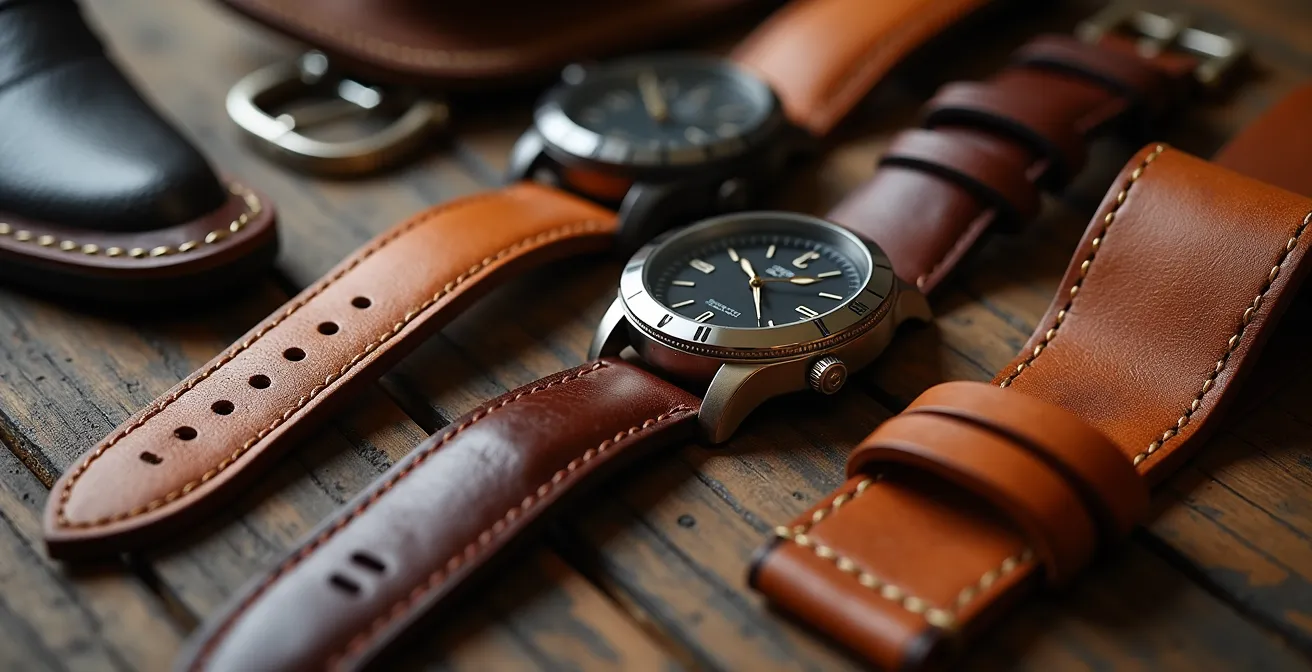
As this detailed view shows, the interplay of different patinas and grains within the same colour family creates a rich, textured look. The modern gentleman understands that a slight variation in leather tones is not a mistake, but a mark of sophistication. The only true remaining rule is to avoid stark, jarring contrasts, such as pairing black leather with light brown.
This evolution from rigid matching to nuanced coordination is a clear indicator of how style rules adapt. The following table illustrates the shift from the historical Savile Row standard to the more flexible approach seen today.
| Approach | Traditional Savile Row | Modern British Style |
|---|---|---|
| Black Leather | Must match exactly | Can mix with charcoal or dark grey |
| Brown Tones | Identical shade required | Tonal variations are encouraged |
| Exotic Leathers | Not traditionally worn | British racing green, oxblood acceptable |
| Metal Hardware | All metals must match | Two-tone acceptable with a bridging piece |
Can You Wear a Sports Watch with a Lounge Suit in 2024?
For decades, the answer was an unequivocal no. A sports watch, particularly a bulky diver’s model, was considered the antithesis of formal elegance. Its place was on the weekend or at the marina, never in the boardroom. However, a significant shift in office dress codes, accelerated in the post-2020 era, has rewritten this rule. The “James Bond effect” has permeated even the most conservative corners of British professional life, legitimising the sports-luxe aesthetic.
Today, wearing a sports watch with a lounge suit is not only acceptable but can be a powerful style statement, provided certain strict conditions are met. The key is refinement and discretion. Not all sports watches are created equal. A garish, oversized model with a rubber strap remains inappropriate. However, a classic dive or pilot’s watch on a refined steel bracelet or a conservative leather strap can integrate seamlessly into a business-casual look. Professionals in the City of London now commonly pair Omega Seamasters or Tudor Black Bays with their suits, a practice validated by a study from the Gentleman’s Gazette on watch-wearing rules.
The crucial considerations are case thickness and dial complexity. The watch must be slim enough—ideally under 13mm thick—to slide comfortably under a shirt cuff. A bulky watch that constantly catches on the cuff looks clumsy and ill-considered. Furthermore, the dial should be clean and relatively simple. A ‘busy’ dial with multiple chronographs and complications can detract from the formality of the suit.
The following guidance from a leading style authority clarifies the modern boundaries:
Business Casual – A light colored suit with no necktie is best paired with a high-end chrono, a pilot or even a smart field watch.
– British Style Authority, Value Your Watch Style Guide
This demonstrates that the context of “business casual” is critical. For the most formal occasions, a traditional dress watch remains the superior choice. But for daily wear with a modern suit, a well-chosen sports watch signals a contemporary and confident approach to professional style.
Why Unusual Watch Shapes Are the Best Ice-Breakers at Networking Events?
In a sea of standard circular timepieces, a distinctive watch shape—be it a rectangle, a tonneau, or an asymmetric design—is a powerful tool of social engagement. It is a subtle signal of individuality and an appreciation for design that goes beyond the conventional. At a networking event, where establishing memorable connections is paramount, such a piece serves as an effortless conversation starter. It invites inquiry and provides an immediate, neutral topic for discussion.
An unusual watch shape speaks to a person’s personality and confidence. It suggests they are not merely following trends but are making deliberate, considered choices. This is particularly effective in professional environments like London’s tech or creative sectors, where originality and a point of view are highly valued. A vintage Smiths Everest, for instance, not only shows an appreciation for British watchmaking heritage but also presents a story that is far more compelling than that of a ubiquitous modern model.
This effect is not merely anecdotal. A well-chosen, distinctive accessory can genuinely facilitate meaningful interactions, as illustrated by one entrepreneur’s experience.
Testimonial: London Tech Week Networking Success
At the 2024 London Tech Week, entrepreneur James Mitchell credits his vintage Smiths Everest for sparking the conversation that led to his £2M funding round. The investor, a fellow enthusiast, recognised the unusual shape and heritage of the piece, leading to a discussion that moved beyond business platitudes and established a genuine personal connection. It demonstrates that the right accessory can be more than an adornment; it can be a strategic asset.
Choosing a watch with a unique silhouette is an investment in one’s personal brand. It conveys an eye for detail, a respect for craftsmanship, and a quiet confidence that is far more impactful than ostentatious branding. In a room full of people trying to stand out, a non-conformist watch shape does so with intellect and grace.
When Should You Switch from a Leather Strap to a NATO Band for Summer?
The seasonal transition of a watch strap is a ritual for the discerning owner, particularly in the unpredictable British climate. Whilst a fine leather strap offers unparalleled elegance for most of the year, it is ill-suited to the heat and humidity of summer. Leather is a porous, organic material; it absorbs moisture, can become uncomfortable against the skin, and may develop an undesirable odour during a sweltering commute on the London Underground or an unexpected summer downpour.
The correct time to make the switch is a matter of practical observation. The general rule is to transition to a more robust, water-resistant strap, such as a NATO or Perlon, when daytime temperatures consistently exceed 20°C. This typically occurs in late May or early June in the UK. The NATO strap, with its military heritage and durable nylon construction, is the ideal summer alternative. It is breathable, quick-drying, and offers a secure fit, making it perfect for more active summer pursuits.
However, the switch does not mean a complete abandonment of style principles. The choice of NATO strap should still be considered. For formal summer events like Wimbledon or the Henley Royal Regatta, a brightly-striped regimental-style band may appear too casual. In these settings, a solid-coloured NATO strap in a conservative hue—such as navy, charcoal, or British racing green—is the more appropriate choice. It maintains the practical benefits of the NATO whilst respecting the formality of the occasion.
A structured approach to this seasonal change ensures both the preservation of your leather straps and sartorial appropriateness throughout the year. One should plan the transition in stages: begin monitoring weather forecasts in late April, acquire the NATO strap in early May to break it in during casual weekend wear, and make the full switch for daily use by early June. The process is then reversed in September as autumn approaches.
Can You Wear Silver and Gold Jewellery Together Without Looking Messy?
This question lies at the very heart of modern accessory coordination. The traditional rulebook would issue a stern prohibition: metals must never be mixed. Yet, a glance at today’s most stylish figures reveals a different story. The ability to artfully combine silver and gold is now a sign of supreme sartorial confidence. The key to avoiding a messy, chaotic look is to establish a clear ‘metal hierarchy’ and ensure a ‘bridging’ element is present.
The metal hierarchy principle dictates that one metal should be dominant, acting as the ‘anchor’ for the entire look. In most cases, this will be your watch. If you are wearing a stainless steel watch, steel or silver becomes your primary metal. You can then introduce gold in smaller, secondary pieces, such as a signet ring, a fine bracelet, or cufflinks. The reverse is true for a gold watch. This creates a cohesive foundation and prevents the metals from competing with each other. This trend is gaining significant traction, with British jewellers reporting a dramatic rise in mixed metal combinations in recent years.
A ‘bridging’ piece is the most sophisticated tool for legitimising a mixed-metal look. This is an item of jewellery that inherently contains both gold and silver tones, such as a two-tone watch or a Cartier Trinity ring. This piece acts as a deliberate link, signalling that the mixing of metals is an intentional style choice, not an oversight. The Princess of Wales is the foremost proponent of this technique in the UK.
Case Study: Kate Middleton’s Mixed Metal Mastery
As detailed by publications like Cosmopolitan UK, the Princess of Wales has become the nation’s unofficial ambassador for mixed metal styling. Her approach frequently involves using her classic ‘Ballon Bleu’ stainless steel watch as the anchor piece. She then confidently layers both gold and silver jewellery around it. Her secret is twofold: using the watch as the dominant metal and maintaining consistency in the finish (e.g., all polished or all brushed), which creates a harmonious, intentional, and supremely elegant look.
Ultimately, the most important rule is confidence. A well-considered combination of gold and silver looks deliberate and chic. An apologetic, hesitant mix will always look like a mistake.
Leather vs Metal: Which Strap Is Acceptable for a Formal Office Environment?
In a formal British office, the choice of watch strap is a subtle but significant indicator of one’s understanding of professional etiquette. The traditional default has always been a simple, high-quality leather strap—typically black or dark brown. This remains the safest and most unequivocally correct choice for a highly conservative environment, such as a Mayfair law firm or a government office in Westminster. A slim dress watch on a polished leather strap is the epitome of understated elegance.
However, the modern workplace is not a monolith. The definition of “formal” varies significantly across industries and locations. Whilst a metal bracelet might be viewed as too casual in a traditional legal setting, it is perfectly acceptable, and often preferred, in the world of finance. In Canary Wharf, an integrated steel bracelet on a luxury sports watch like a Rolex or an Omega is considered a symbol of success and aligns with the modern, dynamic ethos of the industry.
The crucial factor is context. The following guidance provides a framework for navigating these nuances:
| Office Type | Preferred Strap | Acceptable Alternative | Key Consideration |
|---|---|---|---|
| Mayfair Law Firm | Black leather, highly polished | Vintage gold dress watch | Discretion is paramount. Overly complicated designs or colourful bands can distract. |
| Canary Wharf Finance | Integrated steel bracelet | Black alligator leather | A modern sports-luxe aesthetic is widely accepted and valued. |
| Shoreditch Tech Startup | Anything goes | Smart watch acceptable | Creativity and personal expression are valued over convention. |
| Westminster Government | Conservative leather | Simple steel on formal days | Understated tradition and respect for protocol are preferred. |
This table, based on an analysis of professional dress codes like those found in guides on wearing dress watches, underscores the importance of environmental awareness. The most senior figures in British business etiquette maintain a clear line, as one authority states:
For business – go with a simple and classic styled gold or silver watch with a thin dial with limited or no complications.
– British Business Etiquette Authority, Rules to Match Your Watch Guide 2024
This advice holds true across all formal environments. Whether on leather or metal, the watch itself should be classic and understated. The strap choice then becomes a final, context-specific refinement.
Key Takeaways
- Establish a ‘Metal Hierarchy’: Your watch is the anchor. Choose one dominant metal and use others as secondary accents.
- Embrace Tonal Coordination: Match the family of leather colours (e.g., shades of brown), not the exact hue, for a more sophisticated look.
- Prioritise Proportional Balance: The visual weight of your watch must be in harmony with your attire. Balance a bold watch with minimal surrounding jewellery.
Which Designer Handbags Are Better Investments Than the Stock Market?
Whilst this article’s focus is on horological coordination, the principles of accessory harmony extend to all high-value items, particularly investment-grade designer handbags. In recent years, certain handbags from brands like Hermès and Chanel have famously outperformed traditional assets. The 2025 Luxury Investment Index, for instance, revealed significant growth in handbag values, positioning them as a leading category in luxury collectibles. For the discerning individual, this presents a unique opportunity: to create an accessory ecosystem where the investment value of each piece is enhanced by its coordination with others.
The critical point of intersection between a watch and a handbag is the hardware. The metal of the bag’s clasp, feet, and strap rings should be considered in relation to your primary watch metal. A cohesive look, where a gold watch is paired with a handbag featuring gold hardware, is not just aesthetically pleasing—it can have a tangible impact on resale value. UK collectors have noted that coordinated sets can command significant premiums in the secondary market.
This is particularly relevant for British luxury brands. A Mulberry handbag, for example, with its signature Postman’s Lock, presents a clear metallic element. A collector who consistently pairs their silver-hardware Mulberry bags with a stainless steel watch is building a curated, valuable collection. Indeed, some studies suggest that bags with specific hardware colours can appreciate faster when part of a coordinated collection.
The ultimate strategy for the serious collector is to think of their watch and handbag not as separate items, but as a linked investment. A two-tone watch can be a particularly shrewd choice, as it acts as a universal ‘bridging piece’, allowing for seamless coordination with bags featuring either gold or silver hardware. The goal is to move beyond owning a collection of expensive items and toward curating a portfolio of coordinated, high-performing assets.
With these principles of hierarchy, tonality, and context mastered, the next logical step is to audit your own collection. Assess each piece not in isolation, but in relation to the others, and begin to build a truly cohesive and valuable personal style.
Frequently Asked Questions on Watch Coordination
When exactly should I switch to a NATO strap in the UK?
Switch when daytime temperatures consistently exceed 20°C (typically late May), as leather can absorb moisture and develop odor during humid Tube commutes and sudden summer downpours.
Can I wear a NATO strap to Wimbledon or Henley?
For formal summer events, it is essential to choose your NATO strap with care. Opt for solid-coloured straps in conservative hues such as navy or British racing green rather than multi-coloured stripes to respect the occasion’s dress code.
What about the heritage of regimental stripes?
British military tradition should be respected. One should avoid wearing actual regimental patterns unless they have served in that specific regiment. It is far more appropriate to opt for fashion stripes or solid colours instead.