
Contrary to the rigid advice to ‘stand up straight’, projecting true elegance and confidence isn’t about forcing a static shape. This guide reveals that the secret lies in releasing chronic tension—especially ‘tech neck’—and cultivating a dynamic physical awareness. It’s about recalibrating your body’s default settings from the inside out, allowing a natural, commanding presence to emerge in any English social or professional setting.
Spend a day in any British office, and you’ll see it: the universal slump. Heads bowed over screens, shoulders hunched forward, a posture slowly shaped by gravity and glowing rectangles. You feel it in your own body—the tight neck, the dull ache in your upper back. The common advice is a constant, nagging chorus: “sit up straight,” “pull your shoulders back.” We try, holding a stiff, unnatural pose for a few minutes before our muscles tire and we collapse back into our familiar, comfortable slouch. This cycle of tension and collapse is exhausting, and it does nothing to build lasting confidence.
The problem is that we treat posture as an external shape to be held, rather than an internal state to be cultivated. We focus on the ‘what’—a straight spine—without understanding the ‘how’ of achieving it sustainably. This approach ignores the root cause: a ‘postural default’ set by years of habit, stress, and responding to our environment. True, commanding presence isn’t about military rigidity; it’s about learning the principles of dynamic alignment and releasing the tension that pulls you down. It’s the quiet assurance of a body at ease with itself, a quality that is felt by others before a single word is spoken.
But what if the key wasn’t to force a new posture, but to release the old one? This article is your guide to moving beyond the platitudes. As a movement coach, I’ll show you how to recalibrate your body’s framework, not just decorate it. We will explore how to manage stress-induced tension, move with grace in challenging situations, and use your physical presence as a powerful tool for communication. We’ll dismantle the myth of the static “power pose” and replace it with practical techniques for cultivating a state of what I call tensional integrity—a resilient, responsive, and effortlessly elegant posture you can truly own.
For those who prefer a visual format, the following video offers a fantastic introduction to understanding and controlling your upper body, which is the foundation for many of the principles we’ll discuss.
This guide will walk you through the practical mechanics of confident posture, from internal feelings to external expression. You’ll find actionable advice tailored for specific situations common in England, helping you build a presence that is both authentic and commanding.
Summary: Unlocking Your Natural Elegance Through Postural Awareness
- Do ‘Power Poses’ Before a Meeting Actually Boost Confidence?
- How to Sit Gracefully in a Skirt Without Adjusting Constantly?
- How to Stop Your Shoulders from Creeping Up to Your Ears During Stress?
- How to Walk in Heels Without Looking Like a Baby Giraffe?
- Why Holding Eye Contact Is the Ultimate Sign of Social Confidence?
- Why Structuring a Blazer Is Crucial for Female Authority in the Workplace?
- Which Luxury Smartwatches Keep Your Health Data Stored Locally?
- How to Stand at a Cocktail Party to Look Engaged and Elegant?
Do ‘Power Poses’ Before a Meeting Actually Boost Confidence?
The idea of striking a “superhero” pose to boost confidence went viral years ago, promising a quick fix for pre-meeting jitters. The initial claims about hormonal changes have since been largely debunked. However, the psychological effect is real, though more nuanced than first thought. It’s not about tricking your body chemistry, but about changing your mental state. Adopting an expansive posture sends feedback to your brain that can genuinely make you feel more powerful and self-assured.
A comprehensive 2022 meta-analysis confirmed this, looking at data from nearly 10,000 participants. The conclusion was clear: while behavioural and hormonal effects are unreliable, people consistently reported feeling more confident and powerful when holding expansive postures. The key is the feeling itself. This feeling of confidence is the true asset you carry into the meeting room, not a temporary spike in testosterone.
In a British professional context, discretion is often key. You don’t need to stand like Wonder Woman in the loo before a presentation. The goal is subtle signalling. It’s about finding small, private ways to open up your posture and reset your internal state. A few deep breaths while gently rolling your shoulders back in a quiet corner can be just as effective. The focus should be on releasing the contracted, defensive posture that stress creates and adopting one of quiet readiness and openness.
Ultimately, a power pose is a conscious interruption of your ‘postural default’. It’s a tool to remind your body what an open, confident stance feels like, making it easier to access that state under pressure.
How to Sit Gracefully in a Skirt Without Adjusting Constantly?
Wearing a skirt or dress, especially in a formal or professional setting, can introduce a layer of self-consciousness about how one is sitting. The constant need to check, smooth, or rearrange fabric is distracting both for you and for others. It projects unease, undermining the very elegance the outfit is meant to convey. The solution isn’t in the clothing, but in the technique. Graceful sitting is a learned skill, one that combines poise with practicality.
The gold standard for this, often observed in members of the British Royal Family, is a technique known as “the Duchess Slant.” It’s an incredibly effective method for maintaining composure and modesty, particularly when seated for long periods or when being photographed. It eliminates the need for fidgeting by creating a stable and elegant leg position from the moment you sit down.
As etiquette expert Myka Meier, founder of Beaumont Etiquette, explains, the technique is both elegant and protective:
Typically ‘the Duchess Slant’ is used when a lady has to sit for an extended amount of time while keeping poise and posture. It is the perfect pose for when a camera is shooting directly in front of you because by slightly slanting the knees…your legs are angled so that the camera only shoots the sides of your legs and protects your modesty.
– Myka Meier, Founder of Beaumont Etiquette
To adopt this pose, you sit with your spine straight but not stiff. Keep your knees and ankles together, and then simply slant both legs to one side. Your back remains centred on the chair, but your legs create a clean, diagonal line. This small adjustment locks your position, making you feel secure and look effortlessly composed, as demonstrated below.
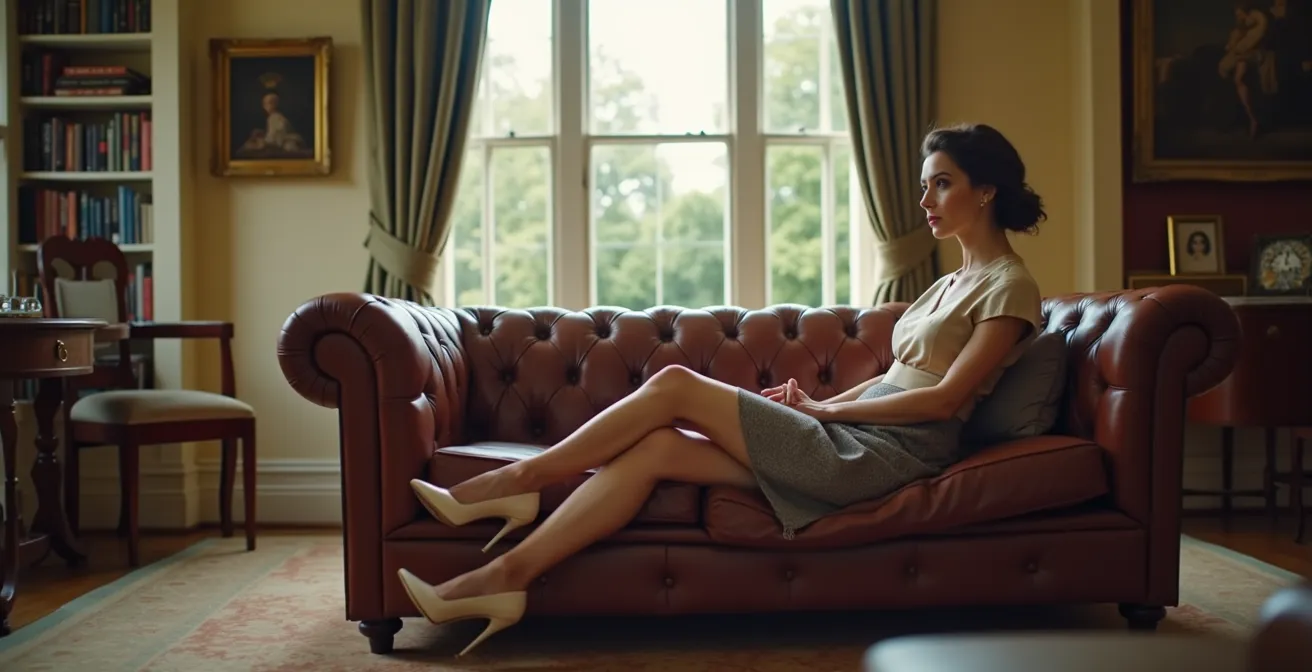
Mastering this simple technique means you can place your attention where it belongs: on the conversation and the people around you, not on your hemline. It transforms sitting from a passive act into a statement of quiet confidence and control.
This is a perfect example of dynamic alignment in practice: a structured but not rigid pose that works with your body to project poise.
How to Stop Your Shoulders from Creeping Up to Your Ears During Stress?
It’s a familiar feeling: the deadline is looming, the train is delayed, or you’re navigating a tense conversation, and without realising it, your shoulders have migrated upwards, creating a knot of tension in your neck and upper back. This physical reaction to stress is a primitive ‘fight or flight’ response, a guarding mechanism that, in the modern world, becomes a chronic source of pain and projects an image of anxiety and pressure. In the UK, this is far from a niche problem; the 2023 CIPD Good Work Index found that a third of UK workers struggle with work-related stress manifesting as physical tension.
Breaking this habit requires interrupting the unconscious cycle. The key is not to just force your shoulders down, but to actively release the muscles holding them up. This is where conscious breathing and movement become your most powerful tools. By pairing an exaggerated shrug with a controlled exhale, you can effectively “reset” the muscles, reminding them of their natural, relaxed position. This is a core principle of achieving tensional integrity—understanding and managing the forces at play in your body.
A simple yet highly effective method is the “Commuter’s Reset,” a technique you can do discreetly whether you’re at your desk or on the Tube. It takes less than a minute and provides immediate relief:
- First, become aware of your shoulder position. Are they tense? Are they high?
- Inhale deeply through your nose for a count of four, and as you do, consciously lift your shoulders as high as you can towards your ears. Embrace the tension.
- Hold this peak tension for a brief count of two.
- Exhale slowly and completely through your mouth for a count of six, letting your shoulders drop entirely. Feel the release and the weight as they fall.
- Finish by rolling your shoulders backwards in three small, slow circles to settle them into a new, lower resting place.
Setting an hourly reminder on your phone to do this quick check-in can be transformative. It moves the process from a reactive fix to a proactive habit, helping you retrain your ‘postural default’ away from a state of constant tension.
By regularly releasing this tension, you not only alleviate physical discomfort but also project an aura of calm and control, even when under pressure.
How to Walk in Heels Without Looking Like a Baby Giraffe?
Heels can be a powerful part of a professional wardrobe, adding height and altering the line of an outfit to create a more authoritative silhouette. However, their power is instantly negated if you can’t walk in them confidently. The teetering, uncertain walk of someone uncomfortable in their shoes projects vulnerability, not authority. The secret to mastering heels isn’t about enduring pain; it’s about choosing the right shoe and fundamentally changing how you move.
The first mistake is equating height with impact. In most British corporate environments, stability and confidence are far more valuable. This is why a well-constructed block heel is often a smarter choice than a stiletto, especially when navigating the charming but treacherous cobblestone streets of historic cities like Bath or York, or simply a long commute. A block heel provides a wider base of support, allowing for a more natural and powerful stride.
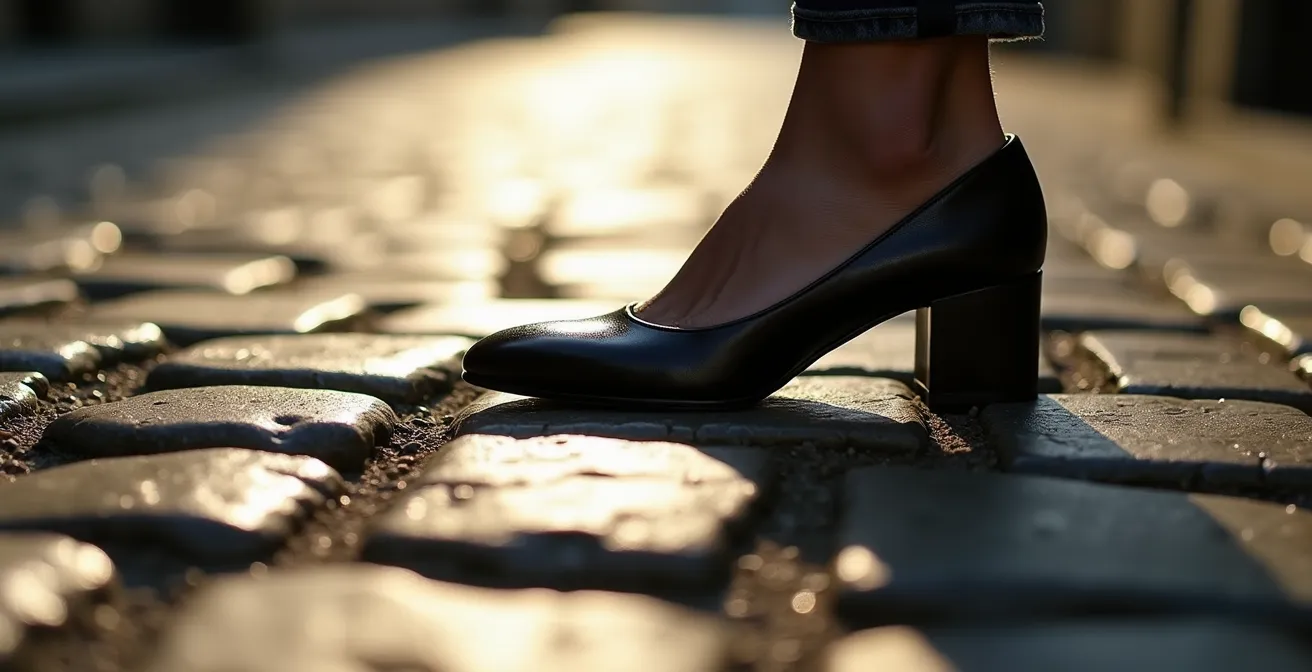
The technique of walking in heels is also different. Instead of stepping from heel to toe as you would in flats, the movement should be more fluid, with your foot landing more evenly. The power comes from your core and hips, not your ankles. Walk with purpose by engaging your abdominal muscles, which stabilizes your entire body. Let your arms swing naturally to provide counterbalance. Your stride may become slightly shorter, but it will be stronger and more deliberate. Think of your posture as the strong central column, with your legs extending from it.
As executive styling consultants note, the shoe is only part of the equation. A powerful presence is an ecosystem of posture, tailoring, and footwear. A stable heel, paired with a well-structured blazer and strong dynamic alignment, creates a cohesive message of competence and authority.
Ultimately, the most powerful shoe is the one that allows you to walk with unwavering confidence. If that’s a 2-inch block heel, it will always be more effective than a 4-inch stiletto you can’t command.
Why Holding Eye Contact Is the Ultimate Sign of Social Confidence?
In any social or professional interaction, your eyes are doing most of the talking. The ability to hold eye contact is one of the most potent, yet often underutilised, tools in non-verbal communication. Averting your gaze can be interpreted as insecurity, dishonesty, or disinterest. Conversely, steady, calm eye contact signals confidence, sincerity, and engagement. It says, “I am present, I am listening, and I value this exchange.” It is the cornerstone of what we can call social kinesthetics—the art of navigating social space with physical intelligence.
However, there’s a fine line between confident eye contact and uncomfortable staring. The key is in the rhythm and context, and British etiquette has unwritten rules for this. It’s not about a constant, unbroken gaze, but about a comfortable and confident pattern of connection and release. This demonstrates social awareness and respect for personal space, which are highly valued traits.
To master this, think in terms of specific scenarios rather than one single rule. Here are some guidelines adapted for typical UK settings:
- Professional Greetings: When meeting someone, maintain direct eye contact for about 3-5 seconds during the introduction and handshake. This is long enough to establish a connection without feeling intense.
- Social Gatherings: At a party or networking event, use a “brief warm glance” of 2-3 seconds. It’s an invitation to converse, not a demand for attention.
- During Conversation: A good general guide is the 70/30 rule. Aim to maintain eye contact about 70% of the time when you are speaking and a smaller portion, perhaps 30-50%, when you are listening. This allows you to look away thoughtfully, which appears natural.
- With Authority Figures: Show respect with strong initial eye contact, then adopt a more relaxed rhythm, occasionally glancing away as if considering their words before re-establishing contact.
Practising this doesn’t mean you need to count seconds in your head. It’s about developing a feel for the natural flow of a conversation. The goal is to make the other person feel seen and heard, which in turn reflects your own self-assurance.
When combined with an open, relaxed posture, appropriate eye contact completes the picture of a person who is comfortable in their own skin and confident in their interactions.
Why Structuring a Blazer Is Crucial for Female Authority in the Workplace?
In the landscape of professional attire, few items carry as much symbolic weight as the blazer. For women, a well-structured blazer does more than just complete an outfit; it physically reshapes the silhouette to project authority and competence. The clean lines and defined shoulders create a “frame” that subconsciously communicates strength and stability. It’s an architectural piece of clothing that lends its structure to the wearer. However, the blazer’s power is only fully realised when it is supported by an equally strong internal frame: your posture.
A slumped posture in an expensive blazer is a contradiction. It signals that the authority is just a costume, not an intrinsic quality. Conversely, when you stand tall with your shoulders aligned, the blazer enhances and amplifies your natural presence. The garment and the body work in harmony. Research from executive styling consultants suggests that professional women who maintain strong posture while wearing structured blazers report a significant improvement in their perceived authority. It’s the combination that unlocks the effect.
Hien Trang Duong of Sumissura UK puts it perfectly: “Posture & Presence: Stand tall, walk with purpose, and maintain steady eye contact. A powerful stance instantly enhances your presence, making your outfit even more impactful.” The blazer provides the sharp edges, but your dynamic alignment provides the powerful core. This synergy is what separates looking the part from truly embodying the role. A blazer with strong shoulder pads can help define your shape, but it’s your ability to “inhabit” the garment with good posture that fills it with life and purpose.
This means paying attention to fit. A blazer that is too tight across the back will pull and restrict movement, encouraging hunching. One that is too large will swallow your frame. The ideal structured blazer should allow you to stand with your shoulders back and your arms moving freely, complementing your posture rather than fighting it.
Your Action Plan: Auditing Your Professional Presence
- Points of Contact: List the primary settings where your presence matters most (e.g., team meetings, client presentations, networking events, daily desk work).
- Collect Inventory: For one week, observe your ‘postural default’ in these settings. Do you slouch? Hunch? Also, assess your key workwear pieces. Does your go-to blazer fit properly across the shoulders?
- Check for Coherence: Compare your observations with the image you want to project. Does your slumped posture in a meeting align with the image of a confident leader?
- Assess Impact & Emotion: Does your current presence feel memorable and authoritative, or forgettable and passive? How do you want others to perceive you non-verbally?
- Create an Integration Plan: Choose one small habit to change (e.g., the ‘Commuter’s Reset’ at your desk) and identify one key garment (like a blazer) to have professionally tailored for a perfect fit.
Think of your blazer not as armour, but as an amplifier. It takes the confident signal your posture is already sending and makes it clearer and more powerful for everyone in the room to see.
Which Luxury Smartwatches Keep Your Health Data Stored Locally?
In today’s hyper-connected world, the concept of luxury is evolving. It’s no longer just about brand names or precious materials; it’s increasingly about control, privacy, and discretion. This is especially true when it comes to personal health data. For a discerning professional, a luxury smartwatch isn’t just a status symbol—it’s a tool. And the most sophisticated tool is one that respects your privacy. The ability to keep your health data stored locally on the device, rather than automatically uploaded to the cloud, is becoming a hallmark of true digital luxury.
This preference is particularly pronounced in a UK and European context, where a high level of awareness around GDPR has made individuals more conscious of their data footprint. Choosing a device with local storage options signals a sophisticated understanding of technology and a commitment to personal data security. It’s a form of subtle signalling that communicates foresight and discretion—qualities highly valued in leadership and professional circles.
But how does this connect to posture and presence? The most forward-thinking way to use these devices is as a personal, private movement coach on your wrist. Many smartwatches now offer features specifically designed to improve your physical habits, and using them effectively can help you reset your ‘postural default’. Instead of being a passive tracker, your watch becomes an active partner in cultivating better physical awareness. You can leverage its features to build better habits throughout your workday:
- Posture Alerts: Configure subtle vibration alerts to nudge you when you’ve been slouching for a prolonged period.
- Hourly Reminders: Use simple reminders to stand, stretch, or perform a quick shoulder reset.
- Breathing Apps: Use the built-in breathing prompts as a cue to not only calm your mind but also to check in and release physical tension.
- Activity Tracking: Monitor your ‘stand hours’ to ensure you’re varying your posture and avoiding the negative effects of sitting all day.
By using these tools, you are taking active control of your physical well-being and, by extension, your professional presence. It transforms the smartwatch from a passive accessory into a proactive tool for self-improvement.
The ultimate luxury, then, is using technology to enhance your natural abilities—to stand taller, move more freely, and project confidence—all while maintaining complete control over your personal information.
Key takeaways
- True elegance comes from releasing tension and cultivating dynamic awareness, not from forcing a rigid “correct” posture.
- The most impactful changes are often the smallest and most subtle: a shoulder drop, a steady gaze, or a shift in how you sit.
- Your posture is not one-size-fits-all; it’s a dynamic strategy that should adapt to your environment, from a boardroom meeting to a cocktail party.
How to Stand at a Cocktail Party to Look Engaged and Elegant?
A cocktail party, a gallery opening, or a networking event is a performance. It’s a space where your social kinesthetics—your awareness of your body in relation to others—are on full display. How you stand communicates volumes before you even join a conversation. Slouching against a wall can signal disinterest or fatigue, while a stiff, overly rigid stance can appear unapproachable. The goal is to find a standing posture that is both elegant and engaging, projecting an image of relaxed confidence that invites interaction.
Once again, we can look to the masters of public appearance—the British royals—for cues. Their protocol for standing at social events is built on a foundation of poise and approachability. Etiquette experts have identified several key stances they use to navigate these situations gracefully. These aren’t rigid poses, but rather a vocabulary of standing positions that can be adapted to the flow of the event. Common positions include a neutral stance with feet hip-width apart for stability, or the “fig leaf” pose (hands clasped lightly in front) for moments of quiet observation.
The key to an engaged stance is openness. Avoid crossing your arms, which creates a barrier. If you are holding a drink, it’s a classic networking tip to hold it in your left hand (if you’re right-handed) to keep your right hand free for handshakes. A slight “S-curve” in the body, with your weight shifted to your back foot, can look more relaxed and elegant than a flat-footed, symmetrical stance. It creates a more dynamic and interesting line, conveying poise without stiffness. This subtle shift is a perfect example of dynamic alignment in a social context.
The ideal stance can also depend on the specific type of event. The demands of a garden party on soft grass are different from those of a formal reception on a marble floor. This table provides a quick guide for adapting your stance to various English social functions.
| Event Type | Recommended Stance | Hand Position | Duration Comfort |
|---|---|---|---|
| Garden Party | Weight slightly shifted to account for grass | One hand holds glass, other free for greeting | Can maintain 30+ minutes |
| Gallery Opening | Squared shoulders, feet together | Both hands on clutch at waist height | 15-20 minutes before shifting |
| Cocktail Reception | Slight S-curve, weight on back foot | Glass in left hand for right-hand shaking | 20-25 minutes comfortably |
| Networking Event | Open stance, quarter turn to group | Minimal accessories for easy movement | Varies with conversation flow |
By choosing your stance consciously, you take control of your non-verbal narrative. You cease to be a passive attendee and become an active, engaged participant who is comfortable, confident, and in command of the space.