In summary:
- True elegance is not about static poses but mastering a dynamic ‘social choreography’ that communicates confidence.
- Use your environment and specific hand positions like the ‘Belly Button Hold’ to eliminate awkwardness when you’re without a drink.
- Adopt the ‘contrapposto’ stance by engaging your core to create a graceful S-curve silhouette without slouching.
- Approach groups by identifying ‘open circles’ and using a conversational hook, rather than interrupting.
- A polished look is built on a foundation of immaculate grooming, which holds more power than designer labels.
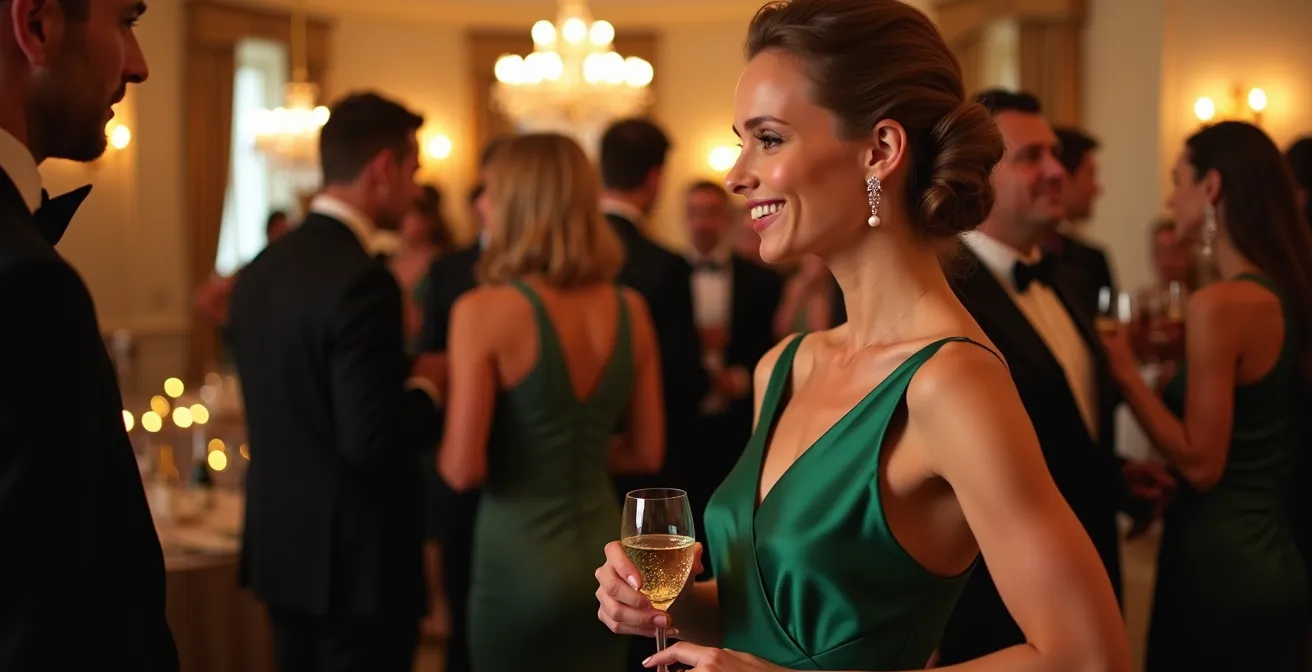
The clinking of glasses, the low hum of conversation, the sea of faces—a cocktail party is a theatre of social interaction. Yet, for many, it brings a familiar sense of awkwardness. What do you do with your hands? How do you stand without looking stiff or, worse, uncomfortable? Most advice centres on generic tips like ‘stand up straight’ or ‘just hold a drink’. While not wrong, this advice barely scratches the surface and often leaves you feeling like a mannequin following a set of rigid rules.
This approach misses the fundamental point. True poise isn’t about memorising a series of static poses. It’s about understanding the principles of ‘social choreography’—the subtle, dynamic art of moving and holding yourself in a way that projects effortless grace and confidence. It’s the language your body speaks before you’ve even said a word. It’s about creating an elegant silhouette, managing your presence in a crowded room, and understanding that the foundation of a polished look begins long before you choose your outfit.
But what if the key wasn’t simply to avoid looking awkward, but to actively craft an aura of engagement and elegance? This guide moves beyond the platitudes. We will deconstruct the mechanics of poise, from the precise placement of your hands and the subtle shift of your weight to the art of entering a conversation and the secrets to enduring an evening in heels. We will explore how details, from your watch to your shoes, contribute to your overall presence, and why impeccable grooming is the ultimate status signifier. It’s time to stop just standing at the party and start owning your space within it.
This article provides a comprehensive guide to mastering the art of presence. Below, you will find a detailed breakdown of each element, from foundational posture to the finishing touches that create a truly polished look.
Contents: Mastering the Art of Party Posture
- Where Should You Put Your Hands When You Don’t Have a Drink or Bag?
- How to Shift Your Weight on One Hip Without Looking Slouchy?
- How to Enter a Circle of People Standing Together Without Being Rude?
- What Is the ‘Red Carpet’ Stance That Slims the Figure Instantly?
- How to Stand for Hours in Heels Without Visible Pain?
- What Distinguishes a Cocktail Watch from a Standard Dress Watch?
- How to Choose the Correct ‘Nude’ Shade to Elongate Your Legs?
- Why Is Grooming More Important Than Designer Clothes for a Polished Look?
Where Should You Put Your Hands When You Don’t Have a Drink or Bag?
The empty-handed dilemma is the most common source of social anxiety at any gathering. Fidgeting with rings, clasping your hands nervously, or crossing your arms can signal discomfort and close you off from interaction. While grabbing a drink is a classic tactic—and if you do, hold it in your left hand to keep your right free for handshakes—it’s not always desirable or possible. The true secret is mastering a few elegant, go-to positions that project calm and confidence.
Think like a royal or a celebrity on the red carpet. These individuals are masters of posing for extended periods without props. One of the most polished techniques is the ‘Belly Button Hold’. Simply place your arms at belly-button level, with one hand resting gently over the other, covering only the first two phalanges. This keeps your posture open and allows any rings to remain visible. Another surprisingly chic option is the ‘Arms Along’ position, where you simply let your arms hang naturally by your sides. It conveys relaxation and confidence.
For a slightly more composed look, try the ‘Resting Butterfly’, where one hand rests lightly on the opposite forearm. This is a wonderfully natural way to showcase a beautiful bracelet or a cocktail watch. Finally, use your environment for ‘architectural anchoring’. Lightly resting a hand on a mantelpiece, the back of a chair, or a bar counter signals that you are at ease and comfortable in the space. These subtle gestures are the building blocks of graceful social choreography, transforming potential awkwardness into an image of pure poise.
By practicing these options, you’ll find they become second nature, leaving you free to focus on the conversation, not on what to do with your hands.
How to Shift Your Weight on One Hip Without Looking Slouchy?
Shifting your weight to one hip is the cornerstone of a relaxed yet elegant standing posture. It’s the difference between looking stiff as a board and exuding a graceful, dynamic presence. However, there’s a fine line between an elegant S-curve and a lazy, hip-jutting slump. The key to achieving the former lies in the classical ‘contrapposto’ technique, a secret of artists for centuries, which is all about active engagement rather than passive collapsing.
The secret is to think ‘up’, not ‘out’. Instead of just pushing your hip to the side, you must engage your oblique muscles on the weight-bearing side. This action lifts the hip slightly, creating a graceful curve while keeping your core stable. To maintain this alignment, imagine your breastbone is being lifted two inches towards the ceiling, all while keeping your ribcage tucked in. This prevents your upper body from slouching forward. This posture not only looks elegant but also feels more stable and comfortable over time.
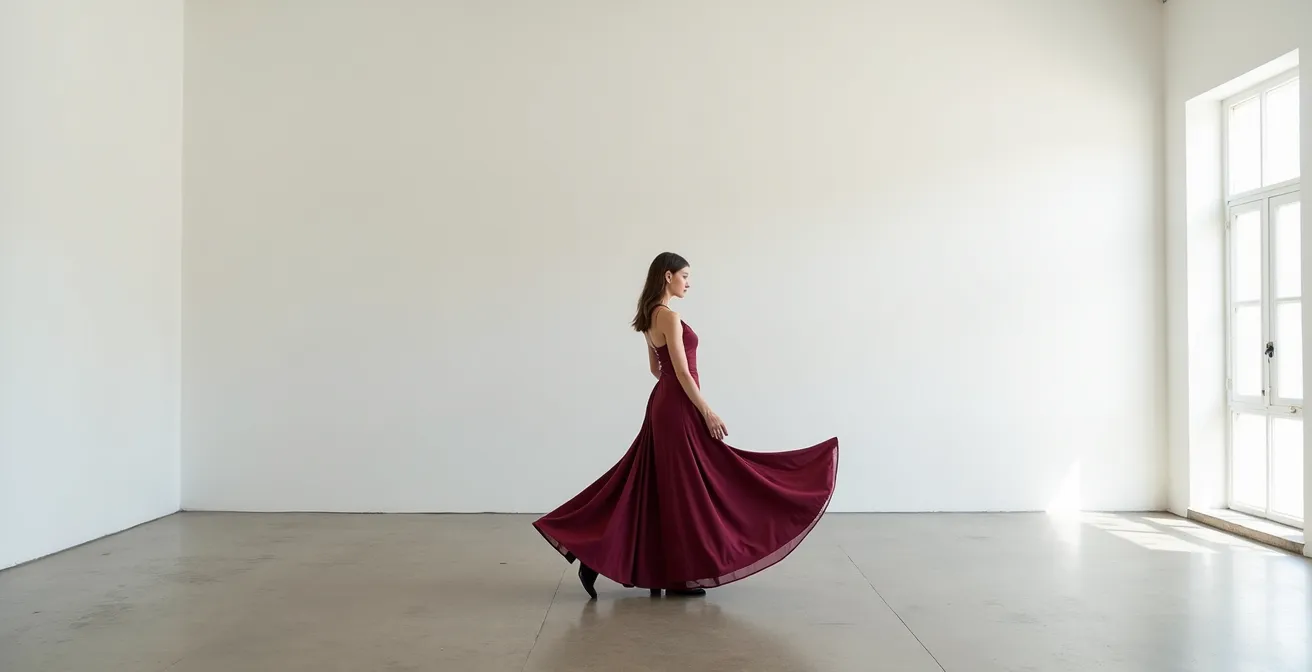
As the image above demonstrates, the contrapposto stance creates a flattering and dynamic line through the body. The final piece of the puzzle is your head and neck alignment. Visualise an invisible thread pulling the crown of your head gently upwards, elongating your spine. Keep your chin parallel to the floor; tilting it up can look haughty, while tilting it down can suggest insecurity. Mastering this postural mechanic is fundamental to social choreography, allowing you to look poised and feel comfortable for hours.
Alternating your standing leg every so often not only provides relief but also adds a natural, fluid quality to your stance as you mingle.
How to Enter a Circle of People Standing Together Without Being Rude?
Navigating a room and joining a conversation is a delicate dance. Approaching a group can feel intimidating, and the fear of being an unwelcome intruder is real. The art of a graceful entry, however, is a learnable skill rooted in observing body language. The first step, embodying the famous British reserve, is to pause and assess. Distinguish between a ‘closed circle’ and an ‘open circle’.
A closed circle involves two or more people in an intense, private conversation. They stand close together, with their bodies angled inwards, leaving very little physical space. Everyone is actively participating. Interrupting this is a social faux pas. An open circle, by contrast, is your invitation to join. The conversation is lighter, people may be looking around the room, and there are noticeable gaps between them. Their body language is more relaxed, and not everyone is actively speaking at once. Etiquette experts confirm that groups of 3 to 5 people are optimal for approaching at cocktail parties, as they are large enough to absorb a new person without disrupting the flow. This is your conversational gateway.
Once you’ve identified an open circle, resist the urge to just walk in. A more sophisticated approach is required to bridge the gap from outsider to participant. This is where a subtle, strategic entry pays dividends.
Your Action Plan: The Conversational Hook Entry
- Observe the group’s dynamic and body language for at least 10 seconds before making your move.
- Identify the ‘gatekeeper’—the person with the most open body language, whose feet or shoulders are angled outwards.
- Listen for a non-personal keyword (a place, a film, a recent event) that you can use as a natural entry point.
- Approach the gatekeeper with a soft, polite opener, such as, “Forgive me for interrupting, I couldn’t help but overhear you mention…”
- Make eye contact and offer a warm smile to the gatekeeper first, before gradually turning your attention to the rest of the group.
By reading the social cues and using a soft entry, you demonstrate high social intelligence and make joining any conversation a smooth and elegant affair.
What Is the ‘Red Carpet’ Stance That Slims the Figure Instantly?
For moments when you know you’ll be seen or photographed, having a go-to pose that is both flattering and elegant is a powerful tool. The ‘Red Carpet’ stance, often seen at events like the BAFTAs, is a masterclass in creating a slim, elongated silhouette. It’s a deliberate and highly effective pose that relies on angles and body torsion to create a powerful visual illusion. It’s not a posture for extended mingling, but for making a memorable first impression or posing for a picture.
The technique involves positioning your body at a 45-degree angle away from the camera or the main viewpoint. You then cross one foot over the other, pointing the toe of the front foot forward. As you do this, you push your back hip slightly outward, away from the camera. The crucial element is the twist: while your lower body is angled, you keep your shoulders and head facing directly forward. This torsion whittles the waist and creates the longest possible line from shoulder to hip. If you’re holding an evening clutch, hold it with both hands at a diagonal angle across your lower torso to further enhance the slimming effect.
While this pose is incredibly effective, it’s important to understand its purpose and limitations. It’s a momentary, high-impact position. After the photo is taken or the initial entrance is made, you should soften into a more relaxed, natural stance like the contrapposto. The key is knowing when to deploy this bit of social choreography for maximum effect.
The table below, drawing on principles from posture experts, clarifies the distinction between this specific pose and a general elegant stance.
| Position Element | Red Carpet Stance | Natural Elegant Standing |
|---|---|---|
| Foot Position | One foot crossed over the other | Feet together or in T-stance |
| Hip Angle | 45-degree twist with back hip out | Hips square or slight shift |
| Shoulder Position | Facing forward despite body twist | Aligned with hips |
| Duration | Momentary for photos | Sustainable for extended periods |
| Visual Effect | Maximum slimming dimension | Natural elegance and poise |
Think of it as the exclamation point in your visual statement—powerful, deliberate, and used for emphasis, not for the entire conversation.
How to Stand for Hours in Heels Without Visible Pain?
Even the most graceful posture will crumble if your feet are in agony. Enduring hours in heels at a cocktail party or a key event during the English social season is a common challenge. The secret to surviving without a grimace is a combination of preparation, the right footwear choices, and discreet relief techniques. A well-prepared social butterfly has a ‘survival kit’ of tricks up their sleeve.
Preparation starts before you even leave the house. A technique used by insiders is Morton’s Neuroma taping: using surgical tape to bind your third and fourth toes (counting from the big toe) together. This alleviates pressure on a key nerve that often causes burning pain in the ball of the foot. For extra insurance, a foot-numbing spray, readily available at UK chemists like Boots or Superdrug, can provide a couple of hours of relief. When selecting shoes, consider the venue. For grassy events like Royal Ascot or countryside weddings, elegant heel stoppers are non-negotiable. Investing in quality block heels or wedges from respected British brands like L.K.Bennett or Rupert Sanderson can also make a world of difference in comfort without sacrificing style.
During the event, you can employ invisible isometric exercises to maintain blood flow and relieve pressure. As you stand and chat, subtly practice ‘toe presses’ by pressing your toes down into the insole for five seconds and releasing. Gentle ‘calf clenches’ or discreet ‘ankle rotations’ (done while one leg is crossed casually behind the other) can also work wonders. And of course, always pack a few gel insoles and blister plasters in your evening clutch for emergencies. Pain is the enemy of poise, and a little forethought ensures your elegance lasts all night long.
Ultimately, the most elegant person in the room is the one who looks comfortable, and these strategies are your secret weapon to achieving just that.
What Distinguishes a Cocktail Watch from a Standard Dress Watch?
An accessory is never just an accessory; it’s a statement. A watch worn at an evening event is a potent signifier of style and sophistication, but not all watches are created equal. The distinction between a cocktail watch and a standard dress watch is a crucial piece of sartorial knowledge. A standard dress watch is a masterpiece of function with an elegant design; a cocktail watch is a piece of jewellery that happens to tell the time.
The primary difference lies in intent and materials. A cocktail watch’s main purpose is to adorn the wrist. It is often crafted from precious metals like platinum or gold and can feature extensive gem-setting with diamonds, sapphires, or other precious stones. The case shape is free to be creative—oval, rectangular, or even abstract—and the dial is typically minimalist, often lacking a date window or any luminescent markers (lume), as it is designed to sparkle under evening lights, not be read in the dark. It is, in essence, a bracelet with a hidden talent.
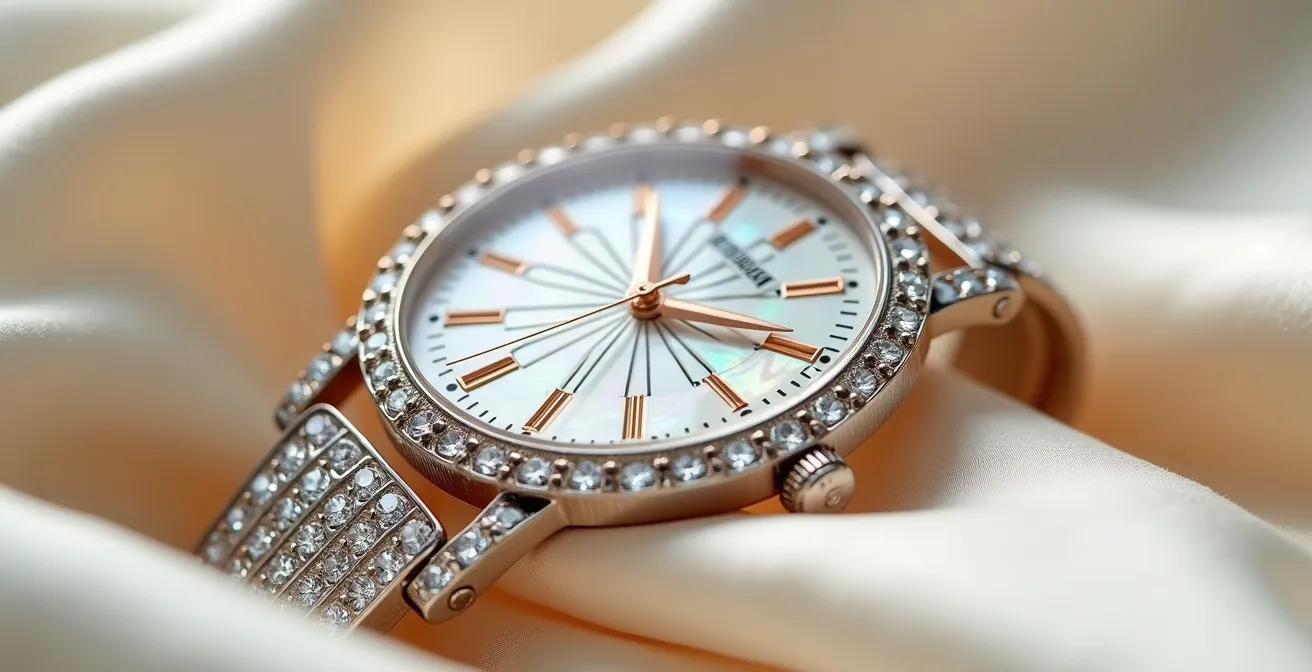
A standard dress watch, while also elegant, prioritises classic design and legibility. It will typically feature a simple round or rectangular case made of steel or gold, with minimal embellishment. While it avoids the ruggedness of a sports watch, it often retains practical features like a date window and subtle lume on the hands or hour markers. The following table, based on information from horological experts at sources like the Gentleman’s Gazette, summarises these key differences.
| Feature | Cocktail Watch | Standard Dress Watch |
|---|---|---|
| Primary Function | Jewelry first, timepiece second | Timekeeping with elegant design |
| Materials | Platinum, gold, extensive gem-setting | Steel, gold, minimal embellishment |
| Luminescence | No lume (purely aesthetic) | Often includes subtle lume |
| Date Window | Typically absent | Usually present |
| Case Shape | Creative: oval, rectangular, abstract | Classic round or rectangular |
| British Examples | Garrard, Asprey designs | Traditional Swiss/British makers |
For a cocktail event, opting for a watch that prioritises beauty over pure utility demonstrates a sophisticated understanding of dress codes and occasion.
How to Choose the Correct ‘Nude’ Shade to Elongate Your Legs?
The ‘nude’ shoe is a cornerstone of an elegant wardrobe, prized for its magical ability to visually elongate the legs. However, this magic only works when you find the *correct* shade of nude for your specific skin tone. A shoe that is too light or too dark can have the opposite effect, visually cutting off the leg line at the ankle. ‘Nude’ is not a single colour; it is a spectrum, and finding your perfect match requires a more methodical approach than simply holding a shoe up in-store.
The first step is to determine your skin’s undertone. A simple ‘vein test’ can be very revealing: look at the veins on the inside of your wrist. If they appear mostly blue, you have cool undertones. If they appear greenish, you have warm undertones. If it’s a mix, you are likely neutral. The ‘jewellery test’ can also help; cool-toned skin is often flattered by silver, while warm-toned skin glows in gold. This undertone is the key to finding a nude shoe that truly blends with your skin.
When you are shopping, especially in the UK, it’s wise to choose a shade that is perhaps half a shade warmer than your exact skin match. The often grey, cool-toned natural daylight in Britain can make an exact match appear ashy. Always test the shoe in natural daylight near a window, not under the harsh, artificial lighting of the store. And crucially, perform the ‘ankle test’. Hold the shoe against your ankle, not your hand, as the skin on your hands is often a different colour from your legs and feet. British retailers have made great strides in inclusivity, with luxury brands like Christian Louboutin’s ‘Nudes’ collection and high-street heroes like Marks & Spencer (with options from around £35) offering an ever-expanding range of shades and undertones.
Taking the time to find your true nude is a small effort that yields a significant payoff, creating a seamless, elegant line from head to toe.
Key Takeaways
- Elegance is dynamic ‘social choreography’, not a list of rigid rules; it’s about projecting confidence through fluid posture and movement.
- Mastering a few key hand positions and learning to use your environment for ‘architectural anchoring’ eliminates awkwardness.
- The foundation of a polished look is immaculate grooming; pristine hair, skin, and nails are more impactful than any designer label.
Why Is Grooming More Important Than Designer Clothes for a Polished Look?
In the world of social events, there’s a quiet hierarchy of style, and it doesn’t begin with a designer label. The ultimate foundation of a polished, high-status look is immaculate grooming. While a beautiful dress or a sharp suit makes a statement, it’s the canvas underneath that truly determines its impact. Flawless grooming communicates self-respect, attention to detail, and a level of personal investment that no logo can ever buy. As leading arbiters of taste will attest, this is the real secret to looking truly put-together.
The esteemed English Manner Etiquette School puts it best, a sentiment echoed by seasoned hostesses and stylists alike. They champion the ‘Frame and Foundation’ principle: grooming is the ‘foundation’ (healthy skin) and the ‘frame’ (pristine hair) of your personal portrait. The clothes are merely the artwork within. If the foundation is flawed or the frame is cheap, the overall impression is diminished, regardless of the artwork’s value.
Immaculate grooming (pristine hair, perfect manicure, healthy skin) is a more potent and respected signifier of status than conspicuous logos.
– The English Manner Etiquette School, Guide to British Social Etiquette
This is why a person in a simple, well-fitting outfit who is impeccably groomed will always look more elegant than someone in a head-to-toe designer look with chipped nails or unruly hair. Grooming priorities should focus on high-impact areas: hair that is clean, shiny, and deliberately styled; hands with a clean, chip-free manicure; and skin that is hydrated and glowing. These elements show consistent care, something far more impressive than a one-off luxury purchase. It is the quiet confidence that comes from knowing you are polished from the ground up that allows you to wear your clothes, rather than letting them wear you.
By focusing on this foundation first, you ensure that every other element of your presentation—from your posture to your accessories—is elevated, creating an authentic and unshakable aura of elegance.