The secret to accelerating your career isn’t just impressing your boss—it’s altering your own brain chemistry through what you wear.
- Scientific research shows that clothing doesn’t just signal to others; it primes your own mind for higher performance, a concept known as ‘enclothed cognition’.
- Strategic choices in colour, fit, and even footwear can measurably boost your confidence, decisiveness, and productivity.
Recommendation: Stop dressing as a costume for others and start using your wardrobe as a psychological toolkit to become a more effective version of yourself.
As a junior employee, the pressure to get noticed can feel immense. You’re told to perform, to network, and you’ve almost certainly heard the age-old advice: “dress for the job you want, not the job you have.” While well-intentioned, this platitude is often misunderstood. It’s presented as a simple trick of perception—a way to fool senior management into seeing you as one of them. The advice rarely delves into the ‘why’, leaving you to wonder if a new blazer is really the key to a promotion.
The common wisdom focuses entirely on the external message. Wear a suit to look serious, a smart watch to look tech-savvy, polished shoes to look detail-oriented. But what if this is only half the story? As a career psychologist, my work centres on a fascinating and powerful phenomenon called ‘enclothed cognition’. This is the crucial, often-overlooked truth: the most important person your clothes influence is not your boss, but you.
This article will deconstruct the superficial advice and rebuild it on a foundation of psychology. We are not just discussing fashion; we are exploring a practical tool for cognitive enhancement. We will examine how the symbolic meaning and physical experience of your clothes systematically change how you think, feel, and perform. From the colour of your shirt in a negotiation to the very shoes on your feet, you have the power to prime your brain for success.
Throughout this guide, we will explore the specific mechanisms of enclothed cognition and provide actionable strategies to apply them. By understanding the psychological impact of your attire, you can move beyond simply ‘looking the part’ and start genuinely embodying the confidence and competence you wish to project.
Table of Contents: Unlocking Your Career Potential Through Strategic Dressing
- Why Did Steve Jobs Wear the Same Outfit Every Day and Should You?
- Which Colours Should You Wear to a Negotiation to Project Trust?
- Can You Be Truly Confident in Shoes That Hurt Your Feet?
- Why Wearing Shoes in Your Home Office Increases Productivity?
- When Does Wearing visible Logos Hurt Your Credibility?
- Minimalist or Skeleton Dial: What Your Watch Choice Says About You?
- Do ‘Power Poses’ Before a Meeting Actually Boost Confidence?
- Why Is Posture the Most Expensive Thing You Can Wear for Free?
Why Did Steve Jobs Wear the Same Outfit Every Day and Should You?
The story of Steve Jobs and his iconic black turtleneck is a popular tale in productivity circles. The logic was simple: adopting a personal ‘uniform’ eliminates one decision from a day filled with them, conserving precious mental energy for what truly matters. For a CEO at the pinnacle of his career, this makes perfect sense. However, for a junior employee aiming to climb the ladder, this strategy can be counterproductive. Your goal is not just to be efficient, but to be seen, understood, and respected.
A better approach for someone in the early stages of their career is the ‘capsule wardrobe’. This isn’t about wearing the exact same thing, but about creating a limited, curated collection of high-quality, complementary pieces. This reduces decision fatigue while still allowing for strategic signalling. It communicates intentionality and an understanding of professional norms. This is particularly relevant in the UK, where research shows that over 50% of professionals wear smart attire most of the time, establishing a clear baseline expectation in many industries.
The psychological power of this approach lies in building confidence from the inside out. As Dr. Kathryn Brownbridge, a Senior Lecturer at Manchester Met University, notes, clothing is often a tool for managing self-perception.
My own research shows that some men are impacted by body-related issues and feel critical about their own bodies which can impact their confidence at work. Men that are uncomfortable about their bodies will be looking for clothing that can flatter, disguise, and accentuate certain areas.
– Dr Kathryn Brownbridge, Senior Lecturer in Fashion Design at Manchester Met University
A well-curated wardrobe, therefore, isn’t a costume. It’s a form of psychological armour. When your clothes fit well and make you feel good, you project a natural confidence that a hastily chosen ‘uniform’ never could. It allows you to focus on your work, not on feeling self-conscious.

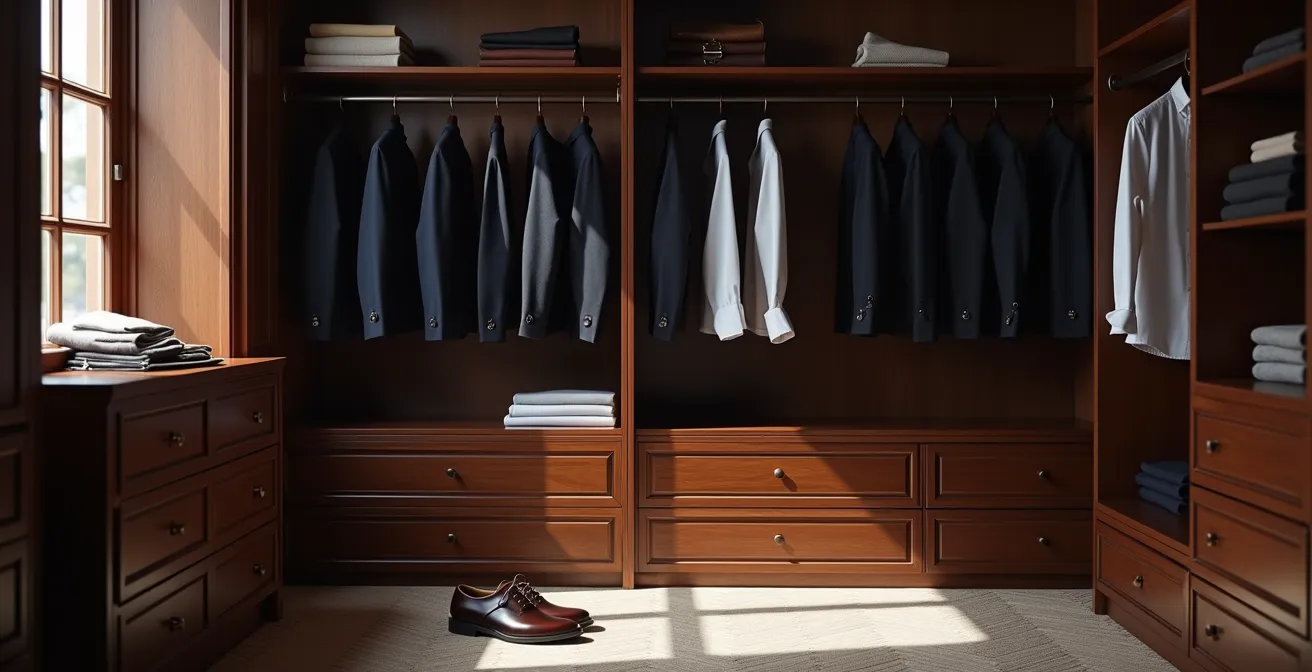
The image above captures the essence of a strategic capsule wardrobe: quality textures, complementary tones, and timeless patterns. This is not about being a clone, but about building a reliable system that empowers you to present your best self, day after day, without the mental overhead.
Which Colours Should You Wear to a Negotiation to Project Trust?
Colour is one of the most powerful and subconscious communicators in your professional toolkit. In a high-stakes situation like a negotiation or a client pitch, your choice of colour is actively priming the perception of everyone in the room, including yourself. This is a core tenet of enclothed cognition: we have deep-seated symbolic associations with different hues, and wearing them can influence behaviour.
Traditional wisdom often points to blue as the colour of trust and stability, and grey for analytical sophistication. Black can signal authority, but it can also create distance. These are not just fashion myths; they are rooted in psychological research. An early study by Yener (1982) demonstrated that specific colours are directly linked to perceived traits in the workplace, where bold colours can signal power and muted tones can be perceived as weaker. This affects how colleagues and clients assess your authority and trustworthiness before you’ve even spoken a word.
The stakes are higher than you might think. It’s not just about a fleeting first impression. A survey by OfficeTeam, cited by recruitment specialists Intelligent People, found that 80% of managers feel an employee’s clothing choices can affect their chances of promotion. Your attire is a constant, subtle part of your performance review. Choosing a navy blue or a deep charcoal grey for a negotiation is a strategic move. It’s non-verbal communication that says, “I am credible, calm, and in control.”
Conversely, wearing an overly bright or jarring colour might signal creativity in some fields, but in a corporate negotiation, it can be distracting and undermine your perceived seriousness. The goal is to choose a colour that supports your message, not one that competes with it. Think of your colour choice as the backdrop to your arguments: it should make your audience feel secure and receptive, allowing your words and ideas to take centre stage.
Can You Be Truly Confident in Shoes That Hurt Your Feet?
The simple answer is no. This is where the theory of enclothed cognition meets the hard reality of human biology. You can wear the most impeccably tailored, psychologically resonant suit, but if your shoes are pinching, rubbing, or forcing you into an unnatural gait, any and all confidence benefits are immediately nullified. Physical discomfort is a powerful cognitive distraction. It drains your mental resources, making you irritable, less focused, and visibly less confident.
As the UK property firm Pickard Properties advises young professionals, footwear is a critical, not secondary, element of your professional image. It speaks volumes about your practicality and preparation.
Footwear often takes a backseat in the outfit-planning process but can speak volumes about your professionalism and attitude in the workplace. Your shoe style should align with your industry and work environment.
– Pickard Properties, Eight tips on how to dress as a young professional
True confidence is embodied. It’s in your steady stance, your purposeful walk, and your ability to stand for long periods without wincing. Shoes that hurt you actively sabotage this. They make you hesitant and project an image of vulnerability. The junior employee who is constantly shifting their weight or desperate to sit down is not signalling ‘future leader’. They are signalling ‘I made a poor choice this morning’.
The solution is to prioritise comfort without sacrificing style. This means investing in quality materials, ensuring a proper fit, and breaking in new shoes before a critical meeting. For many roles in UK cities, this also means choosing footwear that can handle a commute involving walking and public transport. A smart leather brogue, a quality loafer, or a stylish, supportive boot are far better investments than a high-fashion item that will be unbearable by lunchtime.
Your Action Plan: Vetting Professional Footwear
- Assess the Terrain: List every part of your daily commute and office environment. Consider stairs, standing meetings, and walking distances.
- Conduct a Comfort Audit: Wear new shoes at home for at least three hours. Identify any points of rubbing or pinching. If they aren’t comfortable at home, they will be a disaster at work.
- Check for Coherence: Does the shoe style align with your industry’s dress code (e.g., formal leather for law, smart trainers for tech)? Confront your choice with company norms.
- Prioritise Materials: Favour breathable, natural materials like leather or suede over rigid synthetics. A quality material signals care and will adapt to your foot over time.
- Build a Rotation Plan: Identify at least two pairs of comfortable, professional shoes to rotate between. This extends their life and ensures you always have a reliable option.
Why Wearing Shoes in Your Home Office Increases Productivity?
The rise of remote and hybrid work has blurred the lines between our personal and professional lives. In this new landscape, creating mental boundaries is more important than ever for productivity and well-being. One of the most surprisingly effective ways to do this is through a simple act of enclothed cognition: putting on ‘work shoes’ even when you’re not leaving the house.
Slippers or bare feet are symbolically associated with relaxation, leisure, and home life. When you wear them while working, you are sending a constant, subconscious signal to your brain that it is time to relax. This can lead to a lack of focus, procrastination, and a general feeling of lethargy. Changing into a pair of dedicated indoor shoes—like loafers, smart flats, or clean trainers—acts as a powerful cognitive primer. It’s a physical ritual that tells your brain, “The personal part of the day is over; it’s time to focus.”

This isn’t just a psychological quirk; it has a measurable impact. A UK study found that 52% of people feel more productive when wearing smart attire, even when no one else can see them. The act of ‘dressing for work’ triggers the mindset associated with it. The shoes are the anchor for this ritual, the final step that solidifies the transition from ‘home you’ to ‘work you’.
This ritual also helps create a clear end to the workday. As Catriona Morrison, Dean of Science at The University of Law, explains, the symbolic act of changing clothes is vital for well-being.
For many, a distinction between home and work life starts at the end of each working day with the shedding of our work clothes. This symbolic shift to our personal identity through the clothes that we don can also help to support our wellbeing by recharging when we are away from work.
– Catriona Morrison, Dean of Science at The University of Law
Taking off your work shoes at 5:30 PM becomes as definitive as leaving the office building. It helps you mentally ‘clock out’, protecting your personal time and preventing burnout. It’s a small, simple habit with a profound psychological payoff.
When Does Wearing visible Logos Hurt Your Credibility?
In the world of professional attire, logos are a double-edged sword. On one hand, a small, discreet logo from a heritage brand can signal an appreciation for quality. On the other, large, flashy logos often scream ‘nouveau riche’ or, worse, a lack of personal identity. For a junior employee, navigating this is critical. The general rule is one of strict subtlety. Your work, not your clothes, should be doing the talking.
Wearing prominent logos can undermine your credibility because it shifts the focus from your professional value to the brand’s perceived value. It suggests you are borrowing status rather than earning it. This is particularly true in more traditional British sectors like finance or law, where understatement is a key part of the professional code. However, there’s a fascinating exception to this rule, which we can call intentional dissonance.
Research from Harvard Business School revealed that, under the right circumstances, deliberately straying from the norm can signal higher status and competence. The key is that the non-conformity must be perceived as intentional. For example, a renowned professor wearing red trainers with a suit might be seen as a confident visionary. However, this is a high-risk strategy. As a junior, pairing a hoodie with a suit is more likely to be seen as a mistake than a power move. You have not yet earned the ‘social capital’ to break the rules effectively.
Interestingly, it seems the younger generation in the UK understands this power of traditional conformity instinctively. In an era of increasingly casual workplaces, UK research reveals a surprising trend: 42% of 18-24 year olds wear professional business attire in front of clients, compared to only 10% of their over-55 colleagues. This suggests that young professionals recognise that in the early stages of a career, adhering to established codes of professionalism is the safest and most effective way to build credibility.
Minimalist or Skeleton Dial: What Your Watch Choice Says About You?
Accessories are the finishing touches of your professional persona. While a simple “less is more” approach is often wise, a single, well-chosen item like a watch can communicate a great deal about your personality, values, and attention to detail. It’s a micro-expression of the same enclothed cognition principles we’ve been discussing. The watch on your wrist doesn’t just tell time; it tells a story about you.
Consider the difference in perception. A minimalist, Bauhaus-style watch might suggest you are modern, efficient, and have a keen eye for design. A complex skeleton dial, which reveals the intricate mechanics within, could signal an appreciation for craftsmanship, transparency, and engineering. A smartwatch projects an image of being connected, tech-savvy, and data-driven. None of these is inherently ‘better’ than the other; their effectiveness depends entirely on the context of your industry and role.
The key is alignment. A creative director in a Shoreditch agency would look perfectly at home with a minimalist watch, while a private banker in the City of London might find a traditional Swiss luxury brand more appropriate for signalling stability and tradition. The choice should feel authentic to you, but also be congruent with the expectations of your professional environment.
This table, adapted from analysis of UK professional norms, provides a clear guide to how different watch styles are perceived across various industries. Use it to ensure your choice aligns with the message you want to send.
| Watch Type | Perceived Message | Suitable Industries |
|---|---|---|
| Swiss Luxury Watch | Status, tradition, attention to detail | Finance, Law, City of London |
| British Heritage Brand | Patriotic choice, discerning taste | Government, Traditional sectors |
| Minimalist Design | Modern, efficient, design-conscious | Creative, Tech, Architecture |
| Smart Watch | Tech-savvy, connected | Tech startups, Digital agencies |
| Vintage/Classic | Appreciation for craftsmanship | Academia, Arts, Heritage sectors |
Do ‘Power Poses’ Before a Meeting Actually Boost Confidence?
The concept of ‘power posing’—adopting an expansive posture for two minutes to boost confidence—became a cultural phenomenon. However, the science behind it has been heavily debated, with many of the original findings failing to replicate. While posture itself is incredibly important (as we’ll see), a quick fix in a bathroom stall is not a sustainable strategy for building genuine confidence. A far more effective and scientifically robust approach is to leverage enclothed cognition.
Instead of a fleeting pose, consider the lasting psychological impact of your attire. The most famous study in this field, conducted by researchers at the Kellogg School of Management, provides undeniable evidence. In an experiment, participants who were told they were wearing a doctor’s lab coat performed tasks with significantly more focus and made fewer mistakes than those wearing their street clothes. Crucially, when another group was told the exact same coat belonged to a painter, their performance did not improve. This demonstrates that performance is enhanced by the symbolic meaning we attach to the garment. The coat didn’t have magic powers; it activated the concepts of ‘careful’, ‘attentive’, and ‘intelligent’ in the wearer’s mind.
This is the real ‘power pose’. When you put on a sharp, well-fitting blazer, you are, in effect, putting on your ‘professional coat’. You are not faking it; you are activating the most capable version of yourself. This internal shift is palpable. UK research confirms this, showing that 59% of people feel more decisive and a staggering 78% feel more authoritative when wearing smart attire. This isn’t a feeling; it’s a cognitive shift that directly impacts your behaviour in a meeting.
So, the next time you have an important meeting, don’t worry about finding a private corner to stand like a superhero. Instead, focus on choosing an outfit that you symbolically associate with competence and authority. The confidence it instills will last far longer than two minutes, because it comes from within, triggered by the powerful, proven science of enclothed cognition.
Key Takeaways
- It’s an Internal Tool: The primary benefit of strategic dressing is its effect on your own psychology, confidence, and cognitive performance.
- Context is King: The ‘right’ outfit is entirely dependent on your industry, role, and the specific situation (e.g., negotiation vs. creative brainstorm).
- Comfort is Non-Negotiable: Physical discomfort from ill-fitting clothes or painful shoes will always negate any potential psychological benefits.
Why Is Posture the Most Expensive Thing You Can Wear for Free?
We have explored how the clothes you buy can fundamentally alter your mindset and performance. But the most impactful element of your professional presence costs nothing at all: your posture. Posture is the frame upon which your entire professional image is built. A £2,000 suit on a slumped, hesitant frame looks like a costume. A £200 outfit on a person standing tall with an open, confident posture looks authoritative and intentional.
Your posture is a constant broadcast of your internal state. Slouching communicates disinterest, low energy, or a lack of confidence. Standing or sitting upright, with your shoulders back and head held high, signals engagement, energy, and self-assurance. It makes you appear more competent and trustworthy before you say a single word. It also has a powerful feedback loop on your own psychology; adopting a more confident posture can actually make you feel more confident.
As Catriona Morrison of The University of Law notes, the way we present ourselves is an indicator of our identity and our ‘fit’ with a workplace. Posture is the very foundation of that presentation.
The way we dress indicates something about our identity and how we feel. Regardless of work context, the clothes, or uniforms that we wear can indicate something about our professional identity, and the values we hold and promote as a professional. A key factor that affects our well-being at work, and thus our productivity, is our ‘fit’ with the workplace.
– Catriona Morrison, Dean of Science at The University of Law
Think of your posture as the amplifier for your clothing. Good posture ensures your clothes hang correctly, creating the clean lines that signal professionalism. It allows you to command a room, to hold eye contact, and to project your voice effectively. In a competitive environment, where over 25% of the UK workforce is in professional roles, these non-verbal cues can be a significant differentiator. Mastering your posture is the ultimate act of ‘dressing for success’, providing a foundation of confidence that makes every other choice more effective.
Begin today by consciously auditing not just your wardrobe, but how you carry yourself in it. This integrated approach, combining the psychological power of clothing with the physical foundation of good posture, is the most authentic and sustainable path to accelerating your career.