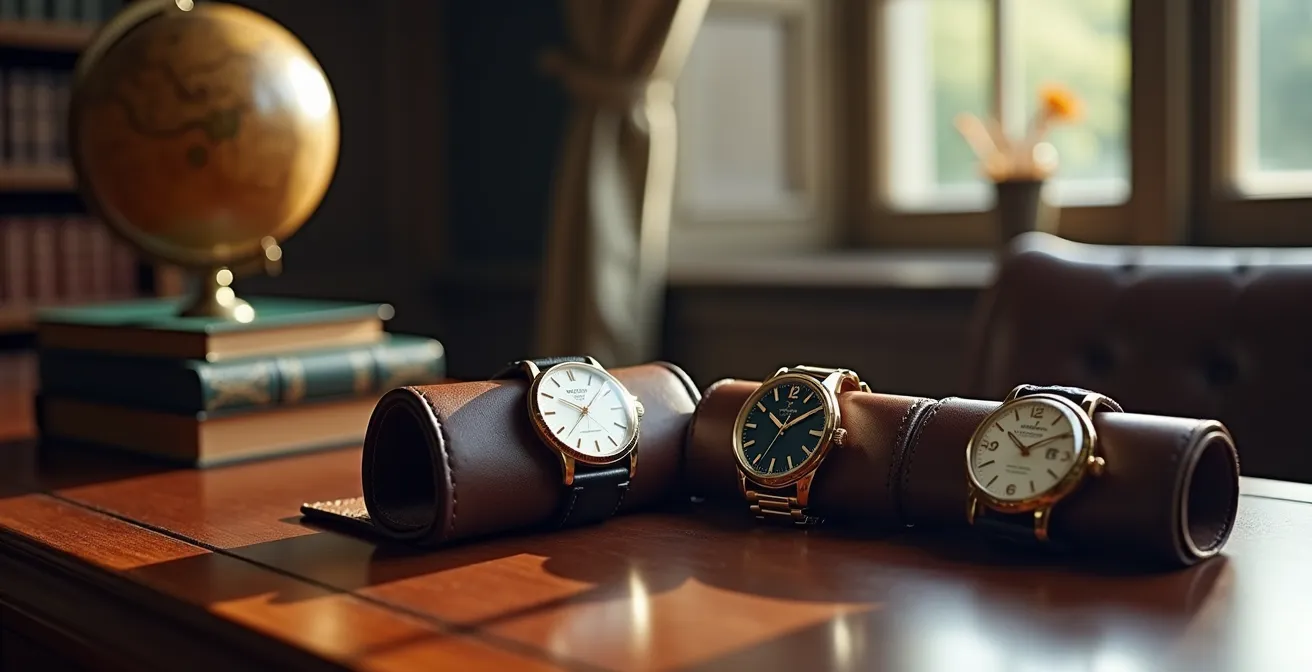
A Swiss watch’s value is not just marketing; it is a tangible asset class backed by a robust, UK-centric ecosystem of service and demand.
- Legally enforced production standards (‘Swiss Made’) and a vast UK service network guarantee long-term repairability and integrity.
- London’s status as a global hub for both pre-owned sales and independent collecting drives consistent value appreciation and market liquidity.
Recommendation: Focus on provenance and mechanical integrity over fleeting trends to secure a true horological asset.
For the budding collector standing on Bond Street, the question is not merely one of luxury, but of legacy. Why does a Swiss timepiece command such a profound premium, and more importantly, why does that value endure? Many will point to vague notions of “quality” or “heritage.” They might mention the gleam of 316L steel or the romantic image of an artisan hunched over a workbench in a snow-covered valley. While not untrue, these are just facets of a much larger, more intricate picture.
The real answer is less about romanticism and more about a meticulously engineered ecosystem. The enduring value of a Swiss watch, particularly for a UK-based collector, is anchored in a trinity of guarantees: legally protected engineering integrity, a deeply-rooted service infrastructure on British soil, and a vibrant, sophisticated secondary market with London at its epicentre. It’s an investment in a system designed for longevity, not just a purchase.
This goes beyond simply owning a beautiful object. It is about acquiring a horological asset. Understanding this distinction is the first step from being a watch buyer to becoming a true collector. The key lies not in asking what makes them expensive, but in discovering what makes them valuable for decades to come.
This guide will deconstruct the ‘Swiss Made’ promise from the perspective of a UK collector. We will explore the tangible guarantees behind the label, navigate the practical choices for a London lifestyle, and reveal the infrastructure that underpins your investment’s long-term security and potential for appreciation.
Summary: A UK Collector’s Guide to Swiss Watch Value
- What Does ‘Swiss Made’ Actually Guarantee for Your Timepiece Investment?
- Vintage vs Modern Swiss Watches: Which Choice Suits a Busy London Lifestyle?
- How to Plan a Horological Pilgrimage to the Vallée de Joux from the UK?
- Why Independent Swiss Brands Are the New Status Symbol in The City?
- When to Service Your Swiss Watch: The 5 Signs Most Owners Ignore
- Why Buying a Mainstream Swiss Brand Guarantees Repairability in 2050?
- Does a ‘Paul Newman’ Dial Only Have Value Because of the Actor?
- How to Distinguish True Haute Horlogerie from Mass-Produced Luxury?
What Does ‘Swiss Made’ Actually Guarantee for Your Timepiece Investment?
The ‘Swiss Made’ designation on a dial is far more than a statement of origin; it is a legally binding seal of quality and a foundational pillar of a watch’s investment potential. For the UK collector, this label provides a baseline of assurance in a market saturated with luxury goods. The UK’s appetite for these timepieces is significant, with forecasts showing the luxury watch market is worth £2.85 billion in 2024, demonstrating a robust domestic demand that supports value retention.
So, what does it legally guarantee? The criteria are strict and have been reinforced over time to protect the label’s integrity. As the Swiss Federal Council mandates:
Since 2017, Swiss law requires that at least 60% of the total production cost of a watch originate in Switzerland. This rule prevents brands from outsourcing most production while still benefiting from the Swiss Made label.
– Swiss Federal Council, analysis by Exquisite Luxury
This rule ensures that the critical components, such as the movement, and the skilled labour involved in its assembly and testing, are genuinely Swiss. This commitment to domestic production is a key reason why the UK has become the fifth-largest global market for Swiss watch exports. The strong demand from sophisticated British collectors, who show a particular favour for sports luxury models, resulted in Swiss watch exports to the UK reaching CHF 1.6 billion, reflecting a compound annual growth rate of 7.4% since 2000. This synergy between Swiss legal standards and strong UK demand creates a stable environment for your investment.
Vintage vs Modern Swiss Watches: Which Choice Suits a Busy London Lifestyle?
For a collector with a demanding schedule in The City, the choice between a vintage classic and a modern marvel is a crucial one, balancing romantic appeal with pragmatic reality. A vintage timepiece carries a unique narrative and potential for significant appreciation, but it often requires a more considered approach to daily wear. A modern Swiss watch, by contrast, is engineered for the rigours of contemporary life, from the unpredictable London weather to a crowded Tube commute.
The differences are not merely aesthetic; they have tangible implications for ownership in the UK. Modern pieces benefit from a vast network of official service centres, superior materials science, and more straightforward insurance processes. Vintage watches, while often more characterful, may demand specialist care from independent watchmakers and command higher insurance premiums due to the difficulty of replacement. The decision hinges on your lifestyle and risk tolerance.
The following table outlines the key considerations for a London-based owner, comparing the practical realities of owning a vintage piece versus a modern one.
| Aspect | Vintage Swiss Watches | Modern Swiss Watches |
|---|---|---|
| Weather Resistance | Limited water resistance (typically 30m) | Superior water resistance (100m+) |
| Service Infrastructure | Specialist independent watchmakers needed | Official service centres readily available |
| Insurance Premiums | Higher due to replacement challenges | Lower with better traceability systems |
| Daily Wearability | Delicate, requires careful handling | Robust for tube commutes and City life |
| Value Retention | Can appreciate significantly if rare | Stable retention, especially sports models |
Ultimately, the choice reflects your priorities. A modern Swiss sports watch offers peace of mind and robust functionality for a fast-paced life. A vintage piece offers a deeper connection to horological history and a different kind of investment potential, demanding a greater degree of care but rewarding its owner with unparalleled distinction.
How to Plan a Horological Pilgrimage to the Vallée de Joux from the UK?
To truly understand the soul of Swiss watchmaking, one must journey to its source: the Vallée de Joux. This serene, isolated valley in the Jura Mountains is the historical heartland of haute horlogerie, home to legendary manufactures like Audemars Piguet and Jaeger-LeCoultre. For a British collector, planning a pilgrimage here is more than a holiday; it’s an immersive education in the provenance and artistry that underpins their investment. The tranquillity of the landscape itself seems to explain the centuries of patient innovation that flourished here, far from the world’s distractions.

Organising such a trip from the UK is surprisingly straightforward, but it requires forward planning, especially for securing coveted manufacture tours. These are not tourist attractions but working factories, and access is typically arranged months in advance through authorised dealers in London, such as those in Harrods Fine Watch Room or a Watches of Switzerland flagship. This journey transforms an abstract appreciation for craftsmanship into a tangible experience, allowing you to witness the meticulous assembly of a calibre firsthand.
A well-planned itinerary from London can be achieved in a long weekend. The key is to leverage UK-based contacts to open doors in Switzerland, turning a simple trip into an exclusive look behind the curtain of the world’s most revered watchmakers.
Your Action Plan: The British Collector’s Swiss Watch Valley Itinerary
- Book direct flights from London Heathrow to Geneva (a 90-minute flight with multiple daily options on British Airways and Swiss).
- Arrange your Geneva to Le Brassus transfer via the Swiss train network (approx. 2.5 hours, with changes at Lausanne and Le Sentier).
- Schedule manufacture visits through your UK authorized dealer like Watches of Switzerland or Harrods Fine Watch Room, allowing for 3-6 months of advance booking.
- Reserve accommodation at a specialized location like the Hôtel des Horlogers for proximity to the Audemars Piguet museum and manufacture.
- Plan visits to smaller independent workshops in Le Sentier by making contact through a London-based specialist like A Collected Man for introductions.
Why Independent Swiss Brands Are the New Status Symbol in The City?
For a growing number of discerning collectors in The City of London, the ultimate expression of status is no longer the most recognisable brand, but the most respected. Independent Swiss watchmakers—masters like F.P. Journe, Laurent Ferrier, or Kari Voutilainen—are becoming the new hallmark of true connoisseurship. Owning one of these timepieces signals a deeper understanding of horology, an appreciation for artisanal production, and a move beyond mainstream luxury.
This trend is particularly potent in London, which has cemented itself as a global hub for independent collecting. The demand is measurable; recent data shows that while 13% of UK consumers intend to buy a luxury watch, that figure jumps to a remarkable 22% among individuals residing in London, a clear indicator of the city’s concentrated passion for high-end horology. This enthusiasm is fueled by a desire for rarity, mechanical ingenuity, and a direct connection to the watchmaker themselves, something mass-produced brands cannot offer.
Exclusive collector circles and specialist dealers, such as the renowned ‘A Collected Man’, have cultivated this sophisticated market. As a recent Hodinkee report on London’s scene noted, the city hosts secretive gatherings for the world’s most dedicated collectors, with some flying in from as far as New York and Bali. At these events, pieces from independent makers are the main attraction, solidifying their status not just as watches, but as tickets into an elite community. This is not about flaunting wealth; it’s about demonstrating knowledge and taste. In the quiet corridors of power in London, a Laurent Ferrier on the wrist speaks volumes more than a ubiquitous logo.
When to Service Your Swiss Watch: The 5 Signs Most Owners Ignore
Acquiring a fine Swiss timepiece is the beginning of a long-term relationship. Like any high-performance machine, a mechanical watch requires periodic maintenance to ensure its accuracy, longevity, and value. For a busy owner, it’s easy to overlook the subtle signs that a service is due, yet ignoring them can lead to costly repairs down the line. A service is not a repair; it is preventative care that protects your horological asset.
The general recommendation is a service every 5 to 7 years, but this can vary based on usage. However, waiting for a calendar date is less effective than learning to recognise the watch’s own signals. These are subtle indicators that the intricate mechanism of over 100 tiny parts, lubricated by minuscule drops of oil, is beginning to experience friction and wear. Paying attention to these signs is a fundamental part of responsible ownership.
Fortunately, the UK has a world-class serviceability infrastructure. Major groups like Watches of Switzerland have invested heavily in state-of-the-art service centres in London and Manchester, employing more accredited watchmakers than any other UK retailer. This ensures that expert care is readily available, making the process of maintaining your investment both convenient and reliable. The first step is knowing when to seek it out.
Your Checklist: 5 Critical Service Warning Signs to Monitor
- The Shard Test: After a week of consistent daily wear, you notice your watch is losing or gaining more than 4-6 seconds per day. This indicates a need for regulation.
- Crown Resistance: Winding the crown feels gritty, stiff, or requires noticeably more effort than when it was new. This can signal that lubricants are drying up.
- Moisture Inside the Crystal: You spot even a hint of condensation under the sapphire crystal after a change in temperature. This means the water-resistance seals are compromised.
- Power Reserve Degradation: Your automatic watch stops overnight or fails to last its specified power reserve, despite being worn all day. This suggests an issue with the winding mechanism.
- Date Change Irregularity: The date wheel doesn’t ‘snap’ crisply at midnight, or it changes slowly over several hours. This points to wear in the date complication.
Why Buying a Mainstream Swiss Brand Guarantees Repairability in 2050?
While independent brands offer exclusivity, the world’s leading Swiss manufactures like Rolex, Patek Philippe, or those within the Richemont Group offer something equally valuable: a near-certain guarantee of serviceability for generations. This long-term commitment to parts and service is a cornerstone of their value proposition. When you buy from a major brand, you are investing in an industrial powerhouse with a global infrastructure dedicated to ensuring your watch remains functional—and valuable—in 2030, 2050, and beyond.
This engineering integrity extends from the movement to the support network. Major brands maintain extensive UK operations, with Rolex alone operating seven dedicated mono-brand boutiques and comprehensive service centers. The Watches of Switzerland Group’s major investment in its Manchester Service Centre is a testament to this long-term strategy, ensuring that certified watchmakers and genuine parts are available on British soil for decades. This robust serviceability infrastructure is a critical, often overlooked, factor in a watch’s ability to retain value.
This guarantee has a powerful effect on the secondary market. A watch that can be reliably serviced is a watch that can be confidently traded. It creates a liquid market, where buyers know they are acquiring an asset that can be maintained, not a disposable curiosity. The strength of this ecosystem is why recent Deloitte research indicates the pre-owned watch market is expected to equal the primary market in size within a decade. This vibrant pre-owned market, underpinned by guaranteed repairability, is what transforms a luxury purchase into a resilient horological asset.
Does a ‘Paul Newman’ Dial Only Have Value Because of the Actor?
The Rolex “Paul Newman” Daytona is the archetypal example of a watch whose value skyrocketed due to celebrity association. Its story often leads to the assumption that provenance is everything. While a famous owner undoubtedly adds immense value—a phenomenon seen consistently at London auctions where recent data shows that Phillips, Sotheby’s, and Christie’s achieve 95%+ sell-through rates for celebrity provenance pieces—the full story is more nuanced.
The “Paul Newman” dial was not initially a commercial success. Its quirky, Art Deco-influenced “exotic” dial was an outlier compared to the standard Daytona configuration. It was precisely this unconventional aesthetic that made it unpopular at the time, resulting in low production numbers. The watch’s value today is a perfect storm of three factors: the powerful provenance narrative of Paul Newman, the resulting rarity, and a latent appreciation for its distinctive design.
This appreciation for unique aesthetics is a hallmark of the sophisticated British collecting scene. The UK pre-owned market, with its hub in London’s Mayfair and Burlington Arcade, shows a particular fondness for unconventional designs that mirrors a historical preference seen in vintage car collecting. For example, exotic dials can command premiums of 40-60% over their standard counterparts, even without celebrity linkage. This suggests that while Newman was the catalyst, the market was already primed to value the dial’s intrinsic design uniqueness. The actor didn’t create the value out of thin air; he shone a spotlight on a design that was already, in its own right, extraordinary.
Key Takeaways
- The ‘Swiss Made’ label is a legal guarantee of quality, requiring at least 60% of production costs to be Swiss, which underpins investment security.
- The UK has a robust service infrastructure for Swiss watches, ensuring long-term repairability and protecting the value of your asset.
- Value is driven by a combination of brand heritage, mechanical integrity, rarity, and provenance, with London serving as a key global hub for the pre-owned market.
How to Distinguish True Haute Horlogerie from Mass-Produced Luxury?
For the aspiring collector, the final and most crucial skill is discernment. Not all expensive Swiss watches are created equal. There is a profound difference between a mass-produced luxury watch from a major global brand and a true piece of haute horlogerie (high watchmaking). The former offers brand recognition and solid quality; the latter offers artistry, rarity, and superior long-term investment potential. In London, this distinction can be seen by comparing the offerings of a Bond Street flagship with those of a specialist boutique in the Burlington Arcade.
The difference lies in four key areas: production volume, movement origin, finishing, and market behaviour. True haute horlogerie brands produce pieces in the hundreds or low thousands annually, not hundreds of thousands. They use in-house manufacture calibres, designed and built from the ground up, rather than modifying a base movement from a third-party supplier like ETA or Sellita. The most telling sign, however, is the level of hand-finishing. Look for details like anglage (polished bevels on movement bridges), black polishing, and intricate decoration that serve no functional purpose, only an aesthetic one. These are the marks of human artistry that machines cannot replicate.
This higher level of craftsmanship is why the finest watches significantly outperform. As the Watches of Switzerland Group reports, watches at the top end of the market represent 95% of the value of global Swiss watch exports in 2024. Learning to spot these differences is how a collector identifies a true horological asset.
| Criteria | True Haute Horlogerie | Mass-Produced Luxury |
|---|---|---|
| Annual Production | Under 10,000 pieces | 100,000+ pieces |
| Movement Origin | In-house manufacture calibre | Modified ETA/Sellita base |
| Hand Finishing | Anglage, black polish, perlage visible | Machine finishing, minimal decoration |
| UK Availability | Burlington Arcade specialists | Bond Street flagship stores |
| Service Wait Times | 6-12 months | 4-8 weeks |
| Price Appreciation | Often exceeds retail within 5 years | 20-40% depreciation typical |
To truly build a collection of enduring value, the journey begins with understanding that a Swiss watch is more than an object; it is a functioning piece of a robust international ecosystem. By focusing on the principles of mechanical integrity, long-term serviceability, and authentic provenance, you position yourself to acquire not just a luxury good, but a genuine horological asset. Begin today by applying this discerning eye to your next acquisition.