
Contrary to popular belief, the key to wearing a smartwatch with a suit isn’t hiding the technology—it’s mastering it to project an image of controlled efficiency.
- Digital integration is a matter of strategy, not just aesthetics. Focus on curating notifications and customising functions to serve your professional presence.
- The value of a luxury smartwatch isn’t in its longevity, but in its ability to signify you are at the forefront of modern executive function.
Recommendation: Shift your mindset from ‘accessory’ to ‘tool’. Define a specific role for your smartwatch within a broader, curated collection that includes traditional timepieces.
The modern executive’s dilemma is often worn right on the wrist. In a city like London, where the sartorial standards of Savile Row meet the relentless pace of global finance, the smartwatch presents a paradox. You need its instant connectivity to navigate a demanding schedule, yet fear its glowing screen and constant vibrations will undermine a carefully crafted professional image. The very device meant to enhance efficiency threatens to make you look less like a seasoned director and more like a tech-obsessed intern.
Common advice often misses the point entirely. Suggestions to simply “buy a leather strap” or “choose a minimalist face” are superficial fixes to a much deeper strategic question. These tips treat the smartwatch as a purely aesthetic problem, attempting to camouflage the technology. They ignore the core tension: the clash between the constant-on digital world and the unwritten rules of corporate presence, focus, and discretion. The real challenge isn’t about making a piece of tech *look* like a traditional watch.
But what if the true solution lies not in hiding the technology, but in demonstrating absolute mastery over it? The ultimate power move is not to pretend your smartwatch is an analogue heirloom, but to integrate it so seamlessly that it becomes a symbol of your control and efficiency. It’s about transforming it from a potential distraction into an instrument of digital discretion. This is not just about style; it’s about curating your technology to amplify your professional brand.
This guide will deconstruct the strategy for achieving this balance. We will explore how to manage your device’s data, extend its utility, and curate its functions. We will then re-contextualise the smartwatch within the traditions of watchmaking and modern style, culminating in a framework for building a watch collection that reflects a powerful, contemporary personal brand.
This article provides a complete roadmap for the discerning professional. Below is a summary of the key areas we will cover to help you master the art of wearing your smartwatch with authority and style.
Summary: Mastering the Smartwatch in a Corporate Context
- Which Luxury Smartwatches Keep Your Health Data Stored Locally?
- How to configure Your Smartwatch to Last Through a Long Weekend Trip?
- Why Hybrid Smartwatches Are the Best Compromise for Traditional Watch Lovers?
- Is Spending £1,500 on a Luxury Smartwatch Worth It If It Expires in 3 Years?
- How to Set Up Smartwatch Notifications to Reduce Anxiety Instead of Increasing It?
- How Does Your Arm Movement Actually Power an Automatic Watch?
- Is It Tacky to Wear Trainers with a Suit on the Tube?
- How to Curate a Watch Collection That Defines Your Personal Brand?
Which Luxury Smartwatches Keep Your Health Data Stored Locally?
For a senior professional, control begins with information. Before a smartwatch even touches your wrist, its handling of personal data is a primary concern. In the UK, the GDPR framework is not just a regulatory hurdle; it’s a standard of trust. A device that indiscriminately sends your health, location, and communication data to the cloud is a liability. True luxury, in this context, is digital sovereignty—knowing precisely where your data resides and who has access to it.
High-end manufacturers are increasingly aware of this. Brands that prioritise on-device processing or offer explicit, granular control over cloud synchronisation are demonstrating an understanding of the executive mindset. This isn’t just about privacy; it’s about security. The data on your watch can paint a detailed picture of your habits, routines, and even your physical state—information that is highly sensitive in a corporate environment. Choosing a device that respects this is the first step in aligning your tech with professional standards.
When evaluating a new device, it’s crucial to go beyond the marketing materials and scrutinise its privacy architecture. Verifying its compliance with UK-specific data protection laws is a non-negotiable due diligence step. The following points provide a clear framework for this verification process:
- Policy Review: Check if the manufacturer provides a UK-specific privacy policy that directly addresses Information Commissioner’s Office (ICO) guidelines. Generic policies are a red flag.
- Health Data Consent: Under GDPR Article 9, health data requires explicit consent. Verify how the watch obtains and manages this consent, ensuring it’s not bundled with general terms of service.
- Storage Location: Determine if data is processed and stored locally on the device by default, or if it requires mandatory cloud synchronisation to function.
- Privacy by Design: Look for certifications or mentions of ‘Privacy by Design’ principles, which indicate that privacy is a core part of the product’s architecture, with strong default settings.
- Data Access Rights: Before purchasing, understand the process. A transparent manufacturer, as noted in guidelines from bodies like the Society for Computers and Law, will make it simple for you to request and review the information they collect.
Ultimately, a smartwatch that respects your data is the only kind that belongs in a boardroom. It demonstrates a shared value of discretion and control, making it a true tool rather than a potential risk.
How to configure Your Smartwatch to Last Through a Long Weekend Trip?
An executive’s schedule is not confined to a 9-to-5 cycle. A last-minute business trip to Frankfurt or a long weekend retreat requires tools that can keep up. A smartwatch with a dead battery is worse than no watch at all; it’s a failed piece of technology and a disruption you cannot afford. Therefore, battery longevity and intelligent power management are not just technical specifications—they are critical features for sustained professional utility.
The solution isn’t just about picking the model with the biggest battery. It’s about mastering the art of power configuration. Modern smartwatches offer sophisticated low-power modes and granular settings that can extend their life from a single day to the better part of a week. Configuring your device for a long trip involves a strategic trade-off: disabling non-essential, power-hungry features like always-on displays, continuous heart-rate monitoring, and ‘raise-to-wake’ functionality while keeping core notification and timekeeping functions active.
This pre-emptive configuration is a mark of a prepared professional. It ensures your device remains a reliable asset throughout your journey, from the airport lounge to the final meeting. The market now offers several models designed specifically for endurance, catering to users who demand multi-day performance without compromise.
The following table, based on recent analysis, highlights some of the leading models for battery performance, offering a clear comparison for professionals who prioritise endurance. This data from an extensive review of market options provides a reliable benchmark.
| Model | Standard Battery Life | With Power Saving | GPS Mode |
|---|---|---|---|
| Garmin Enduro 3 | 36 days | 90 days with solar | 320 hours |
| Amazfit T-Rex 3 | 27 days | 30+ days | 180 hours |
| OnePlus Watch 2 | 100 hours | 12 days | 50 hours |
| Samsung Galaxy Watch Ultra | 100 hours | 5-6 days | 48 hours |
Choosing a device with robust battery life and learning to optimise its settings is not merely a technical task. It is a strategic decision that guarantees your most important connectivity tool remains functional when you need it most, reflecting an ethos of preparedness and reliability.
Why Hybrid Smartwatches Are the Best Compromise for Traditional Watch Lovers?
For many professionals, the emotional connection to a traditional timepiece is profound. The sweep of a second hand, the weight of machined steel, and the intricate beauty of a visible movement represent craftsmanship and heritage. The purely digital interface of a standard smartwatch can feel cold and disposable by comparison. This is where the hybrid smartwatch carves out its unique, and arguably most sophisticated, niche. It represents not a compromise, but a synthesis of analogue soul and digital intelligence.
A hybrid watch maintains a classic analogue dial with physical hands, powered by a traditional quartz or automatic movement. Beneath this timeless facade, however, lies a layer of smart technology. It discreetly tracks activity, sleep, and delivers subtle notifications through vibration or the movement of a small sub-dial. There is no glowing screen to distract during a meeting, no touch interface to smudge. It offers the core benefits of connectivity without sacrificing the aesthetic integrity of a classic watch.
This approach is the epitome of digital discretion. It allows the wearer to stay connected and collect valuable data while presenting an image of pure, traditional elegance. It’s the perfect solution for the executive who values classic style but requires modern functionality.
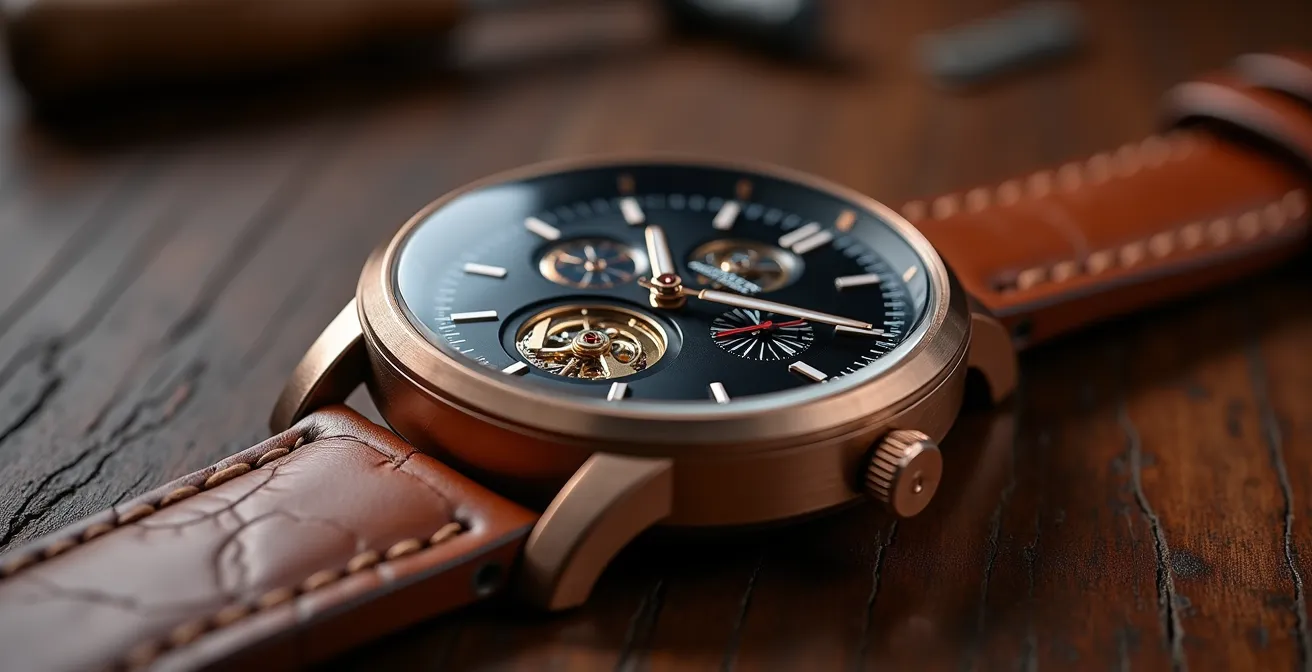
As this image suggests, the appeal lies in the fusion of textures and technologies. The warmth of a stitched leather strap and the cool precision of a brushed metal case house a mechanism that is both beautiful and functional. This is functional elegance in its purest form, where the technology enhances the experience without dominating the aesthetic.
Ultimately, the hybrid smartwatch is for the individual who believes technology should be a silent partner. It’s a statement that one can be fully connected to the digital world without being visually tethered to it, representing the highest form of sophisticated integration.
Is Spending £1,500 on a Luxury Smartwatch Worth It If It Expires in 3 Years?
The question of value is central to any luxury purchase. A traditional mechanical watch from a heritage brand is often seen as an heirloom, an investment that can last generations. A £1,500 luxury smartwatch, with its battery degradation and inevitable software obsolescence in 3-5 years, seems to defy this logic. This perception, however, stems from applying an old-world metric—permanence—to a new-world asset. The value of a luxury smartwatch is not in its longevity; it’s in its contemporaneous performance.
Spending a significant sum on a premium smartwatch is not an investment in an object that will appreciate, but an investment in your personal brand *right now*. It signals that you are at the forefront of technology, equipped with the best tools for modern efficiency. In the executive world, being current is a currency in itself. The “expiry date” is not a flaw; it’s the subscription cost for staying at the cutting edge. It’s no different from upgrading a company car or a laptop every few years to maintain peak performance and image.
The market for these devices is expanding rapidly, demonstrating a clear shift in perception. With projections indicating there will be over 740 million smartwatch users globally by 2029, these devices are moving from niche gadgets to mainstream executive tools. The premium segment of this market caters to those who understand that the cost-per-wear calculation must include the intangible benefit of projecting a modern, efficient, and technologically adept image.
Furthermore, the value is also in the user experience. A luxury smartwatch offers superior materials (sapphire crystal, titanium), more refined software, and often better integration with a brand’s ecosystem. This enhanced daily interaction is a tangible benefit. When you amortise the £1,500 cost over three years of daily use, the “cost per day” to operate at the highest level of functional elegance becomes a justifiable business expense.
Therefore, the question is not whether the watch will last forever, but whether it provides sufficient value during its operational lifespan. For the modern executive, the ability to operate with seamless efficiency and project a forward-thinking image is a return on investment that far outweighs the cost of the hardware.
How to Set Up Smartwatch Notifications to Reduce Anxiety Instead of Increasing It?
A smartwatch, improperly configured, is a weapon of mass distraction. A constant barrage of vibrations for every email, social media like, and news alert transforms a tool of efficiency into a source of perpetual anxiety. It forces you into a state of reactive servitude, glancing at your wrist every few seconds and shattering your focus. This is the single biggest mistake professionals make and the primary reason smartwatches can look unprofessional. True mastery lies in transforming the device from a firehose of information into a curated stream of vital intelligence. This is the art of notification curation.
The goal is to achieve a state of controlled connectivity, where you, not the app developers, decide what deserves your immediate attention. This requires a ruthless and strategic audit of your notification settings. The default for every app should be ‘off’. You then selectively enable only the most critical alerts: messages from key team members, calendar reminders for your next meeting, and urgent system alerts. Everything else is noise.
Modern operating systems on watches from Apple, Google, and Samsung offer powerful “Focus Modes” or “Do Not Disturb” schedules. A sophisticated user will have modes for ‘Boardroom’, ‘Deep Work’, and ‘Commute’. The ‘Boardroom’ mode might only allow vibrations from a single VIP—your chief of staff or family. ‘Deep Work’ might silence everything except calendar alerts. This level of customisation turns the watch into a guardian of your focus, not a saboteur.
By implementing a disciplined notification strategy, you change your relationship with the device. You are no longer nervously checking it; you trust that any vibration is significant. This calm confidence is visible to others and reinforces an image of someone in complete control.
Your action plan: The Digital Discretion Checklist
- Review your battery management settings to identify the apps that send the most notifications and consume the most power.
- Limit notifications to essential communication platforms only (e.g., Teams/Slack from your direct reports, not every channel).
- Disable the ‘raise-to-wake’ feature during meetings and focused work sessions to eliminate accidental screen activation.
- Create custom Focus Modes for different contexts (e.g., ‘Meeting’, ‘Travel’, ‘Home’) with unique notification permissions.
- Set up VIP contact lists so that only messages and calls from your most critical contacts can break through your silent modes.
- Schedule ‘Do Not Disturb’ to automatically activate during your daily commute on the Tube to reclaim that time for reading or thinking.
- Use distinct haptic (vibration) patterns for different notification types, allowing you to identify an alert’s urgency without even looking at the screen.
By meticulously curating your notifications, you transform your smartwatch from a symbol of distraction into a testament to your focus and discipline. It becomes a tool that serves you, protects your time, and enhances your executive presence.
How Does Your Arm Movement Actually Power an Automatic Watch?
To understand the challenge of integrating a smartwatch, one must first appreciate the legacy it stands against. The automatic mechanical watch is a marvel of micro-engineering, a self-sustaining ecosystem powered by a beautifully simple principle: kinetic energy. It embodies a sense of permanence and a connection to the physical world that is the antithesis of a battery-powered digital device.
Inside every automatic watch is a semi-circular piece of metal called a rotor or oscillating weight. As you go about your day, the natural movement of your arm causes this rotor to swing back and forth. This motion winds the mainspring, a tightly coiled ribbon of metal that stores potential energy. As the mainspring gradually unwinds, it releases this energy in a controlled manner through a series of gears and levers known as the escapement. This is what drives the hands of the watch with a smooth, sweeping motion—a visual hallmark of a mechanical heart.
This ingenious, self-powering mechanism is more than just functional; it’s deeply symbolic. It represents a harmony between the wearer and the object, a device that lives and works in direct response to your own life force. There are no batteries to replace, no software to update. It is a closed system of pure, elegant physics, designed to last for generations with proper care.
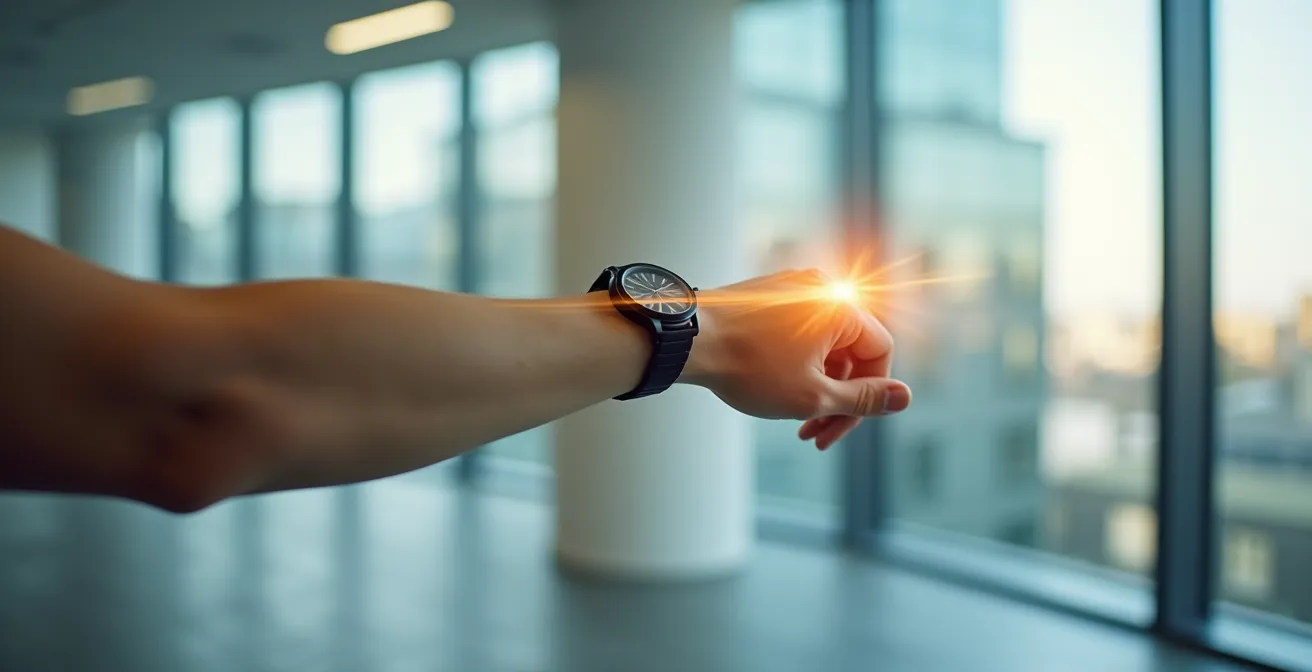
The allure of this kinetic partnership is powerful. It explains why traditional watches are considered “investments” or “heirlooms.” Their value lies in this timeless craftsmanship and the promise of perpetual motion, a stark contrast to the planned obsolescence of consumer electronics. Acknowledging this difference is not about dismissing the smartwatch, but about respecting the context into which it is being introduced.
The smartwatch cannot compete with the automatic watch on the grounds of permanence or heritage. Instead, it must establish its own form of value, rooted in intelligent function and modern efficiency. The goal is not to replace the old world, but to find an elegant way for the new world to coexist with it.
Is It Tacky to Wear Trainers with a Suit on the Tube?
The question of wearing trainers with a suit for the London commute is a perfect analogy for the smartwatch dilemma. A decade ago, it would have been an undeniable sartorial faux pas. Today, it is a common sight and, when done correctly, a sign of sophisticated, pragmatic style. This evolution in the dress code provides a crucial lesson: rules are not broken, they are rewritten by a change in context and an understanding of modern life. The smartwatch is part of this same sartorial shift.
Just as the rise of minimalist, premium leather trainers (from brands like Common Projects or Axel Arigato) created a new category between formal shoes and athletic gear, the smartwatch has created a new category of wristwear. It is neither a traditional dress watch nor a purely functional sports gadget. It is a hybrid of style and utility that demands its own set of rules. As the UK’s own OX Magazine notes, the conversation has fundamentally changed:
Smartwatches are no longer gadgets for the techie; they are now part of modern outfits. Offering a range of looks —from sleek and understated to vibrant and eye-catching— there’s a smartwatch style for every person. This evolution has prompted a growing focus on how to wear these devices in style.
– OX Magazine UK, Smartwatch Fashion: How to Style Your Tech Accessory
The key to success, both with trainers and smartwatches, lies in intention and elevation. A battered pair of running shoes with a bespoke suit looks careless. A clean, minimalist white trainer looks intentional. Similarly, a brightly coloured plastic smartwatch with a loud, animated watch face looks juvenile. A titanium-cased smartwatch with a discreet, information-dense modular face looks purposeful and modern.
The modern executive’s wardrobe is about blending performance with professionalism. The choice to wear smart trainers for a commute that involves walking and standing on the Tube is a practical one. The choice to wear a smartwatch is similarly practical. The art is in ensuring the choice looks deliberate and curated, not lazy or thoughtless. This means coordinating colours, materials, and overall levels of formality to create a cohesive, contemporary look.
Ultimately, wearing a smartwatch with a suit is no more “tacky” than wearing smart trainers. It is a reflection of a modern, efficient lifestyle. The only faux pas is a lack of intention. When integrated thoughtfully, it becomes a powerful part of a contemporary professional uniform.
Key takeaways
- Shift your focus from aesthetics to function; mastering your smartwatch’s settings is the ultimate sign of professionalism.
- Treat your smartwatch not as a timeless heirloom but as a high-performance tool, where its value lies in current efficiency, not future longevity.
- The goal is ‘controlled connectivity’—curate your notifications ruthlessly to protect your focus and project an image of calm authority.
How to Curate a Watch Collection That Defines Your Personal Brand?
The ultimate solution to the smartwatch dilemma is to stop thinking in terms of a single, all-purpose watch. A discerning professional does not have one pair of shoes for all occasions, and the same logic should apply to timepieces. The most powerful statement is a curated watch collection, where each piece has a distinct role and purpose. In this context, the smartwatch is not a compromise; it is an indispensable component of a modern horological wardrobe. Its role is the high-performance daily driver.
A well-rounded collection for a UK-based professional could be built around a three-watch strategy: the Daily Driver, the Dress Watch, and the Weekend Watch. The smartwatch, like an Apple Watch or a Garmin, excels as the daily tool for the commute and office hours. It manages communication, tracks activity, and provides at-a-glance information with unmatched efficiency. It is the workhorse.
For client dinners, formal events, or board meetings where traditional presence is paramount, you switch to the Dress Watch. This could be a classic mechanical piece from a heritage brand—perhaps a vintage Smiths, nodding to British watchmaking history, or an elegant Bremont. This watch speaks to an appreciation for craftsmanship, permanence, and tradition. Finally, for a weekend hike in the Peak District or more rugged pursuits, a durable G-Shock or a feature-packed Garmin Instinct is the logical choice. This demonstrates an understanding of function-specific tools.
This approach transforms the conversation. You are no longer trying to force one watch to be all things. Instead, you are demonstrating a sophisticated understanding of context, choosing the right tool for the job. This act of curation is a powerful expression of your personal brand—it says you are efficient, traditional, and adventurous, all in the appropriate measure. The following table provides a sample framework for building such a collection in a UK context.
| Watch Type | Best UK Occasion | Recommended Style | Price Range |
|---|---|---|---|
| Daily Smartwatch | City commute, office | Apple Watch or Garmin Venu | £300-£800 |
| Dress Watch | Client dinners, theatre | Bremont or vintage Smiths | £2,000-£5,000 |
| Weekend Watch | Peak District hikes | G-Shock or Garmin Instinct | £150-£500 |
By defining a clear role for your smartwatch within a broader collection, you resolve the conflict between technology and tradition. It becomes a testament to your ability to navigate the modern world with intelligence, strategy, and impeccable style. Your next step is to assess your current needs and begin curating the collection that best tells your professional story.
Frequently Asked Questions on Smartwatch Integration
How much battery does constant notifications drain?
If you have all notifications turned on in your smartwatch and you receive a high volume daily, this will cause the screen display to light up and vibrate frequently. As a result, this will significantly drain the battery, often being one of the primary causes of poor battery life.
What’s the most battery-efficient notification setting?
The most efficient setting is to disable all notifications by default and create a ‘VIP’ or ‘allow list’ for only essential contacts and apps. Furthermore, turning off the ‘wake-on-wave’ or ‘raise-to-wake’ feature that activates the screen with every wrist movement can dramatically conserve battery life throughout the day.
Should I use always-on display with notifications?
While aesthetically pleasing, an always-on display (especially on AMOLED screens) is a major power consumer. Disabling the always-on feature is one of the single most effective ways to save power, typically extending daily battery life by 20-30 percent or more, giving you a crucial buffer for long days.