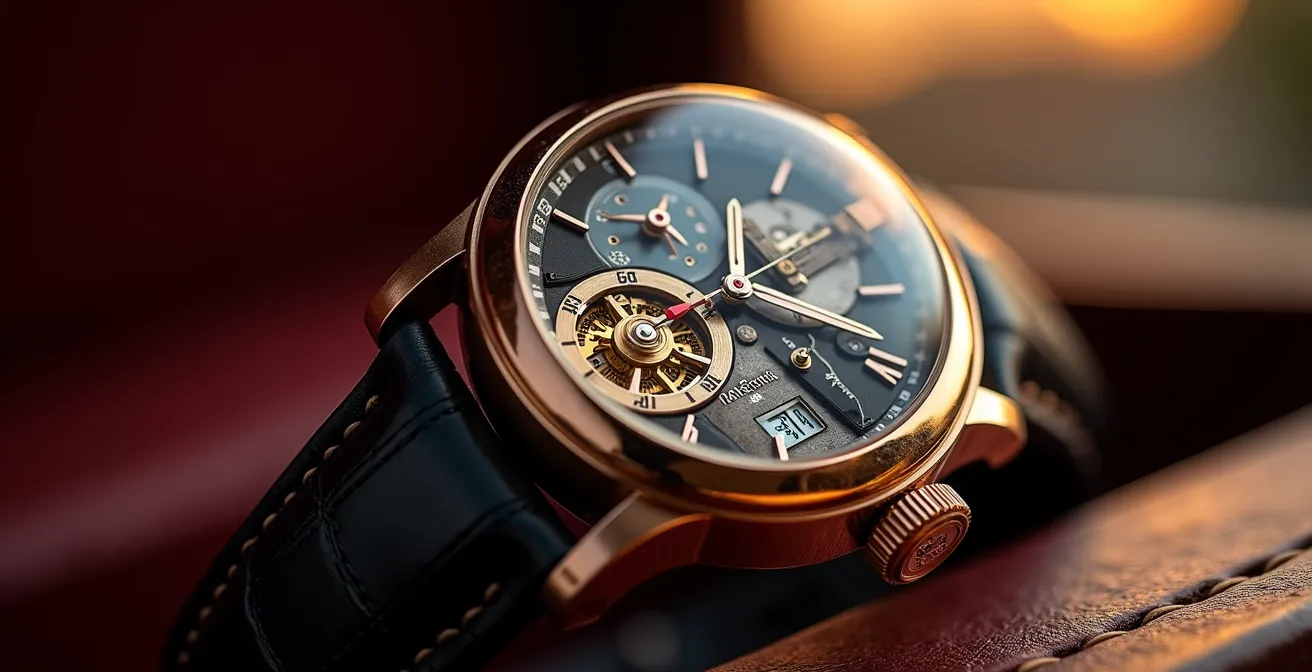
An automatic watch is not a purchase; it’s a one-time investment in a permanent asset that becomes significantly cheaper than any smartwatch over its lifetime.
- Lifecycle costing proves a £1,500 automatic watch is nearly half the price of a “luxury” smartwatch over ten years, which is designed for obsolescence.
- It is powered by your own movement—a personal, battery-free contract—and engineered for multi-generational repair, not disposal.
Recommendation: View your next accessory purchase through the lens of total ownership cost and heirloom potential, not just the initial price tag.
In a world saturated with disposable technology, the search for genuine sustainability often leads us down familiar paths: tote bags, reusable coffee cups, and shunning fast fashion. We are told to consume less, but the conversation rarely extends to the gadgets on our wrists. The modern smartwatch, with its promise of connectivity, is a marvel of engineering. It is also a paragon of planned obsolescence, a device designed to be replaced every few years, its battery fading and its software becoming unsupported. This cycle of consumption creates a mountain of electronic waste and a constant drain on resources.
The common argument against this is to choose something that lasts. But what if the most sustainable choice was not just about longevity, but about a fundamentally different relationship with an object? What if true sustainability lies in an investment in ‘engineered permanence’? This is the philosophy behind the automatic watch. It’s an accessory that challenges the very notion of disposability. It’s not just about avoiding batteries; it’s about embracing a piece of machinery designed to outlive you, powered by your own life force, and whose value—both financial and emotional—only grows with time. It asks us to ‘buy once, buy well’ in the most literal sense.
For those who prefer a visual format, the following video, a classic from 1949, beautifully illustrates the timeless mechanical principles that still power the automatic watches of today. It offers a fascinating glimpse into the intricate world of gears and springs that we will explore.
This guide will deconstruct the sustainable case for the automatic watch, moving beyond the surface-level benefits to a deeper analysis of its mechanics, maintenance, and long-term value. We will explore the engineering that makes it a permanent object and run the numbers to compare its true cost against the fleeting appeal of its smart counterparts.
Summary: Deconstructing the Value of a Permanent Timepiece
- How Does Your Arm Movement Actually Power an Automatic Watch?
- Do You Really Need a Watch Winder or Is It Damaging Your Movement?
- What to Do When Your Automatic Watch Stops After a Weekend Off the Wrist?
- Why Buying an Automatic with a See-Through Back Is Essential for New Collectors?
- Can You Break an Automatic Watch by Manually Winding It Too Much?
- Is Spending £1,500 on a Luxury Smartwatch Worth It If It Expires in 3 Years?
- Is a £300 Cashmere Jumper Cheaper Than Five £60 Synthetics?
- Choosing Timeless Professionalism Over Tech-Obsolescence
How Does Your Arm Movement Actually Power an Automatic Watch?
The magic of an automatic watch lies in a principle we can call the ‘Kinetic Contract’: a symbiotic relationship between your body and a piece of precision machinery. Unlike a quartz watch that relies on a disposable battery, or a manual watch that requires daily winding, an automatic movement harnesses your own energy. As you go about your day—commuting on the London Tube, typing at your desk, or simply walking—your arm’s natural motions cause a semi-circular weight inside the watch, called the rotor, to spin.
This spinning rotor is connected to a series of gears that wind the watch’s mainspring, a tightly coiled ribbon of metal that stores mechanical energy. As the mainspring slowly and consistently unwinds, it releases this energy to power the intricate dance of gears and levers that turn the hands on the dial. It is a completely self-sufficient, closed-loop system, a miniature power plant on your wrist. The market for these remarkable devices is far from niche; market analysis shows that mechanical watches are the fastest growing segment in UK luxury timepieces, demonstrating a clear shift towards lasting craftsmanship.

This stored energy is known as the ‘power reserve’. According to UK watch experts at 10to2, a typical automatic watch can store around a 40-hour power reserve, more than enough to survive being left on a nightstand over a weekend break in the Cotswolds. More advanced movements can offer 80 hours or more, easily handling a long Bank Holiday weekend without missing a beat. This elegant transfer of kinetic energy into timekeeping is the very foundation of the automatic watch’s sustainability.
Do You Really Need a Watch Winder or Is It Damaging Your Movement?
For new collectors, the idea of a watch winder—a device that keeps your automatic watch moving when you’re not wearing it—can seem like a sensible investment. The logic is that it prevents the watch from stopping. However, from a ‘buy well’ and sustainability perspective, a winder is often an unnecessary expense that can actively work against the principle of longevity. Think of it like leaving your car’s engine running 24/7 just so you don’t have to turn the key in the morning. It causes continuous, needless wear on the mechanical components.
An automatic watch is designed to be worn. It is also designed to stop and be easily restarted. Constant rotation in a winder puts perpetual strain on the movement’s winding mechanism and gear train. This accelerates the degradation of lubricants and can lead to premature wear, potentially requiring servicing sooner than necessary. Considering UK watchmakers typically charge an average of £400-£600 for a standard automatic service, avoiding unnecessary wear is a sound financial and sustainable decision. A mechanical watch is not a disposable gadget; it’s a piece of engineering that thrives on a balanced cycle of use and rest.
The consensus among experts is clear. As the specialists at Volt & Weiss state, “Most manufacturers recommend servicing mechanical watches every 4-5 years to maintain accuracy and extend their lifespan.” A winder doesn’t eliminate this need; it simply keeps parts moving that could otherwise be at rest. The most sustainable approach is to let your watch stop when you’re not wearing it for extended periods and follow a simple maintenance ritual to care for it properly.
Your ‘Buy Well’ Watch Maintenance Plan: Key Points to Verify
- Restart Ritual: If the watch has stopped, gently turn the crown 20-30 times to build up an initial power reserve before wearing.
- Accurate Time-Setting: When setting the time, use a reliable source like the UK’s MSF atomic time signal for maximum precision.
- Environmental Awareness: Store your watch in a stable, dry environment, away from the UK’s notorious damp, and avoid strong magnetic fields from electronics or security scanners.
- Scheduled Servicing: Adhere to the manufacturer’s recommended service interval (typically 4-5 years) with a certified watchmaker to ensure lubricants are fresh and components are sound.
- Long-Term Value: Document each service. A full service history is a crucial part of the watch’s provenance and enhances its long-term heirloom and resale value.
What to Do When Your Automatic Watch Stops After a Weekend Off the Wrist?
For those accustomed to the unceasing tick of a battery-powered watch, finding your cherished automatic has stopped can induce a moment of panic. But this is not a fault; it is a normal and expected feature of the ‘Kinetic Contract’. Your watch has simply exhausted its power reserve, the stored energy in its mainspring, after a period of inactivity. It’s the mechanical equivalent of a peaceful sleep, waiting for you to re-engage with it.
The solution is beautifully simple and requires no technical expertise. There is no need to shake the watch violently, a common misconception that can potentially damage the delicate movement. Instead, you simply need to give it a manual wind. Unscrew the crown (if it’s a screw-down type, common on dive watches) to the first position and gently turn it clockwise for about 20 to 30 rotations. You may feel a subtle resistance as the mainspring tightens. This action manually replenishes the power reserve, breathing life back into the mechanism. Once wound, set the time, screw the crown back in, and put it on your wrist. Your movement will do the rest.
Modern engineering ensures this process is foolproof. A common concern is the possibility of ‘overwinding’, but automatic watches are equipped with a slipping bridle mechanism that prevents this. Once the mainspring is fully wound, the mechanism disengages, allowing the rotor (or manual winding) to turn without adding further tension. Watchfinder & Co. reports that most modern automatics have a power reserve of 38-70 hours, ample for most UK collectors to navigate a weekend away from their watch. When it stops, it’s not a sign of failure, but a quiet invitation to interact with your timepiece.
Why Buying an Automatic with a See-Through Back Is Essential for New Collectors?
When investing in an object of ‘engineered permanence’, appreciating its inner workings is part of the ownership experience. This is why a watch with an exhibition or see-through caseback is so much more than a stylistic flourish; it is a window into the soul of your investment. For a new collector, it transforms an abstract concept of “craftsmanship” into a tangible, mesmerising reality. It allows you to see the spinning rotor, the rhythmic pulse of the balance wheel, and the intricate web of gears and bridges working in perfect harmony.
This transparency is a statement of confidence from the watchmaker. It signifies that the movement inside is not just a functional workhorse but is finished to a standard worthy of display. Details like Côtes de Genève (Geneva stripes), perlage (circular graining), and blued screws are not essential for timekeeping, but they are hallmarks of high-end horology. Observing these details fosters a deeper connection to the watch, reinforcing the ‘buy well’ philosophy. It is a constant reminder that you have purchased a piece of mechanical art, not a sealed electronic unit. The UK watch market, valued at USD 2.57 billion in 2024, is increasingly driven by consumers who appreciate this level of detail.
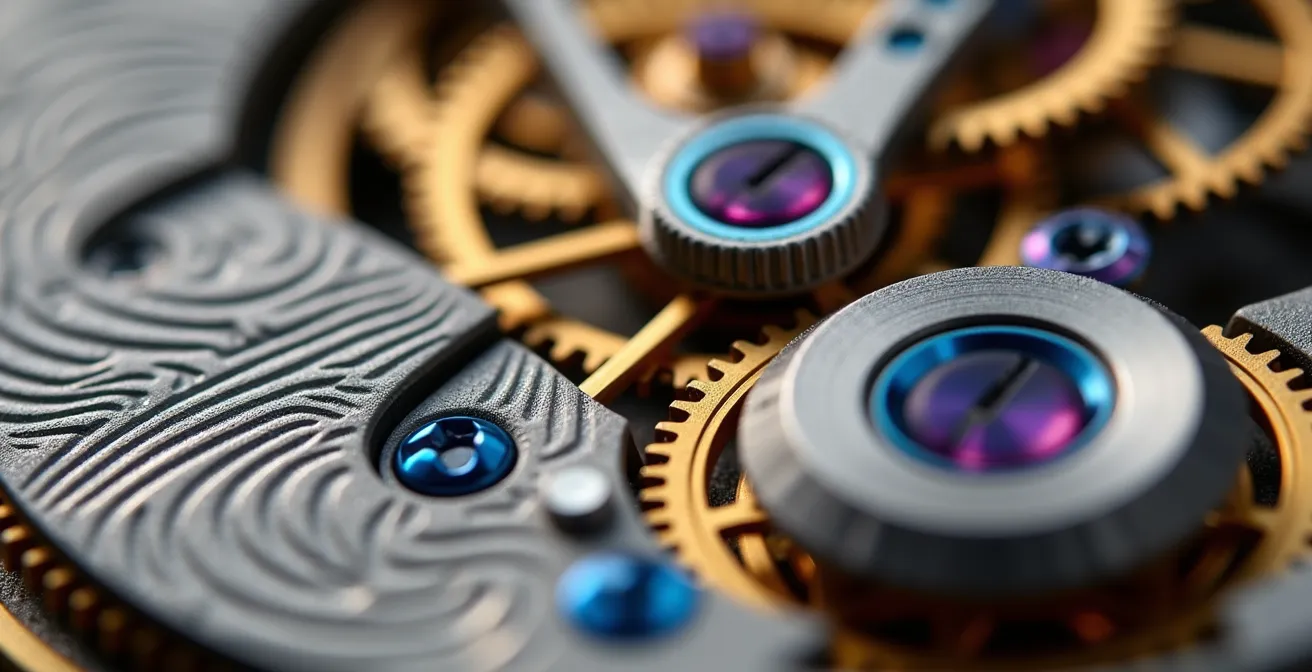
This appreciation for visible mechanics is central to the modern British watch revival. Brands like Christopher Ward, famously founded in a converted Berkshire chicken shed, have built their reputation on offering exceptional value with Swiss movements and designs that celebrate this engineering. Their frequent use of exhibition casebacks has helped to educate a new generation of UK enthusiasts, proving that an appreciation for fine watchmaking is not exclusive to historic Swiss Maisons. The see-through back is your entry point to becoming not just a watch owner, but a true horological enthusiast.
Can You Break an Automatic Watch by Manually Winding It Too Much?
One of the most persistent fears among new owners of automatic watches is the potential for damage through overwinding. It’s an understandable concern rooted in the experience of older, purely manual-wind timepieces. The fear is that you might turn the crown one too many times, break a delicate part, and face a costly repair. Fortunately, with any modern automatic watch, this fear is entirely unfounded. You simply cannot break it by winding it too much.
The engineering that makes this possible is an ingenious safety feature called a slipping bridle or slipping spring. Inside the barrel that houses the mainspring, the spring’s outermost end is not fixed directly to the barrel wall. Instead, it is attached to a C-shaped piece of metal that presses against the barrel’s inner wall with friction. When you wind the watch, this bridle holds firm, allowing the spring to tighten and store energy. However, once the mainspring is fully wound, any additional force from winding will cause the bridle to ‘slip’ slightly along the barrel wall, releasing the excess tension with a faint click (though it’s usually inaudible). This mechanism ensures that the winding system is never subjected to excessive stress.
This built-in protection is a key differentiator from traditional manual-wind watches, which lack this feature and will offer firm resistance when fully wound, a clear signal to stop. As the technical experts at SwissWatchExpo explain, this feature is fundamental to the design.
You cannot overwind an automatic watch. Manual watches don’t have built-in safety features that make this possible. The slipping spring sets in around the barrel when fully wound.
– SwissWatchExpo Technical Team, The Watch Club Guide to Automatic Movements
This piece of engineering provides complete peace of mind. It allows you to wind your watch confidently to restart it, knowing that the movement is protecting itself from your enthusiasm. It is another small but crucial element of the ‘engineered permanence’ that defines a quality automatic watch.
Is Spending £1,500 on a Luxury Smartwatch Worth It If It Expires in 3 Years?
The concept of a “luxury smartwatch” is, from a sustainability and financial standpoint, a contradiction in terms. While it may carry a premium price tag and a high-end brand name, it is fundamentally a disposable electronic device. Its value is tied to its software and battery, both of which have a deliberately limited lifespan. This is where the principle of lifecycle costing delivers a stark and revealing verdict. An initial £1,500 outlay is not the true cost; it is merely the first instalment in a cycle of repeated purchases.
A smartwatch’s battery performance degrades noticeably within two to three years. Around the same time, it will likely cease to receive critical software updates, losing functionality and security. It becomes electronic waste. To maintain the same level of function, you must replace it. In contrast, a £1,500 automatic watch, when purchased, is an asset. Its servicing cost is a predictable and manageable part of its lifecycle, not a precursor to its disposal. The financial calculus over a single decade is staggering.
This table illustrates the total cost of ownership over ten years, based on a three-year replacement cycle for the smartwatch and a five-year service interval for the automatic. The conclusion is inescapable.
| Timepiece Type | Initial Cost | 10-Year Replacements | Servicing | Total 10-Year Cost |
|---|---|---|---|---|
| Luxury Smartwatch | £1,500 | £3,000 (2 replacements) | £0 | £4,500 |
| Automatic Watch | £1,500 | £0 | £800 (2 services) | £2,300 |
The numbers speak for themselves. The automatic watch is not just slightly cheaper; it costs nearly half as much over a decade. Furthermore, while the smartwatch’s value depreciates to effectively zero, the automatic watch retains a significant portion of its value, and can even appreciate. While market research indicates that while the UK smartwatch market will reach £4.15 billion by 2035, this growth is fuelled by a model of rapid replacement that is both financially and environmentally unsustainable for the individual consumer.
Is a £300 Cashmere Jumper Cheaper Than Five £60 Synthetics?
The question seems simple, but it cuts to the heart of the ‘buy once, buy well’ philosophy. A single, high-quality cashmere jumper, properly cared for, can last for decades. Five synthetic jumpers will likely pill, lose their shape, and be discarded within a few seasons, ultimately costing the same amount but creating more waste and providing a lesser experience. This exact logic applies, with even greater force, to the world of watches. An automatic watch is the horological equivalent of that cashmere jumper: an initial investment that pays dividends in longevity, satisfaction, and retained value.
Unlike smart devices or fast fashion, a well-made mechanical watch does not just avoid depreciation; it can be a genuine store of value. The pre-owned market provides clear evidence of this. A 2024 report from Watchfinder & Co. revealed that Rolex Certified Pre-Owned pieces can command premiums of 30% over non-certified models, showcasing the robust value retention of quality timepieces. This is an asset class that is simply unavailable to owners of disposable electronics. Even outside of top-tier brands, quality watches hold their worth remarkably well.
This isn’t a phenomenon limited to boom years or specific models. Across the UK’s major cities, the trend is consistent. Data from the market shows that quality vintage watch values remain significantly above pre-2020 levels across dealers in London, Manchester, Edinburgh, and Birmingham. This resilience demonstrates that consumers are increasingly recognising these pieces not as mere accessories, but as tangible investments. Choosing an automatic watch is a vote for an economic model based on enduring value, not fleeting consumption. It’s a decision that benefits your wallet and the planet in the long run.
Key Takeaways
- An automatic watch operates on a ‘Kinetic Contract’, using your own movement to power itself indefinitely, eliminating battery waste.
- The true cost of a smartwatch is its initial price plus mandatory replacements, making an automatic watch nearly 50% cheaper over a decade.
- Mechanical watches are designed for a lifetime of servicing, not disposal, and can retain or even appreciate in value, acting as a tangible asset.
Choosing Timeless Professionalism Over Tech-Obsolescence
In a corporate environment, every detail of your attire contributes to the professional image you project. The question of what to wear on your wrist is more than stylistic; it’s a statement of priorities. While a smartwatch signals a connection to the fast-paced world of technology, it can also project an image of disposability and transient trends, sometimes appearing more juvenile than authoritative. The alternative, an automatic watch, communicates something entirely different: an appreciation for permanence, craftsmanship, and quiet confidence.
Choosing a classic timepiece for the workplace aligns you with a tradition of professionalism. It’s a subtle nod to a world where value is measured in decades, not software updates. The choice of watch can be tailored to the specific context of UK business culture. For high-stakes meetings in the City of London, a classic dress watch from a heritage brand like Omega or Tudor speaks a language of stability and tradition. For a presentation in the tech sector, a piece from a modern British brand like Christopher Ward or a vintage Smiths watch shows an appreciation for engineering and design without being ostentatious. It demonstrates that your focus is on the work, not on the notifications buzzing on your wrist.
This mindset is not an old-fashioned relic; it’s being actively embraced by the next generation of savvy consumers and professionals. They understand the difference between temporary gadgets and permanent assets. As Arjen van de Vall, CEO of Watchfinder & Co., notes, younger generations are diving into this market with a keen eye for value, with over 80% of Gen Z buyers purchasing through the pre-owned market. They see these watches not as antiques, but as smart, sustainable investments in their personal brand.
Ultimately, opting for an automatic watch is a conscious act of rebellion against the culture of disposability. It is a financial, aesthetic, and ethical statement. To take the next step, begin exploring the world of pre-owned and new automatic watches from brands that champion craftsmanship and transparent engineering.
Frequently asked questions about The Sustainability of Automatic Watches
Can you damage an automatic watch by winding it when stopped?
No, modern automatic watches have a slipping bridle mechanism that prevents overwinding. Simply turn the crown 20-30 times to restart.
How long can an automatic watch sit without wearing?
Most automatic watches can sit for 40-80 hours depending on their specific power reserve. After this period, they simply stop and await rewinding without any harm to the movement.
Should I use the GMT/BST changeover as a maintenance reminder?
Yes, the bi-annual UK time change is a perfect, regular reminder to check your watch’s accuracy and consider if it is approaching its recommended 4-5 year service interval.