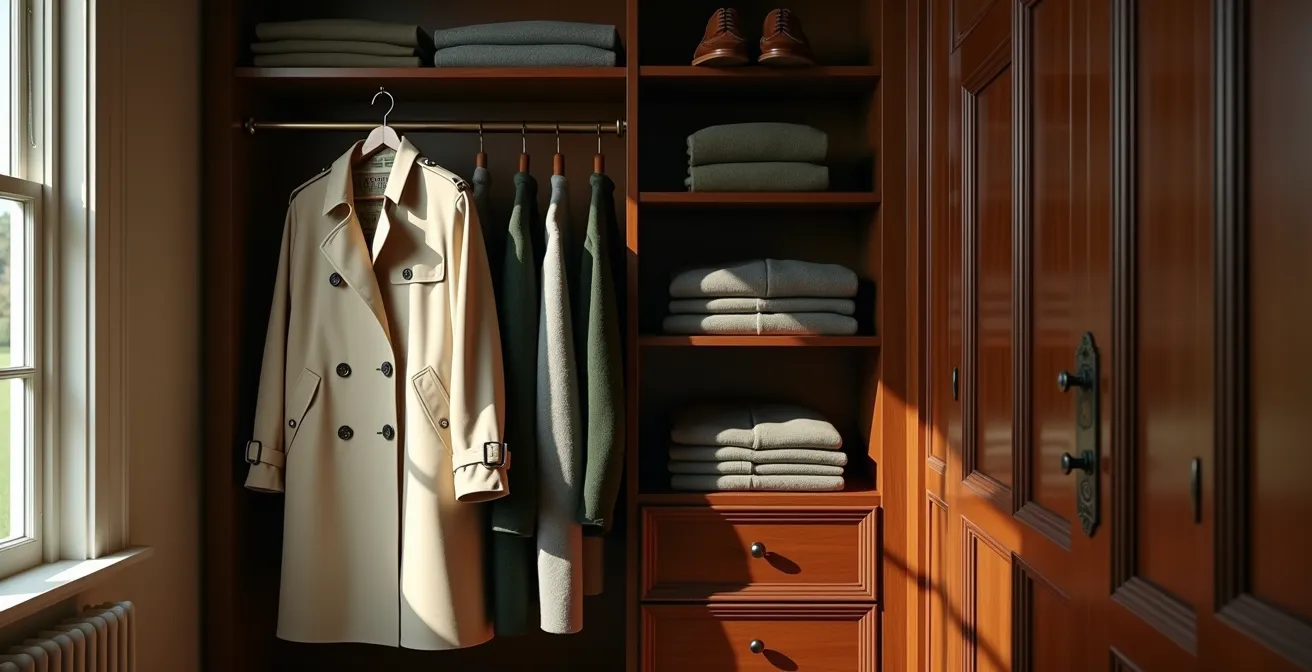
Contrary to popular belief, effortless style isn’t about owning a trench coat or a specific set of ‘classics’; it’s about mastering a strategic system.
- True elegance begins with understanding your unique ‘silhouette architecture’—the foundation upon which every outfit is built.
- Quality is not a luxury but a functional necessity, identifiable through the ‘physics’ of fabrics like wool and silk.
Recommendation: Shift your focus from buying more clothes to making fewer, more intelligent choices based on fit, fabric, and function.
You know the feeling. A wardrobe overflowing with clothes, yet the daily refrain remains a frustrated, “I have nothing to wear.” For the busy professional woman in Britain, this paradox is more than a minor inconvenience; it’s a daily drain on time and confidence. The common advice is to buy timeless ‘classics’ or invest in a few designer pieces. We’re told to embrace layering for the unpredictable weather and to build a palette of neutrals. But these are symptoms, not the solution. This approach often leads to a collection of expensive but disconnected items, failing to deliver that coveted sense of cohesive, effortless style.
What if the secret to genuine British elegance wasn’t in the items themselves, but in the underlying philosophy? The problem isn’t a lack of clothes; it’s the absence of a system. True style isn’t about acquiring a pre-approved list of garments. It’s an intellectual exercise in reduction and strategy. It’s about understanding the core principles of silhouette, the physics of fabric, and the science of colour, all adapted to the unique light and lifestyle of the UK. This is the essence of a true capsule wardrobe: not a restriction, but a liberation. It’s a tool for clarity, designed to give you back your time and empower your choices.
This guide will not give you another shopping list. Instead, it will equip you with the strategic framework to build a functional, beautiful, and truly personal wardrobe. We will deconstruct the process, moving from the foundational architecture of your silhouette to the practical realities of dressing for a commute on the Tube. Prepare to transform your relationship with your clothes from one of chaos to one of quiet confidence.
This article provides a structured approach to building a wardrobe that works for you. Below, the summary outlines each strategic step, from identifying your core silhouette to mastering the art of transformation with simple accessories.
Summary: Building Your System for British Elegance
- How to Identify the Signature Silhouette That Flatters Your Body Type?
- How to Spot High-Quality Wool and Silk Before You Even Try It On?
- How to Balance Basics and Statement Pieces for a Functional Wardrobe?
- Which Neutral Colours Should Form the Base of Your Wardrobe Based on Skin Tone?
- How to Adapt Your Core Wardrobe for the Unpredictable British Weather?
- Why Is Merino Wool Superior to Acrylic for UK Winters?
- Is It Tacky to Wear Trainers with a Suit on the Tube?
- How to Use Scarves and Belts to Transform a Basic Dress?
How to Identify the Signature Silhouette That Flatters Your Body Type?
Before considering a single colour or fabric, the first principle is silhouette architecture. This is the foundational blueprint of your wardrobe. It’s not about chasing trends, but about understanding the lines and shapes that work in harmony with your natural form. Ignoring this step is like building a house without a floor plan; the result will be unstable and incoherent, no matter how beautiful the individual components are. Identifying your signature silhouette means you can edit your choices with surgical precision, instantly knowing whether a piece will contribute to your overall vision or detract from it.
Historically, fashion has always been about shaping the silhouette. As a study from the London Image Institute highlights, Christian Dior’s “New Look” post-WWII was revolutionary precisely because it celebrated a specific form—the hourglass—by cinching the waist and creating a structured, feminine curve. This demonstrates that a powerful silhouette is intentional. For example, the same study notes that for an hourglass figure, the key is to celebrate the waist. This translates into practical choices like high-waisted trousers and skirts that draw the eye to your narrowest point.
The goal is to identify your core shapes and build from there. Are you best served by the sharp, tailored lines of a ‘Savile Row’ aesthetic, perfect for rectangular shapes needing definition? Or does the soft, flowing ‘Bloomsbury’ style, with its A-lines and empire waists, better complement an apple shape by creating elegant vertical lines? Understanding this allows you to shop with purpose, seeking out specific cuts rather than being swayed by fleeting fashions. It’s the difference between buying a dress and investing in a piece of personal architecture.
This initial analysis is the most powerful tool in your arsenal. It simplifies every future decision and is the true starting point for building a wardrobe that feels not just stylish, but fundamentally *right*.
How to Spot High-Quality Wool and Silk Before You Even Try It On?
Once your silhouette architecture is defined, the next layer of strategy involves fabric physics. In a minimalist wardrobe where each piece must perform, the quality of your materials is non-negotiable. High-quality natural fibres like wool and silk don’t just feel better; they behave better. They drape correctly, regulate temperature, and endure years of wear, making them a cornerstone of any serious capsule wardrobe. Learning to identify quality before you even reach the fitting room is a skill that saves both time and money, protecting you from the false economy of cheaper, synthetic alternatives.
The tactile and visual clues are there, if you know what to look for. For wool, think of iconic British textiles like Harris Tweed. Its quality is not just in its heritage, but in its physical properties: a dense, tight weave that provides warmth and weather resistance. For silk, the ‘crush test’ is a simple but effective indicator: a quality piece will release from your fist with minimal wrinkling, its fibres springing back into place. Cheap polyester satin, by contrast, will hold every crease. The way a fabric hangs—its ‘drape’—is another key sign. Premium materials possess a certain weight and fluidity, moving with you rather than sitting stiffly on your frame.
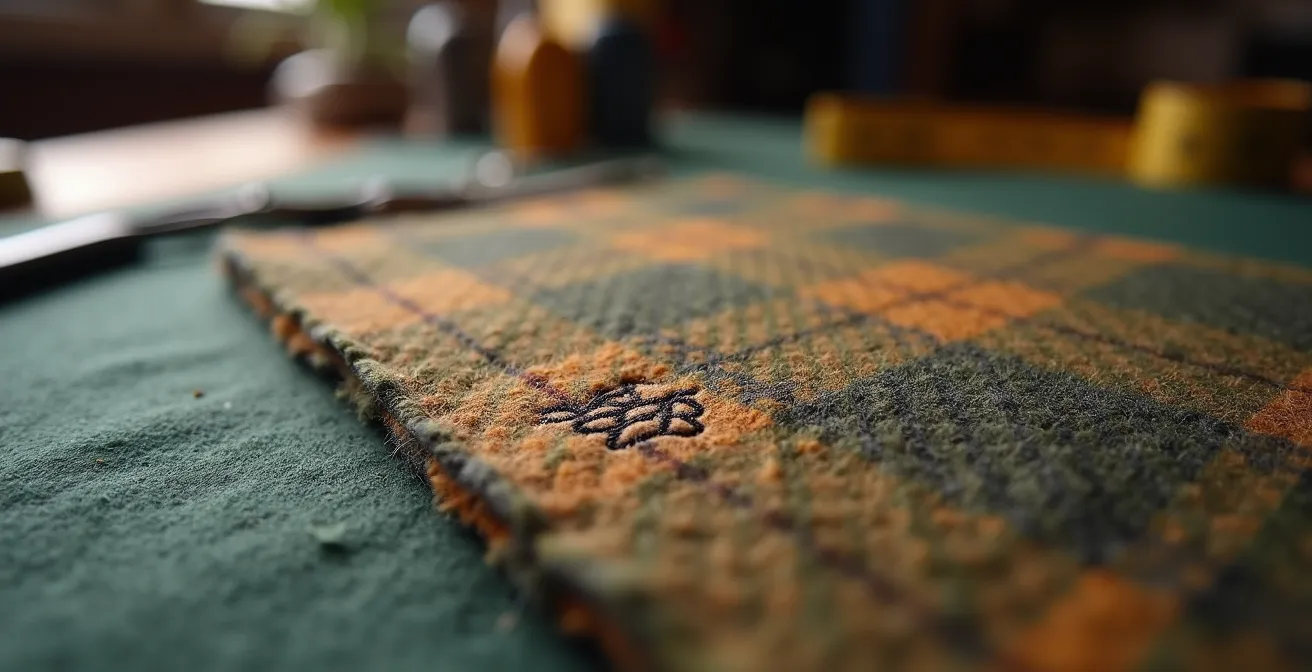
These simple, physical tests allow you to assess a garment’s integrity on the shop floor. To further refine your evaluation, consider these practical steps:
- The Light Test for Wool: Hold the fabric up to a light source. A quality, dense wool will be nearly opaque, indicating a tight weave that will hold its shape and provide superior insulation.
- The Drape Test: Let the fabric fall from your hand. It should move fluidly and have a satisfying weight, not a papery or stiff feel.
- The Touch Test for Cashmere: True Scottish cashmere feels incredibly soft but also has a resilience; it should spring back when compressed. Cheaper blends often feel slippery due to synthetic additives.
By shifting your focus from brand labels to the intrinsic qualities of the material, you build a wardrobe based on tangible performance and longevity. This is the essence of ‘less but better’.
How to Balance Basics and Statement Pieces for a Functional Wardrobe?
A common misconception is that a capsule wardrobe must be a sea of monotonous basics. This is a fundamental misunderstanding of the concept. The system’s true power lies in the strategic interplay between a foundation of high-quality basics and a few, carefully chosen statement pieces. The basics provide the canvas and the versatility; the statement pieces provide the personality and context. Without the right balance, a wardrobe can feel either boring or chaotic. The goal is a functional ecosystem where every item works together, allowing for maximum expression with minimal items.
The foundation is critical. According to Susie Faux, the London boutique owner who popularised the term in the 1970s, a woman’s core capsule should contain a lean but powerful set of essentials. Her foundational list suggests that a woman’s capsule wardrobe should contain at least 2 pairs of trousers, a dress or a skirt, a jacket, a coat, a knit, two pairs of shoes and two bags. This core framework of around ten items provides the reliable structure. Upon this base, you can then layer your statement pieces—a dress in a bold print from a brand like Erdem for a specific event like the Chelsea Flower Show, or a slinky maxi skirt that can be dressed up or down. These are the items that prevent wardrobe fatigue and adapt your core look for different social settings.
This approach is not just about style; it is also a sound financial strategy, particularly in uncertain economic times. As British style consultant Gok Wan has noted, it’s a tool for smart budgeting.
The capsule wardrobe is an especially important tool in a recession as it allows people to look good on a small budget
– Gok Wan, As cited in Wikipedia’s Capsule Wardrobe entry
This principle of balance is about making your wardrobe work harder. A simple, versatile item like a maxi skirt becomes a powerful asset when you realise it looks just as chic with an oversized knit for a casual weekend as it does with heels and a silk shirt for an evening out. The statement is in how you combine the elements, not just in the individual pieces themselves.
Ultimately, a functional wardrobe is not about the number of clothes you own, but the number of outfits you can create. This strategic balance is what unlocks that potential.
Which Neutral Colours Should Form the Base of Your Wardrobe Based on Skin Tone?
The conventional wisdom to “stick to neutrals” is overly simplistic. The third principle, colour science, requires a more nuanced approach. Not all neutrals are created equal, and the wrong ones can make you look tired and washed out, especially under the soft, diffused light characteristic of the British Isles. Choosing the *right* neutrals for your skin tone and environment is as critical as getting the silhouette right. This foundational palette acts as the unifying element in your wardrobe, ensuring that every piece can be mixed and matched seamlessly.
Forget harsh, absolute blacks or generic beiges. British elegance often lies in complex, muted tones that have more depth and sophistication. Think of a Farrow & Ball paint chart: the colours are complex and react beautifully to natural light. Your wardrobe should follow the same philosophy. ‘British neutrals’ like slate grey, moss green, warm navy, and clotted cream offer a richer, more flattering alternative. These tones have an inherent softness that works in harmony with the local environment, avoiding the starkness that pure black or white can create on an overcast day.

To find your ideal neutral base, you must test colours in the right conditions. In-store lighting is designed to be flattering and is often completely different from the daylight you live in. The most effective way to assess a colour is to follow a few practical steps:
- Test Outside: Always take a potential garment to a window or, better yet, step outside. See how the colour performs on an overcast day—this is its true test in the UK.
- Compare to Your Skin: Hold the fabric up to your face. Does it illuminate your complexion, or does it cast shadows and highlight unevenness? The right neutral will make your skin look healthier and more vibrant.
- Seek Heritage Palettes: Look to British brands known for their masterful use of colour, like Margaret Howell or Toast. Their seasonal palettes are a masterclass in selecting sophisticated, liveable neutrals.
By applying a little colour science, you create a base palette that is not only cohesive but actively enhances your appearance, providing a quiet confidence that is the hallmark of true elegance.
How to Adapt Your Core Wardrobe for the Unpredictable British Weather?
A perfectly curated capsule wardrobe is useless if it cannot withstand the realities of its environment. In Britain, that means one thing above all: unpredictable weather. A successful wardrobe is one that is weatherproofed without sacrificing style. This is not about owning bulky, purely functional gear; it’s about making strategic investments in pieces that blend high performance with classic design. The ability to layer, stay dry, and transition between a chilly morning, a rain-soaked commute, and a warm office is the ultimate test of a British capsule wardrobe.
The key is to invest in a few high-performing outerwear and footwear archetypes, often from heritage brands that have spent decades perfecting their craft. A classic trench coat, for example, is not just a style statement; its water-resistant cotton gabardine construction is a functional response to light rain and wind. For more challenging conditions, a waxed cotton jacket offers robust protection, while classic Wellington boots are the only sensible solution for wet, muddy terrain. These pieces are not trend-driven; they are time-tested solutions to recurring environmental problems.
The following table breaks down the essential investment pieces for weather-proofing your wardrobe, highlighting their key features and specific benefits. Investing in one or two of these items provides a reliable defence against the elements, allowing the rest of your wardrobe to function as intended.
| Item | Brand Examples | Key Features | Weather Benefit |
|---|---|---|---|
| Trench Coat | Burberry, Mackintosh | Water-resistant cotton gabardine | Light rain protection, wind barrier |
| Waxed Jacket | Barbour | Weatherproof waxed cotton | Heavy rain, countryside conditions |
| Wellington Boots | Hunter, Le Chameau | Natural rubber, neoprene lining | Puddles, mud, wet conditions |
| Quilted Gilet | Various British brands | Insulated, sleeveless design | Layering for temperature changes |
Beyond these key pieces, the art of adaptation lies in clever layering and accessorising. A lightweight scarf can provide warmth on a chilly morning, while a foldable hat can be a lifesaver in a sudden downpour. It is this combination of strategic investment and nimble adaptation that creates a truly resilient and elegant British wardrobe.
Why Is Merino Wool Superior to Acrylic for UK Winters?
Diving deeper into fabric physics, the choice of knitwear is a critical decision in any UK-based wardrobe. On the surface, a £30 acrylic jumper and a £150 Merino wool sweater might seem to serve the same purpose. However, this is where a minimalist, strategic mindset reveals the flaws in short-term thinking. Merino wool is not merely a luxury; it is a high-performance technical fibre whose superiority over acrylic is proven in comfort, durability, and long-term value. For the British climate and a busy professional lifestyle, it is an unequivocally better investment.
The functional benefits of Merino wool are perfectly suited to the challenges of a British winter and the daily commute. Its key properties include:
- Thermoregulation: Merino wool fibres are active, reacting to changes in body temperature. This means they keep you warm in the cold but prevent overheating on a stuffy Tube journey, a feat acrylic cannot match.
- Moisture-wicking: The fibre can absorb up to 30% of its own weight in moisture before feeling damp, drawing perspiration away from the skin. This keeps you dry and comfortable after rushing through the rain, whereas acrylic traps moisture and can leave you feeling chilled.
- Odour resistance: Merino wool has natural antibacterial properties, meaning it can be worn multiple times before needing to be washed. This is a significant practical advantage for a busy work week.
Beyond the immediate functional benefits, the economic argument is compelling. The concept of ‘cost per wear’ demonstrates the long-term value of investing in quality. As British fashion experts have calculated, the numbers speak for themselves. Their analysis shows that a £150 John Smedley merino sweater worn 150 times comes to £1 per wear, whereas a £30 acrylic jumper lasting only 15 wears costs £2 per wear. The initial investment in quality is repaid through superior durability and a much longer lifespan. An acrylic jumper may lose its shape and begin to pill after only a few washes, while fine gauge wool from the Midlands or cashmere from the Scottish Borders will maintain its form for seasons.
Choosing Merino wool over acrylic is not an act of indulgence. It is a strategic decision based on performance, durability, and sound financial logic—the very principles that define an intelligent and elegant wardrobe.
Is It Tacky to Wear Trainers with a Suit on the Tube?
The modern workplace has blurred the lines of traditional dress codes, and nowhere is this more evident than in the daily London commute. The question of wearing trainers with a suit is no longer a simple ‘yes’ or ‘no’. It has become a nuanced signal of industry, personal style, and an understanding of contemporary sartorial rules. For the professional woman, navigating this territory correctly is key to projecting an image that is both modern and appropriate. The short answer is no, it is not inherently tacky—provided it is executed with precision and context.
This look, often dubbed ‘The Modern London Uniform’, is now widely accepted in creative, tech, and media industries. It represents a practical response to a life lived in motion—walking to the station, standing on the Tube, and navigating a busy city. However, the success of this pairing hinges entirely on the *type* of trainer. Bulky, brightly-coloured athletic shoes will almost always look out of place. The key is to opt for sleek, minimalist leather sneakers in neutral colours like white, black, or navy. As one British fashion editor succinctly puts it:
It’s not the ‘what’ (trainers) but the ‘which’ – sleek, minimalist leather sneakers from brands like Grenson or Church’s are designed for this exact purpose
– British Fashion Editor, Style guidance from the article content
These are not an afterthought; they are an intentional choice. Brands like these have elevated the sneaker from purely athletic wear to a legitimate component of smart-casual and even business-casual attire. The look is completed by pairing them with well-tailored trousers or a modern suit, and often softened with a chic knit, like a versatile cardigan. This uniform signals an understanding of both comfort and style, a very contemporary form of elegance. However, it’s crucial to recognise its limitations; this look remains largely inappropriate for highly traditional sectors such as corporate law or finance, where classic dress codes still prevail.
Ultimately, wearing trainers with a suit is a calculated style choice. When done correctly, it is not tacky; it is a sophisticated and practical statement for the modern British professional.
Key takeaways
- True elegance is a system, not a shopping list, starting with your unique ‘silhouette architecture’.
- Invest in ‘fabric physics’: quality materials like Merino wool offer superior performance and lower long-term ‘cost per wear’.
- Balance is crucial: a foundation of perfect ‘British neutrals’ allows a few well-chosen statement pieces to define your personal style.
How to Use Scarves and Belts to Transform a Basic Dress?
The final principle of a masterful capsule wardrobe is leverage. Once you have a streamlined collection of high-quality, well-fitting pieces, the art lies in maximising their versatility. This is where strategic accessorising comes into play. With a few simple tools—primarily scarves and belts—you can transform a single basic garment, like a simple navy dress, to suit multiple occasions. This is the secret to making a small wardrobe feel expansive, allowing you to create distinct looks for the office, a weekend brunch, or an evening out, all from the same core item.
A high-quality silk or wool scarf is one of the most powerful transformation tools you can own. It can add a pop of colour and pattern, alter the neckline of a dress, or even serve as a makeshift belt. British heritage brands like Liberty London have built an entire legacy on the transformative power of the scarf. A simple knot can change the entire mood of an outfit. For instance, the ‘Sloane Square Knot’—a neat, loose knot at the front—lends an elegant, professional air to a dress. For a more relaxed, countryside feel inspired by royal style, the ‘Balmoral Headscarf’ technique adds a touch of classic charm.
Similarly, a belt does more than just cinch your waist; it redraws your silhouette. A slim leather belt can give a simple dress a more structured, office-appropriate feel. A wider, woven belt can create a more relaxed, bohemian vibe for the weekend. By simply changing the belt and scarf, you can take a single dress from a 9 AM board meeting to a 7 PM pub dinner. For example, a navy dress can be styled for the office with a slim leather belt and a neatly tied silk scarf, then transformed for the evening by removing the scarf and swapping the slim belt for a statement vintage piece.
Action Plan: Transforming Your Basics with Accessories
- Points of Contact: Identify the key transformation points on a basic dress: the waist, the neckline, the shoulders, and even your bag handle.
- Collect: Inventory your existing accessories. Do you have a slim leather belt, a wider woven one, a large square silk scarf, and a long wool one?
- Coherence: For an office look, choose accessories with clean lines and subtle textures (smooth leather, fine silk). For a casual look, opt for more texture (woven materials, chunky knits).
- Mémorabilité/émotion: A unique vintage belt or a Liberty print scarf is a memorable signature. Does your combination feel generic or personal?
- Plan d’intégration: Practice three distinct combinations for one of your basic dresses. Aim for ‘Office’, ‘Weekend’, and ‘Evening’ looks.
This is the ultimate expression of the ‘less is more’ philosophy. It’s not about having more clothes, but about having more ideas. With a few key accessories and a little creativity, your minimalist wardrobe becomes a source of endless stylistic possibilities.