In summary:
- Surviving a full day in heels is not about endurance, but about engineering a system of support for your feet and body.
- For UK professionals, this means a dual-shoe strategy for the commute and choosing materials suited for damp conditions.
- Properly breaking in leather, selecting the right sole, and ensuring a perfect trouser-hem-to-heel ratio are crucial.
- Ultimately, posture is the free, foundational element that dictates comfort and prevents long-term damage.
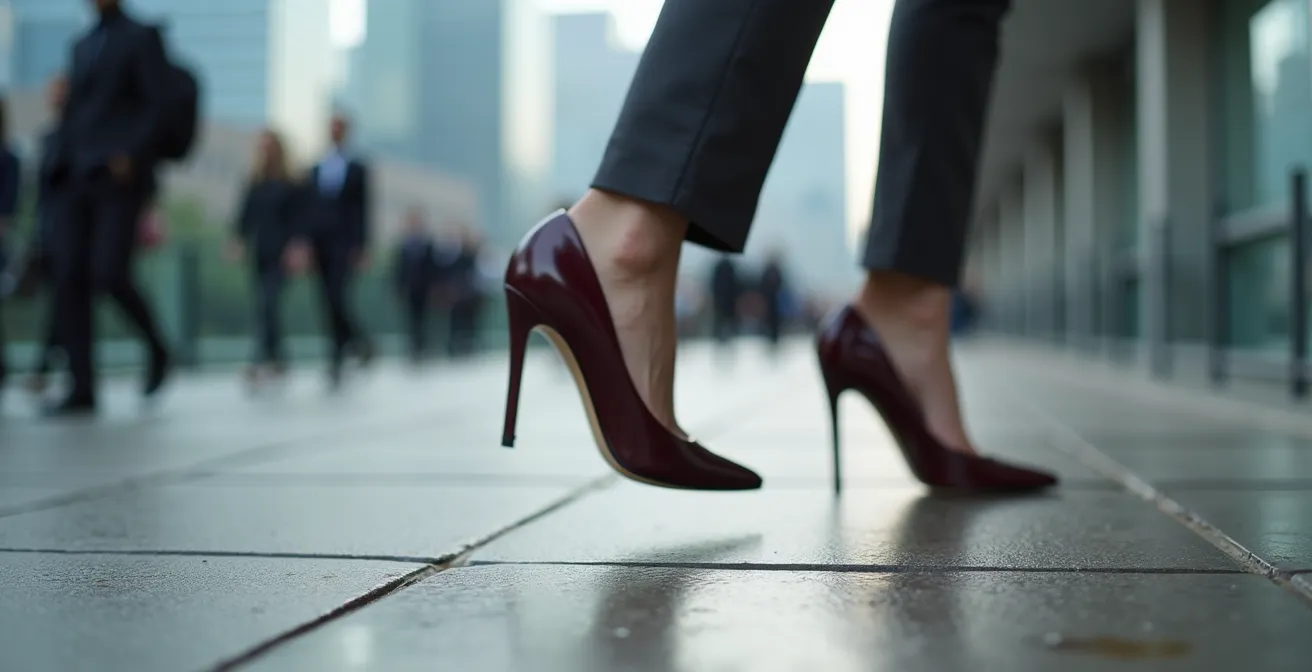
For the corporate woman in London, the day often begins with a brisk walk to the Tube, a packed commute, and a 5,000-step journey between the office, client meetings, and after-work engagements. The desire for the elegance and height of a heel clashes with the harsh reality of unforgiving pavements and a demanding schedule. The common advice—use gel pads, take breaks, or simply “get used to it”—often feels woefully inadequate, treating the symptom rather than the root cause.
But what if the secret to all-day heel-wearing wasn’t about pain tolerance, but about proactive engineering? The key lies in shifting your mindset from one of passive suffering to one of active management. This involves understanding the biomechanics of your walk, the material science of your shoes, and the crucial role of posture. It’s a holistic system where your footwear, your clothing, and your body work in concert. As a podiatrist with a passion for fashion, I can tell you that orthopaedic health and high-fashion aesthetics are not mutually exclusive; they simply require a more strategic approach.
This guide will deconstruct that strategy. We will explore how to manage the commuter’s shoe dilemma, select soles for Britain’s rainy streets, break in leather methodically, and align your entire posture to transform your relationship with your favourite heels. Forget enduring the pain; it’s time to engineer your comfort.
Summary: A Podiatrist’s Blueprint for All-Day Heel Comfort
- Is It Tacky to Wear Trainers with a Suit on the Tube?
- Leather vs Rubber Soles: Which Is Best for Rainy British Pavements?
- How to Break in Leather Shoes Without Blisters in 3 Days?
- How to Choose the Correct ‘Nude’ Shade to Elongate Your Legs?
- Why Using Shoe Trees Is Non-Negotiable for Leather Longevity?
- How to Walk in Heels Without Looking Like a Baby Giraffe?
- Full Break vs No Break: Which Trouser Length Is Right for Your Height?
- Why Is Posture the Most Expensive Thing You Can Wear for Free?
Is It Tacky to Wear Trainers with a Suit on the Tube?
The image of a professional woman in a sharp suit paired with trainers on her commute is no longer a sign of defeat, but a hallmark of a smart, modern strategy. The “commuter’s dichotomy”—balancing professionalism with the practicalities of a journey that involves walking, stairs, and crowded public transport—has been officially resolved. It’s not tacky; it’s tactical. In fact, research confirms this cultural shift, showing that 48% of UK women aged 35-44 bought trainers compared to just 30% who bought heels in a recent year.
The key to executing this “shoe switch” with sophistication lies in the choice of trainer. Opt for sleek, minimalist designs with minimal branding, such as clean white leather or monochrome styles. These act as a neutral base that complements, rather than clashes with, tailored trousers or a structured blazer. The goal is to look intentional, not like you’ve forgotten your work shoes. This strategy prioritises the health of your feet during the most strenuous part of your day, saving your heels for the controlled environment of the office. Pack your heels in a structured tote, ideally in protective bags, to prevent scuffs. This isn’t a fashion compromise; it’s a form of footwear engineering that allows you to enjoy the best of both worlds without sacrificing your podiatric health.
Leather vs Rubber Soles: Which Is Best for Rainy British Pavements?
For anyone navigating the perpetually damp pavements of London or any other British city, the choice of sole is not a minor detail—it’s a critical safety and longevity decision. A beautiful leather-soled heel can become a treacherous liability on a wet surface. From a podiatric and material science perspective, understanding the properties of your shoe’s foundation is paramount. Leather offers a classic, elegant profile but provides notoriously poor grip in wet conditions and absorbs moisture, leading to premature wear and costly repairs.
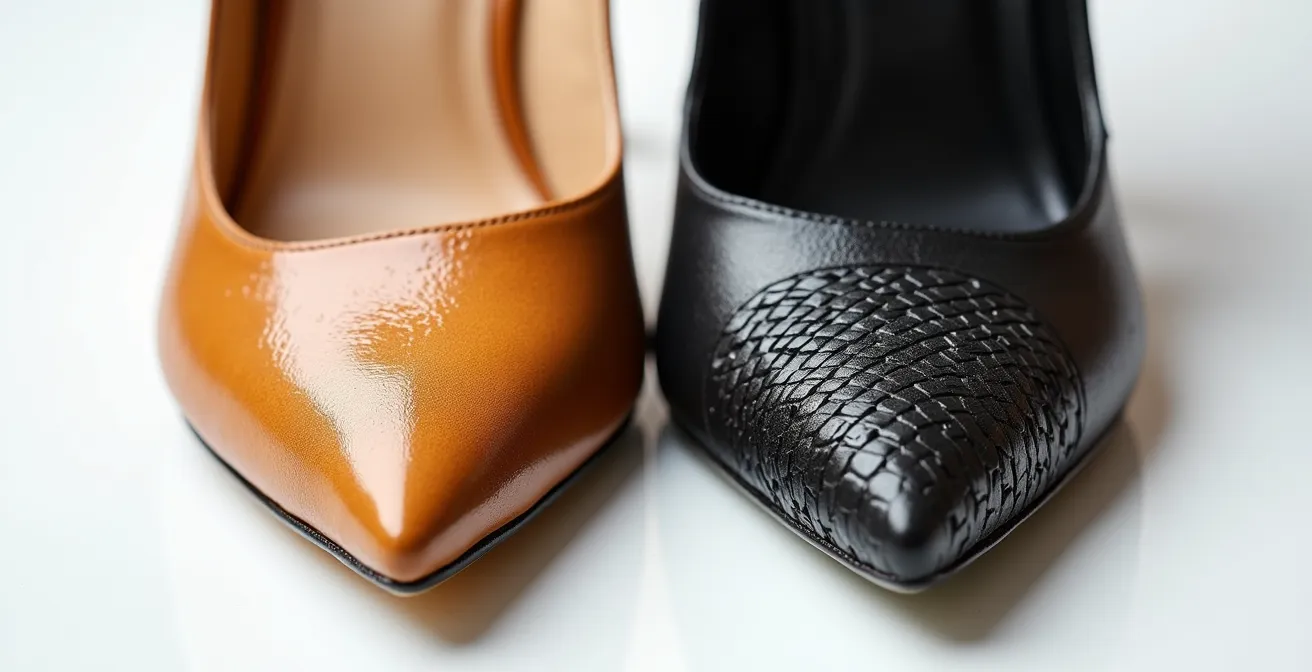
In contrast, a high-quality rubber sole is engineered for traction and durability. While some may associate rubber with casual footwear, modern manufacturing offers sleek, discreet rubber soles that don’t compromise the shoe’s professional aesthetic. For the corporate woman, this means you don’t have to choose between style and stability.
Case Study: Timpson’s ‘Topy’ Sole Service
A prime example of practical footwear engineering in the UK is the service offered by shoe repair chains like Timpson. For a modest investment of around £15-£20, they can apply a thin, durable rubber sole (often called a ‘Topy’) to the front of a luxury leather-soled shoe. This preserves the shoe’s elegant silhouette while providing essential grip on wet pavements and protecting the original leather from water damage and abrasion, a smart investment for any high-quality pair of heels.
The following table breaks down the key differences, making it clear why rubber is the superior choice for daily wear in the UK climate.
| Feature | Leather Soles | Rubber Soles |
|---|---|---|
| Grip on Wet Pavements | Poor – Very slippery | Excellent – Designed for traction |
| Durability in UK Climate | Low – Absorbs moisture | High – Water resistant |
| Professional Appearance | Premium & elegant | Can look casual |
| Cost of Maintenance | High – Regular resoling needed | Low – Minimal upkeep |
How to Break in Leather Shoes Without Blisters in 3 Days?
The “break-in period” for a new pair of leather heels is often viewed as an unavoidable week of pain and plasters. However, with a methodical, podiatrist-approved approach, you can mould expensive leather to your feet in just three days, preventing blisters before they even form. This process is about applying gentle, consistent pressure and targeted heat to encourage the leather’s natural plasticity, not about brute force. As Dave Wain, a podiatrist for Carnation Footcare, advises, it’s about being prepared.
Go prepared – have in your bag some first aid supplies to deal with potential foot problems before they get too painful i.e. sticky plasters for cuts, damaged toenails or bleeding blisters, anti-blister treatments for rubbing areas
– Dave Wain, Carnation Footcare’s Podiatrist
This proactive mindset is key. By treating potential friction points before you even leave the house, you’re managing the problem rather than reacting to it. Here is a structured, three-day plan to make your new heels feel like a second skin:
- Day 1: Indoor Acclimatisation. Wear the heels with a pair of thick socks for 30-60 minutes while walking on a soft surface like a carpet. This gently stretches the leather. In the evening, apply a leather-stretching spray (widely available at stores like John Lewis) to any tight spots and stuff the shoes firmly with newspaper overnight to hold the shape.
- Day 2: Targeted Heat & Movement. While wearing the shoes with thick socks, use a hairdryer on medium heat to warm any tight areas for about 30 seconds. As you do this, flex and point your feet to help the warm leather mould to their shape. Let the shoes cool on your feet. Later, apply anti-blister prevention sticks or strips (like Compeed) to common friction points such as the heel, little toe, and big toe joint before wearing them for a 45-minute walk, alternating between sitting and standing.
- Day 3: Real-World Simulation. Wear the heels with normal tights or thin socks for a 1-2 hour period that mimics your workday. Try to walk for 15 minutes, then sit for 15 minutes. This simulates the transition from commuting to sitting at your desk. Finish with a short outdoor walk on pavement to ensure they are ready for their full debut.
How to Choose the Correct ‘Nude’ Shade to Elongate Your Legs?
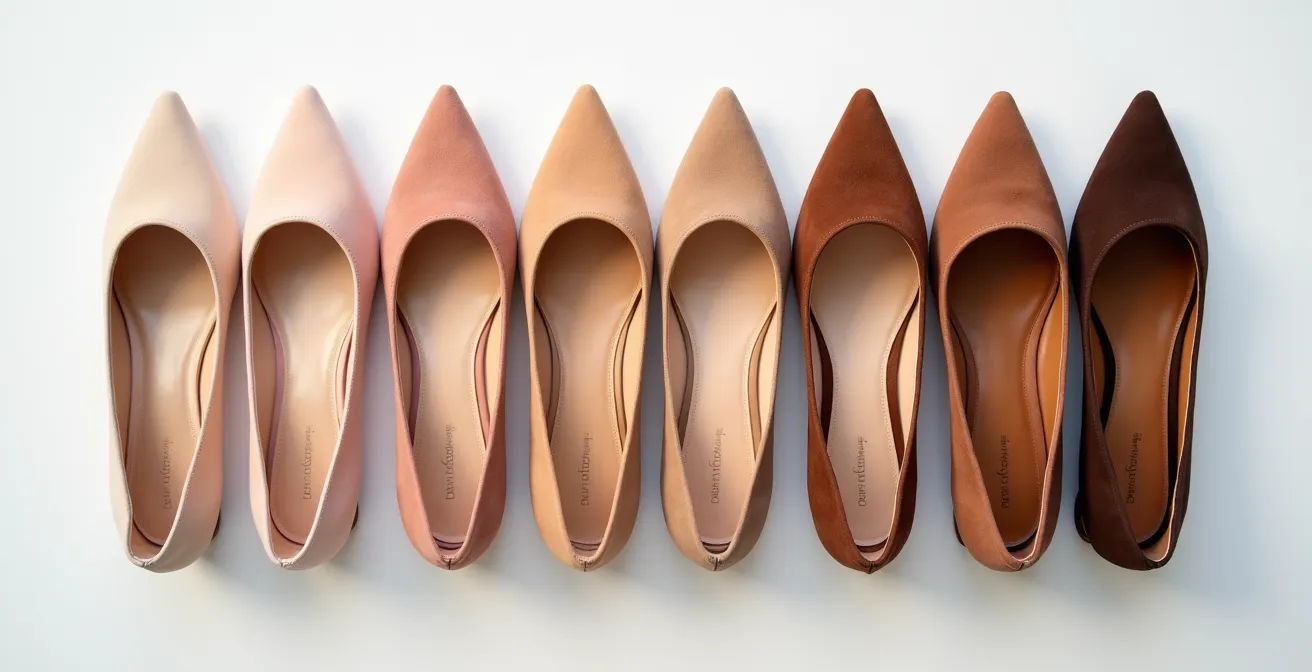
The “nude” heel is a cornerstone of the corporate wardrobe, prized for its ability to create an unbroken visual line that elongates the leg. However, the term “nude” is not a single colour. The magic of this illusion only works when the shade is a near-perfect match for your skin tone. A “nude” that is too light or too dark shatters the effect, drawing attention to the shoe rather than creating a seamless silhouette. Thankfully, the UK market has made significant strides in inclusivity.
Case Study: UK Retailers Embracing Shade Diversity
Recognising that the traditional beige “nude” excludes a vast portion of Britain’s diverse population, major retailers have expanded their offerings. Businesses like Kurt Geiger and department stores such as Selfridges and John Lewis now offer dedicated “nude” collections that feature a spectrum of 8 to 12 different shades, ranging from porcelain and taupe to rich sienna and deep mahogany. This allows consumers to find a true match that delivers the desired leg-lengthening effect.
Finding your perfect match is a science. It’s not enough to simply hold a shoe against your foot in a store. Skin tone varies across your body and can look different under various lighting conditions. A methodical approach is required to ensure you are making the right investment.
Your Nude Heel Audit: A 5-Point Checklist
- Lighting Test: Evaluate the shoe shade under at least three different light sources: natural daylight (near a window), office fluorescent light, and warm, artificial evening light to see how it performs in all conditions.
- Ankle & Calf Match: Don’t just test the colour against your foot. Hold the shoe directly against your ankle and calf; this is the area that determines the leg-elongating effect.
- Undertone Analysis: Identify your skin’s undertone. Cool-toned skin (with pink or blue hints) pairs best with taupe-based or rosy nudes. Warm-toned skin (with golden or olive hints) is complemented by peachy or caramel-beige nudes.
- Seasonal Variation: If your skin tone changes significantly between winter and summer, consider investing in two different nude shades to maintain a perfect match year-round.
- Outfit Cohesion: Test your final choice against the three most-worn skirts or trousers in your work wardrobe to ensure the undertones of the shoe and your clothing are harmonious.
Why Using Shoe Trees Is Non-Negotiable for Leather Longevity?
Investing in a quality pair of leather heels is only the first step; protecting that investment is an ongoing process, and the single most effective tool for this is a pair of proper shoe trees. This is not an old-fashioned indulgence but a crucial element of shoe care, especially in the UK. The damp climate is leather’s worst enemy. Feet can sweat up to half a pint of moisture per day, and this, combined with external humidity, can saturate the leather, causing it to lose its shape, crack, and develop odours. The impact of weather is clear, with data showing a 12% year-on-year growth in weather-resistant footwear sales, highlighting the need for protective measures.
A shoe tree made from aromatic cedar wood is the gold standard of footwear engineering. Unlike plastic versions which only hold shape, cedar actively draws moisture out of the leather, allowing it to dry in its correct form. This prevents the toe from curling upwards and stops creases from setting in. Furthermore, cedar’s natural properties neutralise odour-causing bacteria. Using shoe trees immediately after taking off your heels is the best way to preserve their structure and significantly extend their lifespan. For a professional woman whose footwear is a key part of her image, this small daily habit protects a significant financial investment.
In the UK, excellent shoe trees are available at various price points, making them accessible for any budget.
| Price Range | Where to Buy | Material Quality | Best For |
|---|---|---|---|
| £15-25 | Marks & Spencer, John Lewis basics | Pine or basic cedar | Occasional heel wearers |
| £25-45 | Selfridges, Liberty London | Premium red cedar | Regular professional wear |
| £45-80 | Jermyn Street shops, Northampton makers | Aromatic cedar with brass fittings | Investment designer heels |
| £80+ | Bespoke from heritage shoemakers | Lasted cedar, exact fit | Luxury shoe collections |
How to Walk in Heels Without Looking Like a Baby Giraffe?
The ability to walk gracefully in heels has nothing to do with natural talent and everything to do with biomechanics. The awkward, stilted walk often seen is a direct result of the body trying to move as if it were in flat shoes, which is a recipe for instability. Heels fundamentally alter your centre of gravity, shifting it forward. To counteract this, you must engage your core and adjust your gait. It’s not about your feet; it’s about your postural alignment from the ground up.
Instead of leading with your feet, think about initiating movement from your core. Imagine a string pulling you upwards from the crown of your head and forwards from your navel. This engages your abdominal muscles, stabilises your pelvis, and keeps your torso upright, preventing the forward lean that leads to a clumsy stride. Your steps should become shorter and more deliberate. Aim to place one foot almost directly in front of the other, as if walking on an imaginary straight line. This creates a more fluid, hip-driven motion rather than a clomping, knee-driven one. The correct motion is a smooth roll from heel to toe. Landing flat-footed or on your toes sends jarring impacts up your leg and creates instability. Practice this on different surfaces to build muscle memory, paying particular attention to navigating stairs, a common challenge in the UK.
- Engage Your Core First: Before taking a single step, gently pull your belly button towards your spine. This provides the central stability your body needs.
- Walk the Line: Visualise a straight line in front of you and aim to place each foot on it. This narrows your gait and promotes a natural hip sway.
- Shorten Your Stride: Your steps in heels should be significantly shorter than in flats. Over-striding is the primary cause of instability and the “baby giraffe” look.
- Heel, Then Toe: Make a conscious effort to land on your heel first, then roll smoothly through the ball of your foot and push off with your toes.
- Shoulders Back and Down: Resist the urge to hunch. Keep your shoulders relaxed, back, and down, with your head held high. This completes the chain of good biomechanical alignment.
Full Break vs No Break: Which Trouser Length Is Right for Your Height?
The final polish to a powerful, elegant look is the perfect interaction between your heel and your trouser hem. This “hem-to-heel ratio” is a crucial detail that can make or break an outfit, impacting both aesthetics and practicality. A trouser hem that is too long creates a sloppy look, drags on the ground, and poses a tripping hazard. In the UK, it also means your expensive trousers will be ruined by rain and dirt. Conversely, a hem that is too short can look awkward and disrupt the long, lean line you’re trying to create. The ideal length, or “break,” depends entirely on the height and style of your heel.
The “break” refers to the fold or crease in the fabric of the trouser leg as it rests on the shoe. A “no break” or “hover” style, where the hem just skims the top of the shoe, is modern, sharp, and ideal for stilettos and kitten heels. It’s also the most practical choice for wet British pavements. A “half break,” with a slight fold, works well with block heels. A “full break,” where the trouser has a distinct fold, is a more traditional look best reserved for wider-leg trousers and platform heels that provide enough height to keep the hem off the ground. Investing £10-£15 in a professional tailor to hem your trousers specifically for your most-worn heel height is one of the smartest investments you can make. It ensures a bespoke, polished finish every time.
This table provides a clear formula for matching your heel to your hem, with specific considerations for the UK climate.
| Heel Type | Ideal Trouser Break | UK Weather Consideration |
|---|---|---|
| Stiletto (3-4 inches) | No break/Cropped | Prevents hem damage in rain |
| Block heel (2-3 inches) | Half break | Versatile for all weather |
| Platform (4+ inches) | Full break acceptable | Height compensates for puddles |
| Kitten heel (1-2 inches) | Hover (1-2cm clearance) | Perfect for wet pavements |
Key takeaways
- Proactive Footwear Engineering: Comfort in heels comes from strategic choices about soles, break-in methods, and commuter strategies, not passive endurance.
- Respect for Materials: Understanding how leather reacts to moisture and using tools like cedar shoe trees is crucial for protecting your investment in the UK climate.
- The Postural Foundation: Graceful walking and all-day comfort are built from the core out; good posture is the non-negotiable, free accessory that makes everything else work.
Why Is Posture the Most Expensive Thing You Can Wear for Free?
You can invest in the finest Italian leather heels, have your trousers tailored to perfection, and master the commuter shoe-switch, but if your posture is poor, you will never be truly comfortable. Posture is the invisible foundation upon which all-day heel-wearing is built. It is, without a doubt, the most valuable and impactful accessory you can own, and it costs nothing. From a podiatric and orthopaedic standpoint, the mechanics are clear. As a leading surgeon explains, the problems start when alignment is off.
Wearing high heels shifts your weight towards the front of your foot, and increases compression on your feet. When you wear high heels, you create pressure on the balls of your feet, so if your foot is misaligned, you will increase pain in your feet, and perhaps elsewhere in your body too
– Dr Andrea Bianchi, Leading orthopaedic surgeon at The Private Clinic, Harley Street
Good posture—a straight back, engaged core, and aligned spine—distributes this pressure more evenly. It pulls your weight back from the balls of your feet, reducing strain on the delicate metatarsal bones. It also prevents compensatory issues like lower back pain, neck strain, and hip problems. For the corporate woman who spends hours at a desk, maintaining this alignment requires conscious effort. Integrating small, discreet “posture resets” into your workday can make a profound difference.
These simple exercises can be done at your desk without drawing attention, helping to counteract the negative effects of both sitting and wearing heels. They serve as a constant reminder to your body to return to its optimal biomechanical alignment, ensuring that your heels elevate your style, not your pain levels.
- Seated Pelvic Tilts: While seated, slowly rock your pelvis forward and back 10-15 times. This realigns your lower spine and can be done discreetly during a video call.
- Under-Desk Calf Raises: Every hour, lift your heels off the floor while keeping your toes down, holding for a second at the top. Repeat 20 times to keep calf muscles active.
- Chin Tucks: Gently pull your chin straight back as if making a double chin, hold for 5 seconds, and release. Repeat 10 times to correct “tech neck”.
- Shoulder Blade Squeezes: Pull your shoulder blades together and down, as if trying to hold a pencil between them. Hold for 5 seconds. This is a perfect reset to do during a tea break.
By integrating these principles of footwear engineering, material science, and biomechanical alignment, you can transform high heels from instruments of pain into tools of empowerment. The next logical step is to consciously apply this holistic system, starting with an audit of your current shoes and habits, to build a foundation for comfortable, confident, all-day wear.