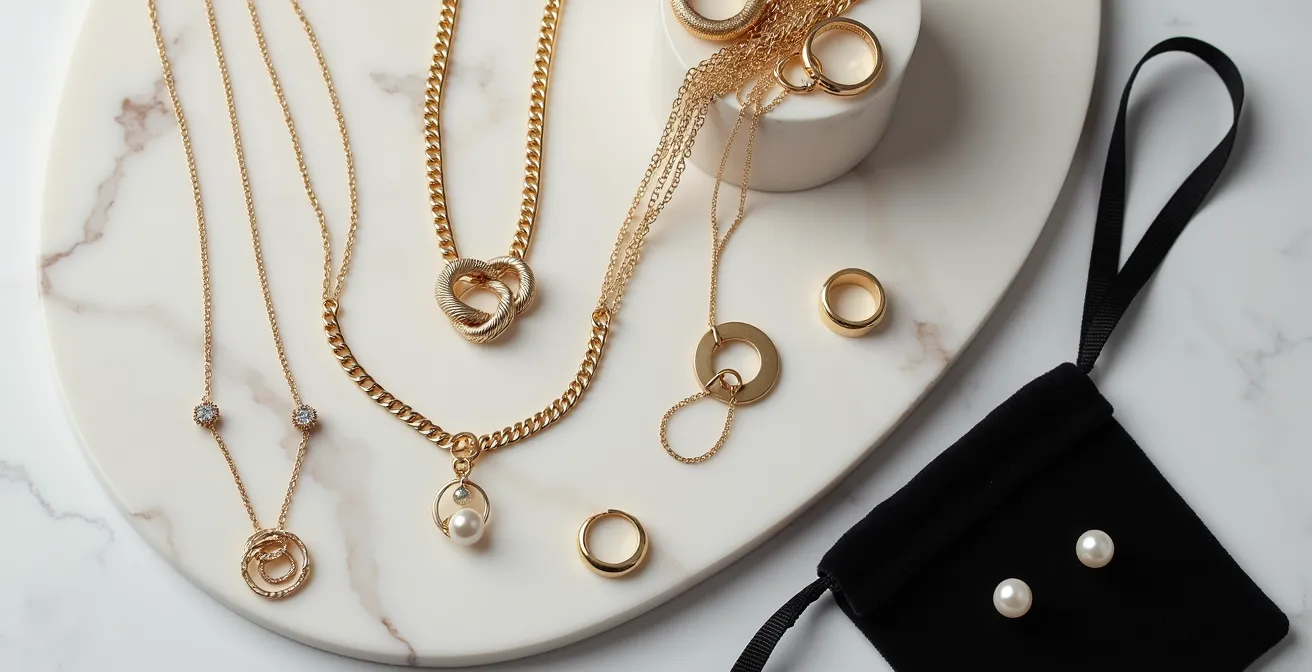
Building a fine jewellery capsule isn’t about buying a list of ‘essentials’; it’s about mastering a strategy for versatility.
- Prioritise a core ‘Metal Anchor’ (like 9ct or 14ct gold) to ensure all your pieces work together cohesively.
- Focus on acquiring ‘Workhorse’ pieces with silhouettes that effortlessly transition from your desk to dinner.
- Understand the crucial durability-to-budget ratio of different gold carats to make smart, long-lasting investments.
Recommendation: Start by auditing your existing wardrobe and choosing one core metal that will form the foundation of your timeless collection.
You’ve reached a point where the fleeting charm of costume jewellery has worn off, perhaps leaving a tell-tale green mark on your skin as a final goodbye. You’re ready to invest in yourself, to own pieces that feel as good as they look, and that will last a lifetime. The idea of a “fine jewellery capsule” is appealing—a curated collection of beautiful, versatile pieces. Yet, most advice feels overwhelming, presenting a shopping list of five-figure items that are simply out of reach. You want real gold, but your budget is finite, and the fear of making a costly mistake is paralysing.
Many guides will tell you to simply “buy classics” like diamond studs or a tennis bracelet. While not bad advice, it overlooks the fundamental strategy needed when you can’t buy everything at once. It ignores the nuances of daily life in the UK, from a rainy commute to after-work drinks at the pub, and the need for pieces that can navigate it all. The conversation often revolves around what to buy, rather than *how* to build a collection that is cohesive, personal, and intelligent from the very first purchase.
But what if the secret wasn’t in the specific items you own, but in the philosophy behind how you choose them? The true art of a successful jewellery capsule lies not in ticking boxes, but in mastering the principle of versatility. It’s about making strategic choices—selecting a core metal, understanding the practical differences between gold carats, and choosing silhouettes that work with your face shape and your wardrobe. It’s about ensuring every pound spent builds upon the last, creating a hard-working collection that tells your story.
This guide will walk you through that strategy. We’ll deconstruct the old rules, give you practical frameworks for selection, and empower you with the knowledge to build a fine jewellery capsule that is not only beautiful but works for every single occasion in your life, starting today.
This article provides a complete roadmap for curating your first fine jewellery collection. Below, the summary outlines the key strategic pillars we will explore, from mastering metal combinations to ensuring the longevity of your precious investments.
Summary: How to Curate a Versatile Fine Jewellery Collection
- Can You Wear Silver and Gold Jewellery Together Without Looking Messy?
- Which Earring Style Best Balances a Round or Square Face Shape?
- How to Layer Necklaces of Different Lengths Without Tangling?
- How Many Bracelets Are Too Many for a Professional Environment?
- How to Clean Your Diamond Studs at Home to Maintain Maximum Sparkle?
- Rose Gold, Silver, or Two-Tone: Which Matches Your Existing Jewellery Box?
- What Is the Difference Between 18ct, 22ct, and 24ct Gold for Investment?
- Why Are Coloured Gemstones Often Rarer Than Diamonds?
Can You Wear Silver and Gold Jewellery Together Without Looking Messy?
Let’s start by dismantling an outdated rule: the idea that gold and silver can’t be worn together. For years, this was considered a fashion faux pas, but today, it’s a sign of confident, modern styling. The key to making it look intentional, rather than accidental, is to create cohesion. Think of it less as a random mix and more as a curated blend. The easiest way to achieve this is by using a “bridge” piece—a two-tone item, like a watch or a bracelet with both silver and gold elements, that ties everything together. This single item gives you permission to play with other pieces in both metals.
Another technique is to group by type. For instance, wear a stack of silver rings on one hand and gold on the other, or layer silver and gold necklaces together to create the coveted “London neck mess.” This intentional clustering prevents the look from appearing chaotic. The goal is balance. If you have a statement gold necklace, pair it with delicate silver bracelets. This allows each metal to have its own moment without competing. This trend is not just a fleeting moment; style reports suggest that mixed metal jewellery is set to dominate in 2024, with consumers confidently breaking traditional fashion rules.
This visual demonstrates how different textures and colours of metal can create a rich, layered look that feels both effortless and chic.
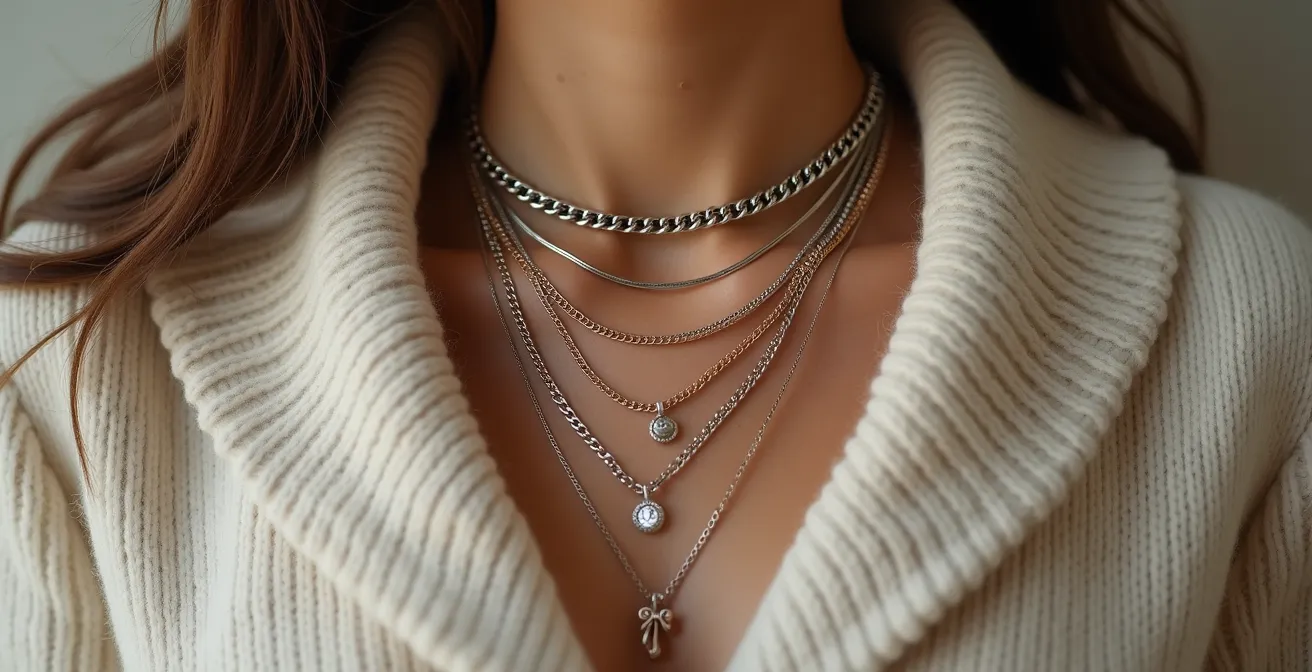
As you can see, the contrast between the warm gold and cool silver adds depth and interest. The secret is in the confidence with which it’s worn. Start small by adding a single piece of the opposite metal to your daily wear and see how it feels. You’ll likely find it opens up a whole new world of styling possibilities for your existing and future pieces, making your capsule collection infinitely more versatile.
Ultimately, wearing mixed metals is a personal choice. If it brings you joy and makes you feel stylish, then it’s the right choice for you. The only real rule in modern jewellery is to wear what you love.
Which Earring Style Best Balances a Round or Square Face Shape?
Earrings are arguably the most impactful piece of jewellery, as they frame your face. For those with round or square face shapes, the goal is to create the illusion of length and soften angles. The most effective styles are those with vertical lines, such as drop or dangle earrings. These draw the eye downward, elongating the face. Think delicate chains with a small gemstone, linear drops, or elegant threaders. Conversely, you should avoid round studs or large, circular hoops, which can accentuate roundness or the width of a square jawline. Oval shapes, however, can be incredibly flattering as they provide length without sharp angles.
As jewellery designer Christina Caruso advises, building a capsule is about intentionality: “It’s about creating a thoughtful edit of pieces that elevate your everyday style while still feeling timeless.” This philosophy applies perfectly to earrings. Instead of buying dozens of trendy pairs, focus on a core trio that serves different functions. A well-rounded earring wardrobe for any face shape could include:
- The Office Stud: For professional settings, you can’t go wrong with classic pearl or diamond studs. They are timeless, sophisticated, and work with everything from a simple T-shirt to a formal suit.
- The Pub Hoop: A medium-sized, slender hoop in your chosen metal offers a touch of polish for casual socialising. For round or square faces, an oval-shaped hoop is an even better choice.
- The Theatre Drop: For evenings or special events, an elegant dangle earring adds movement and a touch of glamour. This is where you can play with coloured gemstones or more intricate designs.
By focusing on silhouettes that flatter your specific features, you ensure every pair you own is a “workhorse” piece. It’s not about restricting yourself, but about making smarter choices that guarantee you’ll always look and feel your best, regardless of the occasion.
Remember, these are guidelines, not rigid rules. The most important factor is how an earring makes you feel. If you have a square face and love a bold stud, wear it with confidence. True style comes from that authenticity.
How to Layer Necklaces of Different Lengths Without Tangling?
Layering necklaces is an art form that can elevate a simple outfit into a statement look, but the reality is often a tangled mess by midday. The secret to a successful, tangle-free “neck mess” lies in two key principles: varying weights and strategic spacing. First, mix different chain styles and weights. A delicate, fine chain is more likely to get caught up in another of the same kind. However, when paired with a slightly heavier snake chain or a beaded style, each necklace has enough presence to hold its own space. The different textures create a natural separation.
The second principle is spacing. Ensure there is at least a one to two-inch difference in length between each necklace. This creates visual tiers and physically prevents them from overlapping and twisting. A common and effective combination is a 16-inch choker, an 18-inch pendant, and a longer 24-inch chain. This creates a beautiful cascade effect down the décolletage. For a more secure setup, you can also use a necklace separator clasp. This small, inexpensive device has multiple rings to attach each necklace to, keeping them perfectly spaced and parallel all day long.
To put this into practice, consider how different lengths work with common necklines in a typical British wardrobe. This table provides a simple guide for building your layers. As noted by the UK lifestyle blog A Considered Life, “The smallest details can make the biggest impact to how an outfit looks and feels,” and necklace layering is a prime example of this.
| Necklace Type | Ideal Length | Best Paired With | British Style Context |
|---|---|---|---|
| Fine Chain | 14-16 inches | Roll-neck sweaters | Sits perfectly above cashmere collars |
| Pendant Necklace | 18-20 inches | Breton tops | Falls at ideal length for striped tees |
| Long Chain | 24-30 inches | White T-shirt + Blazer | Creates depth under structured jackets |
Finally, always put your necklaces on starting with the finest, shortest chain and ending with the longest and heaviest. When taking them off, reverse the order. This simple habit can significantly reduce the chances of them tangling in your jewellery box.
With these techniques, you can confidently create layered looks that remain distinct and beautiful throughout the day, turning a few simple chains into a powerful style statement.
How Many Bracelets Are Too Many for a Professional Environment?
Navigating jewellery etiquette in a professional environment can be tricky, especially with bracelets. The line between stylish and distracting is fine. In most UK offices, the golden rule is “less is more.” A noisy, jangling stack of bangles can be disruptive in a quiet, open-plan office. Therefore, the primary consideration should be sound and movement. A single, elegant bangle or a well-fitted tennis bracelet adds a touch of polish without causing a distraction. A stack of two to three silent, closely-fitted bracelets is generally the upper limit for a formal setting.
The context of your profession matters immensely. In creative industries, a more expressive “arm party” might be perfectly acceptable, even encouraged. In corporate law or finance, restraint is key. For a versatile capsule collection, the best approach is to build a small, curated selection of bracelets that can be styled up or down. Start with two or three coordinating designs: perhaps a classic hinged bangle for everyday wear, a delicate chain bracelet, and a more substantial cuff for when you want to make a statement.
A smart strategy for day-to-night transitions is to wear your most subtle, singular bracelet to the office. Keep a bolder piece, like a cocktail cuff or a few extra stacking bangles, in your handbag to add for after-work events. This “day-to-night switch” allows you to adapt your look in seconds without having to carry an entire jewellery box with you. This approach is particularly relevant given that women represent the largest segment of jewellery consumers, constantly balancing personal style with professional expectations.
Ultimately, your wrist should complement your professional attire, not overpower it. If you find yourself constantly adjusting your bracelets or are conscious of the noise they make when you type, it’s a sign to pare back. A well-chosen bracelet should feel like a seamless extension of your style, projecting quiet confidence and attention to detail.
By being mindful of noise and context, you can ensure your bracelets enhance your professional image rather than detract from it, making them a valuable part of your working wardrobe.
How to Clean Your Diamond Studs at Home to Maintain Maximum Sparkle?
Diamond studs are the ultimate “workhorse” piece in any jewellery capsule, but their brilliance can be dulled by everyday residue like lotions, hairspray, and natural skin oils. Restoring that fire and sparkle is simple and can be done at home with minimal effort. The most effective method involves a gentle soak. Create a solution of warm water and a few drops of mild washing-up liquid. Let your studs soak for 20-30 minutes. This will loosen the grime that has accumulated on the diamond’s surface and underneath the setting, which is where most of the dulling occurs.
After soaking, use a new, soft-bristled baby toothbrush to gently scrub the stones and the setting, paying special attention to the back where dirt is most likely to be trapped. Be gentle; the goal is to dislodge dirt, not to scratch the metal. Once clean, rinse the earrings under warm running water. It’s crucial to place a strainer or plug the sink first to avoid a heartbreaking accident. For a truly professional, streak-free finish, a final rinse with distilled water is highly recommended, especially in hard water areas like London and the South East, as it prevents mineral deposits from leaving a film on the stone.
Proper care is not just about cleaning; it’s also about prevention and maintenance. To ensure your entire collection lasts a lifetime, follow a simple care routine. This checklist, adapted from expert UK jewellers, provides a framework for preserving your precious pieces.
Your Action Plan: Long-Term Jewellery Care
- Safe Storage: Always store each piece separately in a soft-lined box or pouch to prevent scratching from contact with other jewellery.
- Chemical Avoidance: Put your jewellery on last, after applying perfumes, lotions, and hairsprays, as their chemicals can damage precious metals and gemstones.
- Sunlight Protection: Keep gemstones out of prolonged direct sunlight, as some, like amethyst or topaz, can fade over time.
- Professional Check-ups: Have your jewellery professionally cleaned and checked at least once a year by a trusted jeweller to ensure settings are secure.
- Regional Expertise: For major repairs or servicing in the UK, consider scheduling appointments with specialists in historic hubs like Birmingham’s Jewellery Quarter or London’s Hatton Garden.
As the experts at Timothy Roe Fine Jewellery note, “With the right care, your capsule jewellery will remain as radiant in 30 years as it is today.” A few minutes of regular maintenance is a small price to pay to protect your investment and keep it sparkling.
This simple cleaning ritual, performed every few months, will ensure your diamond studs always catch the light and look as stunning as the day you got them.
Rose Gold, Silver, or Two-Tone: Which Matches Your Existing Jewellery Box?
The first and most crucial decision in building a jewellery capsule is choosing your “Metal Anchor.” This is the dominant metal that will form the foundation of your collection, ensuring every piece you acquire works cohesively with the others. To make this choice, start by looking at what you already own and love—not just jewellery, but the hardware on your favourite handbags, belts, and watches. Do you gravitate towards the warmth of gold or the cool, crisp feel of silver? Your existing preferences are the best clue to your innate metal personality.
Consider your skin’s undertone. While this isn’t a strict rule, it can be a helpful guide. People with cool undertones (veins appear blue, skin has pink or red hues) often find that silver, platinum, and white gold are particularly flattering. Those with warm undertones (veins appear green, skin has golden or olive hues) tend to glow in yellow and rose gold. If you can’t tell, you may have a neutral undertone, in which case you can wear any metal beautifully. In the UK, gold jewellery dominates the UK market, holding a significant share, which makes it a popular and widely available choice for a capsule collection.
Don’t feel you must be a purist. If you love both gold and silver, a two-tone strategy can be incredibly chic and offers maximum versatility. This is where a “bridge” piece becomes your most valuable asset. A two-tone watch is the classic example, as it instantly validates mixing other gold and silver pieces. This strategy is used by high-end brands to create timeless, versatile collections.
Case Study: Cartier’s Two-Tone Watch Strategy
Luxury brand Cartier exemplifies the power of the two-tone approach. They offer several of their bestselling watches, like the ‘Panthère de Cartier’ and ‘Santos de Cartier’, in a mix of stainless steel and yellow or rose gold. These iconic timepieces are not just watches; they are designed to be stylish bridges that connect jewellery in different metals. By anchoring a “wrist stack” with a two-tone watch, the wearer can confidently layer both gold and silver bracelets, creating a look that is bold, cohesive, and effortlessly versatile.
Ultimately, your “Metal Anchor” should be the metal you feel most yourself in. It’s the canvas upon which you’ll build your collection. Choosing it thoughtfully is the first step towards a jewellery box where everything has a purpose and everything works together.
Whether you choose the sunny warmth of gold, the sleek modernism of silver, or the clever versatility of two-tone, this single decision will bring focus and intention to your capsule.
What Is the Difference Between 18ct, 22ct, and 24ct Gold for Investment?
Understanding gold carats is the single most important piece of knowledge for building a fine jewellery capsule on a budget. The carat (ct) number tells you the purity of the gold. 24ct is pure gold, but it’s extremely soft and not suitable for jewellery that you intend to wear daily, as it will easily scratch and bend. It is primarily for investment purposes, in the form of bars or coins. For wearable jewellery, gold is mixed with other metals (alloys) like copper, silver, and zinc to give it strength and durability. This is where 18ct, 14ct, and 9ct come in.
As one expert from Timothy Roe Fine Jewellery puts it, the focus should be on “superior materials — think 18ct gold, platinum, and natural diamonds and coloured gemstones — and artisanal craftsmanship.” For special pieces like an engagement ring, 18ct gold (75% pure gold) offers a beautiful balance of rich, vibrant colour and good durability. It’s the standard for luxury jewellery. However, for everyday “workhorse” pieces like a simple chain or stackable rings, especially on a budget, 18ct may not be the most practical choice. It’s more expensive and still relatively soft compared to lower carats.
This is where 9ct gold (37.5% pure gold) becomes a savvy choice for a UK-based collection. It is the most popular carat in the UK for a reason: its higher percentage of alloys makes it significantly more durable and resistant to scratches, perfect for the rigours of daily wear. It also comes at a much more accessible price point, allowing you to acquire your first fine jewellery pieces without breaking the bank. While its colour is slightly less yellow than 18ct, it’s a practical and intelligent trade-off for durability and cost. In the UK, all gold jewellery over 1 gram must be hallmarked, showing the carat and the Assay Office where it was tested—a guarantee of its purity.
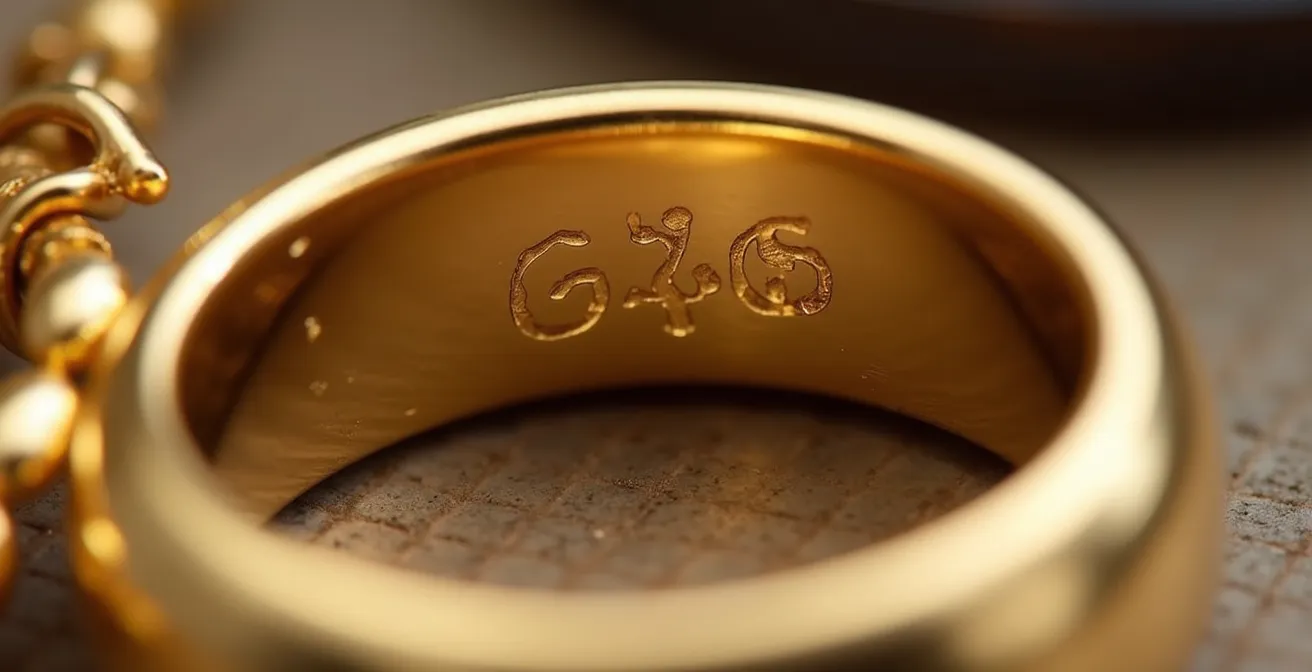
This table breaks down the key differences to help you make the right choice for each piece in your capsule.
| Gold Carat | Purity | Best Use Case | UK Market Context |
|---|---|---|---|
| 9ct Gold | 37.5% pure | Daily wear rings, chains | Most popular for durability & accessible price in UK |
| 18ct Gold | 75% pure | Engagement rings, special pieces | Balance of luxury and wearability |
| 22ct Gold | 91.6% pure | Cultural jewelry, investment pieces | Popular in South Asian UK communities |
| 24ct Gold | 99.9% pure | Investment only | Too soft for daily wear jewelry |
Choosing the right carat is about aligning the piece’s purpose with your budget and lifestyle. A strategic mix—perhaps 9ct for everyday chains and 18ct for those special-occasion earrings—is the hallmark of a truly intelligent jewellery capsule.
Key Takeaways
- Building a jewellery capsule is a marathon, not a sprint; focus on a cohesive strategy rather than a generic shopping list.
- Mastering versatility is paramount: choose pieces that can be styled for multiple occasions, from the office to an evening out.
- Understanding the practical trade-offs between gold carats (e.g., 9ct for durability, 18ct for luxury) is crucial for budget-conscious investing.
Why Are Coloured Gemstones Often Rarer Than Diamonds?
While diamonds are marketed as the ultimate symbol of luxury and rarity, many high-quality coloured gemstones are, in fact, significantly rarer in nature. The perception of diamond rarity is a masterclass in marketing by De Beers, which controlled the global supply for much of the 20th century. In reality, gem-quality emeralds, rubies, and sapphires—especially those with exceptional colour and clarity—are found in far fewer locations and in smaller quantities than diamonds. For example, a flawless, vibrant “pigeon’s blood” ruby from Burma is one of the rarest and most valuable gems on earth.
The rarity of coloured gemstones is also tied to their formation. Each type of gem requires a unique and improbable combination of elements, pressure, and temperature to form. Many, like alexandrite, are famous for their unique properties, such as changing colour under different lighting, which adds to their mystique and value. Unlike the highly standardized “4 Cs” (Carat, Cut, Colour, Clarity) used to grade diamonds, the valuation of coloured gems is more of an art, with colour being the most important factor. The intensity, tone, and saturation of a gem’s hue are what command the highest prices.
In the United Kingdom, the appreciation for coloured gemstones has deep historical roots, often influenced by the Royal Family. Iconic pieces like Princess Diana’s (and now the Princess of Wales’) blue sapphire engagement ring have had a profound impact on public taste, creating enduring demand for these stones. According to a market report from Spherical Insights, the frequent use of ornate jewellery by the Royal Family directly influences purchasing trends among the public, cementing the status of coloured gems in British culture. For your capsule collection, adding a piece with a coloured gemstone—perhaps your birthstone or simply a colour you love—is a powerful way to inject personality and create a unique focal point.
While diamonds represent a classic and safe investment, choosing a coloured gemstone can be a more personal and, in many cases, a more distinctive statement of style. It’s an opportunity to own something that is not only beautiful but, in the quiet language of geology, truly exceptional.
As you build your foundational capsule of metal pieces, think of a coloured gemstone as the future star of the show—the piece that will elevate your collection from timelessly elegant to uniquely yours.
Frequently Asked Questions about Building a Jewellery Capsule
How many bracelets should be in a capsule collection for work?
For a versatile work collection, start with 2 to 3 coordinating designs. A good combination is a classic hinged bangle for simple elegance, a tennis bracelet for a touch of subtle sparkle, and a mixed-metal cuff to ensure you can coordinate with any other jewellery you’re wearing.
What’s the best approach for day-to-night bracelet styling?
The most effective strategy is to wear a single, understated bracelet to the office. Keep bolder pieces, such as a statement cocktail cuff or a few extra stacking bangles, in your handbag or desk drawer. You can add them in seconds to transition your look for an evening event.
Are charm bracelets appropriate for UK offices?
In general, it’s best to avoid noisy, jangling charm bracelets, especially in quiet or open-plan office environments as they can be distracting. If you love the style, opt for more silent alternatives like well-fitted bangles, engraved cuffs, or bracelets made from fabric or cord.