The ultimate status symbol isn’t a logo; it’s the visible discipline of consistent, meticulous grooming.
- It signals non-verbal competence and attention to detail that expensive items can’t fake.
- Focusing on structural elements like hair health, nail care, and skin clarity provides a higher return on investment than decorative fashion.
Recommendation: Build a routine of non-negotiable weekly maintenance tasks, treating your personal presentation as a key professional asset.
We’ve all seen it: the person draped in designer logos whose overall impression is somehow… lacking. The expensive jacket paired with scuffed shoes, or the luxury handbag held by a hand with chipped nails. It’s a common paradox that leads many to believe that simply acquiring expensive items is the shortcut to a polished appearance. The market encourages this, pushing logos and brand names as proxies for success and self-worth.
But this approach mistakes decoration for structure. True polish isn’t something you can buy; it’s something you cultivate. It’s built on a foundation of meticulous hygiene and grooming—the small, consistent acts of self-respect that communicate far more than any label. These details are a form of silent signalling, broadcasting a standard of personal discipline and attention to detail before you even speak. They represent the structural integrity of your personal presentation.
But what if the real key to a high-status appearance isn’t about spending more, but about investing smarter? This guide moves beyond the superficial layer of fashion to explore the foundational pillars of grooming that deliver the highest impact. We will deconstruct the elements—from the health of your hair to the maintenance of your accessories—that truly define a polished look, proving that self-respect is the ultimate luxury.
While this guide focuses on the practical ‘how-tos’ of a polished appearance, the ultimate goal is the confidence that comes with it. The following video explores the body language and mindset tricks that can amplify that feeling of self-assurance in any situation.
To help you build a foundation of genuine polish, this article breaks down the essential, high-impact areas of grooming. The following sections provide a clear roadmap to mastering the details that matter most.
Summary: Why Meticulous Grooming Beats Designer Labels for a Truly Polished Look
- Why Split Ends Ruin the Look of an Expensive Haircut?
- Do You Really Need a Professional Manicure to Look Professional?
- How to Choose a Signature Scent That Isn’t Overpowering in the Office?
- Is Professional Whitening Necessary for a Winning Smile?
- Why Are Well-Groomed Eyebrows the Frame of the Face?
- How to Clean Your Diamond Studs at Home to Maintain Maximum Sparkle?
- When to Service Your Swiss Watch: The 5 Signs Most Owners Ignore
- How to Apply Makeup That Looks Like You Woke Up Like This?
Why Split Ends Ruin the Look of an Expensive Haircut?
An expensive haircut provides the architecture for your look, but its structural integrity is compromised by poor hair health. Split ends are the most visible sign of this decay. They create a frizzy, uneven texture that scatters light instead of reflecting it, making even the most precise cut appear dull and unkempt. This is not merely an aesthetic issue; it’s a silent signal of neglect. It suggests that while you invested in the initial design, you failed at the crucial follow-up: maintenance.
In the UK, environmental factors play a significant role in this battle. With research indicating that over 60% of the UK uses hard water, the mineral deposits from daily showers actively work against hair health. These minerals build up on the hair shaft, preventing moisture from penetrating and leading to brittleness and breakage. A study on hair exposed to hard water, highly relevant for Londoners, showed it developed a rougher, more damaged surface and decreased thickness in just one month.
Therefore, combating split ends is not about expensive, last-minute fixes. It’s about a disciplined routine that protects the hair’s structure from environmental damage. Regular micro-trims every 6-8 weeks are non-negotiable to remove damage before it travels up the hair shaft. Integrating a weekly chelating shampoo helps to strip away mineral buildup, while using a shower head filter provides a frontline defence. This proactive approach ensures your haircut—your investment—retains its intended polish and shine.
Do You Really Need a Professional Manicure to Look Professional?
In a professional setting, your hands are constantly on display—gesturing during a presentation, accepting a document, or engaging in a handshake. They are a primary tool of non-verbal communication. While a full professional manicure is an option, the real objective is not polished colour but immaculate cleanliness and neatness. Ragged cuticles, dirty fingernails, or uneven lengths send a powerful, negative signal about your attention to detail.
It undermines the credibility projected by your suit or your carefully prepared words. As professional etiquette expert Gerard Assey notes, grooming has a direct impact on interactions: “A firm handshake conveys confidence, assurance, interest and respect. Your grooming directly impacts others’ comfort in professional interactions.” The state of your hands is a crucial part of that equation. An ‘invisible manicure’—where nails are simply cleaned, shaped, and buffed to a healthy, natural sheen—is often more effective and professional than a coloured one.
The decision between professional services and DIY maintenance comes down to discipline and cost. For a busy professional in the UK, a monthly visit to a nail technician can be an efficient way to ensure consistency. However, a simple, high-quality maintenance kit used for five minutes each week can achieve the same result at a fraction of the cost. The key is consistency. The goal is to ensure your hands never become a distraction or a point of negative judgment, allowing your skills and confidence to take centre stage.
This comparative table breaks down the options, allowing you to make an informed choice based on your schedule and budget, as detailed in a recent analysis of business etiquette standards.
| Approach | Time Investment | Monthly Cost (£) | Professional Impact |
|---|---|---|---|
| Professional Manicure (Monthly) | 45 mins/month | £25-40 | Consistently polished appearance |
| DIY Maintenance Kit | 5 mins/week | £5-10 | Good with discipline |
| ‘Invisible Manicure’ Service | 30 mins/month | £20-30 | Natural, well-groomed look |
| No maintenance | 0 | £0 | Potential negative first impression |
How to Choose a Signature Scent That Isn’t Overpowering in the Office?
A signature scent should be a subtle discovery, not an announcement. In a professional environment, the goal is to create a pleasant, clean aura, not to dominate the airspace. An overpowering fragrance is the olfactory equivalent of shouting; it’s intrusive, unprofessional, and can be a significant irritant to colleagues, especially in open-plan offices. The right scent should exist in your personal space, detectable only at close proximity.
The key lies in two areas: the type of fragrance and the application method. For office wear, opt for fragrances with low sillage—meaning they don’t leave a heavy trail. Eau de Cologne or Eau de Toilette concentrations are generally safer than a powerful Eau de Parfum. In the UK, heritage brands that hold a Royal Warrant, such as Penhaligon’s or Floris of London, often excel at creating sophisticated, understated scents perfect for professional life. Woody, citrus, or fresh aquatic notes are typically cleaner and less polarizing than heavy florals, gourmands, or spicy oriental fragrances.

Application is just as critical as selection. A disciplined approach prevents over-application and ensures the scent melds with your skin rather than sitting on top of it. Mastering this subtlety is a hallmark of sophisticated grooming. Follow these guidelines for a refined presence:
- Apply fragrance using the ‘One-Spray Rule’ to a single pulse point, such as the wrist or base of the neck.
- Apply it 30 minutes before leaving home. This allows the intense top notes to dissipate, leaving the more subtle heart and base notes.
- For the UK’s damp climate, woody or aquatic bases tend to perform well without becoming overwhelming.
- Test your fragrance’s projection: ask someone to stand at arm’s length. If they can clearly smell it, you’ve used too much.
Is Professional Whitening Necessary for a Winning Smile?
A bright, healthy smile is one of the most powerful assets in communication. It conveys warmth, confidence, and vitality. However, daily habits, particularly in the UK, work directly against this. With lifestyle surveys indicating that over 85% of UK professionals consume tea or coffee daily, surface staining is a near-universal concern. These tannins create a yellow or brown film that dulls the natural brightness of teeth, which can be perceived as a sign of poor hygiene, regardless of how clean your teeth actually are.
While professional whitening offers the most dramatic and immediate results, it’s not the only path to a winning smile. The decision hinges on the severity of the staining, your budget, and your timeline. Professional treatments performed by a dentist use a higher concentration of active ingredients (up to 6% hydrogen peroxide in the UK), providing significant shade changes. This is a high-cost, high-impact option best seen as a periodic reset rather than a regular necessity.
For ongoing maintenance, a disciplined at-home routine is essential. This involves more than just brushing. Using a whitening toothpaste with gentle abrasives can help polish away daily surface stains. At-home whitening strips or gels, compliant with UK regulations (limited to 0.1% hydrogen peroxide), offer a gradual and more subtle brightening effect. The most important factor is consistency. A person who diligently manages stains at home will often present a more consistently bright smile than someone who relies solely on infrequent professional treatments. It’s the daily discipline that maintains the asset.
Why Are Well-Groomed Eyebrows the Frame of the Face?
Eyebrows provide the structural frame for your eyes, and by extension, your facial expressions. Unruly, overgrown, or sparse brows create a chaotic and distracting frame, while well-groomed brows create a clean, intentional structure. This isn’t about creating a perfectly sculpted, high-fashion arch; it’s about tidiness and definition. A clean brow line makes your gaze more direct and powerful, subconsciously enhancing your perceived confidence and authority during interactions.
As one business etiquette expert explains, this detail has a tangible effect on communication: “Body language, eye contact, handshakes, and voice are important to appear confident and sincere. Clean brow lines make eye contact more direct and impactful, subconsciously boosting the wearer’s perceived confidence and authority.” Removing stray hairs between the brows (the ‘monobrow’) and tidying the hairs below the main brow line opens up the eye area, making you appear more awake, alert, and engaged.
Case Study: The Rise of the ‘Tidy, Not Styled’ Brow in the UK
The impact of this simple grooming step is evident in market trends. Major UK department stores like Selfridges and John Lewis have reported a significant increase in male customers at their walk-in Blink Brow Bar locations. Their success is built on a ‘tidy, not styled’ service that takes just 15 minutes. This quick maintenance has become a regular stop for professionals in the City of London, who report feeling more put-together and confident in client-facing meetings after adopting regular brow maintenance.
The required effort is minimal. For most, this doesn’t require expensive treatments. A good pair of tweezers to remove obvious strays and a spoolie brush to sweep hairs into place is often all that is needed. The goal is a natural, clean look that ensures your expressions are communicated clearly and without distraction. This small act of maintenance provides a remarkably high return on your appearance.
How to Clean Your Diamond Studs at Home to Maintain Maximum Sparkle?
A pair of classic diamond studs signals timeless elegance and understated quality. However, the brilliance that makes them so valuable is not a permanent state. It is entirely dependent on light performance. Daily wear exposes diamonds to a film of oils, lotions, hairspray, and general grime. This buildup coats the facets, preventing light from entering the stone and refracting back out, which is what creates its signature sparkle. A dirty diamond is a dull stone; it loses its fire and looks no better than a piece of glass.
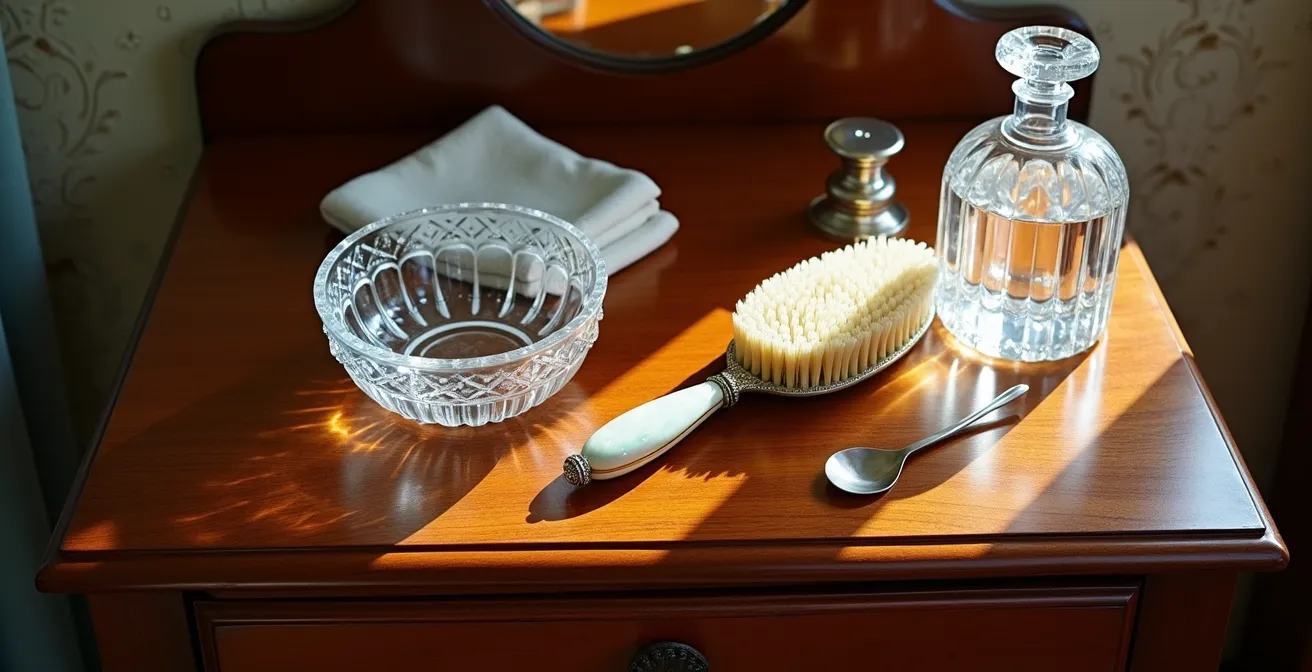
Maintaining your jewellery is a fundamental aspect of grooming often overlooked. It falls under the principle of asset maintenance. Just as you would polish your shoes or press your shirt, your accessories require a disciplined cleaning ritual to perform as intended. In the UK, particularly in areas like London, hard water presents a specific challenge, as the limescale can leave a dulling mineral film on both the diamond and its metal setting.
A simple, regular at-home cleaning is all that’s required to restore a diamond’s brilliance. This weekly or bi-weekly ritual takes only a few minutes but has a dramatic impact on the appearance of your jewellery. It ensures your investment continues to project quality and care, rather than neglect. This small act of discipline is a powerful signal of your attention to the finest details.
Your Action Plan: The UK Limescale-Proof Diamond Cleaning Ritual
- Never use tap water directly, especially in hard water areas like London, as limescale creates a dulling film on diamonds.
- Mix warm distilled water with a single drop of gentle, clear dish soap in a small bowl.
- Soak the diamond studs for 10-15 minutes to loosen oils and grime buildup.
- Use an extra-soft-bristled toothbrush (a baby toothbrush is ideal) to gently scrub the stone, paying close attention to the area behind the setting where dirt accumulates.
- Rinse the studs thoroughly under a gentle stream of distilled or filtered water to prevent any new mineral deposits from forming.
When to Service Your Swiss Watch: The 5 Signs Most Owners Ignore
A fine Swiss watch is more than a time-telling device; it is a symbol of precision, engineering, and an appreciation for quality. However, wearing an expensive watch that is malfunctioning—running slow, fogged with moisture, or stiff to wind—sends the opposite message. It signals neglect and a failure to maintain a valuable asset. A mechanical watch is a complex machine with hundreds of moving parts that require lubrication and protection from the elements. Over time, these lubricants degrade and the protective seals perish.
The UK’s climate poses a specific threat to these delicate mechanisms. Horological studies demonstrate that the UK’s 70% average humidity can accelerate watch seal degradation by as much as 30%. When seals fail, moisture can enter the case, leading to internal fogging on the crystal, and worse, corrosion of the delicate movement inside. This is not just an aesthetic problem; it’s a catastrophic failure that can lead to expensive repairs.
While most manufacturers recommend a service every 5 years, this is a guideline for ideal conditions. In a humid climate, or with frequent exposure to temperature changes, a more proactive 3-4 year interval is wise. More importantly, owners must learn to recognise the subtle warning signs that a service is due immediately. Ignoring these signs is akin to ignoring the engine warning light in a luxury car. It’s a gamble that risks turning a symbol of precision into a mark of carelessness.
This table, based on guidance from an analysis of environmental impacts on precision instruments, helps distinguish between normal aging and a critical service warning.
| Observation | Normal Aging | Service Required | UK-Specific Risk |
|---|---|---|---|
| Time Accuracy | Loses/gains a few seconds/day | Loses/gains 15+ seconds/day | Temperature fluctuations affect movement |
| Crystal Clarity | Minor external scratches | Internal fogging or condensation | High humidity causes seal failure |
| Crown Function | Smooth winding and setting | Stiff, loose, or fails to ‘catch’ | Moisture infiltration risk |
| Case Condition | Surface scuffs (patina) | Pitting or deep corrosion | Salt air in coastal UK areas |
| Service Interval | Every 5 years (ideal) | Immediate if signs are present | Consider every 3-4 years in UK climate |
Key Takeaways
- Grooming is about signaling discipline and attention to detail, not just aesthetics.
- Focus on “structural” elements like hair health, skin clarity, and nail care for the highest return on investment.
- Consistent, disciplined maintenance of both yourself and your key accessories is non-negotiable for a truly polished look.
How to Apply Makeup That Looks Like You Woke Up Like This?
The most sophisticated form of grooming is the one that appears effortless. The “no-makeup makeup” look is the ultimate expression of the minimalist philosophy: to enhance, not to conceal. The goal is to look healthy, rested, and vibrant, as if your skin is naturally flawless. This is not about vanity, but about projecting an image of vitality and well-being. It subtly communicates that you are energetic, healthy, and on top of your game—powerful signals in any professional or social context.
This approach relies on a few, well-chosen products applied with precision. The focus is on perfecting the canvas—the skin—rather than adding colour. It starts with hydrated, well-moisturised skin. Then, a lightweight tinted moisturiser or BB cream can even out skin tone without the heavy look of foundation. The most critical tool is a high-quality concealer, used sparingly to target specific areas: under-eye circles, redness around the nose, or any minor blemishes. The trick is to blend it seamlessly so it becomes invisible.
Case Study: The Rise of Corrective Concealment in the UK
This trend is no longer gender-specific. War Paint for Men, a UK-based male makeup brand, reported 300% growth in 2024, with concealer as its top-selling product. Driven by the “Zoom effect” and a desire for a polished on-screen presence, professional men, particularly in London’s financial district, are increasingly using ‘corrective concealment’ for video calls. The trend is becoming so mainstream that a growing number of UK companies are now including gender-neutral grooming standards in their workplace training programs.
Finishing touches are minimal: a clear or tinted brow gel to set brows in place, a touch of cream blush for a healthy flush, and a neutral lip balm. The entire process should take no more than five minutes. It’s a strategic investment of time that pays dividends in how you are perceived throughout the day, ensuring you always present a fresh and capable front.
Now that you understand the foundational elements of a polished look, the next step is to build a simple, sustainable routine that you can execute consistently. Start by choosing one or two areas from this guide and commit to a weekly maintenance ritual.
Frequently Asked Questions About Professional Grooming
What are the UK/EU regulations for hydrogen peroxide in whitening products?
Over-the-counter products sold in the UK are legally limited to a maximum of 0.1% hydrogen peroxide. Professional whitening treatments performed or prescribed by a qualified dentist can use a much higher concentration of up to 6%, which is why they deliver more significant results.
How often should UK professionals whiten their teeth given high tea/coffee consumption?
For those with significant staining from daily tea or coffee, a practical approach is to undergo dentist-led whitening every 12 to 18 months as a “reset.” Between these professional treatments, consistent monthly maintenance using UK-compliant at-home products is recommended to manage new surface stains.
What’s the cost difference between professional and DIY whitening in the UK?
There is a substantial cost difference. Professional, dentist-led whitening in the UK typically ranges from £300 to £600. In contrast, UK-compliant DIY home kits are much more accessible, costing between £20 and £50, though their effectiveness is limited by the lower concentration of active ingredients allowed by regulation.