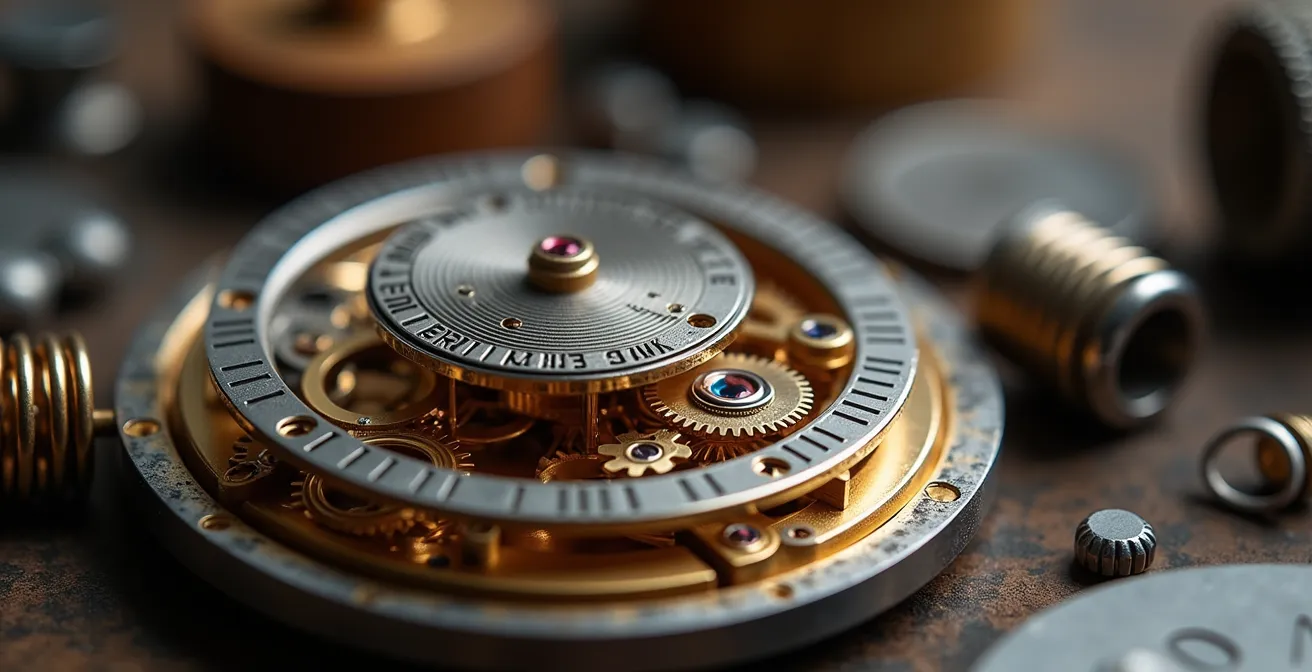
A grand complication’s price isn’t for telling time; it is an investment in a master’s lifetime of work, encapsulated in a mechanical form.
- Value stems from thousands of hours of singular craftsmanship and the mechanical genius required to solve centuries-old problems.
- Provenance and rarity, especially within the lineage of English horology, create a market where these pieces are treated as fine art, not accessories.
Recommendation: When evaluating these timepieces, view them not through the lens of functionality, but as portable works of mechanical art, each possessing a tangible legacy.
To see a minute repeater or a grand complication watch listed for a price exceeding that of a detached house in Surrey or a chic London flat often provokes a single, logical question: why? It is tempting to seek simple answers in the gleam of polished platinum or the prestige of a storied brand name. Yet, these explanations are superficial, akin to valuing a Rembrandt by the cost of its canvas and frame. They miss the fundamental truth of what you are truly acquiring.
The astronomical price is not for a mere time-telling device. It is the cost of acquiring a tangible piece of a master’s life, an aggregation of irreplaceable skill, and thousands of hours of focused, singular labour. When you hold a grand complication, you are holding a mechanical soul, an object imbued with the intellectual and physical struggle of its creator to conquer physics with nothing more than levers, springs, and gears. This is not manufacturing; it is horological artistry at its zenith.
This perspective shifts the conversation from one of utility to one of legacy and art. The value is not in the function, but in the form, the finish, and the sheer human genius required to bring it into existence. This is the world of mechanical art, where the price reflects the irreplaceability of the artist’s touch.
To truly understand this value, we must dissect the very essence of these machines. This guide will explore the intricate complications, the staggering investment of time, the philosophy of hand-finishing, and the undeniable social currency these masterpieces command, particularly within England’s most exclusive circles.
For those who prefer a visual exploration, the following video offers an immersive look into the world of these chiming masterpieces, perfectly complementing the detailed analysis within this article.
The following sections will deconstruct the layers of value embedded in these extraordinary timepieces, moving from the mechanical heart of the movement to its cultural impact. Prepare to look beyond the dial and appreciate the true artistry within.
Contents: Decoding the Value of Mechanical Art
- Is a Tourbillon Actually Necessary for Accuracy on a Modern Wristwatch?
- How Does a Perpetual Calendar Watch Know When It Is a Leap Year?
- Why Does It Take Nine Months to Assemble a Single Grand Complication Movement?
- The Hidden Cost of Owning a Complex Calibre: Preparing for the Service Bill
- Does Skeletonizing a Complex Movement Compromise Its Durability?
- Why Hand-Finishing Can Double the Price of a Watch Movement?
- Does a ‘Paul Newman’ Dial Only Have Value Because of the Actor?
- Why Do Certain Luxury Watches Open Doors in London’s Exclusive Circles?
Is a Tourbillon Actually Necessary for Accuracy on a Modern Wristwatch?
To ask if a tourbillon is ‘necessary’ for a modern wristwatch is like asking if fresco is necessary for a modern ceiling. From a purely functional standpoint, the answer is no. Abraham-Louis Breguet’s 1795 invention was designed to counteract the effects of gravity on the escapement of a pocket watch, which remained in a static vertical position for long periods. A modern wristwatch, with its constant movement on the wrist, largely negates the problem the tourbillon was created to solve. But this is where the perspective of the art dealer, not the engineer, is crucial.
The tourbillon in a contemporary timepiece is not about necessity; it is a demonstration of mastery. It is a kinetic sculpture, a testament to a watchmaker’s ability to conquer one of horology’s most complex mechanisms. It represents a commitment to the art form itself, pushing its boundaries for the sake of beauty and tradition. This dedication to craft is exemplified by the masters of English watchmaking. As the celebrated watchmaker Roger W. Smith notes of his mentor, George Daniels:
George worked alone for the vast proportion of his life and built his watches using, what we now refer to, as the Daniels Method. This is where one person conceives, designs and singlehandedly builds a complete watch… each watch would take between 2,500 – 4,000 hours to complete. It was this single-handed approach which make all of Georges watches so incredibly rare.
– Roger W. Smith, Phillips Auction House Interview
This “single-handed approach” is the soul of the value. It’s not a production line; it’s an artist’s entire focus condensed into one object. This is why the workshop of Roger W. Smith, Daniels’ own successor, produces just 15 pieces per year. The value is not in its functional necessity, but in its profound rarity and the human genius it embodies.
How Does a Perpetual Calendar Watch Know When It Is a Leap Year?
A perpetual calendar achieves its mechanical magic through a system of gears and levers that function as a form of mechanical memory. Unlike a simple calendar that requires manual correction for any month with fewer than 31 days, a perpetual calendar automatically accounts for the varying lengths of all 12 months, including the 29th of February in a leap year. This is not digital code; it is a physical, pre-programmed intelligence.
The heart of this mechanism is a complex wheel, often called the 48-month cam, which completes a single rotation every four years. This wheel has a series of notches and steps of varying depths on its edge, each corresponding to the length of one of the 48 months in a four-year cycle. A lever “reads” the depth of the notch for the current month, which in turn instructs the date-changing mechanism how many days to advance. The deepest notch, which appears only once every four years, corresponds to the 29th of February.

As the illustration reveals, this is a miniature mechanical computer, a ballet of precisely calculated components working in harmony. This pursuit of mechanical perfection was an obsession for masters like George Daniels. His Edward Hornby Tourbillon, made in 1971, was subjected to an 8-month timing trial against a quartz watch, demonstrating an unwavering commitment to achieving the highest possible precision through purely mechanical means. It is this relentless drive for perfection, this encoding of knowledge into metal, that constitutes a significant portion of the watch’s intrinsic value.
Why Does It Take Nine Months to Assemble a Single Grand Complication Movement?
The nine-month timeframe often cited for a grand complication is not an exaggeration but a conservative average reflecting an almost unimaginable density of skilled labour. This is not simple assembly; it is a process of construction, adjustment, disassembly, finishing, and reassembly, repeated dozens of times. A minute repeater mechanism alone can contain over 200 individual components, each of which must be shaped, polished, and calibrated by a single master watchmaker.
The most time-consuming element is not putting the pieces together, but making them sing in perfect harmony. In a minute repeater, two tiny, specially hardened steel hammers strike two circular gongs to chime the hours, quarter-hours, and minutes. The tone of this chime is the watchmaker’s signature. As the editorial team at Chrono24 explains, “If not, the watchmaker has to remove the gong and recalibrate it by removing minuscule amounts of material. This process alone can take multiple days or even weeks.” It is an act of sculpting sound, a task for which there is no machine.
The scale of this undertaking is immense. For instance, it took a staggering 50,000 hours to develop the strike train for IWC’s Grande Complication. This process includes perfecting safety features like the “all-or-nothing” piece, which ensures the chime never plays an incorrect time. When you acquire such a watch, you are not paying for nine months of work; you are acquiring a share of those 50,000 hours of research and development, and the lifetime of experience that made it possible. This is the tangible legacy of the craft.
The Hidden Cost of Owning a Complex Calibre: Preparing for the Service Bill
Acquiring a grand complication is the beginning of a relationship, not the end of a transaction. The stewardship of such a complex piece of mechanical art carries its own responsibilities and costs, primarily servicing and insurance. A movement with hundreds of tiny, interacting parts requires a periodic overhaul by a master watchmaker—often only the one who built it or a specially trained artisan at the manufacture. This is not a simple battery change; it is a complete disassembly, cleaning, re-lubrication, and re-assembly that can take weeks and cost thousands, or even tens of thousands, of pounds.
Furthermore, protecting such a valuable asset is non-negotiable, particularly in the UK. Standard home insurance policies are often inadequate for single items of such high value. Specialist watch insurance is required, and the premiums reflect the risk and replacement cost of these rare pieces. A look at the UK market provides a clear picture of this ongoing investment.
The following table, based on data from UK insurance specialists, illustrates the annual premiums for high-value watches, providing a concrete example of the carrying cost of ownership, as shown in a recent analysis of luxury watch insurance.
| Watch Model | Value | Annual Premium (from) |
|---|---|---|
| Patek Philippe Nautilus | £55,000 | £856.60 |
| Audemars Piguet Royal Oak | £45,000 | £705.40 |
For a minute repeater valued in the hundreds of thousands, these premiums rise accordingly. This “hidden cost” should not be seen as a burden, but as part of the commitment to preserving a work of art. It is the cost of ensuring the mechanical soul of the watch continues to beat for generations to come, a necessary expense in the custodianship of a masterpiece.
Does Skeletonizing a Complex Movement Compromise Its Durability?
Skeletonization, the art of removing as much metal as possible from the movement’s plates and bridges to reveal the mechanism beneath, appears at first glance to be an act of subtraction. A common concern is that this removal of material inherently compromises the structural integrity and durability of the calibre. While this is a valid consideration, in the hands of a master, skeletonization is not a weakening but a transformation. It is a re-engineering of the movement into a piece of architecture, what can be called the ‘Art of the Void’.
A master artisan does not simply cut away material. They meticulously recalculate the forces flowing through the movement and redesign the bridges and plates to maintain or even enhance rigidity with minimal structure. It is a process akin to an architect designing a cathedral, where every arch and buttress is both beautiful and structurally essential. The remaining metal forms an intricate, web-like sculpture that must be strong enough to withstand the shocks of daily wear.
This process dramatically increases the labour involved. Every newly exposed edge must be painstakingly bevelled, polished, and decorated by hand—a process that can add hundreds of hours to the production time. Therefore, rather than compromising the watch, a properly executed skeletonization is a testament to an even higher level of horological artistry and engineering prowess. It is a confident declaration that the movement’s beauty is not just skin deep but extends to its very bones. The durability is not compromised; it is simply achieved through a more elegant and artistic structural solution.
Why Hand-Finishing Can Double the Price of a Watch Movement?
To the untrained eye, hand-finishing may seem like mere decoration—polishing surfaces, bevelling edges, and engraving patterns. These are seen as aesthetic flourishes that justify a higher price. This view, however, misses the fundamental purpose of finishing in high horology. Finishing is, first and foremost, a functional imperative. Every polished surface reduces friction, every bevelled edge adds durability and catches microscopic debris, and every perfectly flat plate ensures the precise alignment of gears rotating on jewel bearings.
This dedication to functional perfection through finishing is what allows for true horological innovation. A case in point is George Daniels’ unique chronograph wristwatch. As Roger W. Smith explains, Daniels “utilised a tiny space to the right of the tourbillon cage in which to plant his chronograph mechanism. The result is a completely original mechanism, which adds no thickness to the movement.” This was not just clever design; it was an achievement made possible only by finishing every component to such an exacting degree that they could operate in impossibly tight tolerances. The finishing was not applied to the design; the finishing *enabled* the design.
When this functional obsession is combined with extreme rarity, the value multiplies exponentially. It is one thing to finish one movement beautifully; it is another to know that the artist who did so created only a handful in his entire life. Across his celebrated career, it’s believed that George Daniels completed a total of 94 timekeepers. This is the ultimate expression of value: a functional masterpiece born from a master’s hands, of which only a finite, tiny number will ever exist.
Your Action Plan: Auditing the Horological Artistry
- Points of Contact: Examine the movement under a loupe. Identify all visible bridges, plates, screw heads, and wheels.
- Collecte: Inventory the types of finishing present. Look for anglage (bevelled edges), perlage (circular graining), and Côtes de Genève (stripes).
- Coherence: Confront the finishing with the watch’s positioning. Is the level of detail consistent across the entire movement, even in hidden parts?
- Mémorabilité/Emotion: Distinguish between industrial, machine-applied finishing (perfect but sterile) and hand-finishing (possessing minute, characterful imperfections). Is it art or just decoration?
- Plan d’intégration: Assess whether the finishing enhances the movement’s architecture or merely covers it. Does it serve a functional and aesthetic purpose in harmony?
The Essence of Value
- The cost of a grand complication reflects the thousands of hours of irreplaceable, single-master craftsmanship.
- Complexities like the perpetual calendar or minute repeater are not just features but feats of mechanical engineering and artistry.
- True value resides in the maker’s legacy and the extreme rarity of their work, a market dynamic identical to that of fine art.
Does a ‘Paul Newman’ Dial Only Have Value Because of the Actor?
The ‘Paul Newman’ Daytona is a perfect case study in how provenance—the story and ownership history of an object—can create immense value. Yes, the exotic dial is distinct, but its stratospheric market price is inextricably linked to Paul Newman, the actor and style icon. The watch became a legend because he wore it. This is the value of the famous owner. However, in the elevated world of high horology, there exists an even more profound and fundamental source of value: the value of the famous creator.
While a ‘Paul Newman’ derives its aura from its wearer, a watch made by George Daniels derives its value from the man himself. In this instance, the artist is the celebrity. Collectors are not buying a watch that was touched by fame; they are buying a watch that is the very source of it. This represents a higher tier of collectability. The object is not a prop in a famous person’s story; the object *is* the story, a direct conduit to the genius of its maker. The market has validated this hierarchy of value in no uncertain terms.
The most famous ‘Paul Newman’ Daytona sold for $17.8 million, an incredible sum. Yet, a piece of pure horological art, with no celebrity owner, can command similar reverence. In 2019, The Daniels Space Traveller became the most expensive English watch to ever sell at auction, achieving $4.6 million. This value comes entirely from Daniels’ name and the peerless quality of his work. The largest single sale of his pieces at Sotheby’s in 2012 saw a collection of his watches ignite a bidding war, cementing his status as a blue-chip artist. A Paul Newman dial has value because of the actor; a George Daniels watch has value because it is a George Daniels.
Why Do Certain Luxury Watches Open Doors in London’s Exclusive Circles?
Once the intrinsic value of a grand complication is understood—the labour, the genius, the art—we can appreciate its extrinsic power: its role as a social signifier. In the exclusive circles of London, from Mayfair clubs to City boardrooms, a truly exceptional timepiece is not a mere accessory. It is a key. It operates as a silent, immediate communication of taste, discernment, and an understanding of a world beyond mainstream luxury.
While many luxury brands are recognized, a grand complication speaks a different language. It signals an appreciation for craftsmanship over branding, for substance over spectacle. It can act as an instant point of connection between two individuals who recognize the rarity and significance of what is on the other’s wrist. This is a form of social currency that cannot be bought easily. As the team at Watchfinder notes when discussing a high-end IWC repeater compared to its even more exclusive Patek Philippe counterpart:
An Audemars Piguet Royal Oak Minute Repeater is around a quarter million. A Patek Philippe 5539G is twice that again—and you’ll get interviewed before you buy it to make sure you’re going to keep it.
– Watchfinder Editorial, Review: IWC Portugieser Minute Repeater
This “interview” process is the ultimate tell. The brand is not just selling a watch; it is curating its collectors. To be granted the privilege of purchasing certain pieces is to be accepted into a club. While Patek Philippe watches cost around £36,000 on average in the UK market, these grand complications exist in a different stratosphere of access and cost. Wearing one is a quiet statement that you have passed the test. It signals that you are not just a consumer of luxury, but a custodian of art, a gatekeeper of a tradition. And in circles where heritage and legacy are the ultimate currencies, this signal opens doors that logos alone cannot.
When considering the acquisition of such a monumental piece, therefore, the final step is to shift your perspective. The critical question is not “What does it do?” or even “How much is it worth?” The most important question, the one that truly unlocks its value, is: “Whose legacy does it carry?”