
Certain hard-asset luxury watch models have generated returns significantly outpacing traditional UK equity benchmarks like the FTSE 100, functioning as a viable alternative asset class.
- Market outperformance, or “Horological Alpha,” is driven by quantifiable factors including production scarcity, brand equity, and specific model characteristics, not merely intrinsic material value.
- The true net asset value is determined by a strict assessment of condition (‘Unworn’ vs. ‘Mint’), provenance (a complete ‘full set’), and market liquidity, which can command a substantial discount for rapid liquidation.
Recommendation: A data-driven methodology, treating watches as an illiquid asset with specific risk factors like liquidity discounts and holding costs, is essential for successful portfolio diversification into this class.
For the discerning UK investor, the pursuit of portfolio diversification beyond volatile equities and low-yield bonds is a constant operational imperative. Traditional alternatives like fine art or real estate are well-understood asset classes. However, another tangible asset has quietly demonstrated remarkable performance, often obscured by the language of hobbyists and enthusiasts: the luxury mechanical watch. The typical discussion revolves around aesthetics and brand heritage, but this perspective overlooks the core financial metrics.
The critical question for a portfolio manager is not “Is this watch beautiful?” but rather “What is its alpha, its liquidity profile, and its correlation to the broader market?” We must move beyond the collector’s passion to establish a rigorous framework for evaluating these horological assets. This involves deconstructing their value into quantifiable components: intrinsic mechanical value, provenance premium, and the speculative value driven by market narrative. It requires analysing the secondary market not as a collector’s forum, but as an inefficient exchange with its own form of derivatives and risk profiles.
But if the fundamental analysis is sound, can a Patek Philippe or a Rolex truly function as a robust diversifier, or even a growth engine, within a sophisticated portfolio? What if we treated these timepieces not as jewellery, but as financial instruments? This analysis provides that very framework. We will dissect the critical factors that separate a mere luxury good from a high-performing tangible asset, offering a clear-eyed methodology for evaluating their potential to outperform benchmarks like the FTSE 100.
This report provides a structured analysis for the modern investor. It breaks down the asset class by examining liquidity constraints, market cycle indicators, the quantifiable impact of an asset’s condition, and the real drivers behind iconic model valuations, equipping you with a portfolio manager’s perspective on this unique market.
Summary: A Portfolio Manager’s Analysis of Horological Assets
- How Quickly Can You Turn a Luxury Watch into Cash in an Emergency?
- Are We in a Watch Market Bubble and How to Spot the Burst?
- How Does ‘Unworn’ vs ‘Mint’ Condition Affect the Asset Value of a Watch?
- Does a ‘Paul Newman’ Dial Only Have Value Because of the Actor?
- Which Undervalued Neo-Vintage Models Are the Next Blue Chip Assets?
- Saffiano, Epsom, or Lambskin: Which Leather Survives the Daily Commute?
- Do Futures Contracts Manipulate the Physical Spot Value of Gold?
- Why Is Solid Gold Considered the Ultimate ‘Crisis Insurance’ for British Investors?
How Quickly Can You Turn a Luxury Watch into Cash in an Emergency?
The primary risk factor for any alternative asset is liquidity. For luxury watches, the ability to convert the asset to cash is not instantaneous and is subject to a significant ‘liquidity discount’. Unlike a publicly traded stock, a watch’s sale price is highly dependent on the channel and the urgency of the transaction. A private sale may yield a higher price but take months, whereas a quick sale to a dealer necessitates a haircut on the market value. This is a critical calculation for portfolio allocation, as the asset cannot be considered equivalent to cash.
The speed of liquidation is inversely proportional to the realised value. For a true emergency cash-out, specialist dealers in hubs like London’s Burlington Arcade provide the fastest route. However, this service comes at a defined cost. Analysis of the UK luxury watch market shows that a 72-hour emergency sale requires a 20-25% discount from the prevailing secondary market price. This figure represents the dealer’s margin and the cost of immediate capital deployment. Therefore, when marking this asset to market within a portfolio, its ’emergency value’ must be calculated with this discount factored in.
This process of rapid liquidation is a high-pressure transaction where the seller’s leverage is minimal. The dealer’s assessment is swift, focusing on condition, authenticity, and the current market demand for that specific reference.

As this scenario illustrates, the transaction is less a retail experience and more a financial negotiation. The liquidity risk is tangible and must be priced into any investment thesis. For an investor, this means a portion of their watch portfolio’s paper value is inaccessible in a crisis without accepting a substantial loss, a factor that must be balanced against its potential for capital appreciation.
Are We in a Watch Market Bubble and How to Spot the Burst?
The term ‘bubble’ implies an unsustainable asset price inflation driven by speculative demand, which eventually leads to a sharp and sudden correction or ‘burst’. The secondary watch market experienced a period of unprecedented growth, culminating in early 2022. During this time, the narrative shifted from collecting to pure financial speculation, with certain models trading at multiples of their authorised dealer price. This behaviour is a classic indicator of a market overheating.
As noted by industry experts at Luxe Watches UK in their guide to pre-owned watch investment:
At the height, some models were trading at over three times their retail price
– Luxe Watches UK, Pre-owned Watch Investment Guide
However, what followed was not a catastrophic burst but a significant market correction. Current market analysis shows a 20-25% price retraction from the early 2022 peak across many popular references. For example, the Patek Philippe Nautilus 5711, which peaked around £150,000, corrected to trade closer to £90,000. This was not a burst, but a healthy deleveraging, shaking out short-term speculators and returning prices to levels more aligned with underlying demand and scarcity. The key takeaway is that the market has shown an ability to self-correct rather than collapse, suggesting a maturation of the asset class.
Spotting a true bubble involves monitoring key metrics: the premium-over-retail percentage, the volume of new and inexperienced buyers entering the market, and the velocity of transactions. A rapid acceleration in all three, coupled with a dominant “get rich quick” narrative, signals maximum risk. Conversely, a stable or gradually increasing premium-over-retail suggests a more sustainable and fundamentally driven market. Investors should track these indicators to differentiate between rational growth and speculative frenzy.
How Does ‘Unworn’ vs ‘Mint’ Condition Affect the Asset Value of a Watch?
In the horological asset class, the distinction between ‘Unworn’ and ‘Mint’ is not semantic; it is a critical determinant of value with a direct, quantifiable impact on an asset’s price. ‘Unworn’ or ‘New Old Stock’ (NOS) refers to a timepiece that is in factory condition, often with protective stickers intact, having never been worn by a consumer. ‘Mint’ describes a pre-owned watch that has been meticulously maintained and shows minimal to no signs of wear. The premium for an ‘Unworn’ asset can be substantial, as it is the closest a buyer can get to acquiring a discontinued or highly allocated model in its original state.
A crucial component of this valuation is the presence of the original box and papers, often referred to as a ‘full set’. This documentation serves as the asset’s provenance, verifying its authenticity and origin. As Happy Jewelers states in their investment guide, its importance cannot be overstated:
Is original packaging important? Absolutely. A watch with its box and papers is far more valuable than one without.
– Happy Jewelers, Investment Watches Guide
The absence of a ‘full set’ can diminish an asset’s value by 15-30% in the UK market, transforming an otherwise ‘Mint’ piece into a less desirable investment vehicle. Furthermore, the investor must account for holding costs, which directly impact net returns. Servicing a luxury watch is a significant expense, especially for complicated movements. For example, complex chronographs can cost thousands to service, an outlay that must be deducted from any capital appreciation to calculate the true return on investment (ROI). An ‘Unworn’ watch typically has a longer interval before its first required service, further enhancing its value proposition over a ‘Mint’ equivalent.
Therefore, a financial assessment requires a checklist approach: verify the condition grade, confirm the presence of a ‘full set’, and factor in the potential near-term servicing liabilities. These factors combine to create a clear hierarchy of value, where an ‘Unworn’ watch with a ‘full set’ represents the pinnacle of investment-grade quality.
Does a ‘Paul Newman’ Dial Only Have Value Because of the Actor?
The valuation of the Rolex Daytona with an ‘exotic’ dial, colloquially known as the ‘Paul Newman’, is a prime case study in separating intrinsic value from narrative value. The dial itself was initially a slow-seller for Rolex. Its value explosion is directly tied to its association with the actor and motorsport icon, Paul Newman. This is the definition of a provenance premium, where the story and cultural significance attached to an asset dramatically inflate its value beyond its mechanical and material worth.
As HIM Business School notes in its analysis of iconic watches, the Daytona’s identity is inextricably linked to its high-profile wearers. This association creates a powerful brand narrative that fuels demand and, consequently, price.
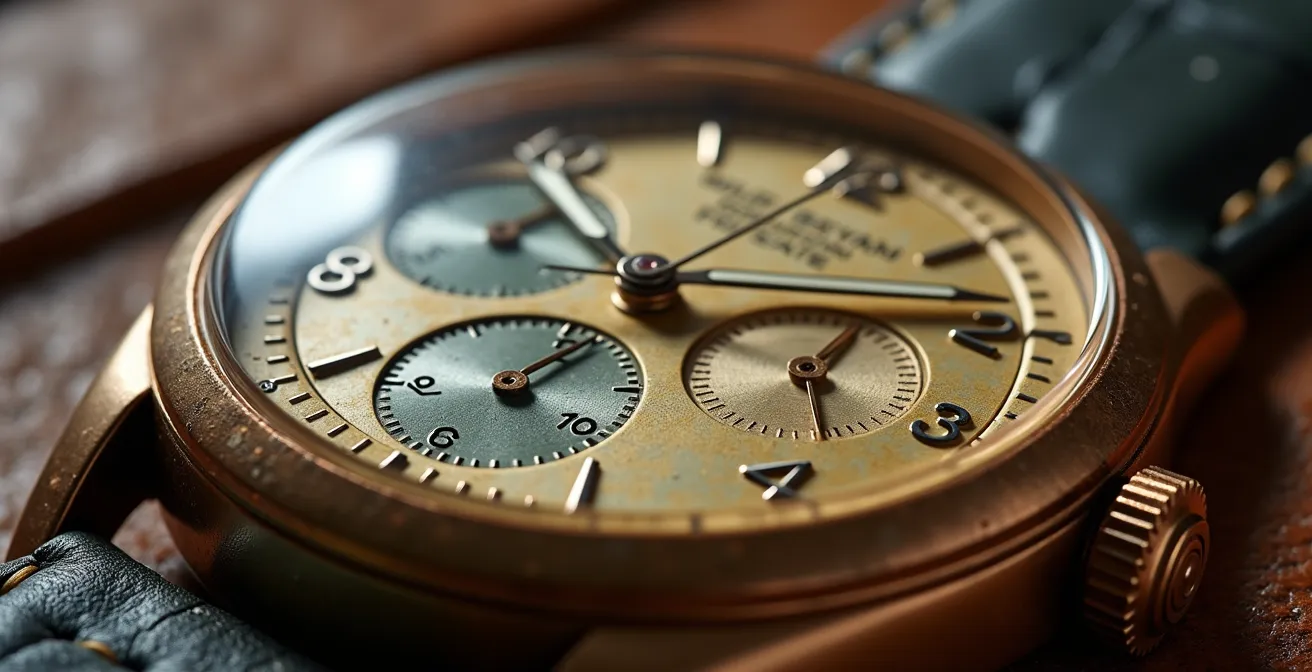
The financial impact of this narrative is not abstract; it is quantifiable. The Rolex Daytona, a model originally designed for professional drivers, has seen its value skyrocket due to this very effect. A study highlighted by the business school shows a staggering 260% appreciation from approximately $11,300 to over $30,000 since 2016 for standard models, with the ‘Paul Newman’ variants commanding multiples of that. This demonstrates that while the underlying asset is a high-quality chronograph, a significant portion of its market price is a direct result of the powerful narrative woven by figures like Newman.
From a portfolio management perspective, this means the asset’s value is comprised of two components: a ‘base value’ derived from the Rolex brand, its movement, and materials, and a ‘narrative value’ derived from the Paul Newman story. The narrative value is more volatile and susceptible to shifts in cultural tastes, representing both higher risk and higher potential reward. An investor is not just buying a watch; they are buying a piece of cultural history, and that story is what has driven its outperformance.
Which Undervalued Neo-Vintage Models Are the Next Blue Chip Assets?
Identifying the ‘next blue chip’ in the horological market requires a methodology that balances brand equity, production scarcity, and emerging collector interest. The ‘neo-vintage’ category, typically spanning the 1980s to the early 2000s, presents a particularly fertile ground for finding undervalued assets. These models combine the charm of vintage aesthetics with the reliability of modern manufacturing, a combination highly attractive to a broad base of buyers.
A prime example of a model that has successfully transitioned to a solid investment is the Tudor Black Bay 58. As a leading secondary market platform Bob’s Watches highlights, its value proposition is clear:
The Tudor Black Bay 58 stands out as a solid investment choice… Its heritage design, inspired by Tudor’s iconic dive watches from the 1950s, appeals to vintage enthusiasts while offering modern reliability. Key factors contributing to its investment potential include Tudor’s association with Rolex.
– Bob’s Watches, Best Investment Watches Guide
The Tudor example underscores a key strategy: look for ‘B-tier’ brands with ‘A-tier’ parentage or heritage. The Rolex-Tudor relationship provides a halo effect, lending credibility and a built-in collector base. Other potential indicators of an undervalued asset include models that were recently discontinued and replaced by a less desirable successor, or limited production models from respected independent brands before they achieved widespread recognition.
To operationalise the search for these assets, a systematic approach is necessary. An investor must move beyond the hype of the most popular models and perform fundamental analysis on the next tier of timepieces. This involves researching production numbers, tracking auction results from regional houses, and understanding the specific features that make a model unique (e.g., a specific movement, a transitional dial).
Action Plan: Identifying High-Alpha Neo-Vintage Assets
- Regional Auction Analysis: Research regional auction houses outside of London, as they often present better value opportunities and less competition from major dealers.
- Brand Performance Monitoring: Monitor the performance of ‘B-tier’ brands with strong heritage as they can be early indicators of broader market trends and present value.
- Discontinuation Tracking: Actively track recently discontinued models, particularly those replaced by upgrades that are considered less desirable by the collector community (e.g., due to size increases or design changes).
- UK-Centric Portfolio Hedging: Focus on models with strong UK-centric demand and heritage to build a portfolio more resilient to currency fluctuations and post-Brexit market shifts.
- Supply vs. Demand Analysis: For emerging independent brands, analyse production numbers against market demand and waitlist lengths to identify future scarcity-driven value increases.
Saffiano, Epsom, or Lambskin: Which Leather Survives the Daily Commute?
While the watch head constitutes the bulk of the asset’s value, the attached strap or bracelet is a critical component that significantly impacts its total return and liquidity. The choice of material is not merely an aesthetic one; it has direct implications for durability, patina development, and, most importantly, the watch’s classification as a ‘full set’ investment-grade piece. The presence of the original, period-correct strap or bracelet can, according to market data, affect the total asset value by as much as 15-30% in the UK market. Replacing an original with an aftermarket equivalent immediately degrades the asset’s integrity.
The following table breaks down the financial characteristics of common strap and bracelet materials from an investment perspective. The data is aggregated from market analysis of UK resale values and replacement costs, providing a clear framework for assessing this component’s contribution to overall asset value.
| Material Type | Daily Wear Resistance | Patina Development | Impact on Watch Value | Replacement Cost (UK) |
|---|---|---|---|---|
| Alligator | Moderate | Develops character | +10-15% if original | £800-2000 |
| Steel Bracelet | Excellent | Scratches add authenticity | +20-25% if original | £2000-5000 |
| Vintage Tropic Rubber | Good | Unique aging patterns | +15-20% if original | £500-1500 |
| Aftermarket Leather | Variable | No collectible value | -5-10% vs original | £200-600 |
As the data clearly indicates, the original steel bracelet adds the most significant value, reflecting its durability and integral design. Even vintage materials like Tropic rubber, prized for their unique aging properties, command a substantial premium. Conversely, an aftermarket strap, no matter the quality, represents a net deduction from the potential maximum value. For the portfolio manager, this means a watch advertised without its original bracelet must be immediately re-valued downwards, and the high cost of sourcing a period-correct replacement must be factored into the acquisition price. The strap is not an accessory; it is a key part of the asset’s financial structure.
Do Futures Contracts Manipulate the Physical Spot Value of Gold?
While the luxury watch market lacks a formal, regulated futures exchange like that for gold or oil, it exhibits a de facto futures market dynamic driven by supply and demand imbalances. This informal market is primarily composed of Authorised Dealer (AD) waitlists and the premiums paid on the secondary (or ‘grey’) market. When a buyer joins a multi-year waitlist for a Rolex or pays a significant premium for a pre-owned Patek Philippe, they are making a leveraged bet on the future value of that physical asset. They are locking in a position based on the anticipation of continued or increased scarcity and demand.
This dynamic is fuelled by a structural supply constraint, as Investment Watches explains in their market analysis:
The supply of luxury watches is limited by factors such as production capacity, craftsmanship, and controlled distribution agreements. Simultaneously, the demand for luxury watches continues to grow, driven by increasing affluence, global economic growth, and aspirational consumption in emerging markets.
– Investment Watches, Luxury Watch Investment Analysis
This controlled, limited supply against ever-increasing global demand creates the perfect environment for future-price speculation. The premium paid on the grey market today for a model like an F.P. Journe is effectively the market’s consensus on its price appreciation tomorrow. It functions exactly like a futures contract premium, representing the difference between the ‘spot’ (retail) price and the expected future spot price. A savvy investor can analyse these premiums as a real-time sentiment indicator for specific models. A rapidly increasing premium signals strong bullish sentiment, while a shrinking premium can be an early warning of a potential price correction.
Therefore, the manipulation of physical spot value doesn’t come from traded paper contracts but from the collective actions of buyers willing to pay above retail. This willingness is a direct vote of confidence in the asset’s future worth, creating a self-fulfilling cycle where high secondary market prices validate the perception of scarcity and desirability, further fuelling demand.
Key Takeaways
- Treat Watches as Illiquid Assets: A significant liquidity discount (20-25%) must be factored into any valuation for emergency cash conversion.
- Value is in the Details: A ‘full set’ (original box and papers) is non-negotiable for investment-grade status and can impact value by up to 30%. Condition is paramount.
- Narrative Drives Alpha: For iconic models like the ‘Paul Newman’ Daytona, a significant portion of the asset’s value is derived from its story and cultural provenance, not just its mechanical properties.
Why Is Solid Gold Considered the Ultimate ‘Crisis Insurance’ for British Investors?
For British investors, physical gold has long been the default ‘crisis insurance’—a tangible store of value outside the traditional financial system. However, an analysis of asset performance reveals a compelling alternative. While gold offers stability, certain luxury watches have provided not only stability but also significant capital growth, functioning as a superior vehicle for wealth preservation and appreciation during turbulent periods. The value of a gold watch is twofold: its intrinsic value as a precious metal and its horological value as a complex, branded asset.
This dual nature has allowed the watch asset class to generate superior returns. When compared directly, analysis from Global Boutique shows that over certain periods, select luxury watches have significantly outperformed precious metals, delivering returns that can be multiples of those seen in gold or silver. This suggests that while gold provides a floor value, the brand equity and collector demand for the watch itself provide a powerful engine for growth that commodity gold lacks.

Furthermore, these assets have demonstrated resilience during stock market volatility. Unlike equities, which can be subject to sharp, systemic downturns, the value of blue-chip watches is driven by a different set of factors: scarcity, brand heritage, and a global collector base. This partially insulates them from domestic market shocks, making them a more stable investment option in a crisis. While a financial crisis may impact discretionary spending, the highest-tier assets often see a ‘flight to quality’, where demand from the ultra-wealthy remains robust or even increases.
Therefore, from a UK investor’s standpoint, a solid gold Rolex or Patek Philippe represents a modern form of crisis insurance. It combines the traditional security of its precious metal content with the potential for alpha generation driven by its status as a Veblen good. It is a portable, globally recognised store of value with a performance track record that, in many cases, surpasses its purely commodity-based counterpart.
For investors looking to diversify their portfolio with tangible assets that have a proven track record of outperformance, the next logical step is to conduct a detailed analysis of specific models that align with your risk tolerance and investment horizon. A bespoke assessment can identify undervalued opportunities in the current market.