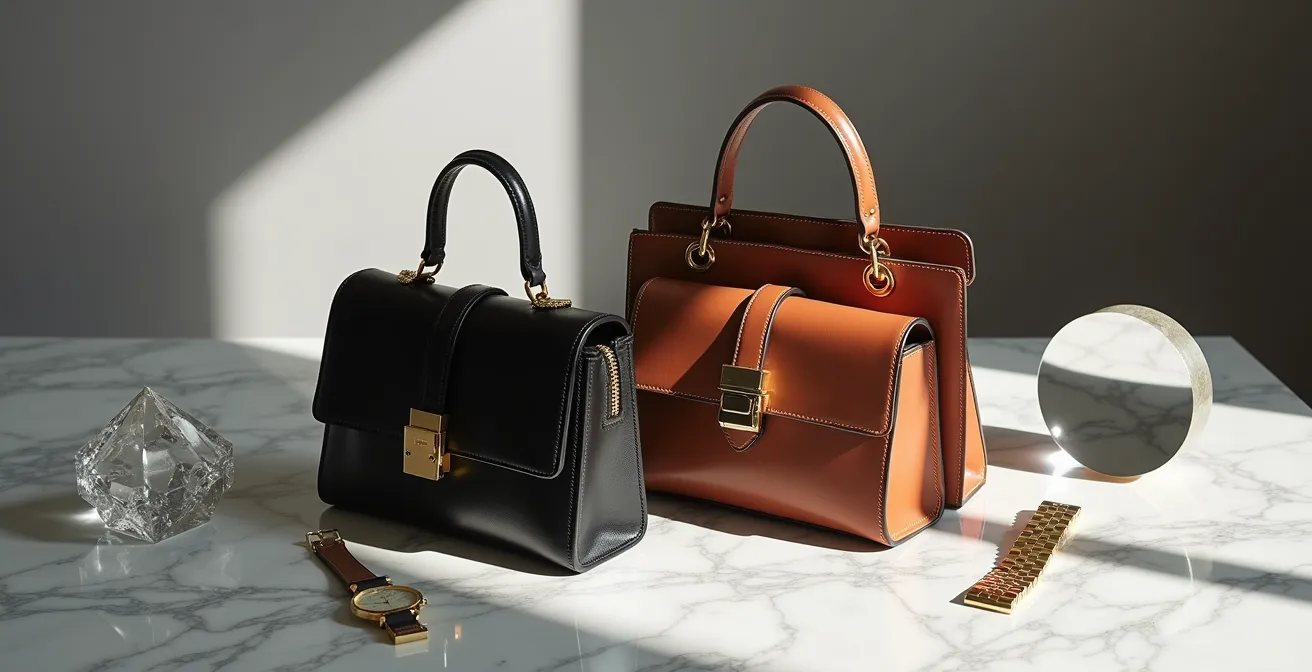
A luxury handbag is more than a purchase; it’s a tangible asset that can outperform traditional investments when chosen correctly.
- Key models from Hermès have historically offered higher annual returns than the S&P 500, turning a fashion item into a serious portfolio contender.
- Factors like leather type (Epsom vs. Lambskin), hardware finish, and bag size directly impact an item’s Total Cost of Ownership and final resale value in the UK market.
Recommendation: Treat your next purchase as a portfolio decision by analysing its value retention mechanics, not just its price tag.
Presenting a £5,000 charge for a new handbag to a partner often feels like confessing a guilty pleasure. It’s framed as an indulgence, a fleeting fashion fancy. The typical justification revolves around craftsmanship or a “treat yourself” mentality, but these arguments rarely stand up to financial scrutiny. We’re conditioned to see fashion as an expense, a depreciating good that loses value the moment it leaves the store.
But what if this perspective is fundamentally flawed? What if that handbag isn’t an expense, but an asset class in its own right? This isn’t about justifying a purchase through emotional reasoning. It’s about applying the cold, hard logic of investment analysis to the world of luxury goods. The conversation shifts from “cost” to “Total Cost of Ownership,” from “trend” to “value retention,” and from “shopping” to “portfolio diversification.” The data shows that certain handbags aren’t just holding their value; they are actively appreciating, in some cases outperforming traditional assets like stocks or gold.
This guide reframes the entire debate. We will move beyond aesthetics and delve into the specific, data-driven factors that separate a beautiful but costly accessory from a savvy, tangible investment. By treating your next luxury handbag with the same analytical rigour as a stock purchase, you’re not just buying an item of beauty; you’re acquiring a blue-chip asset whose performance is predictable and, most importantly, defensible.
This article will provide the analytical framework to make an informed decision. We will explore the critical variables that determine a bag’s investment potential, from the resilience of its leather to the strategic importance of its hardware, providing a clear roadmap for your next portfolio addition.
Contents: A Strategic Analysis of Handbag Investment Value
- Saffiano, Epsom, or Lambskin: Which Leather Survives the Daily Commute?
- How to Choose a Bag Size That Doesn’t Overwhelm a Petite Frame?
- Why Do Expensive Bags Often Lack Pockets and How to Fix It?
- Should Your Bag Hardware Match Your Jewellery?
- How to Stuff and Store Your Designer Bags to Prevent Sagging?
- Which Undervalued Neo-Vintage Models Are the Next Blue Chip Assets?
- Is a £300 Cashmere Jumper Cheaper Than Five £60 Synthetics?
- How to Wear High Heels All Day Without Destroying Your Feet?
Saffiano, Epsom, or Lambskin: Which Leather Survives the Daily Commute?
The choice of leather is the single most important factor determining a handbag’s long-term value. It’s not an aesthetic preference; it’s a strategic decision about durability and condition preservation. A bag’s ability to withstand daily use—the commute on the Tube, accidental rain showers, and inevitable scuffs—directly correlates to its final resale price. Buttery-soft lambskin may feel luxurious, but its tendency to scratch and stain makes it a high-maintenance asset requiring costly upkeep.
In contrast, structured and treated leathers like Hermès’ Epsom or Prada’s Saffiano are the workhorses of the investment world. Their rigid, scratch-resistant, and often water-resistant properties ensure the bag maintains a ‘Pristine’ or ‘Excellent’ condition rating for years. This is not a minor detail. According to UK luxury resale market analysis, the difference between ‘Excellent’ and ‘Good’ condition can mean a 20-30% value loss, translating to a £500-£1,000 hit on a £3,000 bag. Choosing a durable leather is the first and most critical step in risk mitigation for your investment.
This table breaks down the financial implications of your leather choice, factoring in resistance, value retention, and typical repair costs in the UK.
| Leather Type | Weather Resistance | Scratch Resistance | Value Retention After 3 Years | UK Repair Cost Range |
|---|---|---|---|---|
| Epsom (Hermès) | Excellent – Water resistant | Excellent – Minimal scratching | 95-100% in Excellent condition | £150-300 |
| Saffiano (Prada) | Very Good – Treated surface | Very Good – Cross-hatch pattern | 70-85% in Excellent condition | £100-250 |
| Lambskin (Chanel) | Poor – Requires protection | Poor – Shows wear quickly | 60-70% in Good condition | £200-500 for colour restoration |
Case Study: The Handbag Spa UK Restoration Services
The Handbag Spa, a UK-based restoration service, provides hard data on this topic. They report that Saffiano leather repairs average £150 for deep scratch removal, while Lambskin colour restoration can easily exceed £400. More tellingly, their data shows that Epsom leather requires 60% fewer repairs than Lambskin over a 5-year period. This directly correlates to higher resale values observed on UK platforms like Vestiaire Collective and Xupes, proving that a resilient leather choice actively lowers the total cost of ownership.
How to Choose a Bag Size That Doesn’t Overwhelm a Petite Frame?
While personal proportion is a valid style consideration, in the world of handbag assets, size is a function of market demand and scarcity. For years, practicality dictated that larger totes and carry-alls were the sensible choice. However, the resale market has flipped this logic on its head. Smaller, and particularly ‘mini’, versions of iconic bags are now commanding enormous premiums, making them a powerful investment lever.
This trend is driven by a confluence of factors: shifting lifestyle needs, their appeal in key Asian markets, and, crucially, their lower production numbers, which creates artificial scarcity. The Hermès Mini Kelly is the prime example of this phenomenon. It is notoriously difficult to acquire at retail, leading to a secondary market frenzy. In fact, recent UK resale data reveals that the Hermès Mini Kelly resells for 120-150% of its retail price, an immediate and substantial return on investment. For a petite frame, choosing a smaller bag is therefore not a compromise; it’s a shrewd investment strategy that aligns personal ergonomics with maximum market value.
This isn’t just a high-end phenomenon. The same principle applies to other brands. A Chanel Mini Square Flap or a Lady Dior Mini consistently outperforms its larger siblings on UK resale platforms. The takeaway is clear: when considering size, think less about carrying capacity and more about demand density. Smaller bags pack a bigger investment punch.
As Josie Gardner, Head of Buying at Harrods, confirms, this is a distinct trend in the UK capital:
Mini bags and smaller versions have performed particularly well recently, especially in the London market where practicality for public transport drives demand.
– Josie Gardner, Harrods Head of Buying
Why Do Expensive Bags Often Lack Pockets and How to Fix It?
The minimalist interior of many high-end handbags is a deliberate design choice, rooted in a philosophy of pure form and uninterrupted luxury. From the perspective of a brand like Hermès, a bag’s interior is a pristine canvas of supple leather, and adding multiple stitched pockets would compromise its structural integrity and aesthetic purity. While this commitment to form is admirable, it creates a practical nightmare for the modern owner, leading to a chaotic jumble of keys, phones, and wallets that can scratch and damage the very leather the design sought to protect.
The solution is not to suffer in silence but to treat the bag’s interior with the same strategic care as its exterior. The answer lies in high-quality, non-permanent bag organisers. These felt or fabric inserts provide the necessary compartmentalisation without devaluing the asset. This is a critical point: any permanent modification to a blue-chip handbag immediately voids its investment-grade status. For instance, adding non-original hardware or, heaven forbid, having a third-party artisan add pockets, would get a bag disqualified from premier UK auction houses like Christie’s.
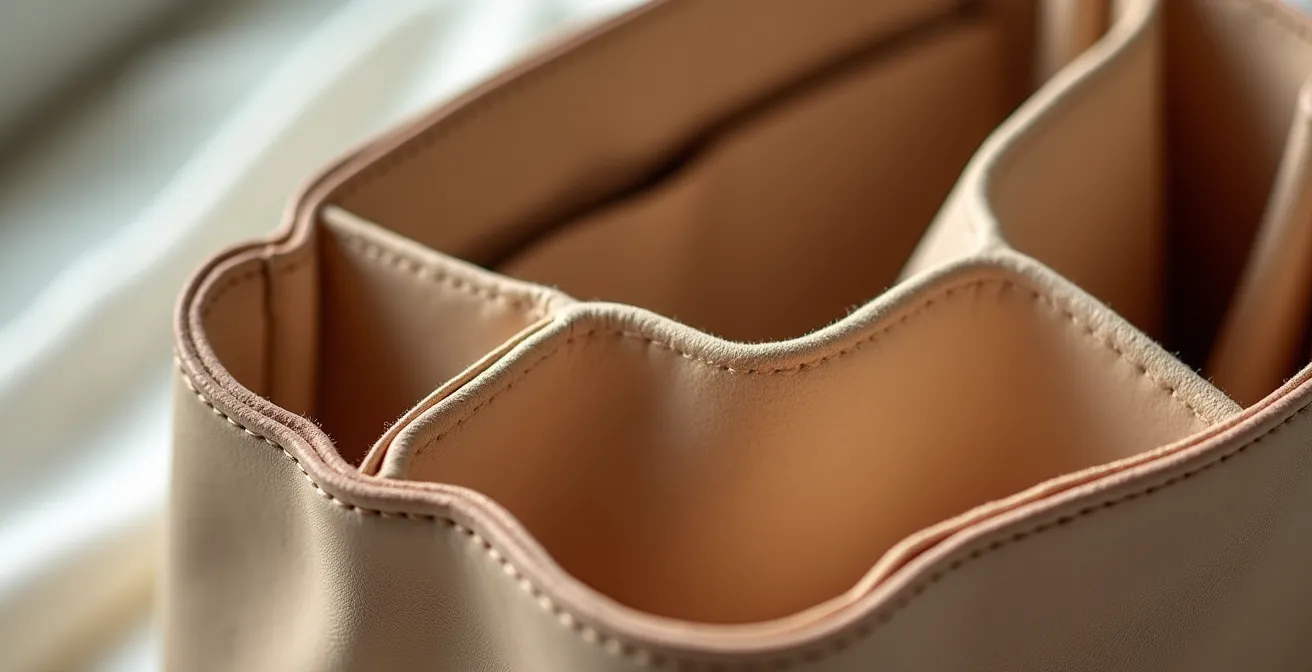
A well-chosen organiser does more than just bring order; it actively preserves the bag’s value. It prevents pen marks, makeup spills, and scratches from keys, all of which would downgrade the bag’s condition from ‘Pristine’ to ‘Good’, wiping thousands off its resale price. Think of an organiser, which costs between £25-£50 from UK suppliers like Handbag Angels, as an insurance policy against interior damage. It’s the single most cost-effective action you can take to protect your investment’s core value.
To maintain the pristine condition that commands top resale value, follow these non-negotiable steps:
- Purchase from Specialists: Opt for acid-free organisers from reputable UK suppliers like Handbag Angels or Felt Obsessed.
- Colour Match: Choose an organiser that matches the bag’s interior lining colour. This maintains aesthetic continuity and is a detail noted by professional valuers.
- Document Everything: Take clear photos of the bag’s pristine interior before you ever use it. This provides a baseline for any potential insurance claim.
- Store Separately: When placing the bag in long-term storage, remove the organiser and store it separately to prevent its shape from imprinting on the leather over time.
Should Your Bag Hardware Match Your Jewellery?
While coordinating your hardware with your jewellery is a matter of personal style, from an investment standpoint, the choice of hardware is a crucial variable that can add significant value. Just like with leather and size, not all hardware is created equal. The standard offerings—typically gold-plated (GPHW) or palladium-plated (PHW)—have their own market dynamics, but the real investment potential lies in limited edition and discontinued hardware finishes.
These rarer options function like a limited-edition print in the art world. Finishes like Chanel’s ‘So Black’ (matte black hardware) or Hermès’ brushed gold, rose gold, or the ultra-rare guilloché (diamond-patterned) hardware are produced in smaller quantities and for limited periods. This scarcity creates a premium on the secondary market that far exceeds the base value of the bag itself. Data from UK auction houses confirms that limited edition hardware like ‘So Black’ or brushed gold commands 15-25% premiums at auction. Choosing a bag with rare hardware is a direct strategy for acquiring an asset with built-in, above-market appreciation potential.
Even with standard hardware, market preferences in the UK can influence value. Gold hardware, for example, often carries a slight premium over palladium due to enduring classic tastes.
Case Study: Christie’s London Hermès Hardware Analysis
The results from Christie’s London 2024 auctions provide clear evidence. In head-to-head sales of otherwise identical Hermès Birkin bags, models with Gold-Plated Hardware (GPHW) consistently achieved final prices that were 12% higher than their Palladium-Plated Hardware (PHW) counterparts. The performance of limited editions was even more dramatic. The ‘So Black’ collection saw exceptional results, with one matte black Kelly 25 selling for £45,000, representing a staggering 180% premium over its original retail price, almost entirely attributable to the desirability and rarity of its hardware.
How to Stuff and Store Your Designer Bags to Prevent Sagging?
A designer handbag’s value is intrinsically linked to its structure. The moment a bag begins to sag, crease, or lose its intended shape, its condition rating plummets, and thousands of pounds can be wiped from its value. Improper storage is the primary culprit. Leaving a bag to collapse on a wardrobe shelf or hanging it by its handles is not just neglect; it is the active destruction of a financial asset. Proper storage is non-negotiable and forms a key part of your asset management strategy.
The golden rule is to help the bag support its own weight and maintain its original form. This involves two key components: stuffing and upright storage. The bag must be gently but firmly stuffed with a material that won’t damage the interior. Acid-free paper is the professional standard; avoid newspaper (ink transfer) or plastic bags (traps moisture). The goal is to fill out the bag’s silhouette completely, from the base to the corners. Once stuffed, it must be placed upright in its original dust bag, which protects it from light and dust without trapping humidity.

Furthermore, the environment matters. A cool, dry, dark place is ideal. For particularly high-value assets in the UK’s damp climate, a dehumidifier in the wardrobe is a wise, low-cost investment. Finally, never underestimate the power of provenance. As UK luxury resale platforms report, bags with complete documentation achieve 10-15% higher prices. This means keeping the original box, dust bag, authenticity cards, and, crucially, the original receipt from a store like Harrods or Selfridges. This ‘full set’ is the handbag equivalent of a stock certificate, proving authenticity and ownership history.
The financial difference between professional and improper storage is stark, as this analysis of UK resale values shows.
| Storage Condition | Bag Condition After 5 Years | UK Resale Value Impact | Required Investment |
|---|---|---|---|
| Professional storage (climate-controlled) | Pristine – no sagging/mould | 90-95% value retention | £200-400/year + dehumidifier |
| Basic home storage with stuffing | Good – minimal shape loss | 70-80% value retention | £50 acid-free paper |
| Improper storage (no protection) | Poor – visible sagging/damage | 50-60% value retention | £0 (false economy) |
Which Undervalued Neo-Vintage Models Are the Next Blue Chip Assets?
While the Hermès Birkin and Chanel Classic Flap are the established “blue-chip” stocks of the handbag world, their high barrier to entry—both in price and availability—puts them out of reach for many. A savvy investor, therefore, looks to the equivalent of emerging markets: undervalued neo-vintage pieces. This category, typically spanning the 1990s to the mid-2000s, is ripe with opportunity as trends cycle back and once-overlooked models become the new objects of desire.
The Y2K revival has been a major catalyst in this space. Bags that were once ubiquitous and held little resale value are now experiencing explosive growth. The prime example is the Prada Re-Nylon series. The Y2K revival has dramatically impacted values, with Prada’s Re-Edition 2000 bags now retaining 109% of retail value, and some specific colourways achieving as much as 190% on UK resale platforms. Identifying the next “It” bag revival is key. Look for models with a strong brand identity, a unique silhouette, and a connection to a specific cultural moment.
The key is to spot the potential before it becomes mainstream. This requires moving away from the herd mentality and looking for intrinsic quality and historical significance. As Josie Gardner of Harrods notes, the market is shifting towards more individualistic choices.
Consumers are moving away from minimal beige silhouettes and craving bags that feel unique and expressive. Mulberry’s early Bayswater and Alexa editions represent accessible entry-points for UK collectors.
– Josie Gardner, Harrods Head of Buying
Models like the Fendi Baguette, the Dior Saddle Bag (pre-revival versions), and early Tom Ford-era Gucci bags are all examples of assets that were once undervalued and have since provided incredible returns. The strategy is to acquire these pieces when the market is cool and hold them until the trend cycle inevitably brings them back into the spotlight. This is where true alpha can be generated in the handbag portfolio.
Is a £300 Cashmere Jumper Cheaper Than Five £60 Synthetics?
This question gets to the heart of investment-grade thinking: the Total Cost of Ownership (TCO). A £8,000 Chanel Classic Flap may seem astronomically more expensive than five £1,600 contemporary bags. But this initial outlay is only one part of the financial equation. The TCO is calculated as: Initial Cost + Maintenance Costs – Final Resale Value. When you apply this formula, the entire financial picture is inverted.
The five contemporary bags, while cheaper upfront, will likely depreciate dramatically, retaining perhaps 25% of their value over a decade. Their net cost to you is enormous. The Chanel Classic Flap, however, is a blue-chip asset. With minimal maintenance, it will not only retain its value but likely appreciate. Its resale value might be 92% (or more) of what you paid, meaning its true cost over a decade of use could be just over £1,000. The “expensive” bag is, in fact, demonstrably cheaper.
This principle is most pronounced with top-tier Hermès bags, which have transcended fashion to become a recognised alternative asset class. An analysis by CNBC reveals that between 1980 and 2015, Hermès Birkin bags averaged a 14.2% annual increase in value. This not only outpaces inflation but also the average annual return of the S&P 500 (around 10%) over the same period. No contemporary bag can offer this kind of performance.
The table below illustrates the 10-year TCO, highlighting the stark difference in net cost and also noting the UK’s Capital Gains Tax (CGT) status for such assets, which are often exempt if the profit per item is below the £6,000 threshold.
| Investment Type | Initial Cost | Maintenance (10yr) | Resale Value | Net Cost | UK Tax Status |
|---|---|---|---|---|---|
| Chanel Classic Flap | £8,000 | £500 | £7,360 (92% retention) | £1,140 | CGT exempt under £6,000 profit |
| 5 x Contemporary Bags | £8,000 | £200 | £2,000 (25% retention) | £6,200 | Not investment grade |
Key Takeaways
- Leather isn’t just aesthetic; durable types like Epsom are the primary driver of condition-based value, minimising repair costs and maximising returns.
- Scarcity is a key performance indicator: limited edition hardware and in-demand mini sizes consistently command significant premiums on the UK resale market.
- Proactive asset management, including proper storage and retaining full documentation, can add a combined 20-30% to the final resale price.
How to Wear High Heels All Day Without Destroying Your Feet?
This classic fashion dilemma is a perfect metaphor for investing in top-tier, “blue-chip” handbags. A Birkin or a Kelly is the financial equivalent of a pair of stunning but punishing stilettos: the rewards are immense, but acquiring and maintaining them requires significant effort, strategy, and a high tolerance for ‘pain’. The journey to acquiring one at retail is notoriously difficult, requiring a long-term relationship with sales associates and a significant purchase history. This is the “high-maintenance” aspect of a high-return strategy.
However, not every good investment needs to feel like walking in heels all day. There is an alternative strategy: the “comfortable wedges.” These are bags from respected luxury houses that offer excellent craftsmanship and strong value retention without the intense competition and gatekeeping of the top tier. The Loewe Puzzle bag is a prime example. It is readily available at UK retailers like Selfridges and Harvey Nichols, offers a unique and celebrated design, and boasts impressive market performance.
Case Study: The ‘Comfortable Wedges’ Alternative: Loewe Puzzle Success Story
The Loewe Puzzle bag perfectly exemplifies this accessible investment strategy. It offers an exceptional 93% value retention according to UK resale data, rivalling many so-called “holy grail” bags. A London-based collector documented purchasing three Puzzle bags over two years. When the oldest was valued by Vestiaire Collective UK, it had already appreciated 15% above its original retail price. This demonstrates that significant returns are possible without navigating the notoriously opaque Hermès system.
Whether you choose the high-heeled path of a Birkin or the comfortable wedge of a Loewe Puzzle, a strategic approach is essential. Managing the ‘pain points’ of luxury bag investment involves a series of calculated steps to protect your asset and plan for eventual liquidity.
Action Plan: Navigating High-Return Bag Investments in the UK
- Points of Contact: Begin building genuine, long-term relationships with sales associates at key London boutiques like the Hermès store on New Bond Street; this can take 12-18 months.
- Asset Collection & Protection: Secure specialist handbag insurance through UK providers like Hiscox, which typically costs 1-2% of the bag’s value annually, to mitigate risks of theft or damage.
- Coherence with Value: For any pre-owned purchase, use UK-based authentication services like Entrupy to guarantee authenticity and secure your investment’s foundation.
- Asset Management: Consider professional storage facilities in London that offer climate-controlled units (£200-£400 per year) to ensure perfect, long-term condition preservation for your highest-value pieces.
- Integration & Exit Plan: Build relationships with reputable UK consignment shops such as Sellier or Xupes well in advance, establishing a clear and efficient path to liquidity when you decide to sell.
The next time you consider a luxury handbag, you are now equipped with the data to reframe the conversation. Move the discussion from one of expense to one of investment, from cost to value, and from a simple purchase to a strategic addition to your personal asset portfolio. Analyse its TCO, assess its value retention mechanics, and present it not as an indulgence, but as the smart, tangible asset it truly is.