
True heirloom quality is defined by structural fortitude and documented legacy, not by fleeting fashion or a high price tag alone.
- Solid construction is non-negotiable; hollow pieces are designed to fail over time.
- Gemstone hardness is only half the story; toughness and stability determine suitability for daily wear.
- Verifiable provenance, starting with the original receipt, can be as valuable as the precious materials themselves.
Recommendation: Prioritise robust settings, deep hand-craftsmanship, and meticulous documentation to select a gift that will genuinely become a multi-generational treasure.
The vision is a powerful one: purchasing a piece of jewellery today that your great-grandchild will one day wear with pride. It’s a dream of legacy, of connection across time. The common advice is predictable—invest in 18-carat gold or platinum, choose a “timeless” design like a solitaire ring, and ensure the gemstone is a diamond. While not wrong, this advice barely scratches the surface and often misses the most critical details that determine whether a piece will endure or end up on my workbench for costly repairs.
As an antique restorer, I see a different story. I see the pieces that have survived a century and those that failed within a decade. The difference is rarely about the initial cost or the brand. It lies in the small, often invisible, choices of construction and materials. It’s about understanding the points of failure—the hollow bangle that dents irreparably, the brittle emerald that chips with a single knock, the shallow laser engraving that vanishes after a few polishes. The jewellery that lasts isn’t just beautiful; it is engineered for longevity.
But what if the true secret to choosing an heirloom wasn’t just about avoiding weakness, but about actively selecting for strength and legacy? This is where the perspective shifts from a buyer to a curator. It’s about understanding that structural integrity is more important than a fashion trend, and that a simple receipt can be the first chapter in a story that outlives us all. A true heirloom is not just bought; it is chosen with foresight.
This guide will walk you through the specific design features that I look for as a restorer. We will examine the hidden signs of durable construction, the realities of gemstone wear, the difference between timeless and dated designs, and why the paperwork is as crucial as the piece itself. By the end, you will have the discerning eye needed to select not just a gift, but a true legacy.
To help you navigate these crucial considerations, this article is structured to address the most common pitfalls and highlight the key attributes of jewellery built to last. The following summary provides a direct path to each essential topic we will cover.
Summary: What Design Features Make a Piece of Jewellery ‘Heirloom Quality’?
- How to Tell if a Gold Bangle Is Hollow and Why It Won’t Last?
- Why Should You Avoid Pearls and Emeralds for Daily Heirloom Wear?
- Will a Halo Setting Look Dated in 20 Years?
- Why Laser Engraving Fades Faster Than Hand Engraving?
- Why Is the Original Receipt Crucial for the Provenance of an Heirloom?
- Why Gifting a Signature Timepiece Is the Ultimate Coming-of-Age Tradition?
- Can You Touch a Cast Gold Bar Without Damaging Its Value?
- Why Are Unheated Pigeon Blood Rubies the Most Expensive Coloured Gems?
How to Tell if a Gold Bangle Is Hollow and Why It Won’t Last?
One of the most common repairs I see is for dented or crushed hollow gold jewellery. While it offers a lower price point for a larger-looking piece, hollow construction is the antithesis of heirloom quality. These pieces are created from a thin sheet of gold, making them exceptionally prone to damage that is often difficult, if not impossible, to repair without leaving visible signs. A solid piece, by contrast, possesses the density and structural integrity to withstand the accidental bumps and pressures of daily life for generations. It may scratch, but it will not easily deform.
In the UK, the law provides a baseline of quality assurance. Gold items over 1g must be hallmarked, which guarantees the purity of the metal. However, the hallmark does not tell you if the item is solid or hollow. That requires a more hands-on assessment. A discerning buyer must learn to identify the subtle clues that betray a hollow construction, as this single factor is a primary determinant of a piece’s long-term survival. Trusting your senses and knowing what to look for is paramount.
Your Action Plan: Identifying Hollow Gold
- Assess the Weight-to-Size Ratio: Get a feel for the item. A solid gold bangle will feel substantially heavier in your hand than a hollow one of the exact same dimensions. This initial sensory check is often the most revealing.
- Perform the Tap Test: Gently tap the bangle with a fingernail. Hollow pieces produce a light, tinny, or metallic ringing sound. A solid piece will create a much duller, more muted “thud,” absorbing the impact.
- Inspect for Seams and Marks: Carefully examine the entire surface, especially the inner curve. Manufacturers often hide subtle joining lines or small solder points where the hollow form was sealed.
- Examine the Clasp and End Caps: In hollow bangles and chains, manufacturers sometimes use disproportionately heavy or solid clasps to give the piece a misleading sense of weight. Check if the ends feel significantly denser than the body.
- Request a Specific Gravity Test: For a high-value purchase where you remain uncertain, ask a certified jeweller to perform a specific gravity test. This non-destructive method definitively measures the item’s density to confirm if it is solid.
Ultimately, choosing a solid piece over a hollow one is the first and most crucial investment in longevity. It is the foundation upon which a true heirloom is built, ensuring the piece has the inherent strength to be worn and cherished, not just stored in a box.
Why Should You Avoid Pearls and Emeralds for Daily Heirloom Wear?
While breathtakingly beautiful, pearls and emeralds are notoriously poor choices for jewellery intended for frequent or daily wear, especially rings. Their vulnerability is a common sight in my restoration work. The conventional wisdom points to the Mohs scale of hardness, where diamond scores a 10 and ruby/sapphire a 9. This scale, however, only measures resistance to scratching. It does not account for toughness (resistance to chipping and breaking) or stability (resistance to chemicals, heat, and humidity).
Emeralds, despite a respectable hardness of 7.5-8, are often heavily included (filled with internal fractures) and brittle. This makes them susceptible to chipping from an everyday knock. Furthermore, most emeralds are “oiled” to fill these fractures and improve clarity, a treatment that can degrade over time and requires professional re-application. Pearls are even more delicate. As organic gems with a hardness of just 2.5-4.5, they are easily scratched, damaged by common chemicals like perfume or hairspray, and require periodic restringing. As the antique jewellery specialists at Heirloom London note, such pieces often need repairs and re-polishing by highly skilled goldsmiths before they can even be considered for remodelling, highlighting their inherent fragility.
For a true “wear-and-forget” heirloom, one must prioritise gems that combine hardness with exceptional toughness. This ensures the piece can endure the rigours of life without demanding constant worry or specialised maintenance.
| Gemstone | Hardness (Mohs) | Daily Wear Suitability | Maintenance Requirements |
|---|---|---|---|
| Diamond | 10 | Excellent | Annual cleaning |
| Ruby/Sapphire | 9 | Excellent | Annual inspection |
| Emerald | 7.5-8 | Poor (brittle, requires oiling) | Professional re-oiling needed |
| Pearl | 2.5-4.5 | Very Poor | Frequent restringing, special storage |
| Tsavorite Garnet | 7-7.5 | Good | Regular cleaning |
Choosing a diamond, ruby, or sapphire for a piece intended to be worn daily isn’t just a “safe” choice; it’s a strategic one. It demonstrates an understanding of material fortitude over transient beauty, ensuring the centrepiece of your heirloom will shine just as brightly for your great-grandchild as it does for you.
Will a Halo Setting Look Dated in 20 Years?
This question touches on a core fear when choosing an heirloom: investing in a design that becomes a fleeting trend. The modern halo setting, with its circle of small diamonds surrounding a central stone, has been so popular that many worry it will look distinctly “of its time.” However, as a restorer, I can assure you that its fundamental design concept is one of the most enduring in jewellery history. The key to its timelessness lies in its ancestry.
The contemporary halo is a direct descendant of the cluster rings that were popular in the Georgian (1714-1837) and Victorian (1837-1901) eras. These designs also featured a central stone framed by smaller gems, intended to create a larger, more brilliant, and more impressive overall look. While techniques and cutting styles have evolved, the core aesthetic principle—using a “halo” to augment and celebrate a central stone—has remained desirable for centuries. The visual dialogue between a Georgian cluster and a modern halo is striking, showing continuity rather than a passing fad.
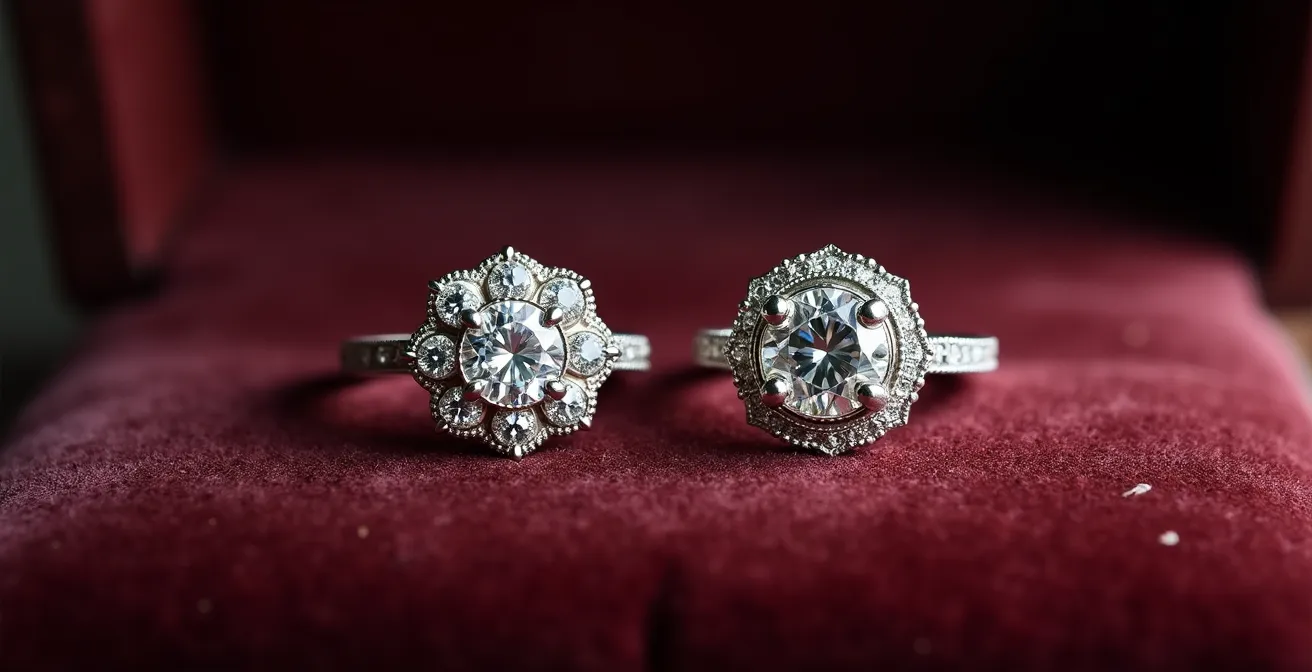
As the image above illustrates, the form has evolved but the essence is unchanged. The risk of looking dated comes not from the halo concept itself, but from its execution. Overly intricate, trendy variations—such as double or triple halos, or those with very specific, fashionable shank details—are more likely to age poorly. A classic, well-proportioned single halo in platinum or gold, however, is simply a modern interpretation of a centuries-old design. It is a choice rooted in a long and proven history of aesthetic appeal, making it a reliable bet for a piece that will be cherished for decades to come.
Why Laser Engraving Fades Faster Than Hand Engraving?
An engraving—be it a date, a monogram, or a heartfelt message—is the soul of an heirloom, transforming it from a beautiful object into a personal testament. However, not all engraving methods are created equal, and the modern convenience of laser engraving comes at a significant cost to longevity. From a restorer’s perspective, the difference is stark: one is a permanent mark, the other is a surface treatment destined to fade.
Laser engraving works by burning or vaporising a microscopic layer off the metal’s surface. It is fast, precise, and inexpensive, but it creates an inscription that is incredibly shallow. Over years of wear, the gentle friction of skin, fabric, and periodic polishing slowly abrades the metal. This material fatigue wears away the shallow laser mark until it becomes faint and eventually illegible. I have seen countless pieces where a once-meaningful date has all but vanished.
In stark contrast, traditional hand engraving creates V-shaped channels that can last for centuries. A master engraver, like those celebrated at London’s Goldsmiths’ Centre, uses hardened steel tools called gravers to physically cut and displace the metal. This process creates deep, crisp channels with angled walls that catch the light. As the award-winning craftsman Graham Saggers demonstrates, this is a craft perfected over decades. The depth of these cuts means that even after generations of wear and polishing, the core of the engraving remains intact. It is a method that invests time and skill to create a mark as enduring as the metal itself.
Choosing hand engraving is a declaration that the message is as important as the medium. It is an investment in permanence, ensuring that the personal story etched into the piece will be just as clear for future generations as it was on the day it was first inscribed.
Why Is the Original Receipt Crucial for the Provenance of an Heirloom?
While we focus on the physical attributes of a piece, its story and authenticity—its provenance—are what elevate it from valuable object to priceless heirloom. The very first and most critical document in establishing this provenance is the original purchase receipt. Too often, this is discarded as a simple proof of a transaction, but from a legacy perspective, its value is immense and grows over time.
Firstly, the receipt is a foundational document for practical matters. It establishes a verifiable date of purchase, the name of the original retailer, and the price paid. This information is vital for insurance purposes; in fact, UK insurers often require proper documentation for items valued over £1,000. Without it, proving value after loss or theft becomes significantly more difficult. The receipt anchors the piece in a specific time and place, preventing ambiguity and solidifying its history from day one.
Secondly, it is the first chapter in the object’s life story. It authenticates the maker or retailer, which can become critically important if they become highly sought after in the future. It records the original materials and specifications, providing a baseline against which any future repairs or modifications can be measured. For your descendants, this piece of paper is a tangible link to you and the moment the heirloom entered the family. It is not just data; it is a connection. Preserving it, along with other key documents, is an act of curatorship.
Your Provenance Audit Checklist: Essential UK Heirloom Documentation
- The Original Purchase Receipt: Safeguard the original receipt showing the date, price, item description, and retailer’s details. This is the cornerstone of your item’s history.
- UK Hallmark Photograph: Take a clear, high-resolution photograph of the hallmark, ensuring the assay office mark (e.g., the leopard’s head for London) is clearly visible. This legally verifies the metal’s purity and origin.
- Gemological Certificates: For any significant gemstone, secure and keep the original certificate from a recognised laboratory (e.g., GIA). This is non-negotiable proof of the stone’s identity and quality.
- Repair and Modification Records: Document any work done on the piece over its lifetime. Keep receipts from the jeweller for any resizing, stone replacement, or repairs. This maintains a transparent history.
- A Digital and Physical Portfolio: Create a digital file with high-resolution photos of the item from multiple angles, alongside scanned copies of all documents. Store physical copies with your solicitor or in a secure deposit box as part of your inheritance planning.
By meticulously curating these documents, you are doing more than just protecting an asset. You are preserving its story, its authenticity, and its value in the most complete sense, ensuring it is passed down not just as an object, but as a fully documented legacy.
Why Gifting a Signature Timepiece Is the Ultimate Coming-of-Age Tradition?
While static jewellery holds immense sentimental value, a mechanical timepiece offers a different, more dynamic kind of legacy. Gifting a fine watch to mark a significant milestone is the ultimate coming-of-age tradition because it is not just an object, but a living system—a piece of intricate engineering designed for a lifetime of use and maintenance. It is a metaphor for responsibility, precision, and the passage of time itself.
Unlike many forms of jewellery that can be seen as purely decorative, a high-quality mechanical watch is a functional tool built with extraordinary craftsmanship. The hundreds of tiny, interacting cogs, springs, and jewels within its movement represent a pinnacle of human ingenuity. This complexity is not a weakness but a strength. As one industry expert from the British watchmaking community notes, “Fine watches are designed from the ground up to be maintained for centuries by a network of skilled watchmakers across the UK.” This inherent serviceability is the key to its status as an heirloom. It is a legacy that is not meant to be sealed away, but to be worn, used, and cared for, with its life extended through regular servicing by skilled hands.
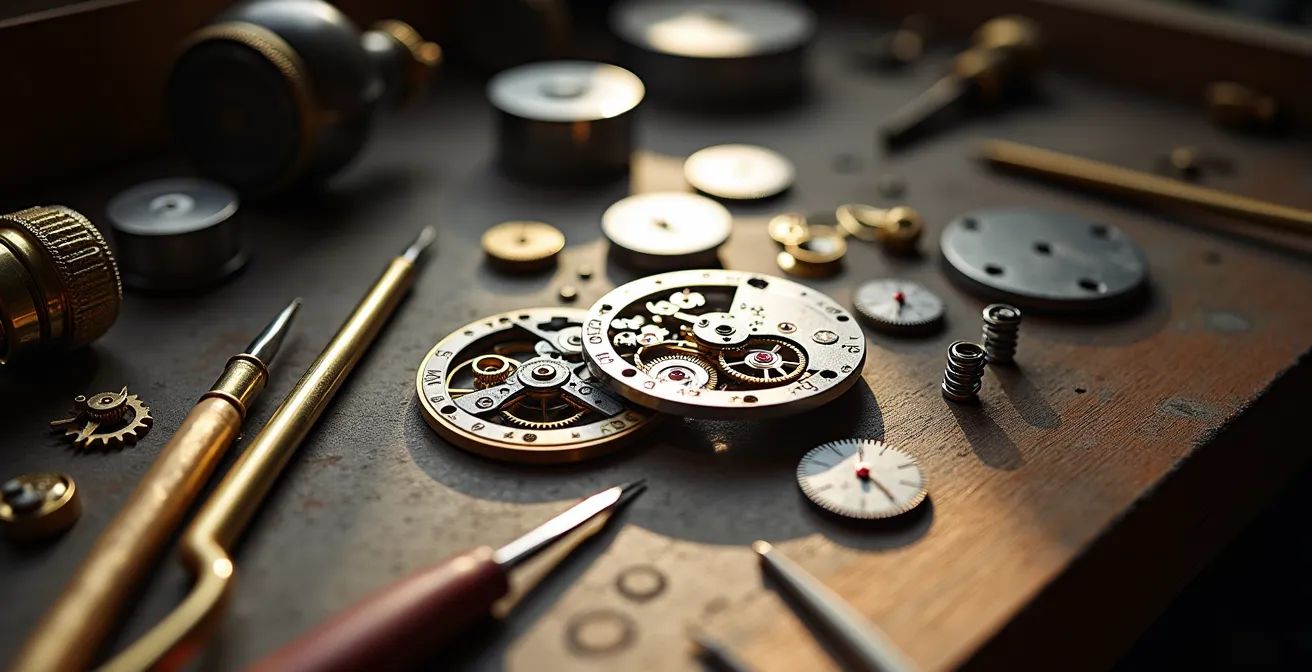
Gifting a timepiece is therefore an act of bestowing a responsibility. It teaches the recipient about the value of maintenance, the beauty of a well-made machine, and the connection to a long tradition of craft. It’s a piece of history that ticks on their wrist, a constant reminder of the moment it was given and the person who gave it. In a world of disposable technology, a mechanical watch is a powerful statement of permanence, making it a uniquely meaningful and enduring heirloom.
Can You Touch a Cast Gold Bar Without Damaging Its Value?
This question brilliantly highlights the fundamental difference between the value of raw material and the value of a crafted heirloom. Yes, you can handle a cast gold bar without diminishing its worth. Its value is almost entirely intrinsic, determined by its weight in troy ounces and its purity (fineness). It is a commodity, and its surface finish is largely irrelevant to its market price.
Heirloom jewellery operates under a completely different value system. Its worth is a complex alchemy of intrinsic material value plus the extrinsic values of craftsmanship, design, provenance, and sentiment. Handling a piece of jewellery absolutely can affect its value over time. Oils from skin can dull the finish, repeated contact can wear down delicate details, and improper handling can cause scratches or damage. The value is not just in the gold; it is in the artistry that shaped it and the history it carries.
The UK’s hallmarking system, with its 700 years of expertise originating from The Goldsmiths’ Company Assay Office, is the first step in transforming raw metal into an object with extrinsic value. The historic leopard’s head stamp for London does more than guarantee purity; it provides an internationally recognised mark of quality and origin, beginning the story of the piece. This is where the divergence in value truly begins.
The following table clarifies this crucial distinction. Understanding it is key to shifting one’s mindset from simply buying precious metal to investing in a piece of lasting art and history.
| Aspect | Cast Gold Bar | Hallmarked Heirloom Jewellery |
|---|---|---|
| Primary Value | Weight in troy ounces | Craftsmanship + provenance + sentiment |
| Touch Impact | None (value is intrinsic) | Can affect surface finish |
| UK Legal Requirement | Refinery stamp only | Full hallmark if over 1g gold |
| Resale Assessment | Weight and purity only | Design, maker, age, condition |
| Storage Requirements | Secure vault | Careful handling, lined box |
Ultimately, a gold bar is an asset; a piece of heirloom jewellery is a legacy. One is valued for what it is, the other for what it represents. This understanding is the foundation of making a wise and lasting choice.
Key Takeaways
- Fortitude First: Always choose solid construction over hollow. The weight is a sign of durability and the single most important factor for longevity.
- Hardness is Not Everything: Prioritise gemstones that are both hard and tough (diamond, ruby, sapphire) for pieces intended for daily wear. Brittleness is a hidden point of failure.
- Craftsmanship is in the Depth: Deep hand engraving will outlast shallow laser marking by centuries. It is a mark of true investment in the piece’s story.
- Document Everything: Provenance begins on day one. The original receipt, gem certificates, and hallmark records are as crucial as the physical object for preserving long-term value.
Why Are Unheated Pigeon Blood Rubies the Most Expensive Coloured Gems?
At the very peak of the heirloom market, we find objects whose value is determined by extreme rarity and specific, verifiable qualities. The unheated “Pigeon Blood” ruby is the perfect case study. It is the most expensive coloured gem not just because it’s a ruby, but because it is a ruby of a precise, naturally occurring quality that is exceptionally rare and highly coveted. Its value is a masterclass in the importance of nuance, certification, and provenance.
The term “Pigeon Blood” refers to a very specific colour: a vibrant, pure red with a minute purplish tint, unmodified by other colours like brown or orange. As defined by top gemological labs like SSEF and Gübelin, this ideal colour is the result of a unique chemical composition—a high chromium content combined with low iron content. This specific chemistry not only produces the coveted hue but also causes the stone to exhibit strong red fluorescence under UV light, giving it a distinct “inner glow” that makes it appear to light up from within. The “unheated” designation is critical, as it means this perfect colour is entirely natural, not enhanced by heat treatment—a common practice for most rubies. This combination of natural, perfect colour and glow is exceedingly rare.
This rarity translates to staggering market values. A staggering example is the sale of a 24.70-carat pigeon blood ruby for over $11 million at auction. At this level, provenance and certification are everything. As the Sotheby’s Jewelry Department states unequivocally:
For a gem of this status, a shop receipt is worthless without a certificate from a top-tier Swiss lab. Certificates from SSEF and Gübelin are highly valued for pigeon blood ruby.
– Sotheby’s Jewelry Department, Complete Guide to the Rare Pigeon Blood Ruby
The Pigeon Blood ruby teaches a final, vital lesson in heirloom quality: true value lies in specific, verifiable, and rare characteristics. It is the ultimate expression of choosing an heirloom based not on what is merely beautiful, but on what is demonstrably exceptional.
By applying these principles of structural fortitude, material science, and documented provenance, you can move beyond simply buying jewellery and begin curating a true family legacy. The next step is to use this knowledge to assess potential pieces with a confident and critical eye, ensuring your gift has the strength to carry its story for generations to come.