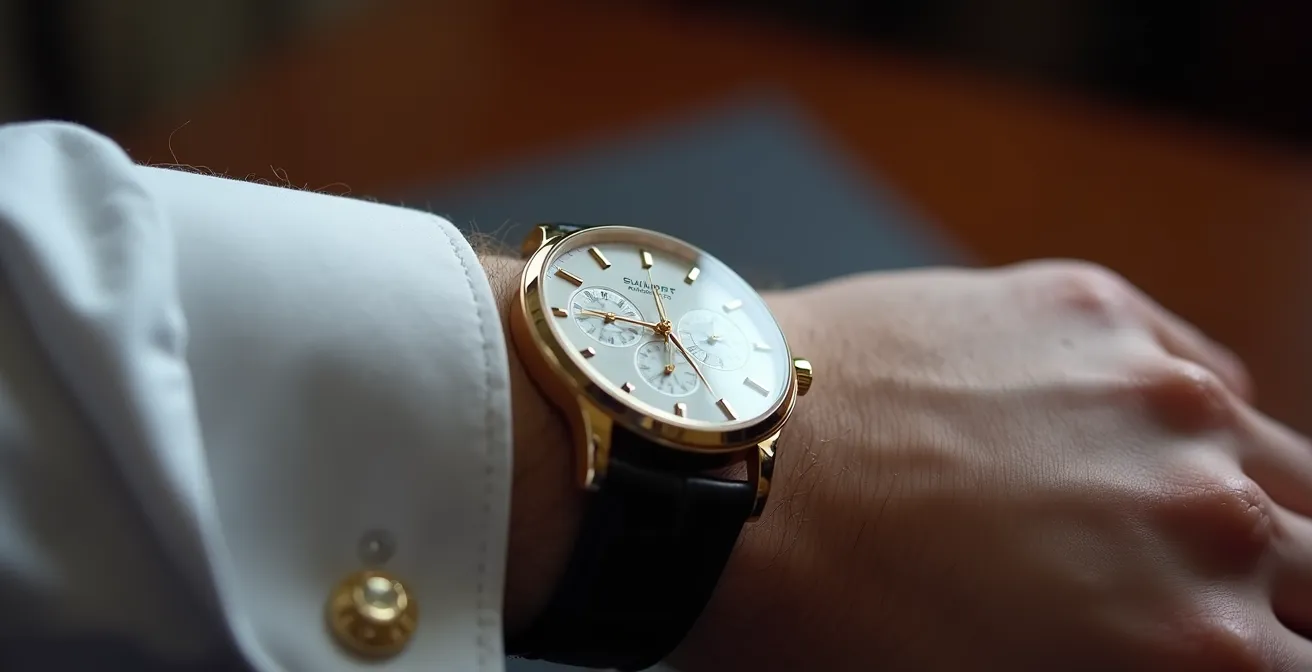
Wearing the correct watch to a formal event is not about telling the time; it is about signalling that you belong.
- Your watch must be thin enough to disappear discreetly under your shirt cuff.
- A simple, time-only dial communicates focus and respect for your company.
Recommendation: Match the watch’s formality to the occasion. A simple, leather-strapped dress watch is imperative for black tie, with specific, modern exceptions for the business world.
The invitation specifies ‘Black Tie’. The suit is pressed, the shoes are polished to a mirror shine, but a nagging uncertainty remains: the watch. For a young professional navigating London’s social and business spheres, this single accessory can feel like a final examination. The common advice—to wear a simple, thin watch with a leather strap—is a starting point, but it is dangerously incomplete. Some traditionalists will even insist that wearing a watch with a tuxedo is a faux pas in itself, the logic being that a gentleman should be so engrossed in the company that he has no need to be aware of the time.
While this historical notion has its charm, in the modern world it is largely obsolete. The reality is that a watch will be worn. The true question is not *if*, but *how*. The platitudes fail to explain the nuanced language a timepiece speaks in Britain’s elite circles. It is a piece of non-verbal communication, a subtle signal of your respect for your host, your understated confidence, and your understanding of social hierarchy. To get it wrong is to shout your inexperience across a crowded room. To get it right is to affirm your position without saying a word.
This guide will not merely list the rules. It will decode the language behind them, transforming your watch from a potential liability into a powerful social asset. We will explore why the fit beneath a cuff is non-negotiable, how your choice of strap speaks to your professional context, and why, in a world of complex gadgets, simplicity remains the ultimate expression of confidence. This is not about fashion; it is about etiquette. And the first rule is to understand the game.
This article provides a comprehensive framework for navigating the intricate world of formal wristwear. The following sections break down each unspoken rule, ensuring you are perfectly equipped for any formal occasion.
Summary: A Gentleman’s Guide to Formal Watch Etiquette
- How to Ensure Your Dress Watch Slides Under a Double Cuff Shirt?
- Leather vs Metal: Which Strap Is Acceptable for a Formal Office Environment?
- Why a ‘Time-Only’ Dial Is the Ultimate Sign of Confidence in a Meeting?
- White Gold or Platinum: Which Material Is Best for Stealth Wealth?
- Why Smaller Case Sizes Are Making a Comeback for the Modern Gentleman?
- What Are the Shoulder and Sleeve Rules That Define a Perfect Jacket Fit?
- Can You Wear a Sports Watch with a Lounge Suit in 2024?
- How to Curate a Watch Collection That Defines Your Personal Brand?
How to Ensure Your Dress Watch Slides Under a Double Cuff Shirt?
The cardinal rule of wearing a watch with formal attire is one of discretion. Your timepiece should not announce itself; it should be discovered. The critical test for this is the relationship between the watch and the shirt cuff. A dress watch must, without exception, slide easily under the cuff of your shirt. If it catches, bunches the fabric, or remains permanently exposed, it is simply too large. This is not a matter of taste, but of sartorial mechanics and social signalling.
An oversized watch creates a jarring silhouette, disrupting the clean line from shoulder to wrist that a well-tailored suit aims to achieve. It suggests a certain lack of sophistication, an ostentatious streak that is deeply at odds with the principles of classic menswear. As the tailors of Savile Row have long understood, elegance lies in harmony and proportion. The experts at the Savile Row Company state it plainly: “It should be round or square, and the size of the case should be thin enough to slide underneath your shirt cuff without getting caught.” This requires a case thickness, ideally, of under 10mm.
Case Study: The Savile Row Favourite
There is a reason why certain timepieces have become the default choice for the discerning clientele of London’s bespoke tailors. Ultra-thin dress watches, such as the Vacheron Constantin Historiques 1955 or the Jaeger-LeCoultre Master Ultra Thin, are engineered for this very purpose. With case profiles often measuring under 8mm, they are designed to integrate seamlessly with the crisp fabric of a double cuff. A study of Savile Row’s preferences confirms that these models are favoured precisely because they solve the cuff problem before it begins, embodying the principle of horological discretion.
Therefore, when selecting a watch for a black-tie event, your first consideration should not be the brand or the complications, but its physical profile. If it cannot pass the cuff test, it is not a dress watch, regardless of what the marketing material may claim. Make this your non-negotiable standard.
Leather vs Metal: Which Strap Is Acceptable for a Formal Office Environment?
While black-tie events have rigid rules, the modern British professional landscape presents a more nuanced picture. The choice between a leather strap and a metal bracelet is no longer a simple binary of formal versus casual; it has become a sophisticated signal of industry context and professional standing. For the most traditional and client-facing roles, a simple black leather strap remains the undisputed champion of formality and taste.
A slim, high-quality black calfskin or alligator strap is the sartorial equivalent of a well-judged handshake: firm, confident, and utterly appropriate. It complements the leather of your dress shoes and belt, creating a cohesive and polished look. A metal bracelet, by contrast, can often read as too sporty or aggressive in a conservative setting. However, to apply this rule universally in 2024 would be a mistake. The acceptability of a metal strap is now highly dependent on the specific corporate culture, particularly in London.

As the table below illustrates, the line has blurred significantly. While a barrister in the Temple might still be expected to adhere to the most conservative standards, a tech entrepreneur in Shoreditch or a creative director in Soho can and often does wear an integrated steel bracelet as a sign of modern, dynamic professionalism. The key is to understand the uniform of your specific tribe.
| Industry Sector | Preferred Strap | Acceptability Rating |
|---|---|---|
| City Finance/Law | Black Leather | Essential |
| Mayfair Hedge Funds | Alligator Leather | Highly Preferred |
| Shoreditch Tech | Metal Bracelet | Acceptable |
| Creative Agencies | Integrated Steel | Encouraged |
This matrix, based on an analysis of City dress codes, demonstrates that context is everything. The choice is no longer just leather or metal, but which leather and which metal, for which environment. Your ability to make this distinction is a mark of your social and professional acumen.
Why a ‘Time-Only’ Dial Is the Ultimate Sign of Confidence in a Meeting?
In a world saturated with information and distraction, the ability to signal one’s undivided attention is the ultimate power move. This is the core reason why a simple, time-only dress watch is considered the pinnacle of formal and business elegance. A complex dial, cluttered with chronographs, date windows, and multiple time zones, sends a subtle but clear message: “My mind is elsewhere.” It suggests you are tracking other events, timing the current one, or already thinking about your next appointment.
A clean, uncluttered dial, by contrast, is a powerful act of social signalling. It states, non-verbally, that the most important thing happening is the conversation in this room, with this person. It demonstrates respect, focus, and a level of confidence so profound that you do not need your wrist to remind you of your schedule. This is a nuance that is particularly potent in British business culture, where politeness and due deference are paramount.
As one British business etiquette expert memorably put it in a commentary on boardroom decorum:
A simple dial sends a powerful non-verbal message in a British business context: ‘My full attention is on you and this conversation, not my next appointment or the time in New York.’ It’s a sign of respect and focus.
– British Business Etiquette Expert, The Unspoken Rules of British Business Culture
This does not mean all complications are forbidden, but they must be chosen with extreme prejudice. The guiding principle is aesthetic and functional purity. Does the complication add clutter, or does it add a touch of poetry without distracting?
- Acceptable: A moonphase complication is often permitted, as it is considered poetic and does not serve an immediate, distracting function. A small seconds subdial is also a classic, elegant feature.
- Discouraged: A chronograph, with its pushers and sub-dials, is too functional and ‘busy’. It belongs on a sports watch. A date window is a common point of failure, suggesting a preoccupation with scheduling.
- Never: Any form of digital display is the absolute antithesis of formal tradition.
White Gold or Platinum: Which Material Is Best for Stealth Wealth?
The concept of ‘stealth wealth’ is central to the mindset of the British upper class. It is the art of displaying quality and substance without resorting to overt, gaudy displays of expense. In horology, the ultimate expression of this philosophy is the choice between white gold and platinum. To the untrained eye, they are virtually identical to steel. But to the connoisseur, the difference is significant, and choosing one over the other is a powerful act of understated confidence.
White gold is an alloy of gold and other white metals like palladium or nickel, plated with rhodium for a bright, silvery finish. It is luxurious yet discreet. Platinum, however, occupies a higher plane. It is a rarer, denser, and purer metal. A platinum watch is noticeably heavier in the hand than its gold or steel counterparts—a secret shared only between the wearer and anyone else knowledgeable enough to recognise the subtle signs.

This is the essence of stealth wealth. It is not about shouting your worth; it is about wearing something whose true value is only apparent to your peers. It is a coded message. Choosing platinum over white gold says that you are not trying to impress the masses. You are operating on a different level, one where quality is an internal metric, not an external performance.
Case Study: The Connoisseur’s Calatrava
The Patek Philippe Calatrava is often considered the quintessential dress watch. While the yellow gold versions are iconic, it is the platinum reference, such as the 5196P, that is most prized in discerning UK collector circles. Its value lies not in its shine, but in its heft and the cool, deep lustre of the metal that is subtly different from steel. This perceptible weight difference, combined with the tiny diamond set discreetly between the lugs at 6 o’clock (Patek’s signature for its platinum cases), makes it the perfect vehicle for stealth wealth. It is an ‘if you know, you know’ timepiece.
So, which is best? For pure, unadulterated stealth wealth, platinum is unmatched. It is the quieter, heavier, and more potent statement. White gold is an excellent and elegant choice, but platinum is the final word in horological discretion.
Why Smaller Case Sizes Are Making a Comeback for the Modern Gentleman?
For a period in the late 1990s and 2000s, the watch industry was gripped by a trend for ever-larger case sizes. Diameters ballooned past 42mm, 44mm, and even further, creating timepieces that dominated the wrist. While these may have had their place in a more ostentatious era, we are now witnessing a profound and welcome return to classical proportions. For the modern gentleman, smaller case sizes—typically ranging from 36mm to 39mm for a dress watch—are making a decisive comeback.
This shift is not driven by nostalgia alone; it is a conscious rejection of the ‘look at me’ culture that oversized watches came to represent. A smaller watch is a statement of confidence. It implies that the wearer does not need a dinner plate on their wrist to feel secure. It speaks of an appreciation for elegance, proportion, and history. A classically sized watch complements the wrist rather than conquering it, maintaining the harmony of an outfit.
Furthermore, this trend aligns with the practical demands of formalwear. As established, a dress watch must fit under a cuff. Smaller, slimmer cases achieve this with ease, whereas larger watches are in a constant battle with the shirt sleeve. This renewed appreciation for smaller sizes is evident across London’s luxury retail landscape, from the vintage arcades of Burlington to the boutiques of Bond Street. The demand is shifting away from bulk and towards refinement.
The modern gentleman understands that true presence is not about size. It is about taste, fit, and an understanding of proportion. Choosing a watch in the classic 36-39mm range is a clear signal of this understanding. It shows that you are a man of substance and style, not one who follows fleeting and often vulgar trends. The comeback of the smaller case is the comeback of elegance itself.
What Are the Shoulder and Sleeve Rules That Define a Perfect Jacket Fit?
A watch, no matter how exquisite, is rendered meaningless if the suit it accompanies is ill-fitting. The two are inextricably linked. The jacket’s fit, particularly around the shoulders and sleeves, provides the frame for the timepiece. A true Savile Row-standard fit is governed by a set of precise rules that create a clean, uninterrupted line and allow for the perfect amount of shirt cuff—and by extension, watch—to be revealed.
The shoulder is the hangar of the suit. If the fit is wrong here, nothing else can be right. The shoulder seam of the jacket must sit precisely on the *acromion*, the bone at the point of your shoulder. Any overhang creates a sloppy, borrowed look; too narrow, and it pinches and pulls. As a master tailor on Savile Row noted in an interview with The Gentleman’s Journal, a tailor’s job is to assess your frame and build the suit accordingly, ensuring every line is perfect.
The sleeve follows from the shoulder. Its length is not arbitrary. When your arms are relaxed at your sides, the jacket sleeve should end precisely at the wrist bone, allowing exactly half an inch of shirt cuff to show. This sliver of linen provides a visual break, elongates the arm, and is the ‘stage’ upon which your watch will make its brief, discreet appearances. A bespoke tailor will even ask which wrist you wear your watch on to make a fractional adjustment.
Your Action Plan: The Savile Row Fit Checklist
- Shoulder Point: Verify that the jacket’s shoulder seam aligns perfectly with the end of your natural shoulder bone. There should be no dipping or overhang.
- Cuff Exposure: With arms at your sides, check that exactly half an inch (or 1.5cm) of shirt cuff is visible beyond the jacket sleeve.
- Watch Allowance: For the watch-wearing wrist, a bespoke tailor adds approximately a quarter-inch of circumference to the shirt cuff (not the jacket) to prevent catching. Ensure your shirt allows for this.
- Sleeve Pitch: Check in a mirror that the sleeve hangs cleanly from the shoulder without any twisting or pulling fabric when your arm is in its natural resting position.
- Sleeve Head: Ensure the top of the sleeve (the ‘sleeve head’) is smooth and does not pucker or create a ‘divot’ below the shoulder seam.
Do not underestimate these details. They are the difference between wearing a suit and owning a look. The perfect jacket fit is the foundation upon which all other elements of formal style are built.
Can You Wear a Sports Watch with a Lounge Suit in 2024?
The question of wearing a sports watch with a suit is one of the most contentious topics in modern menswear. The traditionalist answer is an unequivocal ‘no’. A robust diver’s watch or a complex pilot’s chronograph belongs with casual attire, not tailoring. However, in 2024, such a blanket rule ignores a crucial and powerful nuance that has taken hold in London’s financial and creative sectors: The ‘Genta Exception’.
This refers to the iconic luxury sports watches designed by Gérald Genta in the 1970s, namely the Audemars Piguet Royal Oak and the Patek Philippe Nautilus. These timepieces, with their integrated steel bracelets and distinctive bezels, were born as sports watches but have since transcended their category. In the boardrooms of the City and Canary Wharf, they have become acceptable—and indeed, powerful—statements of success and taste when worn with a lounge suit.
Make no mistake: this is an exception, not a new rule. It does not provide a license to wear any sports watch with a suit. A bulky, brightly-coloured G-Shock or a tool-heavy diving watch remains an unforgivable faux pas. The Genta-designed icons are accepted because their quality, heritage, and price point place them in a different stratosphere. They signal a modern, dynamic form of power that is less stuffy than traditional dress watches.
Case Study: The ‘Genta Effect’ in the City of London
An analysis of post-pandemic dress codes in London’s financial district notes that while overall formality has relaxed, the use of specific high-end sports watches as power statements has increased. Wearing a Royal Oak or Nautilus with a suit signals that you are part of a modern establishment that values success and contemporary design as much as tradition. It is a calculated, confident choice. Crucially, however, this acceptance stops at the boardroom door. These pieces have no place at a ‘Black Tie’ event, where the classic dress watch remains the only acceptable option.
So, can you wear a sports watch with a lounge suit? Yes, but only if it is the *right* sports watch, in the *right* professional context. It is a high-risk, high-reward move that requires a deep understanding of the codes at play. For the novice, the safest and most elegant path remains a classic dress watch.
Key Takeaways
- Discretion is paramount: Your watch should be thin enough to slide unseen beneath your shirt cuff.
- Simplicity signals confidence: A time-only dial shows respect for the present company and occasion.
- Context is king: The rules for a black-tie gala are absolute, while the City boardroom allows for modern nuance.
How to Curate a Watch Collection That Defines Your Personal Brand?
A single correct watch for an event is a sign of good manners. A well-curated collection of watches is a sign of a well-defined personal brand. For the aspiring gentleman, moving beyond one-off choices to build a small, versatile, and meaningful collection is the final step in mastering horological etiquette. This is not about owning dozens of watches; it is about owning the *right* three to five pieces that tell your story and equip you for any occasion life may present.
A strategic collection is built on archetypes. Each watch serves a distinct purpose, reflecting a different facet of your life, from the most formal business dealings to the most relaxed weekend pursuits. This thoughtful approach demonstrates foresight and a deep understanding of style that goes far beyond simply matching a strap to your shoes. It positions you as a man of substance and intention. The goal is to have the perfect answer for every sartorial question.
A blueprint for a foundational collection, particularly for a professional in the UK, might look as follows. It provides a robust framework that covers all bases, from the boardroom to the country estate, while also allowing for personal expression.
Your Action Plan: The UK Professional’s Three-Watch Collection
- The Dress Watch: The non-negotiable cornerstone. An ultra-thin, time-only piece on a black leather strap (e.g., a Patek Philippe Calatrava, Jaeger-LeCoultre Master Ultra Thin). Reserved for black tie, weddings, and the most formal occasions.
- The Daily Wearer: A versatile and robust timepiece for office and smart-casual wear. This could be a classic steel watch with some utility, like a Rolex Datejust or an Omega Aqua Terra. It is elegant but durable.
- The Weekend Piece: This is where personal passion comes in. A watch that reflects your hobbies. It could be a rugged diving watch for a sailing enthusiast, a GMT for a frequent traveller, or a field watch for country pursuits.
- The British Heritage Addition: To anchor the collection in its context, consider a piece from a fine British brand like Bremont or Christopher Ward. It shows an appreciation for local craftsmanship.
- The Heirloom: Finally, always reserve a space in your thinking for a watch of personal significance—a piece inherited from a family member or one acquired to mark a major life milestone. This is the watch with a story that only you can tell.
Building this collection takes time and resources, but the process itself is a rewarding journey in defining who you are. Now, review your own collection—or the plan for one—not as mere instruments, but as communicators. Select the piece that speaks the right language for your next formal occasion.