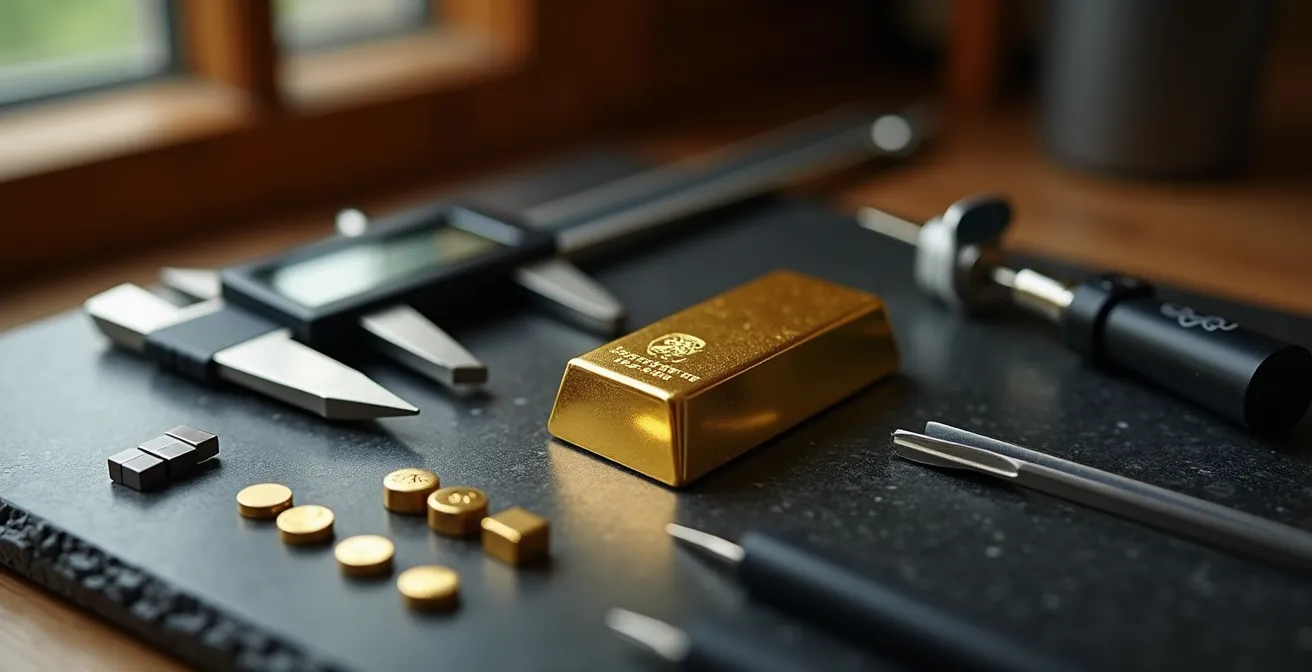
Verifying the purity of a 999.9 fine gold bar is not about simple visual checks or magnet tests. It is a forensic process of non-destructive testing. For the skeptical UK buyer, true confidence comes from precise, objective measurements of physical constants like density and dimensions using calipers and scales, which can reveal even sophisticated tungsten fakes without ever damaging the bar or its packaging.
The moment you hold a new gold bar, a question surfaces: is it real? In a market where trust is paramount, the desire to verify your investment is a sign of prudence, not paranoia. Many will suggest superficial checks: inspect the markings, feel its weight, maybe even use a magnet. These are the platitudes of amateur verification. They offer a thin veneer of security against the most primitive fakes but are utterly useless against sophisticated counterfeits that have become more prevalent.
The truth is, authenticating investment-grade gold isn’t a matter of opinion or a quick glance. It’s a matter of physics. But what if the real key to verification wasn’t in complex chemical assays or damaging scratch tests, but in a methodical, scientific approach you can perform at home? This guide departs from folklore and enters the realm of forensic verification. We will focus on non-destructive testing (NDT) – a series of precise measurements that confirm your bar’s identity by testing its fundamental physical properties.
This process empowers you, the skeptical buyer, to move beyond simply trusting the packaging or the seller’s word. We will explore how to confirm a refiner’s credentials, understand the real-world value difference between fineness levels, and most importantly, how to execute a series of tests to confirm your bar’s density and dimensions with scientific rigour. This is your methodology for transforming doubt into certainty.
This article provides a structured, scientific approach to gold verification for the UK investor. Below, the table of contents outlines each critical step in the process, from understanding industry standards to performing your own precision tests.
Table of Contents: A Forensic Guide to Verifying Your Gold Bar
- What Does ‘LBMA Approved’ Mean and Why Should You Ignore Non-Approved Bars?
- Is There Any Real Difference Between 999 and 999.9 Purity?
- How Does PAMP’s Veriscan Technology Protect You from Fake Bars?
- Does a Broken Blister Pack Ruin the Resale Value of a Fine Bar?
- How to Ensure Your Fine Gold Bars Are Not Conflict Minerals?
- What Is the Difference Between 18ct, 22ct, and 24ct Gold for Investment?
- How to Spot a Tungsten-Filled Fake Gold Bar Without Drilling It?
- How to Track the Gold Spot Price to Time Your Purchase Perfectly?
What Does ‘LBMA Approved’ Mean and Why Should You Ignore Non-Approved Bars?
The term ‘LBMA Approved’ is the single most important trust signal in the global bullion market. It signifies that a refiner has met the London Bullion Market Association’s stringent Good Delivery standards. This isn’t just a quality stamp; it’s a guarantee of integrity, purity, and ethical sourcing. The LBMA acts as a gatekeeper, ensuring that only refiners with a proven track record and substantial financial stability can participate. For an investor in the UK, this is your first line of defence against subpar or fraudulent products.
To qualify, a refiner must meet incredibly high standards; according to LBMA’s strict accreditation criteria, this includes a minimum annual gold refining production of 10 tonnes and a net worth of at least £15 million. This financial and operational barrier ensures that only major, reputable players are on the list. Ignoring bars from non-approved refiners exposes you to significant risks, including questionable purity, poor liquidity when you try to sell, and potential links to illicit activities. Essentially, an LBMA-approved bar is a globally recognised and trusted asset, while a non-approved bar is a speculative risk.
Case Study: The Suspension of Russian Refiners
The real-world authority of the LBMA was demonstrated starkly following international sanctions. As a case in point, the LBMA suspended six Russian gold and silver refiners from its Good Delivery List. While bars produced before the suspension remain ‘Good Delivery’, any produced after are not accepted by the London Bullion market. This shows why it is crucial to check the *current* list, as a refiner’s status can change based on global events, directly impacting the bar’s liquidity and standing in the UK market.
To confirm a refiner’s status, you must consult the official source directly. Here is a simple protocol to follow:
- Access the official LBMA Good Delivery List via their website.
- Use the search function to find the refiner’s name as it is stamped on your bar.
- Crucially, verify the refiner is on the ‘Current List’, not the ‘Former List’. Bars from former refiners can still be valid but may require extra checks by a dealer.
- For an extra layer of security, cross-reference the bar’s markings and serial number format with the style shown on the refiner’s own official website.
Is There Any Real Difference Between 999 and 999.9 Purity?
On paper, the difference between 999 (99.9% pure) and 999.9 (99.99% pure) gold seems minuscule—a mere 0.09% variation in fineness. For the discerning UK investor, the question is whether this tiny percentage translates into a tangible difference in value and practicality. The short answer is: very little for the average investor, but the distinction is still meaningful. Both purities are considered 24 carat gold and are exempt from VAT in the UK, as they exceed the 99.5% (995) purity threshold for investment gold.
From a financial standpoint, the market reflects this small difference. A recent analysis of UK spot prices showed a premium of only about £2.40 per troy ounce for 999.9 gold over 999 gold. When it comes to resale, most UK bullion dealers offer the same buyback price for both, as they are both melted down and reassayed. The primary distinction often lies in branding and product type. Premium coins like the Royal Mint’s Britannia or the Canadian Maple Leaf are struck to a 999.9 standard, whereas many generic cast bars are produced at 999 fineness. This is more a reflection of manufacturing and marketing than a fundamental divergence in investment quality.
The following table provides a clear comparison from a UK investor’s perspective, highlighting the key practical differences between the two fineness levels.
| Aspect | 999 Gold (99.9% Pure) | 999.9 Gold (99.99% Pure) |
|---|---|---|
| UK VAT Status | VAT-free (exceeds 995 minimum) | VAT-free (exceeds 995 minimum) |
| Resale to UK Dealers | Same buyback price | Same buyback price |
| Common UK Products | Generic cast bars, some coins | Royal Mint Britannia, Canadian Maple Leaf |
| Density for Testing | 19.3 g/cm³ | 19.3 g/cm³ (no practical difference) |
| Premium Over Spot | Lower manufacturing premium | Slightly higher premium (£2-3/oz) |
Ultimately, for home testing purposes, particularly density tests, the difference is negligible. Both purities share a density of approximately 19.3 g/cm³, making them indistinguishable with standard equipment. The choice between 999 and 999.9 is therefore less about intrinsic value and more about preference for specific products, brand recognition, and a very slight premium for the “four nines” fineness associated with sovereign mints.
How Does PAMP’s Veriscan Technology Protect You from Fake Bars?
PAMP (Produits Artistiques Métaux Précieux), a leading Swiss refiner, has tackled the issue of counterfeiting head-on with an innovative technology called Veriscan. This system moves verification from the macroscopic to the microscopic level. At its core, Veriscan technology is a form of surface fingerprinting. During production, the unique microscopic topography of each bar’s surface—its unique pattern of ridges, valleys, and textures—is scanned and stored in a secure database. This digital fingerprint is as unique as a human one.
When you, the owner, want to verify the bar, you use the PAMP Veriscan mobile app. The app uses your phone’s camera to scan a portion of the bar’s surface and compares it to the record stored in PAMP’s database. If the microscopic patterns match perfectly, the app confirms authenticity with a green ‘Authentic’ signal. If there is no match, it flags the bar as ‘Not Verified’, indicating a potential counterfeit or an issue requiring dealer investigation. This technology provides a high-tech, non-destructive method of verification that is tied directly to the physical object, rather than just its packaging or a paper certificate which can be more easily faked.

As the image above suggests, the microscopic surface of a gold bar is filled with intricate patterns. Veriscan technology captures these details, making it exceptionally difficult for counterfeiters to replicate. They would not only have to match the weight, dimensions, and purity of the gold, but also the exact, unique surface texture of a specific, registered bar. To use this technology, ensure you are buying a PAMP product that is explicitly marked with the Veriscan logo. The process is straightforward for anyone with a smartphone in the UK.
- Download the ‘PAMP VERISCAN’ app from the Apple App Store or Google Play.
- Ensure your bar is a PAMP product featuring the Veriscan logo, typically on the certicard packaging.
- Open the app and select ‘Scan Product’.
- Follow the on-screen guide to position your phone’s camera over the bar’s surface.
- The app will perform the micro-surface scan and cross-reference it with the PAMP database, delivering a result in seconds.
Does a Broken Blister Pack Ruin the Resale Value of a Fine Bar?
A common fear among new gold investors is that damaging the sealed plastic blister pack, or certicard, that encases their bar will severely harm its value. The short answer is: yes, it will likely reduce the immediate resale price, but it does not ruin the bar’s intrinsic value. The packaging serves as a seal of authenticity and an assay certificate from the refiner. Breaking it removes that first, easy layer of trust for a potential buyer or dealer. Consequently, they must now expend time and resources to re-verify the bar’s purity and weight themselves.
This inconvenience is passed on to the seller in the form of a lower buyback price. Major UK bullion dealers often state that a 5-10% discount is typically applied for bars with damaged packaging. This reduction doesn’t reflect a loss in the gold’s value, but rather the cost of reassaying and the slightly lower liquidity of a “loose” bar compared to a pristine, sealed one. However, this is where your ability to perform non-destructive home verification becomes a powerful tool. If you can confidently demonstrate the bar’s authenticity, you are in a much stronger negotiating position.
This perspective is reinforced by experts in the field. As the team at Gold Bank UK advises, the physical properties of the bar are the ultimate arbiter of its authenticity:
You can test the bar’s weight and dimensions to compare them against standard measures for gold, since counterfeit bars often have irregular sizes or densities. Using these methods helps you confidently prove your gold’s authenticity when selling or transferring ownership.
– Gold Bank UK, How to Authenticate Gold Bars Before Selling
Therefore, while a pristine blister pack is always preferable for maintaining maximum resale value and liquidity, a broken seal is not catastrophic. It simply shifts the burden of proof. By mastering the precision measurement techniques discussed in this guide, you retain the ability to prove the bar’s legitimacy, mitigating much of the potential financial penalty. The gold is still gold; you just have to prove it scientifically.
How to Ensure Your Fine Gold Bars Are Not Conflict Minerals?
Ensuring your gold is ethically sourced and not a ‘conflict mineral’ is a critical aspect of responsible investing. The term refers to minerals mined in areas of armed conflict and sold to finance the fighting. For UK investors, the primary assurance of ethical sourcing comes, once again, from the LBMA’s Responsible Sourcing Programme. This is a mandatory requirement for all Good Delivery List refiners. Each refiner must undergo a rigorous annual third-party audit to prove their supply chain is free from money laundering, terrorist financing, and human rights abuses.
When you buy from an LBMA-approved refiner, you are indirectly supporting this framework. Refiners are now required to provide greater transparency, including disclosing the countries of origin for their gold. This diligence is not just a checkbox exercise; it involves continuous improvement and proactive measures. For example, the German refiner C. Hafner has been highlighted for its leadership in disclosure and for reflecting on best practices to stay ahead of regulatory requirements. This shows the system is dynamic and responsive. As an investor, your role is to perform due diligence on your dealer and the bar’s refiner.
Your UK Due Diligence Checklist for Ethical Gold
- Dealer Legislation: Request the dealer’s Modern Slavery Act 2015 statement. This is a mandatory disclosure for UK companies with a turnover exceeding £36 million and shows their commitment to ethical supply chains.
- Refiner Status: Use the LBMA’s official website to verify the bar’s refiner is on the current Good Delivery List and has an active ‘RSP Compliant’ status.
- Origin Data: Ask your dealer for the specific Country of Origin data for your bar. LBMA-compliant refiners are required to collect and disclose this information.
- Trade Associations: Check if the dealer is a member of a reputable UK trade body like the National Association of Jewellers (NAJ), which has its own ethical trading standards.
- Chain of Custody: For high-value purchases, request the chain of custody documentation, which traces the bar’s journey from the accredited refiner to the dealer.
By following this checklist, you are actively participating in the demand for ethically sourced gold. Your purchase becomes more than just a financial investment; it’s a vote for transparency and accountability in the global bullion industry. Choosing an LBMA-accredited bar from a reputable UK dealer is the most effective way to ensure your investment is not tainted by conflict.
What Is the Difference Between 18ct, 22ct, and 24ct Gold for Investment?
When considering gold for investment in the UK, the carat (ct) is a critical factor that defines purity, tax status, and liquidity. It’s a measure of fineness out of 24 parts. 24ct gold (99.9% to 999.9 fineness) is pure gold and is the standard for investment bars. 22ct gold (91.67% fineness) contains other alloys for durability and is the standard for coins like the British Sovereign and the South African Krugerrand. 18ct gold (75% fineness) is primarily used for jewellery and is unsuitable for investment due to its lower purity and high premiums over the scrap value.
For UK investors, the most significant differentiator is the treatment for Capital Gains Tax (CGT). All gold investment coins produced by the Royal Mint, such as the 22ct Sovereign and the 24ct Britannia, are CGT exempt. This means any profit made upon their sale is tax-free. In contrast, all gold bars, regardless of their 24ct purity, are CGT liable. This single tax rule makes UK-minted coins a highly attractive investment vehicle compared to bars for those concerned with tax efficiency.
The Royal Mint uses 999.999 fineness, known as ‘six nines fineness’, as its benchmark for purity. 995 fineness is the minimum allowed purity for gold investment bars and is used as raw material for further gold alloying. The London Bullion Market Association undertakes gold testing and produces a ‘Good Delivery List’ that specifies standards for gold investment bars.
– BullionByPost, Gold Purity – A Simple Guide
The choice between these purities ultimately depends on your investment strategy. If your priority is holding the purest form of gold with the lowest premium over the spot price, a 24ct generic bar is an excellent choice, though subject to CGT. If tax efficiency and high liquidity are your primary goals, then CGT-exempt 22ct Sovereigns or 24ct Britannias are superior options, despite their slightly higher premiums. The table below summarises these key differences for the UK market.
| Gold Type | Purity | UK CGT Status | Typical Premium | Liquidity |
|---|---|---|---|---|
| 24ct Britannia Coin | 999.9 (99.99%) | CGT Exempt | 5-8% over spot | Excellent |
| 22ct Gold Sovereign | 916.7 (91.67%) | CGT Exempt | 4-7% over spot | Excellent |
| 24ct Generic Bar | 999 (99.9%) | CGT Liable | 2-4% over spot | Good |
| 18ct Jewellery | 750 (75%) | CGT Liable | Scrap value only | Poor (scrap market) |
How to Spot a Tungsten-Filled Fake Gold Bar Without Drilling It?
The most sophisticated threat to gold investors is the tungsten-filled fake bar. Tungsten is used by counterfeiters because its density (19.25 g/cm³) is remarkably close to that of gold (19.3 g/cm³), allowing it to defeat simple weight tests. However, it is not identical, and this small variance—along with other differing physical properties—is the key to its detection through non-destructive testing (NDT). Spotting such a fake requires a forensic approach, using precision tools to check the bar’s fundamental physical constants. Forget the magnet; this is a lab-style verification you can do at home.
The process involves a sequence of tests, each one designed to cross-verify the others. You will need a digital caliper for measuring dimensions and a precision digital scale (accurate to 0.01g) for weight and specific gravity tests. These tools are readily available in the UK from online retailers like Amazon for a modest investment (£15-£30 each). The goal is to identify a density anomaly. Even a small deviation from the expected specific gravity of gold is a major red flag. The setup in the image below illustrates the kind of careful, clean environment needed for accurate measurement.

A more advanced, and arguably the most conclusive, NDT method involves sound. The speed of sound through gold is significantly different from that of tungsten. According to testing equipment specifications, the velocity of sound in gold is 3240 m/s, versus 5180 m/s in tungsten—a 60% difference. While an ultrasonic thickness gauge is an advanced tool, it is the gold standard for detecting tungsten cores. Surface-level tests like X-Ray Fluorescence (XRF) are unreliable for this, as their penetration depth is only about 10 microns, meaning they cannot detect a tungsten core beneath a thin gold plating.
Here is a step-by-step home testing protocol for UK investors:
- Visual & Dimension Check: Use digital calipers to meticulously measure the bar’s length, width, and thickness. Compare these dimensions to the official specifications provided by the mint or refiner. Any deviation is a warning sign.
- Precision Weight Test: Use a precision scale (0.01g accuracy) to weigh the bar. A 2g variance on a kilo bar, for example, is enough to indicate a potential tungsten core.
- Specific Gravity Test: This is the most crucial home test. Weigh the bar in the air, then weigh it while fully submerged in water. The specific gravity is (Weight in Air) / (Weight in Air – Weight in Water). The result for gold must be extremely close to 19.3 g/cm³.
- Sound Test (The ‘Ping’ Test): While not as precise as ultrasonic measurement, the ‘ping’ test can be indicative. Gently tap the bar with another small metal object. Gold should produce a long, high-pitched ringing sound. Base metals and tungsten produce a dull, shorter ‘clunk’.
- Professional Verification: If any of these tests fail or raise suspicion, do not hesitate. Take the bar to a reputable UK bullion dealer for professional XRF and ultrasonic testing. The typical cost of £20-£50 is a small price to pay for certainty.
Key Takeaways
- Verification is a scientific process; rely on non-destructive testing of physical constants (density, dimensions), not on subjective visual checks.
- LBMA approval is your primary assurance of purity and ethical sourcing. Always verify a refiner on the LBMA’s *current* Good Delivery List.
- For UK investors, CGT-exempt coins (Sovereigns, Britannias) offer significant tax advantages over CGT-liable gold bars, despite bars having lower premiums.
How to Track the Gold Spot Price to Time Your Purchase Perfectly?
Timing a gold purchase to perfection is an elusive goal, as the market is influenced by countless global factors. However, understanding the components of the price you pay can lead to more strategic buying. The price of any gold product in the UK is composed of two main parts: the gold spot price and the dealer’s premium. The spot price is the live market price for one troy ounce of gold and is constantly fluctuating. The premium is the additional charge levied by the dealer to cover fabrication, business overheads, and profit. While you can’t control the spot price, you can be strategic about the premium.
The premium is not fixed; it varies significantly based on the product type, its size, and even the time of day. Generally, larger bars have lower percentage premiums than smaller bars or coins. For example, a 10oz bar will have a much smaller premium per ounce than a 1oz bar. Likewise, generic cast bars have lower premiums than highly sought-after coins like the Gold Britannia. Tracking the spot price using live charts available on any major bullion dealer’s website is the first step. The goal is to buy during market dips, but more importantly, to buy products with the lowest possible premium that still meet your investment goals (e.g., CGT efficiency).
For UK investors, liquidity can also influence price. Premiums may be slightly lower during UK business hours when the London market is most active. The following table compares typical dealer premiums for popular UK investment products, offering insight into how to minimise this cost.
| Product Type | Typical UK Dealer Premium | Best Time to Buy | CGT Status |
|---|---|---|---|
| 1oz Gold Britannia | 5-8% over spot | During price dips | Exempt |
| 1oz Generic Gold Bar | 2-4% over spot | UK business hours (better liquidity) | Liable |
| Gold Sovereign | 4-7% over spot | During price dips | Exempt |
| 10oz Gold Bar | 1.5-3% over spot | London PM Fix timing | Liable |
Ultimately, ‘perfect’ timing is less about predicting the market’s peak or trough and more about making an informed, cost-effective decision. This means choosing a product with a low premium that aligns with your tax strategy (CGT-exempt vs. liable) and buying from a reputable dealer. By focusing on minimising the premium, you control a key variable in your purchase price, ensuring you get the most gold for your money at any given spot price.
With this knowledge, you are no longer a passive buyer but an active, informed verifier. The next logical step is to acquire the necessary tools—a precision scale and digital calipers—and begin practicing these non-destructive tests to build your confidence and secure your investments.