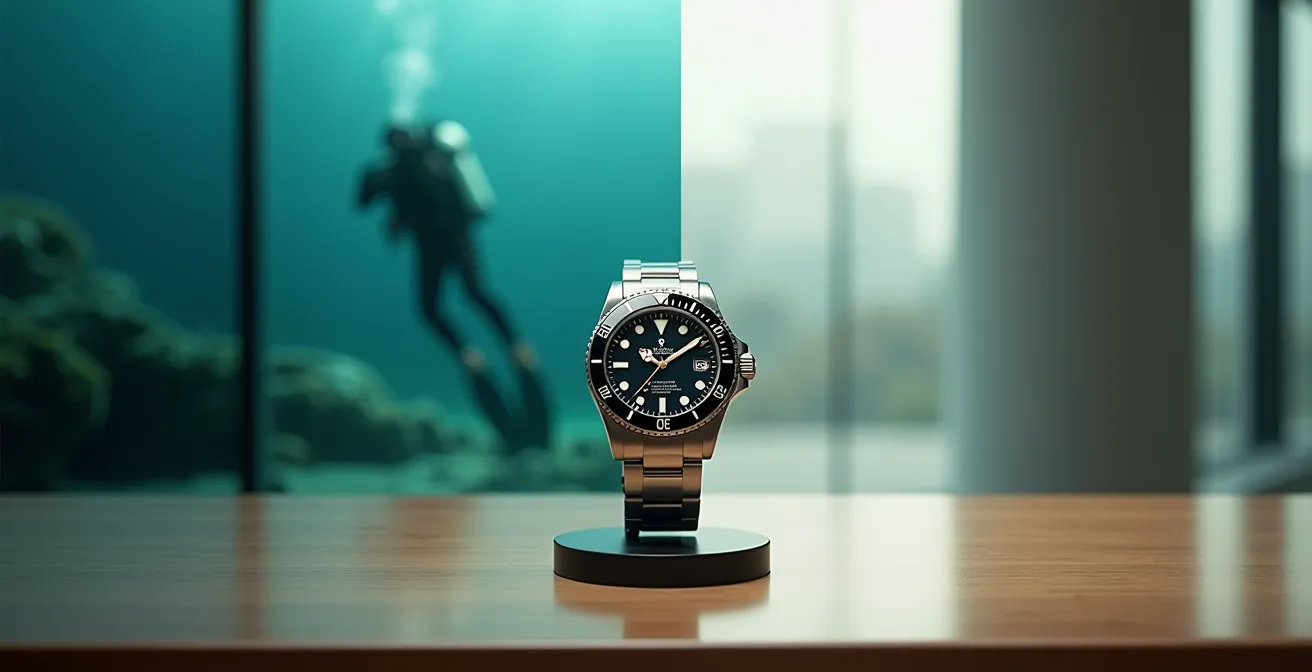
The perfect diver’s watch for a British lifestyle isn’t about having the highest specs, but about understanding the practical trade-offs between durability and daily wearability.
- Water resistance ratings are theoretical; a 200m minimum is essential for actual water sports like surfing or sailing.
- Case materials present a choice: steel offers repairable durability, titanium provides lightweight comfort, and ceramic gives scratch-resistance at the cost of being brittle.
Recommendation: Prioritise a watch with a robust steel case, a true 200m water resistance rating, and a slim profile to ensure it performs as well in a Monday meeting as it does in the Cornish surf.
For the active professional in the UK, the search for the perfect watch is a unique challenge. You might spend your weekend battling the chop while sailing off the Isle of Wight or catching waves in Cornwall, but come Monday morning, you need a timepiece that sits comfortably and stylishly under a shirt cuff in a London boardroom. The market is flooded with “diver’s watches,” but many are merely styled for the part, unprepared for the realities of a cold sea spray, let alone a deep dive.
The common advice is often superficial. Many will tell you to just check the water resistance rating or to follow the lead of style icons like James Bond. But these platitudes miss the point. A number on a dial doesn’t tell you how a watch will handle the shock of cold water, and a cinematic endorsement doesn’t guarantee practicality. True versatility isn’t a feature you can buy; it’s a balance you must understand.
This guide takes a different approach. We’re moving beyond the marketing and into the mechanics of what makes a timepiece a genuine ‘go-anywhere, do-anything’ tool. The key is not to find the “best” watch, but to understand the critical, practical trade-offs of each design choice. It’s about asking the right questions: Will this bezel be useful for more than just timing a dive? Is this ultra-hard material worth the risk of a catastrophic drop on your kitchen tiles? And can it genuinely bridge the gap between wave-break and boardroom?
We will dissect the crucial elements of a diver’s watch, from the misunderstood water resistance ratings to the real-world durability of its case. By the end, you’ll have the knowledge to select a watch based on its toolish integrity and its suitability for the unique demands of an active British life.
This article breaks down the essential considerations into clear, practical sections. Explore the full table of contents below to navigate directly to the answers you need to make a confident choice.
Summary: How to Find a Diver’s Watch That Works for Your Life
- Why ’30m Water Resistance’ Does Not Mean You Can Swim 30 Metres Deep?
- How to Use a Rotating Bezel for Daily Tasks Beyond Scuba Diving?
- Which Clasp Mechanisms Allow for Instant Adjustment Over a Wetsuit?
- Super-LumiNova vs Tritium: Which Is Best for a British Winter’s Darkness?
- What Are the ISO 6425 Requirements That Define a True Professional Diver?
- Can You Wear a Sports Watch with a Lounge Suit in 2024?
- Can You Shatter a Ceramic Watch Case if You Drop It on Tiles?
- Ceramic, Titanium, or Steel: Which Case Material Survived the Scratch Test?
Why ’30m Water Resistance’ Does Not Mean You Can Swim 30 Metres Deep?
One of the most misleading specifications in the watch world is water resistance. The number printed on the dial—30m, 50m, 100m—is not a depth rating. It refers to a static pressure test performed in a laboratory. It does not account for the dynamic pressure changes created by moving your arm through water, diving into a pool, or being hit by a wave. For anyone leading an active life in and around the UK’s waters, understanding the real-world implications is non-negotiable.
The “30m” rating, often found on dress watches, is essentially splash-proof. It can handle hand washing or getting caught in a light English rain shower, but it should never be submerged. A “50m” rating offers slightly more protection, suitable for washing the car, but still not for swimming. To be safe for swimming and snorkelling in calm waters, you need a minimum of 100m resistance. However, for activities like surfing, sailing, or any recreational scuba diving, the baseline is 200m. This level of resistance is built to withstand the significant dynamic pressures of water sports.
The reason for this discrepancy lies in the testing standards. A watch rated for 30 metres is only tested to 3 atmospheres of static pressure. In contrast, a true diver’s watch certified under ISO 6425 must pass a 125% overpressure test on every single unit. This means a 200m watch is actually tested to 250m of pressure, providing a crucial safety margin. For serious use in demanding conditions like the North Sea, a 300m+ rating provides the ultimate peace of mind.
How to Use a Rotating Bezel for Daily Tasks Beyond Scuba Diving?
The unidirectional rotating bezel is the hallmark of a diver’s watch, designed to let divers track elapsed time underwater safely. But for the 99% of the time you’re on dry land, it transforms into an incredibly useful analogue timer. Its “toolish integrity” shines through in everyday situations, from the mundane to the critical. Think of it as a low-tech, high-reliability tool for managing your day, far more tactile and immediate than pulling out your phone.
You can use it to time your parking meter in Manchester, track how long your steak has been on the grill, or manage your presentation time in a meeting. The method is simple: align the “zero” marker (usually a triangle or “pip”) on the bezel with the minute hand. As time passes, the minute hand will point to the corresponding number on the bezel, showing you exactly how many minutes have elapsed. It’s a simple, satisfying, and effective way to keep track of short-term tasks.
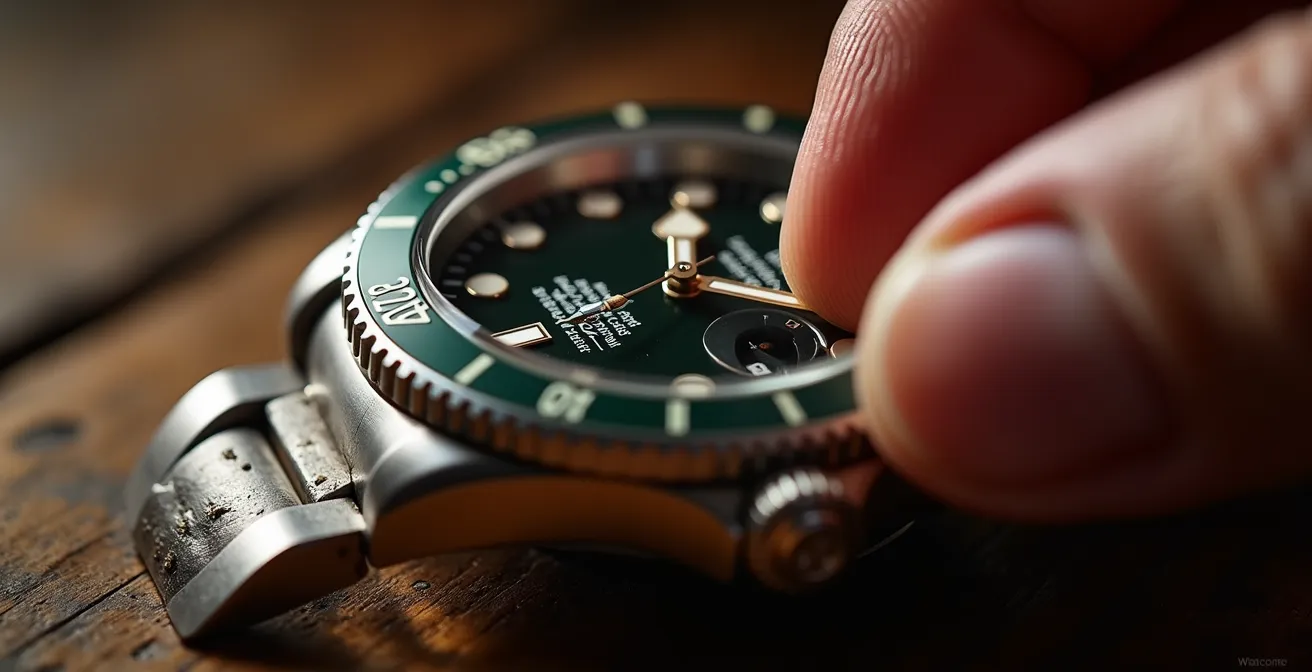
As the image above illustrates, the physical act of setting the bezel creates a mental note. Beyond simple timers, a clever user can even track a second time zone, a particularly useful trick for UK professionals coordinating with international offices.
Case Study: The Bezel as a GMT for the Business Traveller
A technique not widely publicised allows a standard dive bezel to function as a “poor man’s GMT.” For example, if you’re in Tokyo (+9 hours from GMT) and need to track London office hours, you can rotate the bezel. By treating the hour hand as your reference, you can offset the bezel to show the corresponding hour in the UK. This practical hack, highlighted by guides from brands like URORO, is invaluable for the British business traveller needing to manage calls with US or Asian colleagues without a dedicated GMT watch.
Which Clasp Mechanisms Allow for Instant Adjustment Over a Wetsuit?
A watch’s utility is only as good as its comfort and fit, and this is where the clasp mechanism becomes critical. For anyone who might wear their watch over a sailing jacket or a thick wetsuit for a chilly Cornish surf session, the ability to make quick, tool-free adjustments is essential. A standard pin-buckle or butterfly clasp simply won’t do. You need a dedicated diver’s extension or an on-the-fly micro-adjustment system that provides both security and flexibility.
These systems fall into two main categories. The first is a simple fold-out diver’s extension, which adds a fixed length to the bracelet. It’s a binary, all-or-nothing solution. The more advanced and far more practical solution is a glide-style micro-adjustment system. This allows the wearer to slide the clasp along a track in small increments (typically 1-2mm at a time) to achieve a perfect fit, whether over a wetsuit or just to accommodate for wrist swell on a warm day. This is the pinnacle of functional design, blending boardroom comfort with wave-break readiness.
Several brands have perfected this technology, offering robust systems that can be operated easily, even with gloved hands. For the UK buyer, it’s worth noting the availability of these systems, including from excellent British brands.
| Brand/System | Adjustment Range | Gloved Operation | UK Availability |
|---|---|---|---|
| Rolex Glidelock | 20mm extension | Excellent | Authorised dealers |
| Tudor T-Fit | 8mm quick adjust | Very Good | Wide availability |
| Christopher Ward Micro-adjust | 15mm extension | Good | UK-based brand |
| Omega Adjustable Clasp | 21mm extension | Very Good | Boutiques nationwide |
Super-LumiNova vs Tritium: Which Is Best for a British Winter’s Darkness?
Legibility in low light is a cornerstone of any good tool watch. In the UK, this isn’t just a concern for night dives; it’s a daily reality during the long, dark winter mornings and evenings. The ability to glance at your wrist at 6 AM in December and instantly read the time is a practical necessity. The two dominant technologies for achieving this are photoluminescent compounds like Super-LumiNova and radioluminescent tritium gas tubes.
Super-LumiNova is the industry standard. It’s a non-radioactive pigment that acts like a light-storage battery. It needs to be “charged” by a light source (sunlight or artificial light), after which it glows brightly, with the intensity fading over several hours. It’s brilliant for transitioning from a bright office to a dim pub, but its glow will be significantly diminished after a full night’s sleep.
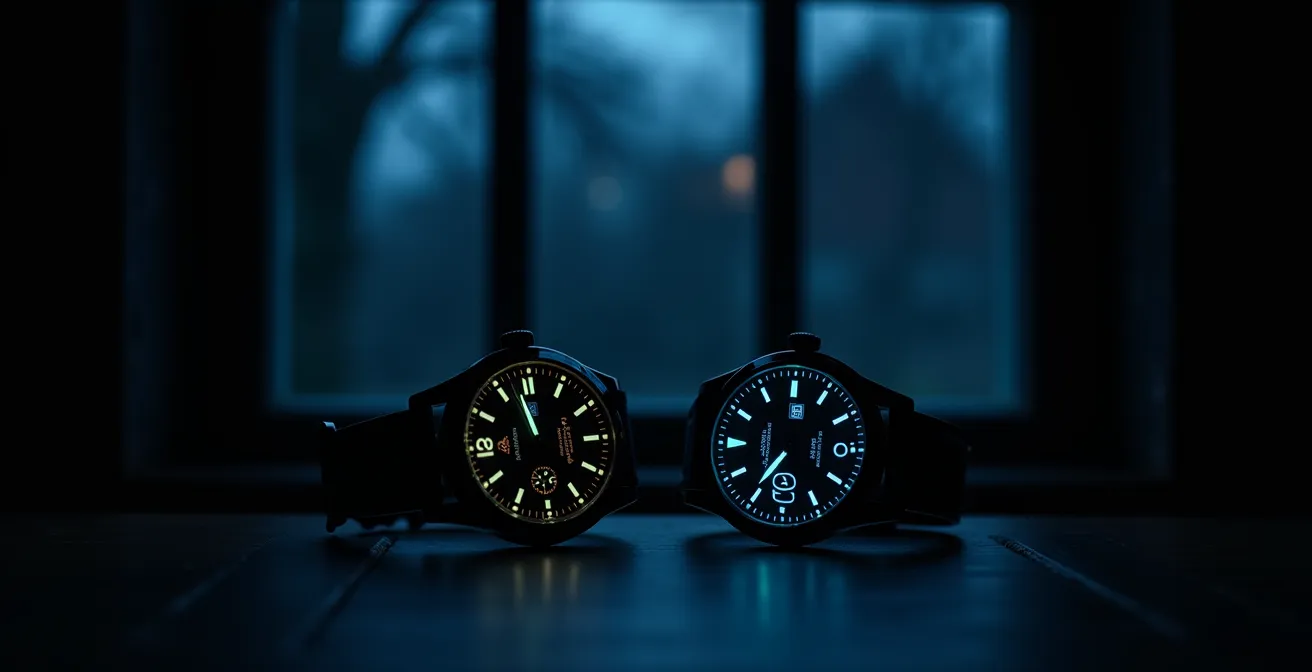
Tritium (H3) gas tubes, on the other hand, offer a different kind of performance. These are tiny, self-powered glass tubes that don’t need charging. They provide a constant, unwavering glow that will be just as visible at 4 AM as it was at 10 PM. This technology boasts a constant glow thanks to the 12.3-year half-life of the gas inside, meaning it will remain consistently visible for decades. While the initial brightness of Super-LumiNova is higher, tritium’s always-on reliability is a compelling advantage for those who value absolute legibility at any hour.
When you’re not diving, the ideal lume glows brightly and for a long time. Diving changes this scenario. If you need your lume underwater, it means that you’re either diving in murky/dark water or you’re on a night dive.
– James Stacey, Hodinkee
The choice is a practical trade-off: the intense but fading brightness of Super-LumiNova versus the perpetual, steady glow of tritium. For the British user, tritium offers a distinct advantage for navigating the long winter nights.
What Are the ISO 6425 Requirements That Define a True Professional Diver?
In a market full of “dive-style” watches, the term “diver’s watch” can feel diluted. However, there is an international standard that separates the serious tools from the fashion accessories: ISO 6425. A watch that is certified to this standard has undergone a rigorous battery of tests that guarantee its performance under pressure. For the buyer seeking a watch with true toolish integrity, looking for ISO 6425 compliance is the ultimate assurance of quality and durability.
This isn’t a simple water resistance check. The standard is a comprehensive suite of requirements covering everything from legibility to shock and magnetic resistance. It dictates that every single watch (not just a sample) must be tested for water resistance at 125% of its rated pressure. It mandates a unidirectional bezel to prevent accidental increases in dive time, and specifies that the time must be clearly legible from 25cm in total darkness. It is the gold standard for a professional-grade underwater instrument.
While many great watches are built to meet these standards without being officially certified (a costly process), a brand’s commitment to ISO 6425 signals a no-compromise approach to engineering.
Your Action Plan: Key ISO 6425 Requirements to Check
- Water Resistance: Verify a minimum 100m rating and ask if the brand tests every watch to 125% of that pressure.
- Bezel Function: Confirm it is unidirectional (rotates only counter-clockwise) with clear minute markings for the full 60 minutes.
- Low-Light Legibility: Check for clear minute markings and a luminous running indicator (like a glowing second hand) to show the watch is working in the dark.
- Robustness: Look for specifications on magnetic resistance (to 4,800 A/m) and shock resistance.
- Corrosion Resistance: Ensure the case and bracelet materials (like 316L steel) are certified for long-term saltwater exposure.
Case Study: British Brands Exceeding the Standard
British manufacturer NITE Watches provides a powerful example of real-world application. Their Alpha series is engineered to exceed ISO 6425, with their 300m rating being a conservative figure. As detailed in their technical briefs, the company supplies watches to UK marine rescue professionals and diving instructors who use them during demanding North Sea operations. This field-testing validates their durability far beyond lab conditions, proving their worth for both professional use and recreational activities like Cornish surfing.
Can You Wear a Sports Watch with a Lounge Suit in 2024?
The old sartorial rule was simple: a sports watch was for sport, a dress watch was for a suit. But those lines have been blurring for decades, and today, they are all but erased. In 2024, wearing a diver’s watch with a lounge suit is not just acceptable; it’s a confident style statement. It projects an image of active, capable masculinity, suggesting a life lived beyond the confines of the office. For the “adventure guide in a suit,” it’s the natural choice.
Once you understand that a dive watch is largely an unnecessary bit of diving kit in 2024, you can relax that shoulder tension a bit and just enjoy the buying process.
– Esquire UK Editorial Team, Esquire UK Dive Watch Buying Guide
The key to pulling it off successfully lies in proportion and context. A monstrous, 46mm behemoth will always look out of place with tailored clothing. The trick is to choose a diver’s watch with a more classic and restrained profile. Look for case diameters between 39mm and 42mm and, crucially, a case thickness under 13mm. This ensures the watch can slide comfortably under a shirt cuff rather than getting caught on it.
The transition from a functional tool to a style accessory has been cemented by cultural tastemakers and real-world adoption in the most formal of environments.
Case Study: The Bond Effect and The City of London Standard
Daniel Craig’s portrayal of James Bond, consistently pairing an Omega Seamaster with immaculate Tom Ford suits, has set a modern precedent. It demonstrated that a robust tool watch could be elegant. This trend has been fully embraced in professional circles. In the City of London, for example, the Tudor Black Bay 58—with its vintage-inspired 39mm case and slim profile—has become a go-to choice. Its popularity stems directly from its ability to look perfectly at home in the boardroom during the week and on a sailboat over the weekend, embodying the modern British work-life balance.
Can You Shatter a Ceramic Watch Case if You Drop It on Tiles?
Ceramic has become a popular “luxury” material for watch cases, prized for its incredible scratch resistance and vibrant, lasting colour. On paper, it seems like the perfect material for a do-anything watch; it will look brand new for years. However, this impressive hardness comes with a significant practical trade-off: brittleness. While steel or titanium will dent or scratch upon a hard impact, ceramic can shatter. And yes, dropping it on hard surfaces common in British homes poses a very real risk.
The material’s crystalline structure, which makes it so hard, also means it cannot absorb impact energy by deforming. Instead, that energy can cause a catastrophic failure. A drop from waist height onto a stone kitchen floor or, notoriously, the hard Victorian tiles found in many UK bathrooms, can be enough to crack or even shatter the case. This isn’t a scratch you can polish out; it’s a terminal event for the case.
This risk is compounded by the cost of repair. Unlike a steel case that can be refinished, a broken ceramic case must be replaced entirely. This is an expensive procedure, often costing 3-4 times more than servicing a steel equivalent. This is a critical factor to weigh. The trade-off is clear: you gain near-perfect immunity to daily scratches at the expense of vulnerability to a single, disastrous impact. For a watch intended for an active lifestyle, where knocks and drops are inevitable, this makes ceramic a high-risk proposition.
Key Takeaways
- A true “do-anything” watch needs a minimum of 200m water resistance for active water sports.
- The rotating bezel is a highly practical everyday tool for timing tasks, not just for diving.
- Material choice is a trade-off: Steel is durable and repairable, titanium is light, and ceramic is scratch-proof but brittle.
Ceramic, Titanium, or Steel: Which Case Material Survived the Scratch Test?
The choice of case material is the final and perhaps most personal decision. It dictates the watch’s weight, its feel against the skin, its long-term appearance, and its ability to withstand the rigours of an active life. There is no single “best” material; there is only the best practical trade-off for your specific needs, balancing scratch resistance, impact durability, and cost. The three primary contenders are 316L Stainless Steel, Grade 2 or 5 Titanium, and Zirconia Ceramic.
316L Stainless Steel is the industry workhorse. It’s relatively heavy, giving a watch a reassuring heft. It scratches, but these “scars” are often seen as part of the watch’s story. Crucially, a steel case can be polished and refinished, restoring its appearance for a reasonable cost. Titanium is about 40% lighter than steel and has a warmer feel on the skin, a noticeable benefit during a cold British winter. It is harder to scratch than steel and develops a unique dark patina over time, which many users appreciate. Refinishing is possible but more expensive than with steel.
Ceramic sits at the top for scratch resistance. It will shrug off almost any daily encounter with keys, desks, or door frames. However, as we’ve discussed, it is brittle. The real-world test is often not about scratches, but about survival.
Field Test: The GearJunkie Durability Verdict
In a long-term test, the team at GearJunkie subjected watches of different materials to months of hard outdoor use. Steel watches accumulated scratches but were easily polished back to a near-new state. Titanium also held up well, with its developing patina seen as a positive. The ceramic watch remained perfectly pristine until it was accidentally dropped on concrete, at which point the case failed completely. Their verdict was clear: for an active lifestyle, steel offers the ultimate balance of everyday durability and long-term repairability.
| Material | Scratch Resistance | UK Winter Feel | Repair Cost | Weight |
|---|---|---|---|---|
| 316L Steel | Moderate | Cold initially | £150-300 polish | Heavy |
| Grade 2 Titanium | Good | Warmer feel | £400-600 refinish | 40% lighter |
| Ceramic | Excellent | Temperature neutral | £2000+ replacement | Moderate |
| 904L Steel (Rolex) | Good | Cold initially | £200-400 polish | Heavy |
Ultimately, the perfect diver’s watch is a tool engineered to serve your life. Armed with this knowledge of practical trade-offs, you can now assess any timepiece not just for its brand or beauty, but for its genuine ability to perform, from a weekend battling the North Sea to a week of meetings in the city.
Frequently Asked Questions about Diver’s Watch Durability
What household surfaces pose the highest risk to ceramic watches?
Victorian bathroom tiles, stone kitchen floors, and brick garden walls present the highest impact risk due to their hardness and common presence in British homes.
Can micro-cracks compromise water resistance?
Yes, even invisible hairline cracks from impacts can breach the water-resistant seal, particularly problematic for watches intended for diving.
Is ceramic worth the risk for a dive watch?
While ceramic offers superior scratch resistance, the inability to polish out damage and high replacement costs make titanium or steel more practical for active use.