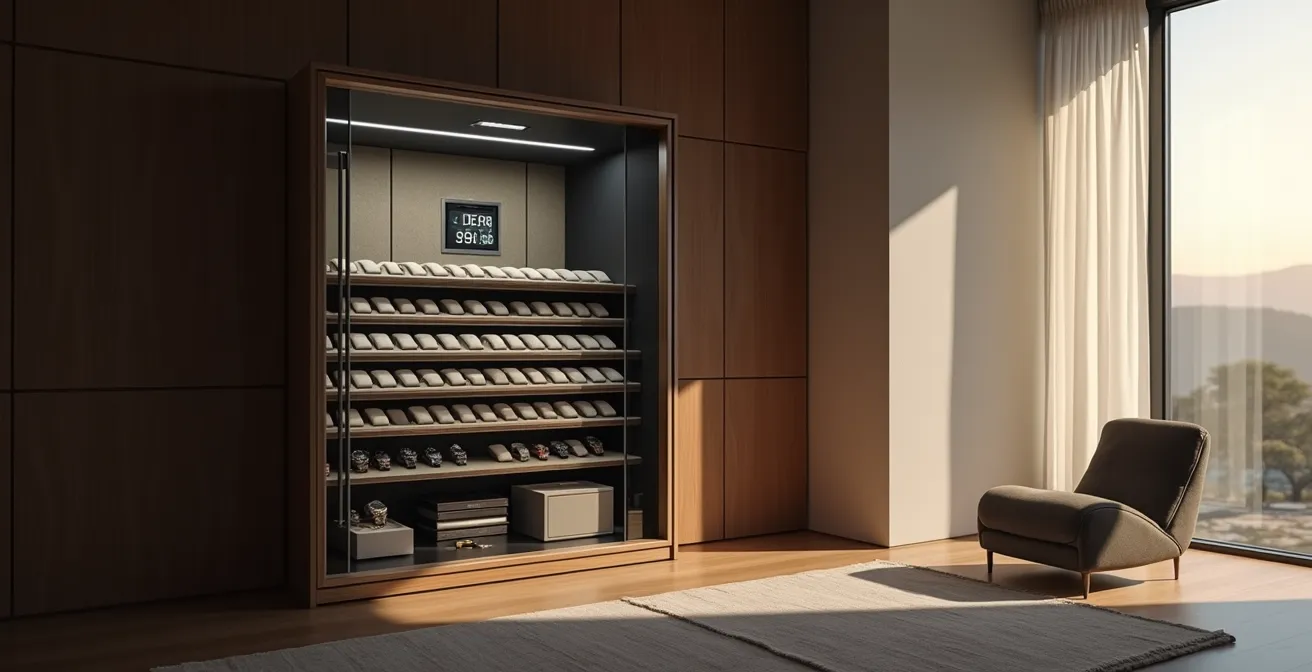
The biggest threat to your luxury watch collection in the UK isn’t theft, but ambient humidity silently destroying its investment value.
- Standard storage solutions, including original boxes and non-climate-controlled safes, can inadvertently trap moisture and accelerate corrosion.
- The professional solution is to create stable, isolated micro-environments for each timepiece using specific materials and monitoring techniques.
Recommendation: Adopt a conservator’s mindset. Your primary task is to control the immediate environment of each watch, not just the room it’s in, to safeguard its material integrity and future worth.
For the discerning collector in the United Kingdom, acquiring a luxury timepiece is just the beginning of the journey. The real stewardship lies in its preservation. In a climate as persistently damp as the UK’s, the most insidious threat to your collection is not a burglar, but the very air around you. Moisture, an invisible enemy, relentlessly seeks to infiltrate watch cases, tarnish dials, corrode delicate movements, and compromise the integrity of leather straps and presentation boxes.
Common advice often revolves around generic solutions like room dehumidifiers or simply using the original box. While not entirely incorrect, these approaches fail to address the core principle of horological conservation. They are blunt instruments in a discipline that requires surgical precision. Storing a watch in its beautiful but potentially hygroscopic (moisture-attracting) wooden box in a damp room can create a concentrated pocket of humidity, doing more harm than good.
The true key to long-term preservation, borrowed from museum conservation practice, is not broad atmospheric control, but rigorous micro-environment control. This is the science of creating a perfectly stable, isolated ecosystem for each individual watch. It means treating each timepiece as a delicate artefact deserving of its own controlled space, shielded from the fluctuations of the outside world. This is how you protect not just the mechanism, but the two things that truly define its worth: its physical condition and its long-term investment value.
This guide will walk you through the essential strategies for implementing this professional-grade approach. We will dissect the critical decisions every UK collector faces, from valuation and storage options to the nuances of material science, providing a clear framework for protecting your valuable assets against the persistent challenge of humidity.
Summary: A Conservator’s Guide to Protecting Your Luxury Watch Collection
- How Often Should You Update the Valuation of Your Luxury Timepiece?
- How Much Value Do You Lose if You Throw Away the Original Watch Box?
- Is It Safer to Keep Your £50k Watch Collection at Home or in a Bank Vault?
- Should You Polish Your Luxury Watch Before Selling It?
- How to Travel Through Airports with Expensive Watches Without Being Targeted?
- How to Stuff and Store Your Designer Bags to Prevent Sagging?
- Why Must Emerald Necklaces Be Stored Flat and Separate from Diamonds?
- Which Watch Models Have Outperformed the FTSE 100 Over the Last Decade?
How Often Should You Update the Valuation of Your Luxury Timepiece?
A valuation certificate is not a static document; it is a snapshot in a volatile market. For a UK-based collector, keeping this snapshot current is fundamental to proper insurance and asset management. Recent years have demonstrated that luxury watch prices can experience extreme fluctuations. A GWS report highlights a critical issue where many UK owners are now either dangerously underinsured, risking catastrophic loss, or overinsured, paying excessive premiums. This volatility makes regular re-evaluation a non-negotiable aspect of responsible ownership.
So, what is the correct cadence? The consensus among experts is clear. Most UK insurance specialists recommend a full revaluation every two to three years. This frequency strikes a balance between staying current with market trends and managing the cost of professional appraisals. For certain high-demand or “hype” models, an even shorter interval of 12-18 months might be prudent, especially if market intelligence suggests a significant price surge. An outdated valuation can be as damaging as humidity, leaving you financially exposed in the event of a claim.
Securing an accurate valuation in the UK requires engaging with accredited professionals. You should consult with valuers accredited by the National Association of Jewellers (NAJ) for insurance purposes, as their documentation carries the weight required by insurers. For market appraisals, utilising the expertise of major UK-based auction houses like Fellows, Bonhams, or Sotheby’s London provides a realistic view of what your piece might achieve in a sale. Always store these certificates securely and separately from your collection.
Ultimately, a current valuation is an integral part of your collection’s preservation strategy, ensuring its financial integrity is as well-maintained as its physical condition.
How Much Value Do You Lose if You Throw Away the Original Watch Box?
To a purist collector, the phrase “box and papers” is a mantra. Discarding the original box is often seen as a cardinal sin, and for good reason. On the secondary market, a “full set” that includes the original box, documentation, and accessories can command a premium of 15-30% or more over a “naked” watch. For highly collectible vintage pieces, the presence of the original, period-correct box can be a significant value multiplier. Losing the box is, therefore, a direct financial loss.
However, from a conservator’s perspective, the box’s value is more complex. While it contributes to provenance, it can also be a liability. Many watch boxes are made from wood, leather, and fabric—all hygroscopic materials that absorb and retain ambient moisture. In the damp UK climate, an improperly stored box can become a “humidity bomb,” actively concentrating moisture around the watch it’s meant to protect. This can lead to dial spotting, hand corrosion, and the degradation of leather straps.
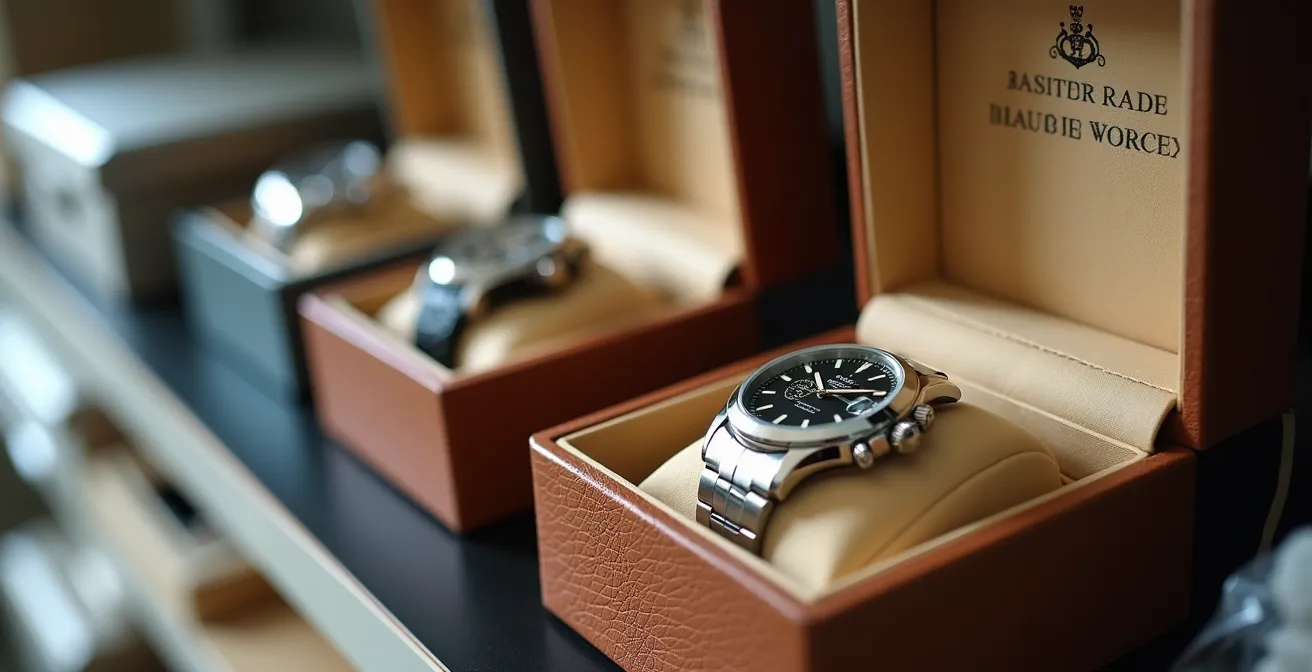
The professional solution is not to discard the box, but to manage its environment. As the image above illustrates, the boxes themselves must be preserved. Store them separately from the watches in a controlled environment, or as shown, use vacuum-sealed bags with high-quality desiccant packets. This isolates them from ambient humidity, preserving their condition and preventing them from becoming a source of contamination. The box is part of the artefact’s history, but it must be treated with the same environmental diligence as the watch itself.
Therefore, never throw away the box. Instead, elevate your preservation strategy to include it, neutralizing its environmental risk while retaining its significant financial and historical value.
Is It Safer to Keep Your £50k Watch Collection at Home or in a Bank Vault?
The decision between home storage and a bank vault is a classic security dilemma for any UK collector with a significant portfolio. A high-quality, professionally installed home safe offers immediate access to your collection, but it also places the entire security burden—and potential risk—on your shoulders. Conversely, a private vault or bank’s safe deposit box provides formidable physical security but sacrifices accessibility and, crucially, environmental control.
From a purely financial and insurance standpoint, the choice has clear implications. A Grade 3 home safe may cost over £2,000 to purchase and install, and while it provides a deterrent, it often leads to higher insurance premiums. In contrast, storing your collection in a specialized private vault can significantly lower your premiums. As a case study from Stonewall Vaults in the UK shows, clients may receive complimentary insurance up to £10,000, with premiums for higher coverage being substantially lower than for home storage due to the facility’s enhanced security protocols.
However, the most critical factor from a conservation standpoint is humidity. As the table below highlights, neither option is a perfect “out-of-the-box” solution. Standard bank vaults do not guarantee a climate-controlled environment, and a basic home safe offers no humidity control at all. This reinforces the core principle: no matter where you store your watches, you are the ultimate custodian of their micro-environment.
| Storage Option | Initial Cost | Annual Insurance Premium | Security Level | Climate Control |
|---|---|---|---|---|
| Home Safe (Grade 3) | £2000+ | Higher premiums | Moderate | Requires separate dehumidifier |
| Bank Vault (Private) | Monthly/yearly fee | Lower premiums with complimentary coverage | High | Not guaranteed – requires desiccant protection |
| Climate-Controlled Home Safe | £3000-5000 | Moderate premiums | Moderate-High | Built-in humidity control |
A climate-controlled home safe offers the best of both worlds—access and a managed environment—but comes at a significant cost. For those using a bank vault, it is imperative to package each watch in an airtight container with a desiccant to create its own stable micro-climate within the vault drawer, as you cannot rely on the facility’s ambient conditions. The analysis from IBV International Vaults provides a detailed look at the security aspects in London.
Ultimately, the “safer” option depends on your ability to actively manage the preservation environment, regardless of the location’s external security level.
Should You Polish Your Luxury Watch Before Selling It?
The question of polishing a luxury watch before a sale is one of the most debated topics in the collector community. The impulse to present a gleaming, scratch-free timepiece is understandable, but often misguided. From a conservation and value perspective, polishing is an irreversible process that removes original case material. Each time a watch is polished, its sharp, factory-defined edges and bevels are softened, altering the architect’s original design.
For vintage watches (generally pre-1990), the consensus is overwhelmingly against polishing. Collectors prize patina and the “honest” wear that tells a watch’s story. An unpolished case, even with minor scratches, is a sign of originality and is far more desirable than a poorly or over-polished one. As experts from Watch Exchange London note, the UK market has a strong preference for ‘original condition’, especially within the specialist hubs of London’s Burlington Arcade, where connoisseurs can spot a softened lug from a mile away.
For modern, common models, a very light, professional polish by a brand-certified UK service centre might be acceptable to remove superficial scuffs. However, the most critical consideration is the potential presence of humidity damage. If a watch has developed any pitting from moisture-induced corrosion, attempting to polish it out will inevitably alter the case shape and dramatically reduce its value. A professional assessment is vital before making any decision.
Your Pre-Sale Polish Decision Checklist
- Points of Contact: Identify all surfaces in question—case, bezel, bracelet—and categorize the damage. Distinguish between surface scratches and deeper pitting caused by moisture.
- Collecte: Inventory existing documentation, including service history and original purchase date, to definitively classify the watch as ‘vintage’ or ‘modern’.
- Cohérence: Confront the watch’s specific model and rarity against current market preference. Does the UK specialist market for this reference value original patina over a factory-fresh finish?
- Mémorabilité/Émotion: Assess the nature of the marks. Are they ‘character’ marks that form part of the watch’s unique story, or are they simply unsightly damage that detracts from its appeal?
- Plan d’intégration: Based on the above, decide the definitive path: no polish, a light professional polish, or a full service. Document this decision and the rationale for the next owner to maintain provenance.
In almost all cases, the safest—and most profitable—course of action is to sell the watch in its original, unpolished condition, allowing the next owner to make that irreversible decision.
How to Travel Through Airports with Expensive Watches Without Being Targeted?
Travelling through a busy UK airport like Heathrow or Manchester with high-value timepieces presents a dual risk: theft and customs complications. The key to mitigating these risks is a strategy of discretion, preparation, and an understanding of current UK regulations. The most visible watch is the most vulnerable, so the first rule is to minimise exposure.
Always wear your primary, most valuable watch on your wrist through security. Never place it in the tray where it can be easily snatched. Additional watches should be secured in a discreet, robust travel case stowed deep within your carry-on luggage, not in checked baggage which can be lost or pilfered. Preparation is equally crucial. With post-Brexit regulations, being able to prove ownership and that a watch was not purchased on your trip is vital. A frighteningly common scenario is UK residents facing a potential 20% VAT import charge on their own high-value watches when returning to the country if they cannot prove prior ownership.
To avoid this, follow a strict protocol:
- Keep digital copies of receipts, valuation certificates, and insurance documents on your phone, ideally saved offline or in the cloud for easy access at customs.
- For very large or valuable collections, consider obtaining an ATA Carnet before you travel. This is an international customs document that serves as a “passport” for your goods, simplifying re-entry into the UK without facing import duty issues.
- From a preservation perspective, use a high-quality, airtight travel case. This not only protects against impacts but also shields the watch from the rapid pressure and humidity changes experienced in an aircraft cabin, preventing moisture from being forced past the gaskets.
By combining physical discretion with meticulous digital documentation, you can navigate UK airports confidently, protecting your collection from both thieves and unforeseen tax liabilities.
How to Stuff and Store Your Designer Bags to Prevent Sagging?
While this article focuses on horological preservation, the principles of luxury goods conservation are universal. The common practice of stuffing a designer handbag with acid-free paper to maintain its structure is an excellent starting point, but the true conservator’s approach goes deeper, considering the interactions between different stored items. A collection of luxury goods—watches, jewellery, handbags—is an ecosystem, and cross-contamination is a significant risk.
UK storage experts warn of a common but disastrous mistake: storing items in direct contact. For example, the treated leather of a handbag strap can, over time, cause dye transfer to a light-coloured leather watch strap if they are pressed together in a crowded safe. This type of staining is often irreversible, permanently damaging the watch strap. Similarly, the PVCs sometimes used in bag shapers or dust bags can emit chemical fumes that may tarnish metals or degrade rubber gaskets on watches over the long term.
The cardinal rule is separation. The principle of “breathing room” is not just about preventing physical deformation like sagging; it’s about creating a chemically inert environment for each item.
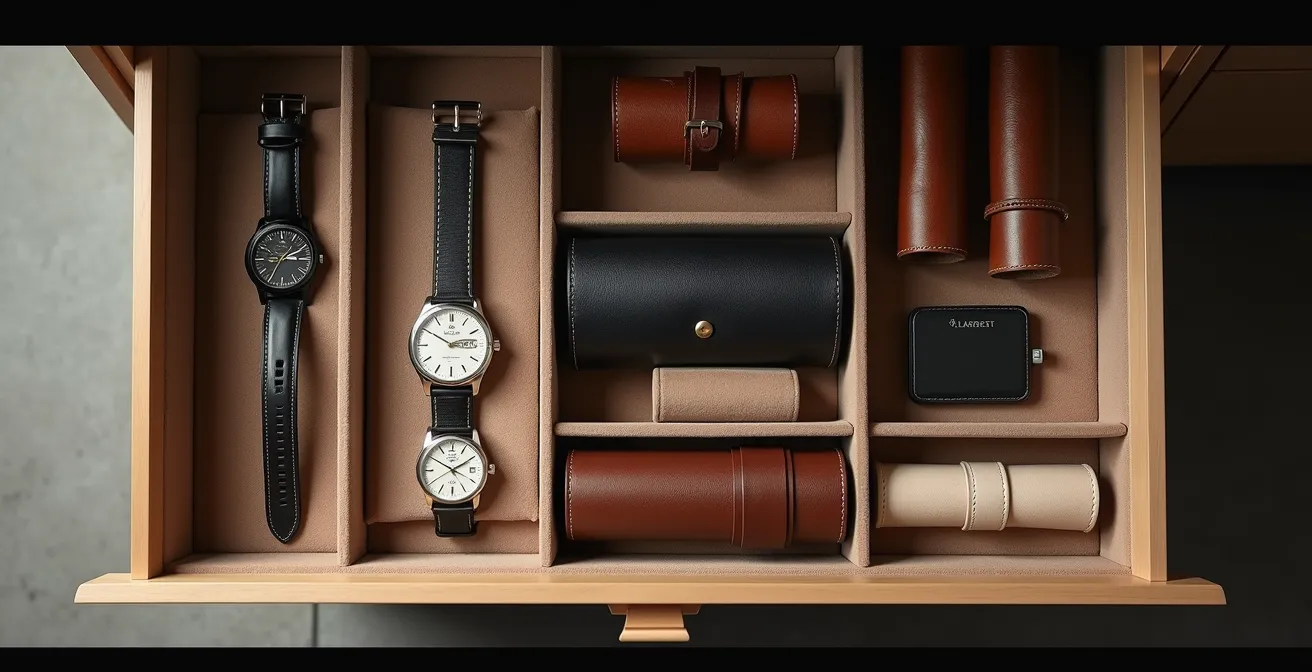
As the image clearly demonstrates, a professional storage system dedicates a separate, cushioned compartment to each individual item. Watches should rest on their own pillows, away from other items. Handbags should be stored in their own breathable fabric dust bags, away from watches. This compartmentalisation prevents not only sagging and scratches but also the more insidious, slow-acting damage from material incompatibility.
Therefore, expand the principle of “stuffing” to a broader philosophy of “separation.” Give each luxury item its own space to ensure its material integrity for years to come.
Why Must Emerald Necklaces Be Stored Flat and Separate from Diamonds?
The logic behind separating gemstones is a perfect analogy for watch storage. An emerald, with a hardness of 7.5-8 on the Mohs scale, is easily scratched by a diamond, which sits at a perfect 10. Storing them together is a recipe for damage. This same principle of hardness differential applies directly within a watch collection and is a compelling reason why timepieces must never be stored touching one another.
Consider the components of a modern luxury sports watch: the case is typically made of 316L or 904L stainless steel, which has a Mohs hardness of around 6-6.5. The crystal, however, is almost always synthetic sapphire, with a hardness of 9. This means that if two watches are loose in a drawer, the incredibly hard sapphire crystal of one watch will easily and deeply scratch the polished or brushed steel case of another. The idea that watches of the same material are “safe” together is a dangerous misconception.
This mandates a “one watch, one slot” rule. Each timepiece requires its own soft, non-abrasive compartment that prevents any contact with another watch. This applies to bracelets scratching case backs, deployant clasps scratching lugs, and crystals scratching cases. Beyond physical contact, different materials also have unique environmental needs:
- Bronze Watches: This material is designed to patina, but high humidity can cause aggressive, uncontrolled green oxidation rather than a desirable patina. They require a drier micro-environment than their steel counterparts.
- Rubber Straps: These must be stored away from direct UV light and any solvents or oils, which can cause them to become brittle and crack.
- Leather Straps: Require stable humidity (around 40-50% RH) to prevent them from drying out and cracking or, conversely, developing mould.
By respecting the unique physical and chemical properties of each watch and giving it an isolated home, you are actively preserving its condition and value against the slow march of entropy.
Key Takeaways
- Condition is King: The investment potential of any luxury watch is directly and inextricably linked to its physical condition. Environmental damage can erase market gains entirely.
- Control the Micro, Not the Macro: Effective preservation in a damp climate like the UK’s focuses on creating a stable, dry micro-environment for each watch, rather than attempting to control an entire room.
- Separation is Non-Negotiable: Different materials (steel, sapphire, leather, bronze) have different vulnerabilities. Storing watches in individual, isolated compartments is essential to prevent scratches and chemical cross-contamination.
Which Watch Models Have Outperformed the FTSE 100 Over the Last Decade?
For many collectors, luxury watches are more than just a passion; they are a tangible asset class. While past performance is no guarantee of future results, analysis of the last decade shows that certain iconic watch models have not just held their value but have delivered returns that significantly eclipse traditional investments like the UK’s flagship FTSE 100 index. This performance solidifies their status as true investment-grade assets.
Data consistently shows blue-chip models from Patek Philippe, Audemars Piguet, and Rolex as the top performers. For instance, over a five-year period where the FTSE 100 delivered modest returns, certain references have exploded in value. This is not a marginal outperformance; it is a dramatic divergence in asset growth, cementing the argument for watches as a serious component of a diversified investment portfolio.
The table below, compiling data from various market analyses, illustrates the stark difference in performance. The returns on specific, highly sought-after models are staggering compared to the general stock market index.
However, these phenomenal returns come with a critical, non-negotiable caveat, which brings us back to the central theme of this guide. As a landmark report from the Boston Consulting Group on the luxury watch market states, this performance is exclusively reserved for watches in pristine condition. Herein lies the ultimate connection between preservation and profit.
These returns are only achievable for examples in ‘investment grade’ condition. An otherwise outperforming watch that has suffered dial damage or movement corrosion from improper humidity control would have underperformed the FTSE 100.
– Boston Consulting Group, Luxury Watch Investment Report 2023
This single statement crystallises the entire purpose of meticulous conservation. All the market analysis, brand prestige, and rarity are rendered moot if the physical object itself has been compromised. The silent, creeping damage from humidity can single-handedly turn a star-performing asset into a liability that underperforms even a basic index fund.
Therefore, the most important investment you can make is not just in the next watch, but in the systems and discipline required to maintain your current collection in impeccable, investment-grade condition. Begin today by conducting an audit of your storage system and implementing the micro-environment strategies detailed here to secure the future value of your assets.