The solitaire ring isn’t just a ‘classic’ choice; it’s the smartest risk-management strategy for a successful proposal.
- It offers unmatched timelessness, insulating your investment from fleeting trends that can make other styles look dated.
- It provides superior structural and financial security through a simpler design that’s easier to maintain and appraise.
Recommendation: Prioritise the diamond’s Cut and the ring’s structural integrity (setting and band) over sheer size to secure the best long-term value and peace of mind.
The pressure is immense. You’re planning one of the most significant moments of your life, and it hinges on a single object: the engagement ring. The modern market is a minefield of choice—dazzling halos, intricate vintage designs, bold three-stone settings. Well-meaning advice often suggests you “get what she’d like,” but what happens when you’re terrified of getting it wrong? The fear of choosing a style that becomes dated, is impractical for her lifestyle, or simply isn’t ‘her’ can be paralysing.
This is where a strategic shift in perspective is required. Instead of viewing this as a test of your taste, consider it an exercise in risk management. The goal is not to chase the perfect, trendy design but to select a ring that is fundamentally secure—aesthetically, structurally, and financially. This is the true strength of the solitaire setting. It’s not merely the ‘safe’ option because it’s traditional; it’s the safest option because its design inherently minimises almost every variable that can lead to buyer’s remorse.
This guide moves beyond the simple “it’s a classic” platitude. We will deconstruct the solitaire, analysing each component through the lens of risk mitigation. From the number of prongs securing the diamond to the profile of the band and its future compatibility with a wedding ring, you will learn why the solitaire is the ultimate low-risk, high-reward investment. We’ll provide a clear, logical framework to help you make a choice grounded in confidence, not fear, ensuring the ring is as enduring as the commitment it represents.
To help you navigate this important decision with a clear strategy, this article breaks down every critical element of choosing a solitaire ring. The following summary outlines the key areas we will explore to de-risk your purchase and ensure complete confidence.
Contents: Why the Solitaire Ring Is Your Most Secure Proposal Strategy
- 4 Prongs vs 6 Prongs: Which Is Safer for Your Diamond?
- How to Add Secret Sparkle to a Classic Solitaire?
- Does a Thin Band Make the Diamond Look Bigger?
- Is a Knife-Edge Band Uncomfortable to Wear Daily?
- How to Ensure Your Solitaire Allows a Wedding Band to Sit Flush?
- Will a Halo Setting Look Dated in 20 Years?
- What Is the Difference Between 18ct, 22ct, and 24ct Gold for Investment?
- How to Prioritize the 4 Cs to Get the Best Looking Diamond for Your Budget?
4 Prongs vs 6 Prongs: Which Is Safer for Your Diamond?
The primary function of the setting is to secure your investment. This is the first and most critical area of risk management. While a 4-prong setting offers a more open view of the diamond, exposing more of it to light, it represents a higher structural risk. With only four points of contact, the loss of a single prong could mean the loss of the diamond. For partners with active lifestyles, such as NHS workers or those constantly using their hands, this is a significant consideration.
A 6-prong setting, popularised by Tiffany & Co., is the superior choice for security. It offers 50% more protection, ensuring that even if one prong were to fail, the diamond would likely remain in place. This increased security often translates to lower insurance premiums. In fact, as UK specialist jewellery insurer T H March reports, there are notably fewer claims for stones lost from 6-prong settings. While the prongs may cover a fraction more of the diamond, the peace of mind this provides is invaluable. The choice between four and six prongs is a direct trade-off between maximum visibility and maximum security.
However, quality of craftsmanship can be a mitigating factor. As one expert from London’s jewellery district notes, quality is paramount:
A well-crafted 4-prong setting from a reputable Hatton Garden artisan can be more secure than a mass-produced 6-prong one.
– Master Jeweller, A Star Diamonds London
This highlights the importance of choosing a reputable jeweller. Investing in quality craftsmanship is a key part of your risk mitigation strategy, ensuring the structural integrity of the setting regardless of the prong count you ultimately select.
How to Add Secret Sparkle to a Classic Solitaire?
One common fear is that a solitaire is “boring” or lacks personality. This is a misconception. The beauty of a solitaire is that it serves as a perfect canvas for “calculated personalization”—subtle, hidden details that make the ring unique to your partner without compromising its timeless aesthetic. This approach avoids the risk of choosing a loud, trend-based design that may fall out of fashion. The personalisation is a secret shared between the two of you.
Contemporary British designers are masters of this art, creating solitaires that are classic at first glance but reveal intricate details upon closer inspection. These hidden elements add a layer of bespoke luxury and sentimentality that a standard ring lacks. Consider a hidden halo—a small circle of pavé diamonds set just below the main stone, visible only from the side profile—or a tiny ‘peekaboo’ diamond set into the gallery rail. These additions catch the light in unexpected ways, creating a private world of sparkle.
Case Study: The Modern Solitaire by British Designers
Rachel Boston’s London workshop is a prime example of modernising the solitaire. Her designs often feature hidden Art Deco-inspired gallery rails with secret geometric patterns visible only from underneath. According to a review in Luxury London, these custom details can add £200-£400 to a standard solitaire while maintaining the classic top-down appearance. Clients consistently report that these hidden features make their rings feel uniquely personal without sacrificing the timeless look they desire.
Other low-risk customisations include engraving a meaningful date or message on the inside of the band or setting a tiny birthstone flush into the inner surface. You can even choose a specific UK Assay Office hallmark—London (Leopard’s Head), Birmingham (Anchor), Sheffield (Rose), or Edinburgh (Castle)—based on a location that is significant to your relationship. These touches make the ring deeply personal while ensuring its public face remains elegant and classic forever.
Does a Thin Band Make the Diamond Look Bigger?
Yes, a thinner band creates an optical illusion that makes the centre diamond appear larger and more prominent. This is a popular strategy for maximising the visual impact of your chosen stone. The contrast in proportion between a delicate band and the diamond draws the eye to the stone, enhancing its perceived size. However, this aesthetic benefit must be weighed against a critical risk: structural integrity. An overly thin band is more susceptible to bending, warping, or even breaking with daily wear.
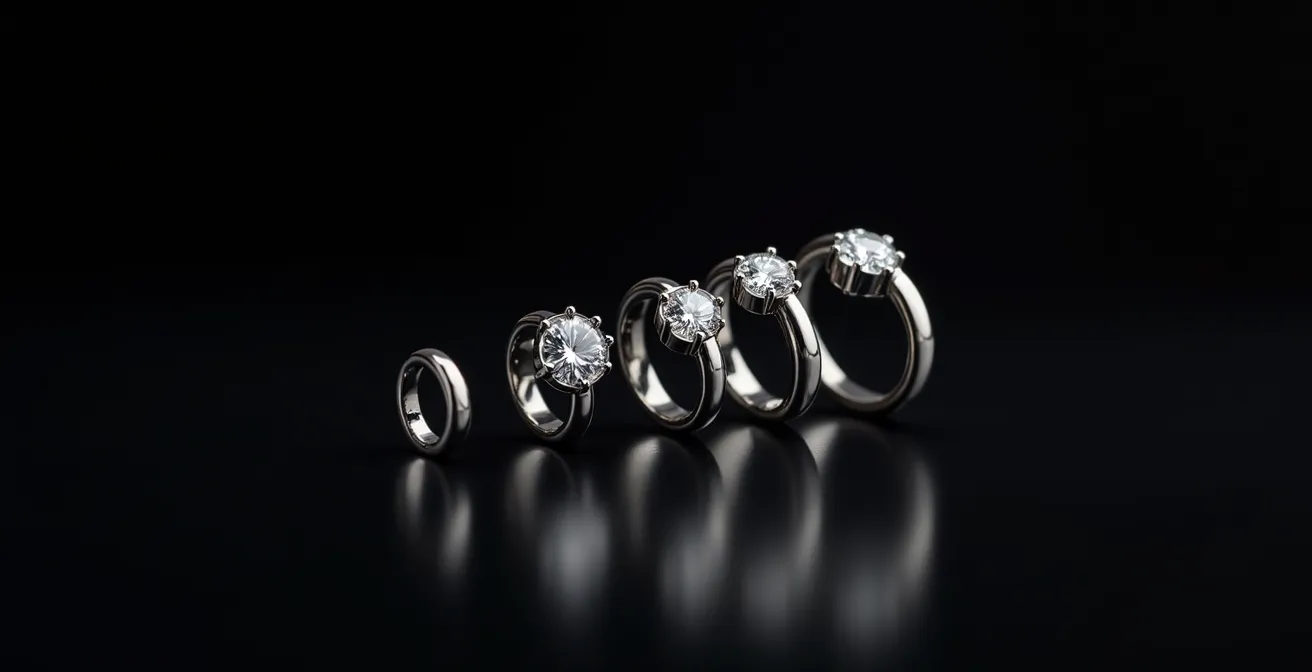
For this reason, there are industry standards for minimum band width. For a durable, long-lasting ring, London master jewellers recommend a minimum width of 1.8mm for 18ct gold and 1.5mm for platinum, which is a harder metal. Going below these thresholds, especially with a larger diamond, introduces a significant risk to the ring’s longevity. A bent band can loosen the prongs, jeopardising the security of the diamond itself. It’s a classic case of balancing aesthetic reward with practical risk.
The following table, based on UK market averages, illustrates the trade-off between the visual effect and the ring’s durability. It provides a clear framework for making a balanced, low-risk decision.
| Band Width | Visual Diamond Size Increase | Durability Score | Price (UK Average) |
|---|---|---|---|
| 1.5mm | +15-20% perceived size | 6/10 | £2,200 |
| 2.0mm | +10% perceived size | 8/10 | £2,400 |
| 2.5mm | Standard appearance | 10/10 | £2,600 |
Ultimately, a band width between 1.8mm and 2.2mm often represents the sweet spot, offering a delicate appearance that enhances the diamond without compromising the ring’s structural integrity for everyday wear.
Is a Knife-Edge Band Uncomfortable to Wear Daily?
The profile of the band is a detail that directly impacts daily comfort—a factor often overlooked during the excitement of the purchase. A knife-edge band is a popular choice for solitaires because its angled design creates sharp, reflective lines that make the band appear thinner and more delicate, further enhancing the centre stone. The name, however, can be misleading and cause concern about comfort. Is it actually sharp?
The answer depends entirely on the quality of the craftsmanship. A well-made knife-edge band from a skilled jeweller is not sharp to the touch. The “edge” is the apex of two angled sides, but it should be slightly rounded and polished to be smooth against the skin and comfortable for continuous wear. A poorly finished or mass-produced version, however, can feel pointed and may dig into adjacent fingers, creating discomfort over time. This is another area where investing in quality from a reputable British jeweller mitigates risk.
When considering comfort, the knife-edge is just one of several options available in the UK market. The “Court” or “Comfort-Fit” profile is widely regarded as the most comfortable, featuring a rounded interior that glides easily over the knuckle. The “D-Shape” is another classic British choice, flat on the inside and rounded on the outside. This table compares the most common profiles.
| Band Profile | Daily Comfort Rating | Pros | Cons |
|---|---|---|---|
| Knife-Edge | 7/10 | Elegant appearance, makes diamond appear larger | Can feel sharp if poorly finished |
| Court (Comfort-Fit) | 10/10 | Rounded interior, most comfortable | Slightly more expensive |
| D-Shape | 9/10 | Classic British choice, very comfortable | Less modern appearance |
| Flat | 6/10 | Contemporary look, stackable | Can pinch skin |
Choosing a Court or D-shape profile is the lowest-risk option for guaranteed comfort. However, if the aesthetic of the knife-edge is appealing, the risk can be managed by ensuring you purchase from a high-quality maker and feeling the ring for yourself before committing.
How to Ensure Your Solitaire Allows a Wedding Band to Sit Flush?
This is a critical element of “future-proofing” your decision, and a common oversight that leads to disappointment later. A flush fit means the wedding band can sit snugly against the engagement ring band with no visible gap. Many settings, especially those that sit low on the finger for a more integrated look, can prevent this. The base of the setting, or ‘collet’, protrudes and holds the wedding band away, creating an awkward space.
The risk here is both aesthetic and practical. A gap can be visually jarring and may require a custom-made curved wedding band to fit, limiting future choices and adding expense. To avoid this, you need to pay close attention to the ring’s side profile. The key is the height of the setting. A “high-set” or “cathedral” setting is the safest choice for ensuring a flush fit. In a cathedral setting, the shoulders of the ring sweep upwards to meet the prongs, naturally creating space underneath for a wedding band to slide in perfectly.
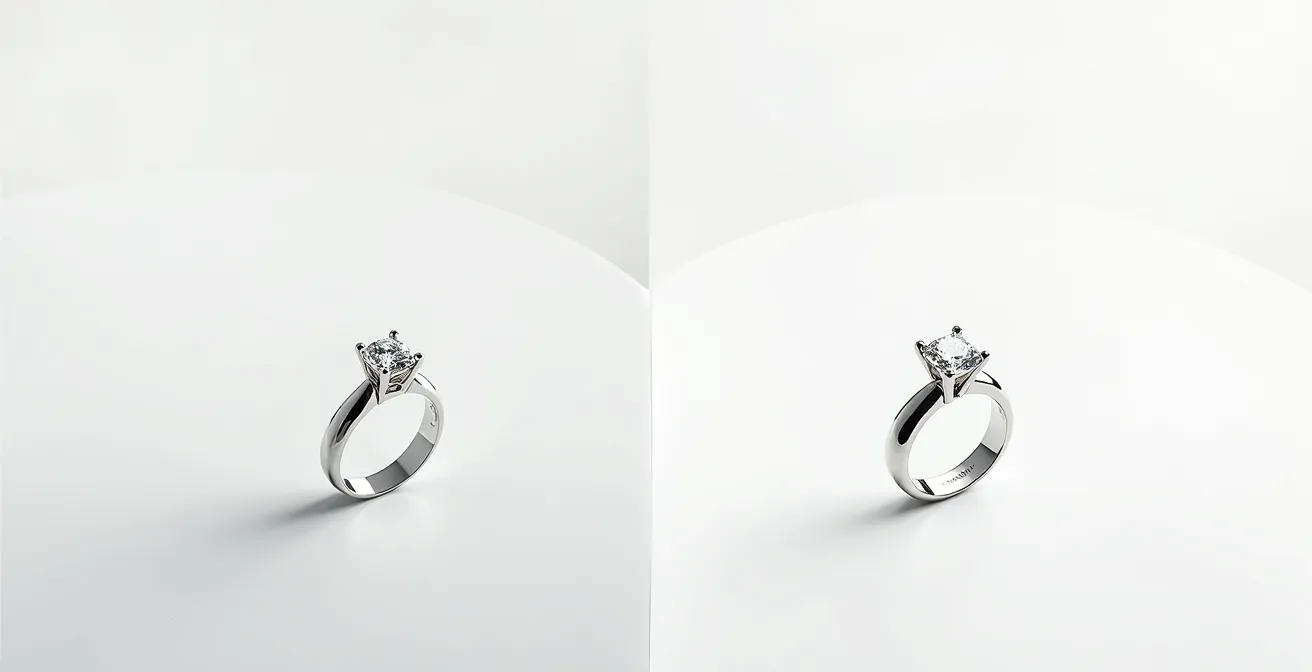
When you are at the jeweller’s, you must be proactive in verifying this. Do not assume a standard solitaire will fit with a standard wedding band. To de-risk this aspect of the purchase, you should:
- Specifically ask the jeweller: “Is this setting designed to allow a wedding band to sit flush?”
- Request to see the ring paired with a straight, sample wedding band.
- Ask about the setting’s height from the band and whether it is considered a “high-set” or “cathedral” style.
- If the setting is low, inquire about matching curved wedding bands to understand the future implications.
- Request CAD (Computer-Aided Design) images that show a clear side profile with measurements, if you are going bespoke.
Ensuring a flush fit from the outset is a simple step that prevents significant frustration and expense down the line, making it a crucial part of a low-risk proposal strategy.
Will a Halo Setting Look Dated in 20 Years?
This question cuts to the heart of aesthetic risk. While a halo setting—a ring of smaller diamonds circling a centre stone—can create a dazzling, high-impact look, it is intrinsically tied to the trends of its time. The solitaire, by contrast, is defined by its lack of ornamentation, which is precisely what makes it timeless. Its simple elegance transcends fashion cycles, making it an incredibly safe long-term investment.
A look at British Royal engagement rings provides a powerful, long-term case study. Queen Elizabeth II’s 3-carat solitaire diamond ring, received in 1947, remains a benchmark of classic, enduring style over 75 years later. In contrast, while Princess Diana’s iconic sapphire and diamond halo ring from 1981 is legendary, it is also distinctly a product of the 1980s aesthetic. This is not a critique, but an observation of how specific, ornate styles become markers of their era. Google Trends data from the UK market further supports this, showing that searches for “halo engagement ring” peaked between 2010-2015 and have been in decline since, whereas searches for “solitaire engagement ring” maintain a consistent, stable volume year after year.
Beyond aesthetics, there’s a practical, financial risk to consider. More stones mean more points of potential failure. A halo setting, with its many tiny pavé-set diamonds, requires more maintenance. The small prongs holding these stones can wear down, leading to loose or lost diamonds. In fact, UK jewellery insurance data reveals that halo settings can require up to three times more maintenance visits over a 20-year period compared to a simple solitaire. By choosing a solitaire, you are not only selecting a timeless design but also opting for a lower-maintenance, more structurally secure ring for the decades to come.
What Is the Difference Between 18ct, 22ct, and 24ct Gold for Investment?
Choosing the right metal is a balance between purity, durability, and value—another key area of risk management. Gold is measured in carats (ct), which indicates its purity. While 24ct gold is 99.9% pure and represents the highest investment value as bullion, it is far too soft for jewellery intended for daily wear. It would scratch and bend almost immediately. Similarly, 22ct gold (91.7% pure), commonly used for investment coins like the British Sovereign, is also generally considered too soft for holding a diamond securely in an engagement ring.
This is why 18ct gold is the industry standard for high-quality fine jewellery in the United Kingdom. Comprising 75% pure gold alloyed with other metals like copper and silver, it offers the perfect balance. It is rich and vibrant in colour, substantial in weight, and most importantly, durable enough to withstand the rigours of everyday life. Choosing 18ct gold is the lowest-risk decision for an engagement ring, providing the best combination of luxury and longevity.
In the UK, your purchase is further secured by a legal requirement that is over 700 years old: hallmarking. Any item sold as gold must be tested and stamped by an independent UK Assay Office. This hallmark is your guarantee of the metal’s purity.
| Gold Purity | Hallmark | Durability | UK Market Use | Investment Value |
|---|---|---|---|---|
| 18ct (75% pure) | 750 | Excellent for daily wear | Industry standard for engagement rings | Protected by UK Hallmarking Act |
| 22ct (91.7% pure) | 916 | Too soft for settings | Gold Sovereign coins | Bullion investment only |
| 24ct (99.9% pure) | 999 | Extremely soft | Never used for rings | Pure bullion bars |
As confirmed by one of the UK’s most historic institutions in this field, this system provides unmatched security for the buyer.
The hallmark from a UK Assay Office is a legal guarantee of the metal’s purity, which is a level of security that makes the purchase ‘safe’.
– The Goldsmiths’ Company, London Assay Office
When you buy an 18ct gold ring in the UK, you are not just buying a beautiful object; you are buying a legally certified asset.
Key Takeaways
- A solitaire’s value lies in its ‘future-proof’ design, minimizing long-term aesthetic and practical risks.
- Prioritise structural integrity: choose a secure setting (e.g., 6-prong) and a band no thinner than 1.8mm in 18ct gold for daily wear.
- Your budget is best spent on an ‘Excellent’ Cut, as this has the greatest impact on the diamond’s brilliance and perceived quality.
How to Prioritize the 4 Cs to Get the Best Looking Diamond for Your Budget?
Finally, we address financial risk. The 4 Cs—Cut, Colour, Clarity, and Carat—determine a diamond’s value. An unguided approach can lead to overspending on the wrong attributes. A strategic, risk-averse approach prioritises the factors that most affect what the eye can see. The single most important factor is Cut. This does not refer to the diamond’s shape (round, oval, etc.), but to the quality of its facets, which dictate how it reflects light. An ‘Excellent’ or ‘Ideal’ cut can make a diamond appear brighter and more brilliant than a stone of higher colour or clarity.
After allocating your budget to the best possible Cut, the next priority is Colour. For a diamond to appear white to the naked eye, a G or H colour grade is often the sweet spot, offering fantastic value without the premium price of a D-F (colourless) grade. This is especially true in the UK’s often overcast natural light. Thirdly, for Clarity, aim for a ‘VS2’ (Very Slightly Included) or ‘SI1’ (Slightly Included) grade, but with a crucial condition: you must have the jeweller confirm it is ‘eye-clean’. This means no inclusions are visible without magnification. You are not paying for microscopic perfection, but for a stone that looks perfect in the real world.
Carat weight should be your last consideration. By being flexible here, you can find significant savings. For example, a 0.95-carat diamond can cost 15-20% less than a full 1.0-carat diamond, despite being visually indistinguishable to most people. This is known as buying ‘shy’ of the magic sizes. This strategic prioritisation maximises the visual beauty of your diamond for every pound spent.
Your Action Plan: The Great British Diamond Buying Strategy
- Budget Allocation: Dedicate at least 40% of your diamond budget to securing a Cut grade of ‘Excellent’ (GIA) or ‘Ideal’ (AGS). This is non-negotiable.
- Colour Targeting: Aim for the ‘near colourless’ G-H range. This provides a bright, white appearance to the naked eye at a much better value than the premium D-F range.
- Clarity Check: Select a VS2 or SI1 grade. Crucially, ask the jeweller to physically inspect the stone and confirm in writing that it is “100% eye-clean.”
- Carat Flexibility: Consider ‘magic sizes’ just below the full and half-carat marks (e.g., 0.90ct or 1.40ct) to achieve savings of up to 20% without a noticeable visual difference.
- Price Verification: Always ask for VAT-inclusive quotes. When comparing online UK prices with high street or Hatton Garden jewellers, ensure the 20% VAT is factored in to get a true comparison.
With this strategic framework, you can walk into any jeweller not with fear, but with a clear, defensible plan. Begin your search with the confidence that you are not just buying a ring, but making a smart, secure, and timeless investment in your future.