
Contrary to the belief that a perfect gem must be flawless, an emerald’s value and identity are found within its inclusions, or ‘jardin’.
- This internal landscape is a Crystalline Fingerprint, proving the gem’s natural origin and telling its unique geological story.
- Understanding and caring for this jardin—through proper cutting, cleaning, and oiling—is the true mark of a knowledgeable connoisseur.
Recommendation: Embrace the jardin not as a defect to be tolerated, but as the very soul of the stone, seeking out the character it imparts rather than a sterile and lifeless clarity.
To see an emerald for the first time is to be confronted with a paradox. A buyer, particularly one accustomed to the icy fire of a diamond, might see its internal world and think: flaw. They see tiny fissures, crystals, and wisps, and the expectation of crystalline perfection falters. This is a common reaction, born from a misunderstanding of what makes an emerald precious. The very features a novice might question are what connoisseurs cherish, a delicate, internal ecosystem known poetically as the jardin—French for garden.
We are taught to seek clarity, to prize the flawless. But the emerald plays by different rules. It is a Type III gemstone, a category where inclusions are not just expected but are a fundamental part of its identity. These are not defects; they are whispers of creation, a complex narrative of the immense pressure and heat that forged this gem deep within the earth millions of years ago. To dismiss them is to miss the point entirely. They are the stone’s birthmarks, its authentic narrative, its geological soul captured in crystal.
But what if we shift our perspective entirely? What if the key to appreciating an emerald is not to look *past* the jardin, but to look *into* it? This guide is an invitation to see beauty in the chaos. We will explore why this inner landscape is a sign of authenticity, how its character is celebrated, and why its perceived fragility is a call for mindful ownership. We will move beyond the simple fear of ‘cracks’ and delve into the poetry of the stone, learning how to care for, value, and style this most fragile and fascinating of the “big three” gemstones.
This article will guide you through the intricate world of emeralds, from their very core to their place in high fashion. We will demystify their treatments, celebrate their unique origins, and provide the knowledge needed to wear them with the confidence and grace they command.
Summary: The Poet’s Guide to an Emerald’s Inner World
- What Is the Difference Between ‘Insignificant’ and ‘Moderate’ Oil in Emeralds?
- Why Is Colombian Green More Desirable Than Zambian Green?
- Why Are Emeralds Almost Always Cut in Rectangles?
- Why Should You Never Put an Emerald Ring in an Ultrasonic Cleaner?
- How Many Inclusions Are Too Many for an Emerald?
- How to Adopt the Green Dial Trend Without Dating Your Collection?
- What Is the Incabloc System and Why Does It Matter if You Drop Your Watch?
- How to Style a Statement Emerald Necklace Without Looking Dated?
What Is the Difference Between ‘Insignificant’ and ‘Moderate’ Oil in Emeralds?
The practice of oiling an emerald is often misunderstood as a way to hide flaws. A more poetic, and accurate, view is that it is an act of care. The oil, typically natural cedarwood oil, has a refractive index similar to the emerald itself. When it seeps into the surface-reaching fissures of the jardin, it doesn’t “fill” them like plaster on a wall; it makes them less visible by reducing light-scatter, allowing the eye to appreciate the stone’s true colour and depth. It is less about concealment and more about clarification, like polishing an old master painting to reveal its true vibrancy.
The extent of this treatment is a critical factor in an emerald’s description. The terminology can seem subtle, but it carries significant weight. While there is no universally adopted grading scale, leading laboratories provide reports that describe the level of clarity enhancement. For instance, GIA classifies emerald clarity enhancement into three levels: minor, moderate, or significant. ‘Insignificant’ or ‘minor’ implies the emerald was of high quality to begin with, requiring only a small amount of oil to enhance its beauty. ‘Moderate’ suggests a more typical jardin that benefits visibly from the treatment. ‘Significant’ indicates a heavily included stone where the oil plays a major role in its appearance.
It’s vital to understand that this treatment is not permanent and is an accepted part of an emerald’s life. As the GIA Laboratory notes in its official guide, its role is one of assessment, not judgment. As they state regarding their process:
GIA evaluates emerald but does not grade it. A GIA Colored Stone Identification & Origin Report assesses the characteristics of an emerald and names any detectable treatments
– GIA Laboratory, GIA Official Emerald Buyer’s Guide
Thinking of oiling as regular maintenance, like conditioning fine leather, places the practice in its proper context. It is not a sign of a lesser stone but a testament to responsible ownership, ensuring the inner landscape remains as beautiful as the day it was first cherished.
Why Is Colombian Green More Desirable Than Zambian Green?
Not all green is created equal. In the world of emeralds, geography is destiny, and the soil from which a stone is born imparts a unique personality. While beautiful emeralds are found across the globe, the historical and emotional benchmark has long been set by Colombia. This South American nation has a mystique built on centuries of production, and even today, Colombia accounts for about 50% of the world’s emerald production, dominating the high-end market.
The desirability of Colombian emeralds lies in their specific hue. They are known for a warm, pure, and intensely saturated green, often described as grassy, with a hint of a yellow undertone. This warmth is due to trace amounts of chromium. In contrast, Zambian emeralds, which have gained significant prominence in recent decades, are typically a cooler, deeper green with a subtle bluish tint, a colour derived from vanadium and a higher iron content. Neither is inherently “better,” but the warm glow of a Colombian emerald has become the archetypal colour in the collective imagination of the luxury world.
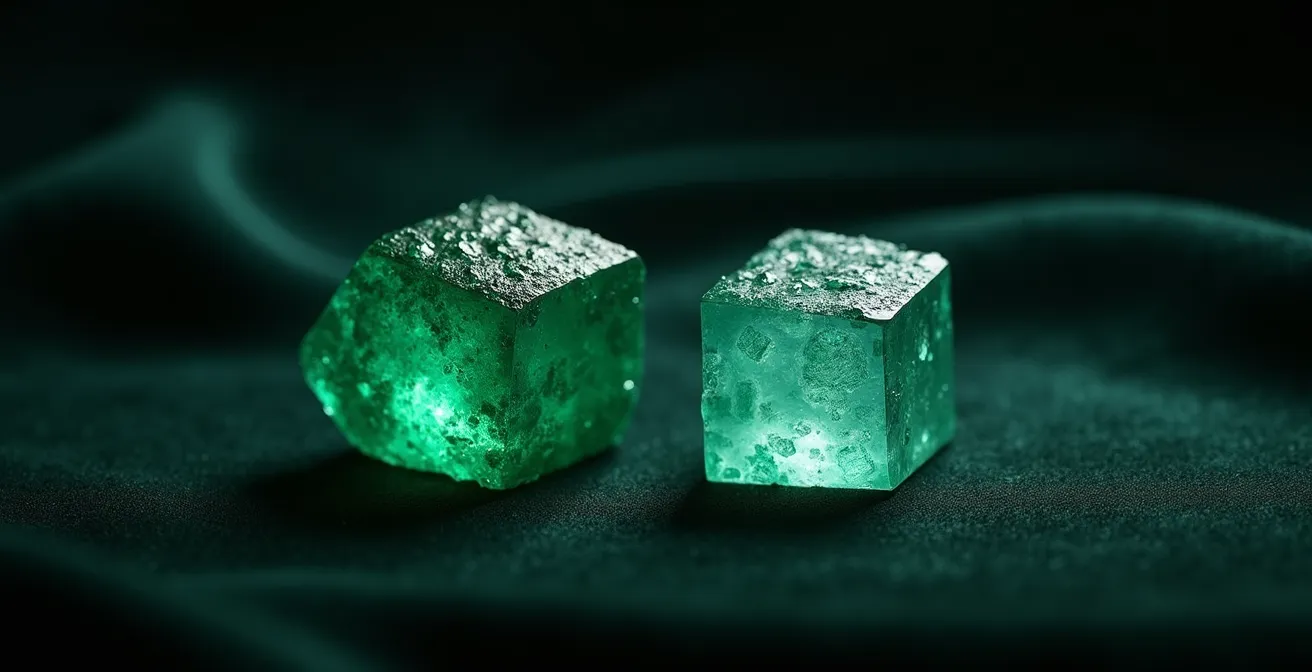
This preference is reflected in the market, where a fine Colombian emerald can command a significant premium over a Zambian stone of similar size and clarity. The historic provenance and the specific character of the Colombian jardin, often featuring distinctive three-phase inclusions (liquid, gas, and a halite crystal), are seen as marks of classic pedigree. This mystique translates into tangible value, as seen in the world of high jewellery auctions.
Case Study: The Historic Van Cleef & Arpels Colombian Emerald Auction
A perfect illustration of this market preference was the sale of a Van Cleef & Arpels ring at Sotheby’s Geneva. The piece, dating from 1942, featured a 26.81-carat Colombian emerald with a gemological report confirming its origin and only minor oil treatment. Despite an estimate of 350,000-530,000 CHF, it sold for an astonishing 673,100 CHF. This demonstrates that for collectors, the combination of a storied jeweller, a historic piece, and the coveted Colombian origin creates a value far exceeding the sum of its parts.
Why Are Emeralds Almost Always Cut in Rectangles?
The distinctive, rectangular step-cut with cropped corners is so intrinsically linked to the gem that it bears its name: the “emerald cut.” This is no accident of fashion; it is a masterclass in lapidary science, a shape born from a deep respect for the emerald’s inherent nature. The decision to cut an emerald this way is driven by two primary factors: its crystal structure and its precious, fragile jardin.
First, the cut follows the stone’s natural form. Deep in the earth, emerald crystals are commonly six-sided with flat tops, forming elongated hexagonal prisms. A rectangular cut is the most efficient way to shape this rough crystal, maximising the final carat weight and minimising waste. It is a practical decision that honours the natural geometry of the gem, working with its innate character rather than against it.
More importantly, the emerald cut is a protective embrace. The long, straight facets of the step-cut are less fiery than the brilliant cuts used for diamonds, but they serve a different purpose. They create a “hall of mirrors” effect, drawing the eye deep into the stone and showcasing its rich colour and unique jardin. This cut doesn’t try to hide the inclusions; it frames them. The cropped corners are not merely an aesthetic choice; they are a crucial structural safeguard, protecting the more vulnerable points of the stone from chipping and impact. As one expert puts it, this cut is a deliberate choice for preservation:
The most desirable cut is ‘step up’ or the ‘trap cut’, which is called classic emerald cut and it is the safest cut for emeralds
– You and I Jewellery Expert, The Emerald – Le Jardin Within
Choosing an emerald cut is therefore an act of reverence. It acknowledges the stone’s hexagonal crystal habit and prioritises the safety of its delicate inner world over the flash and fire sought in other gems. It is a quiet, confident cut designed for a stone that does not need to shout to be heard.
Why Should You Never Put an Emerald Ring in an Ultrasonic Cleaner?
The very feature that gives an emerald its soul—the jardin—also dictates how it must be cared for. These internal inclusions, while beautiful, are points of structural variance. Subjecting an emerald to harsh cleaning methods, especially the intense, high-frequency vibrations of an ultrasonic cleaner, is a risk no owner should take. It is akin to shaking a delicate snow globe, with the potential for disastrous results.
An ultrasonic cleaner works by creating microscopic cavitation bubbles in a liquid solution, which implode and scrub surfaces clean. For a hard, solid stone like a diamond, this is highly effective. For an emerald, it’s a direct assault on its integrity. The vibrations can stress the inclusions, potentially causing them to expand and leading to new fractures. More critically, for an oiled emerald, the ultrasonic cleaner can be devastating. The vigorous agitation can force the protective oil out of the fissures, leaving them looking dry, whitish, and far more prominent. This effectively undoes the careful enhancement that clarified the stone’s beauty, and in the worst cases, the heat generated by some units can cause thermal shock and crack the gem.
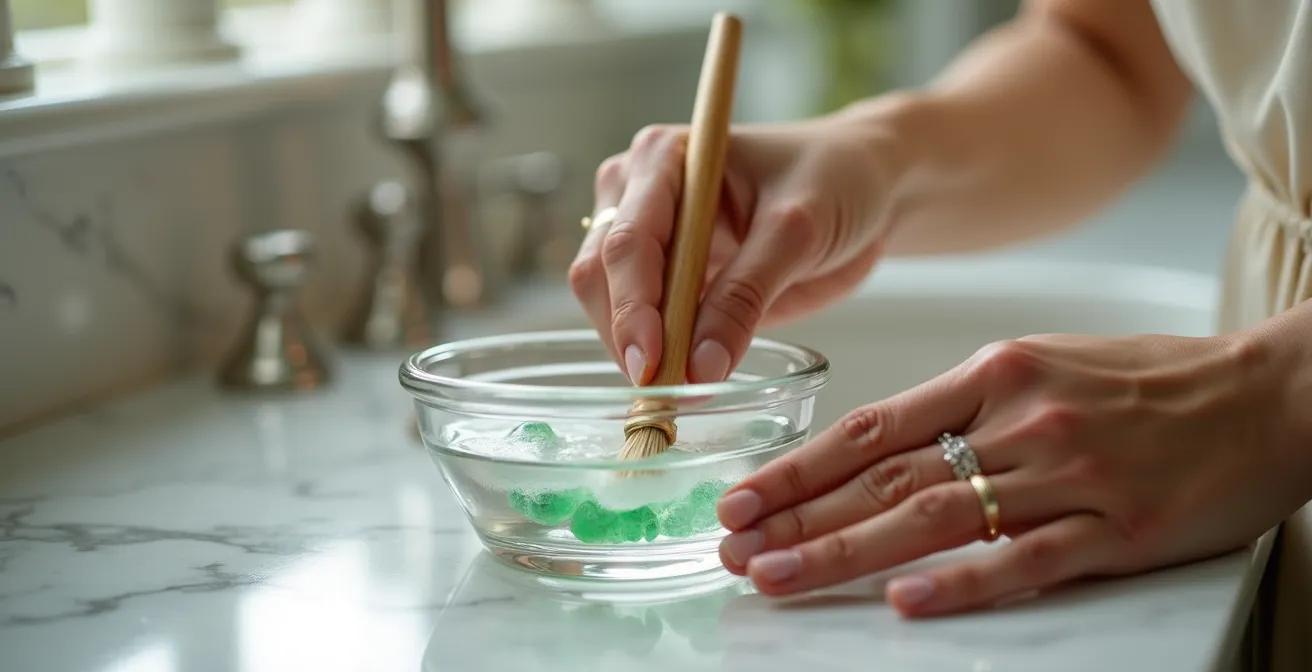
The proper way to clean an emerald is a gentle ritual, a soft touch that respects its nature. It requires no special machinery, only mindfulness and simple household items. This gentle approach ensures that both the stone and its protective oils remain unharmed, preserving the integrity of its cherished jardin for years to come.
Your Action Plan: The Royal Jeweller’s Safe Cleaning Method
- Assessment: Use only lukewarm water; never expose the gem to hot or cold extremes which can cause thermal shock.
- Preparation: Add a single drop of mild dish soap to the water, avoiding harsh chemical detergents that can degrade the oil.
- Gentle Cleaning: Use a baby’s soft toothbrush to gently brush the stone and, more importantly, the metal settings where dirt accumulates.
- Rinsing: Rinse the piece thoroughly with clean, lukewarm water to ensure no soap residue is left behind.
- Drying: Pat the jewellery dry with a soft, lint-free cloth. Never use a hairdryer or other forms of heat.
How Many Inclusions Are Too Many for an Emerald?
This is the ultimate question for any prospective buyer, the point where the poetry of the jardin meets the pragmatism of a purchase. The fear is that one might choose a stone that is “too” flawed. The truth, however, is that a flawless emerald is a statistical anomaly. In fact, based on GIA’s comprehensive emerald quality assessment data, nearly 99% of natural emeralds contain inclusions visible to the naked eye. An “eye-clean” emerald is one of the rarest gems on earth, and its price reflects that extreme scarcity.
Therefore, the question is not “Are there inclusions?” but “How does the jardin affect the stone’s beauty and durability?” The evaluation is a balance of three factors:
- Size and Number: Are the inclusions numerous and large, creating a “cloudy” or “sleepy” appearance that dulls the colour? Or are they discrete and scattered, adding character without overwhelming the stone?
- Location: A large inclusion directly under the main facet (the “table”) will be far more noticeable than smaller ones near the edge (the “girdle”). Inclusions that break the surface are more concerning as they can affect the gem’s durability.
- Type: Some inclusions are celebrated. The three-phase inclusions of a Colombian emerald or the distinctive “mossy” patterns can be seen as desirable marks of origin and authenticity.
The threshold for “too many” is ultimately personal, but a good rule of thumb is this: the jardin should be a feature, not a distraction. It should create a unique inner landscape without compromising the stone’s overall colour and life. If the inclusions are so numerous that the emerald appears opaque or structurally unsound, then it has crossed the line. But if the jardin is a delicate, intricate world that you can get lost in, it is not a flaw; it is the crystalline fingerprint that makes the stone uniquely yours.
How to Adopt the Green Dial Trend Without Dating Your Collection?
The allure of deep, vibrant green is not confined to gemstones. In recent years, the world of haute horlogerie has fallen for the green dial, a trend that speaks to a desire for colour, character, and a touch of nature. For a collector, a new trend can be a double-edged sword: how do you embrace it without buying a piece that will look dated in a few years? The key is to choose a shade of green that is timeless, not trendy.
This is where the wisdom of the emerald intersects with British heritage. The most enduring green is not a fleeting fashion colour but one with deep cultural roots. As one British watch expert insightfully notes, the right green is a classic:
The ‘British Racing Green’ is a timeless British cultural touchstone. A deep forest green, much like a desirable emerald, is a classic, not a fad
– British Watch Expert, Burlington Arcade Watch Analysis
By choosing a watch with a dial in this classic, rich hue—be it forest, olive, or a shade reminiscent of a fine Colombian emerald—you are not buying into a trend. You are investing in a tradition. This deep green has an inherent sophistication and versatility that allows it to pair beautifully with a wardrobe of neutrals, from a tweed jacket to a simple cashmere sweater. It becomes a point of interest, a subtle statement of discerning taste.
For those who already own emerald jewellery, a green dial watch is a natural companion. The art is in creating harmony, not a perfect match. A warm-toned Colombian emerald ring pairs beautifully with an olive-green dial on a yellow gold watch. A cooler Zambian emerald might be complemented by a forest-green dial on a steel timepiece. The goal is a balanced dialogue between the two pieces, allowing each to shine without competing. By limiting the green to these two key elements—the watch and a single piece of jewellery—the look remains sophisticated and modern, a nod to the trend firmly anchored in timeless style.
What Is the Incabloc System and Why Does It Matter if You Drop Your Watch?
At first glance, the inner workings of a mechanical watch and the jardin of an emerald seem worlds apart. One is a marvel of micro-engineering, the other a miracle of nature. Yet, they share a profound connection: both contain a delicate, vital heart that requires a sophisticated system of protection. Understanding this parallel reveals a shared philosophy of luxury—that true quality lies in safeguarding inherent fragility.
The heart of a mechanical watch is its balance wheel, a tiny component oscillating back and forth on pivots finer than a human hair. These pivots are incredibly susceptible to damage from shocks, whether from dropping the watch or the cumulative micro-vibrations of daily life. The Incabloc system is a brilliant invention designed to protect this heart. It is a spring-loaded mounting system that allows the balance wheel’s jewel bearings to move slightly under impact, absorbing the shock and then re-centering perfectly. It is a tiny, internal shock absorber.
This provides a powerful analogy for understanding the setting of an emerald. An emerald’s jardin and its relatively brittle nature make its corners and edges vulnerable. As noted in an analysis of the gem’s structure:
The Emerald-Incabloc Resilience Parallel
Just as emeralds with many inclusions are more vulnerable to damage, the balance staff of a watch is its most fragile component. The Incabloc system was invented to protect this delicate part from the shocks of daily wear. In the same way, a protective bezel or a robust prong setting acts as an external ‘shock absorber’ for an emerald, guarding its vulnerable jardin and corners from impact. Both systems are signs of quality design, acknowledging and mitigating an inherent fragility to ensure longevity.
The presence of an Incabloc system indicates that the watch movement is of a quality worth protecting. Similarly, the careful, protective setting of an emerald shows that the jeweller respected the gem’s nature. In both cases, the “flaw”—the fragility—has given rise to an elegant solution. It is a reminder that resilience is not about being unbreakable, but about having the intelligence and design to withstand life’s impacts.
Key Takeaways
- An emerald’s jardin is not a flaw; it is a unique ‘crystalline fingerprint’ that proves its natural origin and tells its geological story.
- The value and beauty of an emerald are judged on how the jardin interacts with the stone’s colour, not on its absence. An ‘eye-clean’ emerald is almost a myth.
- Proper care, including gentle cleaning and professional re-oiling, is essential maintenance for preserving the beauty of the stone’s inner landscape.
How to Style a Statement Emerald Necklace Without Looking Dated?
A statement emerald necklace is a piece of breathtaking power. It is not a jewel to be worn lightly. The risk, especially with a classic gem, is that it can feel formal, inherited, or even dated. The modern British approach to styling such a significant piece is a lesson in confident restraint. The secret is to deconstruct its formality by creating a thoughtful contrast between the magnificent and the mundane.
The old way was to pair opulence with opulence: a grand necklace with a ballgown, elaborate earrings, and a formal updo for an event at the Royal Opera House. The contemporary method, as seen on modern style icons and even younger members of the Royal Family, is to let the necklace be the single, undisputed star of the show. As one British fashion expert observes, the key is focus:
Modern British royalty and style icons often let the necklace be the single focus, with minimal other jewellery and simple necklines, a key to making it look contemporary
– British Fashion Expert, Contemporary British Style Analysis
This “single focus” rule is transformative. It means pairing the necklace not with more jewels, but with a canvas that allows it to shine. A simple, clean neckline—a boat neck, a crisp open-collared shirt, or even a basic crewneck—acts as the perfect frame. The most modern interpretation involves a “high-low” mix: wearing the extraordinary emerald necklace over a simple white t-shirt or a fine-gauge cashmere sweater with tailored trousers. This juxtaposition is what makes the look feel fresh and relevant, perfect for a lunch in Notting Hill rather than just a gala in Mayfair.
The goal is to wear the jewellery, not to let it wear you. By keeping other accessories to a minimum (perhaps only simple stud earrings or a single ring), the focus remains on the emeralds. This approach communicates that the necklace is part of your personal style, not a costume piece brought out for special occasions. It is the ultimate expression of effortless luxury, a very British way of being elegant without appearing to have tried too hard.
Frequently Asked Questions on The Inner World of Emeralds
How do micro-shocks affect both watches and emeralds?
Daily activities like riding the London Tube or even typing create constant micro-vibrations. Over time, these can damage a watch’s sensitive balance wheel or stress the internal jardin of a heavily included emerald. The Incabloc system in a quality watch protects its movement, just as a robust and protective setting shields an emerald’s vulnerable corners from these daily impacts.
Why are both Incabloc systems and emerald jardins signs of quality?
Both features represent a commitment to authenticity and resilience. The presence of an Incabloc system indicates a high-quality mechanical movement that is worth protecting from shocks. In a parallel way, a natural, untreated jardin is the ultimate proof of an emerald’s authenticity, a mark that distinguishes it from synthetic, flawless alternatives. Both are internal systems that tell a story of quality.
What maintenance do both systems require?
Both watches and emeralds require periodic expert care to maintain their integrity. A mechanical watch with an Incabloc system should be serviced by a professional every 3-5 years to clean and lubricate the movement. Similarly, an emerald with a significant jardin may need professional re-oiling every 2-3 years to maintain its clarity and beauty. In the UK, both tasks are best left to specialist craftsmen who understand the nuances of these luxury items.