The extreme value of a top-tier ruby is not just about its colour; it’s a financial ecosystem built on verifiable naturalness, unimpeachable provenance, and the psychology of power.
- Authenticity is paramount: The market heavily penalises treatments, making certified unheated stones the only true investment-grade assets.
- Origin is king: A Burmese ruby can be worth ten times more than a visually similar stone from Mozambique due to historical prestige and rarity.
Recommendation: An investor must prioritise the laboratory certificate (GIA, SSEF, Gübelin) over the gem’s appearance, as the paper is the ultimate arbiter of value.
In the world of high-end gemstones, one stone reigns supreme in value and mystique: the unheated Pigeon’s Blood ruby. For the discerning investor, it represents more than just a beautiful object; it is ‘Red Gold’, a hard asset class where value is forged by a trinity of factors far more complex than simple aesthetics. While many focus on the stone’s vivid red hue, historically compared to the first two drops of blood from a freshly killed pigeon, the real drivers of its price are less romantic and far more clinical. The market for these gems is an intricate financial ecosystem built on three pillars: verifiable naturalness, unimpeachable provenance, and the potent psychology of its colour.
Most discussions get lost in the basics of the 4Cs. We will move beyond that. This analysis is for the investor who understands that a gem’s worth is not just in its physical properties, but in its story, its rarity, and, most importantly, its certificate. The difference between a £10,000 ruby and a £1,000,000 ruby of the same size often comes down to two words on a piece of paper: “No Heat”. This article deconstructs the architecture of that value. We will explore how to identify synthetics, understand the nuances of inclusions, weigh the merits of new versus old mines, and grasp the market dynamics that elevate a simple red stone into a multi-million-pound asset.
This guide provides the framework for navigating the apex of the coloured stone market. By understanding the forces that create such extraordinary value, you can begin to make investment decisions based on the same criteria as the world’s most seasoned collectors and traders.
Summary: The Investor’s Guide to Pigeon’s Blood Ruby Value
- How to Spot a Flame Fusion Synthetic Ruby with a Magnifying Glass?
- Why Are ‘Silk’ Inclusions Accepted in Rubies but Not in Diamonds?
- Is a Mozambique Ruby a Good Alternative to the Unobtainable Burmese?
- What Does It Mean if a Ruby Is ‘Glass Filled’ and Is It Worth Buying?
- Why Is the Ruby the Traditional Gift for 40th Anniversaries?
- Which Colours Should You Wear to a Negotiation to Project Trust?
- Why Is a Burmese Ruby Worth 10 Times More Than a Mozambique One?
- How Did Princess Diana’s Ring Change the Global Sapphire Market?
How to Spot a Flame Fusion Synthetic Ruby with a Magnifying Glass?
For any investor, the first line of defence against a catastrophic loss is distinguishing natural from synthetic. The flame fusion process, developed by Auguste Verneuil in the late 19th century, made it possible to create chemically identical but structurally different rubies at a fraction of the cost. While a laboratory certificate is the only definitive proof, a trained eye with a 10x jeweller’s loupe can often spot the tell-tale signs of a synthetic stone, protecting you from obvious forgeries during an initial inspection.
The key difference lies in the growth environment. Natural corundum crystals form over millions of years under immense pressure, creating distinctive, angular growth patterns and unique inclusions. Flame fusion stones, by contrast, are grown rapidly in a controlled lab environment from a molten powder, a process that leaves behind characteristic curves and bubbles. As the experts at Star Lanka note, professionals detect a different structure, and “natural rubies will often contain flaws, whereas synthetic gemstones are almost always perfect, except for bubbles that appear every once in a while.” Perfect clarity should be a red flag, not a selling point, when inspecting a potential investment-grade ruby.
Learning to spot these indicators is a foundational skill. It allows you to quickly filter out lower-end synthetics before wasting time and money on gemological reports. While a final purchase should never be made without a top-tier lab report, this initial visual audit is a crucial step in due diligence.
Your Action Plan: Identifying a Synthetic Ruby
- Examine for Curved Striae: Under 10x magnification, look for curved growth lines (striae). These faint, arc-like patterns follow the shape of the synthetic boule and are a definitive sign of the flame fusion process. Natural rubies have angular growth lines.
- Hunt for Gas Bubbles: Search for perfectly spherical gas bubbles. These are tiny, trapped pockets of gas from the manufacturing process. In natural stones, included crystals or negative crystals are typically irregular and angular, not perfectly round.
- Check for ‘Silk’ Absence: Look for the complete absence of natural ‘silk’ inclusions. These fine, needle-like rutile crystals are common in natural rubies, especially from Burma, and are rarely, if ever, seen in flame fusion synthetics.
- Observe Colour Distribution: Assess the colour for unnatural uniformity. Synthetic rubies often display a perfectly even, flat colour distribution. Natural stones frequently exhibit subtle ‘colour zoning’—areas of more or less intense colour.
- Consult an Expert: If any doubt remains, do not proceed. The only secure step is to consult a certified gemologist at a reputable location like Hatton Garden or to submit the stone to a world-class laboratory such as GIA or SSEF for a full report.
Why Are ‘Silk’ Inclusions Accepted in Rubies but Not in Diamonds?
In the diamond trade, clarity is king, and any visible inclusion is a flaw that diminishes value. Yet, in the world of high-end rubies, the opposite can be true. The presence of fine, needle-like inclusions of the mineral rutile, known in the trade as ‘silk’, is not only accepted but often desired. This paradox is central to understanding the unique aesthetic that defines a top-tier Pigeon’s Blood ruby. While rubies are exceptionally durable, second only to diamonds and ranking 9 on the Mohs scale of hardness, their valuation criteria are far more nuanced.
The reason for this acceptance lies in the optical effect of the silk. Rather than obstructing light like a carbon spot in a diamond, these microscopic needles scatter it. This diffusion of light softens the stone’s appearance, creating a velvety, glowing lustre that seems to emanate from within. It is this soft glow that separates a truly magnificent Burmese ruby from a merely transparent one.
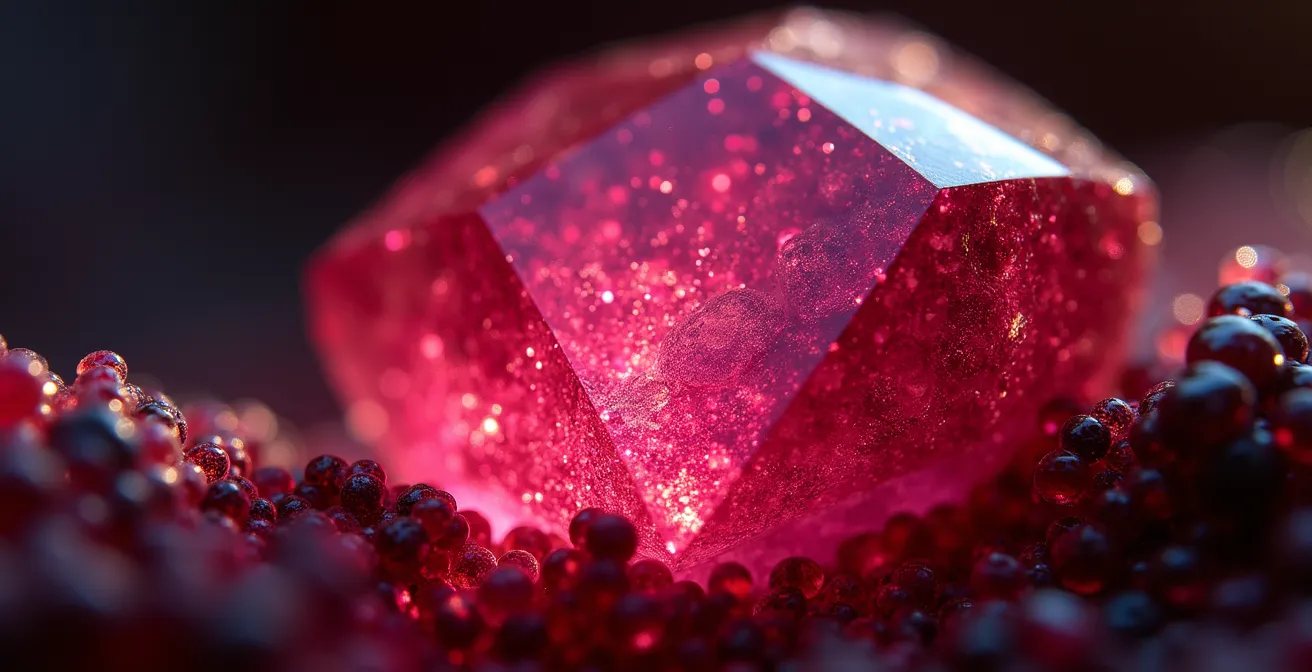
As the specialists at Gemlab Analysis Laboratory explain, this is a matter of degree. “The right amount of ‘silk’ can actually enhance a ruby’s beauty by scattering light, creating a softer, more velvety lustre,” they note, calling it “a subtle quality that distinguishes the finest stones from merely good ones.” Too much silk can make a stone appear cloudy or ‘sleepy’, negatively impacting its value. However, a light, even distribution is considered a hallmark of authenticity and, particularly, of the coveted Burmese origin. An investor must learn to appreciate this subtle beauty, as it is one of the key signatures of the most valuable rubies on earth.
Is a Mozambique Ruby a Good Alternative to the Unobtainable Burmese?
For decades, the Mogok Valley in Burma (now Myanmar) was the undisputed source of the world’s finest rubies. However, with the historical mines largely depleted and political instability restricting supply, Burmese stones have become virtually unobtainable for all but the most elite collectors. This created a significant void in the market, which has been decisively filled by a new source: Mozambique. The discovery of a massive deposit in Montepuez in 2009 has reshaped the global ruby trade. Today, rough rubies from Mozambique represent an estimated 50% to 60% of the market.
From a purely gemological standpoint, Mozambique rubies can be exceptional. They often possess a high clarity and a vibrant red colour that can, in some cases, qualify for the prestigious ‘Pigeon’s Blood’ designation. For an investor, they represent an accessible entry point to high-quality rubies without the astronomical ‘provenance premium’ attached to Burmese stones. Furthermore, the leading operator in the region has made a strong commitment to transparent and ethical sourcing, a factor of growing importance to modern investors.
This commitment to sustainability and community support provides a different kind of value, one that resonates with contemporary ethical standards. It presents a compelling narrative that stands in contrast to the often-murky origins of older stones.
Case Study: Gemfields’ Ethical Mining in Mozambique
As detailed in a report by the Robb Report, the London-based company Gemfields has set a new standard for responsible mining. Near its Montepuez ruby mine, the company funds mobile health clinics serving 5,000 patients a month and has built or refurbished four schools educating nearly 2,000 students. This model demonstrates that extracting precious resources can be done in a way that provides tangible, long-term benefits to the local community, adding an ethical premium to the stones produced.
While a top Mozambique ruby will likely never reach the per-carat price of a comparable Burmese stone due to the latter’s historical prestige, it offers a stable, high-quality, and ethically sound alternative. It is a pragmatic choice for an investor focused on pure quality rather than historical legacy.
What Does It Mean if a Ruby Is ‘Glass Filled’ and Is It Worth Buying?
At the absolute bottom of the market, far removed from investment-grade assets, lies the glass-filled ruby. This is not a minor enhancement but a profound alteration that creates a composite material. The process involves taking low-quality, heavily fractured natural corundum and infusing it with lead glass to fill the cracks and improve its apparent clarity and colour. While this makes unattractive material marketable to a mass audience, it is a catastrophic attribute for any piece intended as a store of value.
The presence of glass drastically compromises the stone’s integrity, durability, and, most importantly, its value. These stones are not true rubies in the purist sense; they are composites. Their price reflects this, with glass-filled rubies typically priced at only $1-5 per carat, a world away from the tens or hundreds of thousands per carat for unheated natural stones. They are exceptionally fragile and can be damaged by simple household chemicals, temperature changes, or even lemon juice. They have no place in a serious investment portfolio.
For a UK-based investor, there is legal protection. The Consumer Rights Act 2015 mandates that all gemstone treatments must be fully and clearly disclosed at the point of sale. Failure to do so constitutes misrepresentation. However, the best defence is knowledge. An investor must understand that ‘glass-filled’ is not a form of ‘treatment’ but a fundamental alteration. These stones have no long-term value and should be avoided unequivocally. Understanding this lowest tier of the market is essential to fully appreciate why genuine, untreated stones command such enormous premiums.
Why Is the Ruby the Traditional Gift for 40th Anniversaries?
The ruby’s status as the traditional gift for a 40th wedding anniversary is not a modern marketing invention. It is rooted in centuries of symbolism, representing a love and passion that has endured for decades, becoming more potent and valuable with time. This tradition adds an emotional and cultural layer to the ruby’s value proposition, linking it to concepts of permanence, durability, and enduring passion—qualities that resonate deeply with the idea of a long-term investment.
Historically, the ruby has always been the king of gems, a talisman of power and protection. As gemstone experts at Angara note, “Burmese royalty wore them as talismans, believing they granted invincibility in battle.” This association with power, vitality, and an unquenchable inner fire makes the ruby the perfect emblem for 40 years of marriage. It signifies that the heat of the relationship has not cooled but has deepened into a strong, glowing ember, much like the deep fluorescence of a Pigeon’s Blood ruby that glows from within.
For an investor, this cultural significance is not merely sentimental; it creates a consistent and reliable source of demand outside the speculative investment market. The anniversary market provides a fundamental baseline of value. A fine ruby is not just an asset; it is a potential heirloom, a symbol of a lifetime of commitment. This dual nature as both a financial instrument and a powerful emotional symbol gives the ruby a unique resilience and a timeless appeal that few other assets can match.
Which Colours Should You Wear to a Negotiation to Project Trust?
While a discussion of fashion might seem out of place, for a high-stakes investor, every detail matters. The psychology of colour is a potent, often subconscious, tool in environments like a crucial negotiation or a boardroom presentation. The colours we wear project a message long before we speak. While blues and greys are the traditional staples for projecting calm and authority, the strategic use of red can be a powerful, high-risk, high-reward gambit. It is the colour of action, power, and passion.
Red is a colour that is impossible to ignore. It is physiologically stimulating, increasing heart rate and grabbing attention. In a negotiation, a flash of deep, rich red—a tie, a pocket square, or, for the ultimate power move, a significant ruby cufflink or ring—projects confidence and a willingness to take decisive action. It signals that you are not there to be a passive participant. As a study from Gemlab Analysis on colour psychology shows, modern studies confirm that red is the colour most associated with “heat, passion, sexuality, love and joy.” In a business context, this translates to energy, ambition, and a non-verbal assertion of dominance.
Wearing the colour of a Pigeon’s Blood ruby is a statement. It leverages the same deep-seated psychological responses that make the gem itself so captivating. It is not about projecting ‘trust’ in the sense of safety and predictability, like the colour blue does. Instead, it projects the trust one has in their own power, position, and the strength of their convictions. For an investor whose success relies on projecting unshakeable confidence, understanding this psychological power of red is another tool in their arsenal.
Why Is a Burmese Ruby Worth 10 Times More Than a Mozambique One?
This is the central question for any ruby investor. Presented with two visually identical rubies, one from Burma and one from Mozambique, why might the former command a price that is an order of magnitude higher? The answer lies in the powerful and often intangible concept of ‘provenance premium’. It is a value derived not just from quality, but from a combination of historical prestige, legendary rarity, and specific gemological characteristics unique to the original source.
Burmese rubies, particularly those from the fabled Mogok Stone Tract, have been the benchmark for quality for centuries. They are woven into the history of empires and royalty. This historical weight creates a brand identity that is, for now, unassailable. This premium is further justified by a key gemological feature: the finest Burmese rubies exhibit a strong red fluorescence. When exposed to ultraviolet light (present in daylight), they emit their own red light, making the stone appear to glow from within. This gives them a vibrant, fiery appearance that rubies from other localities, including Mozambique, often lack or possess to a lesser degree.
The world’s most valuable ruby ever sold at auction, the Estrela de Fura, fetched a staggering $34.8 million in 2023. While this was a Mozambique stone, it was an outlier of supreme size and quality, proving the potential of the new source. However, on a consistent, per-carat basis across the market, the Burmese premium holds firm. The following comparison, based on data from auction houses like Sotheby’s, illustrates the key differences that build this value gap.
| Factor | Burmese Ruby | Mozambique Ruby |
|---|---|---|
| Market Premium | Highest tier pricing | Mid to high tier |
| Fluorescence | Strong red glow in daylight | Variable, often weaker |
| Historical Prestige | Centuries of royal association | Recent market entry (2009) |
| Availability | Extremely limited | More abundant |
| Pigeon Blood Certification | Most likely to qualify | Can qualify but less common |
For an investor, this means a choice must be made: are you acquiring a gemstone or a piece of history? The Mozambique ruby may be the rational choice for quality and value, but the Burmese ruby remains the ultimate trophy asset, its price buoyed by the powerful and enduring mystique of its origin.
Key takeaways
- The value of an investment-grade ruby is determined by its lack of heat treatment and its origin, with a GIA or SSEF certificate being non-negotiable.
- ‘Silk’ inclusions are often desirable in rubies as they create a soft, velvety lustre, a key difference from the clarity standards for diamonds.
- The ‘Provenance Premium’ is the main reason a Burmese ruby commands a far higher price than a visually similar Mozambique stone.
How Did Princess Diana’s Ring Change the Global Sapphire Market?
To fully understand the power of provenance and history in the coloured stone market, we must look to the ruby’s sister stone, the sapphire. When Prince Charles presented Lady Diana Spencer with a 12-carat oval Ceylon sapphire engagement ring in 1981, it was a beautiful piece of jewellery from the royal jeweller Garrard’s public catalogue. Upon her tragic death, and later its re-emergence on the hand of Catherine, Princess of Wales, it transformed into something more: an icon. This phenomenon, often called the ‘Diana Effect’, serves as the quintessential case study in how a gemstone’s story can create a value multiplier that eclipses its intrinsic worth.
Before this ring became globally famous, large, high-quality sapphires were appreciated by connoisseurs but did not have the broad public appeal they do today. Diana’s ring single-handedly catapulted the sapphire into the public consciousness, creating a massive surge in demand for similar-looking rings. It established the sapphire as a legitimate and highly desirable alternative to the traditional diamond for engagement rings. This wasn’t driven by gemological reports or mining output; it was driven by emotion, aspiration, and the power of a global narrative.
The lesson for a ruby investor is profound. The ‘Diana Effect’ is the ultimate example of a provenance premium in action. It proves that a stone’s journey and its association with a significant cultural figure can create a level of demand and value that has little to do with its physical characteristics. The same principle applies to a Burmese Pigeon’s Blood ruby. Its value is not just in its chromium content and fluorescence; it is in its history of being coveted by Maharajas and royalty, its legendary origin in the Mogok Valley, and its reputation as the ‘King of Gems’. Just as Diana’s ring will forever be more valuable than an identical unassociated sapphire, a classic Burmese ruby carries a story that a new stone from Mozambique simply cannot match.
To truly master this asset class, an investor must look beyond the stone and focus on the certificate, the history, and the market psychology. The next logical step is to seek a private consultation to evaluate specific, investment-grade pieces that fit your portfolio objectives.
Frequently Asked Questions About Pigeon’s Blood Rubies
How can I identify a glass-filled ruby?
Glass-filled rubies show gas bubbles and a different lustre under magnification. The filling can be seen as flash effects or colour concentrations along fractures.
Are glass-filled rubies durable for daily wear?
No, glass-filled rubies are fragile and can be damaged by common household chemicals, ultrasonic cleaners, or even lemon juice, making them unsuitable for heirloom pieces.
Do UK jewellers have to disclose glass filling?
Yes, under the Consumer Rights Act 2015, all treatments must be fully disclosed. Failure to do so constitutes misrepresentation and gives buyers legal recourse.