The belief that diamonds are the pinnacle of rarity is a marketing illusion; a top-quality coloured gemstone’s value is driven by a far more complex and ruthless code of scarcity.
- Geological rarity is only the starting point. True value is determined by a consensus of connoisseurship, where origin and purity are paramount.
- Unlike the standardized 4Cs of diamonds, coloured gem grading is a descriptive art, with terms like “Pigeon’s Blood” being defined and controlled by elite labs.
Recommendation: An investor should look beyond simple carat weight and learn to assess a gem’s provenance and the subtlety of its treatment history to identify true treasure.
For over a century, the world has been conditioned to believe that a diamond is the ultimate symbol of rarity and value. This carefully constructed narrative, however, crumbles when you enter the world of elite gem hunting. For the discerning investor and collector, the real treasures are not always clear and colourless. They burn with the deep red of a Burmese ruby, the velvet blue of a Kashmir sapphire, or the vibrant green of a Colombian emerald. These stones play by a different set of rules, where rarity is not just a geological accident but a complex equation of origin, purity, and history.
Most discussions get stuck on the surface, comparing the 4Cs and noting that colour is the most important factor for these gems. But this is entry-level knowledge. It fails to explain why one ruby can be worth ten times more than another of identical quality, or how a microscopic inclusion can either disqualify a stone or multiply its value. The quest for a world-class coloured gemstone is a hunt for a specific kind of perfection—one that goes far beyond what a standard grading report can tell you. It requires an understanding of what gemologists call provenance and a purist’s intolerance for anything but the most subtle and accepted enhancements.
This is not a simple buyer’s guide. This is an initiation into the mindset of a connoisseur. We will deconstruct the factors that create true value, moving beyond the obvious to explore the nuances that separate a beautiful stone from a legendary investment. We will decode why a gem’s birthplace can be its most valuable asset and why the absence of treatment is the ultimate luxury. By understanding this code, you learn to see not just a gemstone, but a tangible piece of the earth’s rarest history.
This article navigates the essential questions a serious collector must ask. From the art of colour grading to the critical importance of a gem’s origin and the fine line between acceptable and deceptive treatments, we will build a complete framework for assessing true scarcity and value in the world of coloured gemstones.
Summary: The Collector’s Guide to Gemstone Scarcity
- How Does Colour Grading for Rubies Differ from Diamonds?
- Why Is a Burmese Ruby Worth 10 Times More Than a Mozambique One?
- What Is the Difference Between ‘Heated’ and ‘Glass Filled’ Gemstones?
- Which Coloured Gemstones Are Too Soft for an Engagement Ring?
- What Are Star Sapphires and Why Do They Have Asterism?
- Do Watch Brands Use the Same Quality Diamonds as High Jewellery Houses?
- When Is an Old Sovereign Worth More Than Just Its Gold Content?
- Why Is the Solitaire Setting the Safest Choice for an Undecided Groom?
How Does Colour Grading for Rubies Differ from Diamonds?
The diamond grading system is a rigid, scientific scale focused on absence: the absence of colour, the absence of inclusions. It’s a quest for clinical purity. Coloured gemstone grading, particularly for a ruby, is the complete opposite. It is an art form, a subjective pursuit of presence: the presence of a perfect hue, saturation, and tone. While a diamond’s value is codified in letters from D to Z, a ruby’s is captured in evocative, almost poetic terms, with “Pigeon’s Blood” being the most revered.
This isn’t just a quaint tradition; it’s a form of manufactured scarcity. The term “Pigeon’s Blood” was formally defined and systemised not by ancient miners, but by modern gemological labs. In 1996, GRS (Gemresearch Swisslab) pioneered a standard for this coveted vivid red with a slight purplish tint. When Sotheby’s in London first auctioned a gem with a GRS certificate specifying this colour, it cemented a new benchmark for value. The lab didn’t discover the colour; it created the market for it by giving a name and a standard to a specific type of rarity.
This fundamental difference in approach is why a direct comparison is impossible. A diamond’s fluorescence can often devalue it, suggesting impurity. In a top Burmese ruby, strong fluorescence is desirable, as it creates an inner glow that makes the stone come alive. The entire value system is inverted, moving from a logic of flawless chemistry to an aesthetic of perfect character.
This table illustrates the profound divergence in the philosophy of grading between these two worlds. It highlights that one is a science of purity, the other an art of intensity, a distinction that every investor must grasp before entering the market.
| Aspect | Ruby Grading | Diamond Grading |
|---|---|---|
| Primary Factor | Hue, Saturation, Tone | Absence of Colour (D-Z) |
| Ideal Standard | Vivid Red (Pigeon Blood) | Colourless (D-F) |
| Scale Type | Descriptive Terms | Letter Grades |
| Fluorescence Impact | Enhances value | Can reduce value |
Ultimately, to invest in a ruby is to buy into a story, a specific ideal of colour that is maintained by the consensus of experts, auction houses, and laboratories.
Why Is a Burmese Ruby Worth 10 Times More Than a Mozambique One?
If colour is the first pillar of value, provenance is the second and arguably the most powerful. Two rubies can have near-identical colour, clarity, and carat weight, yet one can command a price ten times higher simply because of its birthplace. This is the magic and the mystery of origin, and nowhere is it more potent than with rubies from the legendary mines of Burma (now Myanmar).
Burmese rubies, particularly those from the Mogok Valley, are the stuff of legend. For centuries, they have been the benchmark against which all other rubies are measured. This reputation is built on a unique geological recipe: high chromium content gives them an intense, fiery red, while a low iron content prevents the brownish tones that can plague rubies from other sources. This combination, along with their characteristic strong fluorescence, creates an unparalleled inner glow. The market is not just buying a stone; it is buying a piece of this geological pedigree.
Newer sources, like Mozambique, produce stunning and important rubies. They have, in many ways, revitalised the market by providing a steady supply of high-quality stones. However, they lack the centuries of history, the legend, and the specific chemical fingerprint that defines a Burmese stone. For a top collector, “Burmese” is not just an origin; it is a brand, a guarantee of a certain character and a historical lineage. An auction catalogue entry that reads “Classic Burmese” carries a weight that “Fine Mozambique” cannot yet match. This is the heart of connoisseurship: valuing the story and historical context as much as the physical object itself.
Therefore, when you pay a premium for a Burmese ruby, you are not just paying for a rare mineral. You are paying for its passport, its history, and its membership in one of the most exclusive clubs in the world of gemstones.
What Is the Difference Between ‘Heated’ and ‘Glass Filled’ Gemstones?
The quest for gemstone purity inevitably collides with the reality of treatments. Very few coloured gems are unearthed in a perfect state. Enhancements are common, but they exist on a vast spectrum from fully accepted to utterly deceptive. For a collector, understanding this hierarchy is crucial, and the line is drawn most clearly between gentle heating and invasive glass-filling.
Heating is an accepted, permanent, and stable practice in the gem trade, especially for rubies and sapphires. It is essentially a continuation of the geological process that occurred within the earth. By applying high temperatures, gemologists can dissolve minute silk-like inclusions, improve clarity, and remove undesirable purple or blue secondary tones to perfect the stone’s primary colour. The industry views this as “finishing nature’s work.” A heated ruby is still a natural ruby, and its value, while less than a completely unheated stone of the same quality, remains significant.
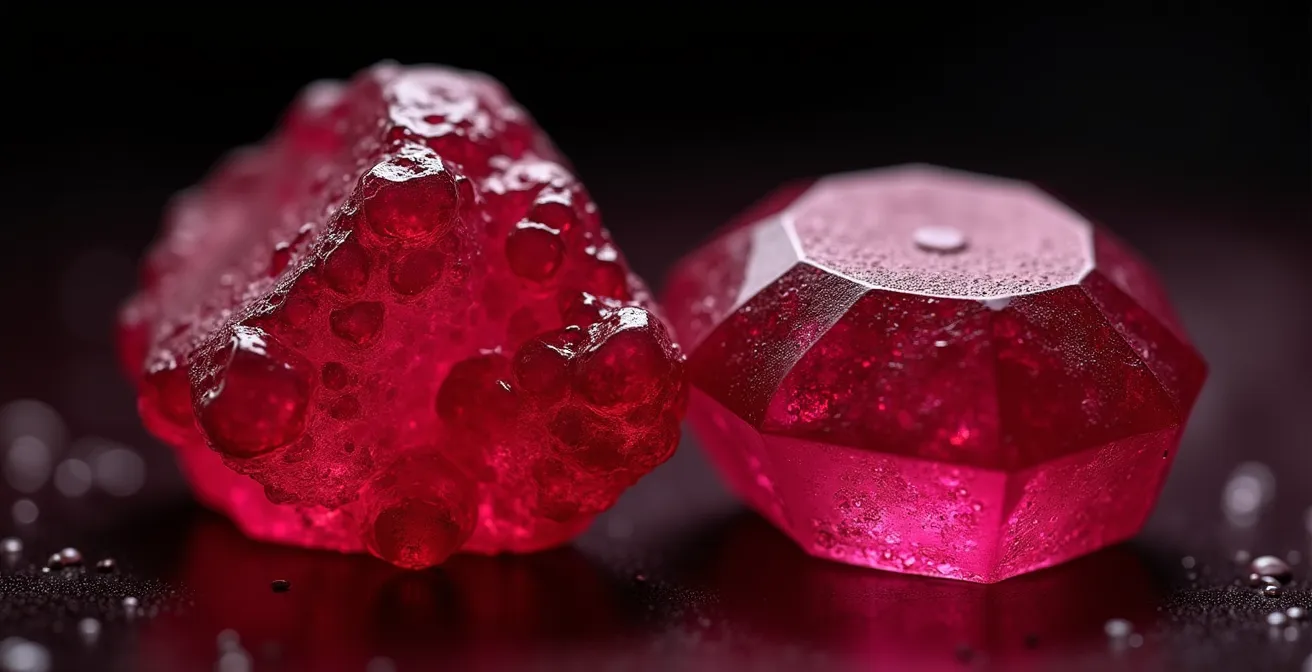
Glass-filling, however, is a fraudulent act of concealment. This treatment is used on heavily fractured, low-quality material. Lead glass is infused into the stone’s surface-reaching cracks to hide them and add weight. This is not an enhancement; it is a repair that renders the stone fundamentally unstable and almost worthless on the serious collector’s market. The glass can degrade over time or even fall out with minor impact or exposure to common chemicals. To a seasoned eye, the difference under magnification is stark, as seen in the comparison below, where the natural structure contrasts with the artificial, often bubbly appearance of a filled stone.
The key distinction for an investor is durability and disclosure. Heat treatment is a one-time, stable enhancement that must be disclosed. Glass-filling is a temporary mask for a fundamentally flawed stone that compromises its integrity. One is a legitimate part of the trade; the other is a red flag that signals a stone to be avoided at all costs.
The ultimate prize in gem hunting remains the ‘untouched’ stone, but a well-heated, beautiful gem will always be a treasure, whereas a filled stone is merely a trinket.
Which Coloured Gemstones Are Too Soft for an Engagement Ring?
An engagement ring is not just a piece of jewellery; it’s a daily companion, exposed to the rigours of life. For an investor choosing a stone that will also be worn, durability is as important as beauty. While diamonds are famously resilient, many coveted coloured gemstones are surprisingly fragile. The dividing line is the Mohs scale of hardness, which measures a mineral’s resistance to scratching.
The industry consensus is that stones rated 7 or higher on the Mohs scale are generally suitable for the daily wear of an engagement ring. This is the hardness of quartz, the primary component of common dust, meaning any stone softer than 7 can be scratched by simple household exposure. Rubies and sapphires, both forms of corundum, rate at a robust 9, making them excellent and durable choices. Diamonds, of course, top the scale at 10.
However, some of the most beautiful and sought-after gems fall into a more delicate category. Emeralds, while rating a respectable 7.5 to 8, are often heavily included (a feature charmingly called their *jardin*, or garden), which can compromise their structural integrity. Opals (5.5-6.5), moonstones (6-6.5), and turquoise (5-6) are notoriously soft and porous, making them highly susceptible to scratches, chips, and damage from chemicals. Tanzanite (6.5) has a stunning violet-blue hue but is brittle and can cleave if struck sharply.
Choosing a softer stone is not impossible, but it is a conscious trade-off between beauty and practicality. It requires a different mindset and specific precautions. A protective setting, such as a bezel or halo, can shield the gem’s vulnerable edges. Furthermore, the wearer must be diligent, removing the ring during any physical activity, cleaning, or gardening. For a collector, this means understanding that the “asset” requires careful stewardship to maintain its condition and value.
Ultimately, the choice reflects a balance: the robust security of a sapphire versus the captivating but fragile beauty of an opal. For a piece meant to last a lifetime, hardness is a non-negotiable aspect of its long-term value.
What Are Star Sapphires and Why Do They Have Asterism?
Beyond the trinity of colour, clarity, and origin lies another dimension of rarity: phenomenal gems. These are stones that exhibit unusual optical effects, and among the most captivating is the star sapphire. Unlike a typical faceted sapphire designed to maximise brilliance, a star sapphire is cut into a smooth, domed cabochon to showcase a phenomenon known as asterism: a silky, star-like pattern that glides across its surface under direct light.
This magical effect is not a trick of the light but a result of the stone’s internal structure. It is caused by dense, needle-like inclusions of the mineral rutile, which are aligned in specific directions within the sapphire’s crystal lattice. As the Gemological Institute of America (GIA) authoritatively explains, the effect is a precise marriage of light and matter.
The phenomenon of asterism occurs when light reflects from tiny rutile inclusions aligned in three directions at 60-degree angles, creating a six-rayed star that appears to float on the surface of the cabochon.
– GIA Gem Encyclopedia, Gemological Institute of America
For asterism to occur, several conditions must be met. The stone must contain enough rutile “silk,” the inclusions must be perfectly oriented, and the gem itself must be translucent enough for light to penetrate and reflect off them. The cutter’s skill is paramount; the cabochon’s dome must be precisely oriented to the crystal axis to centre the star. A sharp, well-defined, and complete six-rayed star on a stone with a strong body colour is an object of great rarity and value.
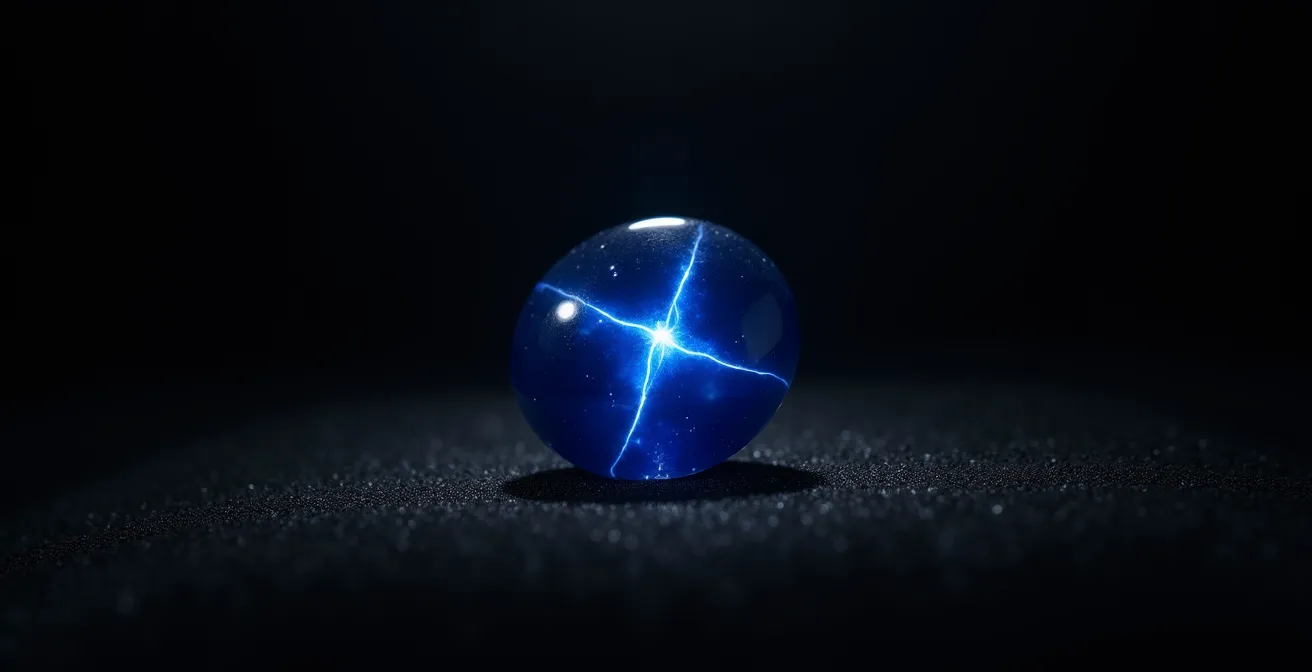
Star sapphires and rubies represent a different kind of connoisseurship. Here, an “inclusion” is not a flaw to be tolerated but the very source of the stone’s beauty and value. It’s a reminder that in the world of gem hunting, the rules are made to be broken, and sometimes the greatest treasures are found not in flawless purity, but in perfect, beautiful imperfections.
A fine star sapphire is a celestial event captured in stone, a testament to a unique and serendipitous alignment of geology and physics.
Do Watch Brands Use the Same Quality Diamonds as High Jewellery Houses?
The diamonds adorning the bezel of a luxury Swiss watch sparkle with undeniable intensity, but are they the same quality as the centrepiece of a high jewellery engagement ring? The answer is no. They serve a fundamentally different purpose and are graded by a different philosophy. The distinction lies in the concept of the “hero stone” versus “collective brilliance.”
High jewellery is built around a single, magnificent diamond—the hero. This stone is individually certified, its every facet scrutinised under the 4Cs. Its purpose is to stand alone, a singular beacon of perfection. In contrast, the small diamonds used in watchmaking, known as *mêlée*, are chosen for their ability to perform as a chorus. Their job is not individual stardom but uniform excellence. Swiss watchmakers, for instance, typically use diamonds in the “Top Wesselton” range, which corresponds to a very respectable F-G colour on the GIA scale. However, these stones are batch-graded for consistency, not individually certified.
The goal is to ensure that every single stone on a watch bezel or dial perfectly matches its neighbours in size, colour, and cut. Any slight deviation would break the seamless river of light the designer aims to create. It’s a testament to precision manufacturing on a micro-scale. High jewellery celebrates the unique personality of a single stone; luxury watchmaking celebrates the flawless harmony of many.
This table from the Gemological Institute of America (GIA) clarifies the different standards and priorities, revealing that while both industries demand high quality, their definition of “quality” is tailored to a different aesthetic and functional goal.
| Aspect | Watch Industry | High Jewellery |
|---|---|---|
| Diamond Type | Mêlée (small diamonds) | Individual certified stones |
| Grading Focus | Batch consistency | Individual Four Cs |
| Typical Grade | Top Wesselton (F-G) | D-F colour grades |
| Purpose | Uniform brilliance in chorus | Single stone prominence |
Neither approach is “better,” but they are different expressions of luxury. One is the art of the soloist, the other is the perfection of the orchestra.
When Is an Old Sovereign Worth More Than Just Its Gold Content?
A collector’s mindset, honed by understanding gemstone provenance and rarity, is perfectly transferable to other asset classes, such as numismatics. An old British gold Sovereign coin is a prime example. To the uninitiated, it’s worth its weight in gold—its “bullion value.” To a connoisseur, its true worth can be exponentially higher, driven by the same principles of rarity, date, and condition that define a fine gem.
A Sovereign’s value transcends its gold content when it possesses numismatic rarity. This is determined primarily by its mintage—how many were produced in a specific year and at a specific mint. For example, the 1819 Sovereign is the holy grail for collectors because records show that only 3,574 coins were struck, making it the rarest date of all. Similarly, Sovereigns minted in branch mints of the British Empire, marked with tiny letters like ‘S’ for Sydney or ‘M’ for Melbourne, are often rarer than their London-minted counterparts and command a significant premium.
Condition is the other critical factor. A coin in “Uncirculated” (UNC) condition, showing no signs of wear and retaining its original mint lustre, is vastly more valuable than a heavily worn piece from the same year. Just as a collector would scrutinise a gemstone for scratches, a numismatist examines a coin’s surfaces for any imperfections that detract from its original state. For anyone in the UK inheriting such pieces, it is vital to recognise their potential beyond a simple “Cash for Gold” transaction.
Your Action Plan: Assessing an Inherited Sovereign in the UK
- Identify the Monarch: Check for the portrait. Sovereigns featuring Queen Victoria’s “Young Head” (1838-1887) are highly sought after.
- Locate the Mint Mark: Look for small letters (‘S’ for Sydney, ‘M’ for Melbourne, etc.) on the reverse side, as these often indicate a rarer coin.
- Check for Key Dates: Research the specific year of your coin. Dates like 1819, 1823, and 1825 are exceptionally valuable.
- Assess the Condition: Evaluate the level of wear. A coin with sharp details and original lustre (Uncirculated) is worth far more than a worn one.
- Seek Expert Authentication: Do not go to a pawn shop. Approach reputable numismatic specialists in the UK, such as Spink & Son, for a professional appraisal.
In both gems and coins, the story is the same: true value lies not in the raw material, but in the rare and historical circumstances of its creation.
Key Takeaways
- Coloured gemstone value is driven by connoisseurship, where provenance (origin) and purity (lack of treatment) are more important than the simple 4Cs.
- The most coveted terms, like “Pigeon’s Blood” ruby, represent a manufactured scarcity defined by elite labs, not just geological chance.
- Durability is a key investment factor; stones softer than a 7 on the Mohs scale require special care and are less suitable for daily-wear rings.
Why Is the Solitaire Setting the Safest Choice for an Undecided Groom?
After navigating the complex world of colour, provenance, treatments, and phenomenal effects, the final decision of how to present the chosen gem can feel overwhelming. In this landscape of infinite choice, the solitaire setting emerges as the undisputed classic—the safest and most confident choice an undecided groom can make. Its power lies in its elegant simplicity and unwavering focus.
The solitaire setting does one thing perfectly: it makes the central gemstone the hero. With minimal metal, typically using four or six delicate claws, it allows the maximum amount of light to enter the stone from all angles, amplifying its brilliance and showcasing its colour to full effect. There are no distracting side stones, no intricate metalwork to compete for attention. It is a pure, unadorned celebration of the gem itself. This minimalism is also practical, making the ring easier to clean and maintain over a lifetime.
This choice telegraphs a powerful message. As the British Jewellers Association notes in its design guide, it shows supreme confidence in the quality of the stone you have so carefully selected. It says, “This gem needs no help. It is magnificent on its own.” Furthermore, its timeless and versatile design ensures it will never go out of style and can be paired seamlessly with any wedding band in the future, removing another potential point of friction.
For a groom navigating the tastes and preferences of his partner, the solitaire is a gesture of profound respect for both the gem and the wearer. It provides a beautiful, classic foundation that can be personalised later with a more elaborate wedding band if desired. It is a choice that is almost impossible to get wrong.
In a world of fleeting trends, the decision to place a single, magnificent stone at the centre of it all is the ultimate expression of enduring value.
Frequently Asked Questions on Coloured Gemstones
Is heat treatment permanent in rubies?
Yes, heat treatment is a stable and permanent enhancement. Its purpose is to improve the ruby’s colour and clarity by removing any purple tinge, dissolving silky inclusions, and eliminating blue patches. The results do not fade or revert over time.
How can I spot glass-filled rubies?
While standard heating is undetectable to the naked eye, glass-filled rubies often betray themselves under magnification (a 10x loupe is sufficient). Look for gas bubbles trapped within the filling or a “flash effect,” where blue and orange flashes of light appear as you rock the stone. These are clear indicators of a composite stone with compromised integrity.
Are heated rubies less valuable?
Heated rubies are widely accepted and traded in the gemstone market and can be very valuable. However, an unheated ruby of the same quality will always command a significant premium due to its extreme rarity. The value hierarchy is: unheated (top), heated (valuable), and glass-filled (commercial grade, low value).