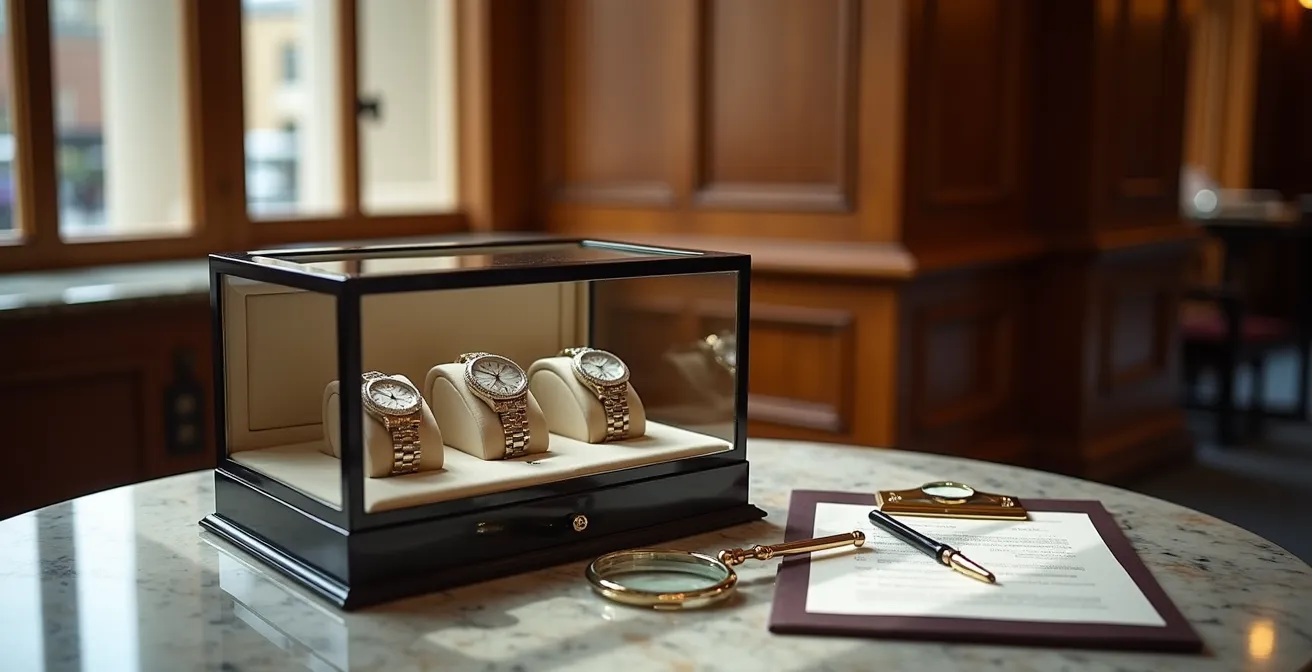
A timepiece transitions from a watch to a high-jewellery asset when its value is driven more by its gemological content and craftsmanship than its horological function, fundamentally altering its risk profile and insurance requirements.
- The choice of a quartz movement, often seen in high-jewellery pieces, is a strategic decision to reduce mechanical complexity, lowering service costs and insurance risk.
- Valuation must be updated every 2-3 years through a certified professional, like a member of the NAJ’s IRV, to ensure coverage reflects current market value, not just retail price.
Recommendation: Treat your high-jewellery watch as a distinct asset class. This requires a specialised insurance policy and a proactive management strategy focused on regular valuation, professional maintenance, and situational risk awareness.
For the discerning collector, the line between a luxury timepiece and a piece of high jewellery is increasingly blurred. You acquire a masterpiece, a symphony of brilliant-cut diamonds and intricate metalwork that also happens to tell the time. The initial thrill of ownership is soon followed by a pragmatic concern: how is this asset protected? The assumption that it’s ‘just a watch’ is the first and most costly mistake. From an insurer’s standpoint, the moment gemological value eclipses horological utility, the entire risk landscape shifts. This is no longer about insuring a mechanism; it’s about underwriting a collection of precious materials assembled with extraordinary artistry.
Many guides will discuss the beauty of these pieces or the prestige of the brands. They will offer generic advice to “get it insured.” This is insufficient. This approach fails to address the critical nuances that define the piece’s true replacement value and its specific vulnerabilities. It ignores the fact that decisions like using a quartz movement or a particular gem-setting technique are not merely aesthetic choices but are key insurability factors that a standard policy will overlook.
Our perspective is different. We will not focus on the glamour, but on the valuation and the risk. This guide deconstructs the high-jewellery watch as an asset. We will analyse why certain technical and artistic choices are made and, crucially, how they directly impact your insurance coverage and the long-term protection of your investment. We will move beyond the superficial and provide a framework for assessing your liability exposure, ensuring your coverage is as meticulously crafted as the timepiece on your wrist.
This analysis provides a clear roadmap for any serious collector. By exploring the specific characteristics that define these unique assets, we will build a comprehensive understanding of how to manage their value and mitigate the associated risks. The following sections break down the key questions that determine the boundary between a functional watch and an insurable high-jewellery asset.
Summary: From Timepiece to High-Value Asset
- What is ‘Snow Setting’ and Why Is It More Expensive Than Pave?
- Why Do Most High-Jewellery Watches Use Quartz Movements?
- Do Watch Brands Use the Same Quality Diamonds as High Jewellery Houses?
- Can You Wear a Full Diamond Watch with Jeans and a T-Shirt?
- How to Clean Lotion out of a Diamond-Set Watch Without Loosening Stones?
- How Often Should You Update the Valuation of Your Luxury Timepiece?
- How Does Colour Grading for Rubies Differ from Diamonds?
- Why Are Coloured Gemstones Often Rarer Than Diamonds?
What is ‘Snow Setting’ and Why Is It More Expensive Than Pave?
From a valuation perspective, the gem-setting technique is a primary factor in determining a watch’s classification as high jewellery. Standard pavé involves laying stones of uniform size in a neat grid. Snow setting, however, is a far more complex and artistic process. It involves setting diamonds of varying sizes—typically from 0.5mm to 1.6mm—side-by-side, with the goal of covering the metal surface entirely, mimicking a fresh blanket of snow. This technique requires the master jeweller to select and place each stone by hand, creating a unique pattern with minimal visible metal.
The impact on value and insurance is significant. The sheer labour and artistry involved mean that a snow-set piece is inherently a bespoke creation, making it more difficult and expensive to repair or replace. According to Hatton Garden master jewellers, this intricate work makes snow setting 30-40% more expensive than standard pavé settings for an equivalent surface area. The non-uniformity means a replacement would require a similar level of artistry, not just a supply of standard-sized stones. This is why artisans, such as those at UK-based workshops like Queensmith, who craft pieces entirely in-house, are so valued; they preserve an artisanal skill set that is crucial for both creation and restoration.
For an insurer, this means the replacement value is not just the cost of gold and diamonds; it’s the cost of a master artisan’s time and a unique design. A valuation for a snow-set watch must explicitly account for this craftsmanship, as a standard “per-carat” calculation would grossly underestimate its true worth and leave you underinsured.
Why Do Most High-Jewellery Watches Use Quartz Movements?
A common point of confusion for collectors is the prevalence of quartz movements in watches that command six-figure prices. Watch purists often champion the intricate engineering of a mechanical movement. However, from a high-jewellery and insurance perspective, the choice of a quartz movement is a deliberate risk-management strategy. The primary value of a high-jewellery watch lies in its case, bracelet, and dial—the “habillage”—not its internal mechanics. A complex mechanical movement introduces hundreds of delicate, moving parts, increasing the risk of malfunction and the need for frequent, expensive servicing.
A quartz movement, by contrast, is robust, reliable, and significantly less complex. This has several direct benefits for the owner and insurer. Firstly, the service intervals are far longer; a quartz movement may need a battery change and check-up every 10-15 years, compared to the 3-5 year interval required for a mechanical watch. Secondly, the cost is substantially lower. In the UK, a quartz service at an authorised dealer might cost £200-£400, whereas servicing a complex mechanical chronograph can easily exceed £2,000. Thirdly, the turnaround time is weeks, not months.
Most importantly, a quartz movement reduces the overall risk profile of the asset. There are fewer points of mechanical failure, less risk of damage from shocks, and a lower likelihood of a costly internal breakdown. For an insurer, a watch that spends less time in transit and at service centres, and has a lower intrinsic mechanical risk, is a more stable and predictable asset to underwrite. The focus remains on the most valuable part: the jewellery itself.
Do Watch Brands Use the Same Quality Diamonds as High Jewellery Houses?
This is a critical question for valuation. The answer is nuanced. Top-tier watch brands that have their own high-jewellery ateliers, such as Cartier, Piaget, or Chopard, uphold the same rigorous standards for the diamonds used in their watches as they do for their necklaces and rings. These stones are typically in the D to F colour range (colourless) and the IF to VVS clarity range (internally flawless to very, very slightly included). However, for watch brands that do not have a deep heritage in high jewellery, the standards can vary. They may use diamonds in the G-H colour range, which are still high quality but not at the absolute peak.
The defining factor for insurance purposes is not the brand name alone, but the independent certification of the gemological work. This is where professional valuation becomes non-negotiable. An appraiser must assess the stones based on the 4Cs (Cut, Colour, Clarity, Carat) independently of the watch’s brand. In the UK, the gold standard for this is a valuation performed by a member of the National Association of Jewellers’ Institute of Registered Valuers (IRV). Their assessment provides an objective, defensible basis for the insurance value, stripping away marketing to focus on the asset’s intrinsic quality.
A certified valuation report will detail the quality of the principal stones, giving the insurer a clear picture of what they are underwriting. Without this, you risk being insured for a “diamond watch” in generic terms, when you actually own a piece set with flawless, investment-grade gems. The visual difference might be subtle to the naked eye but can represent tens of thousands of pounds in replacement value.
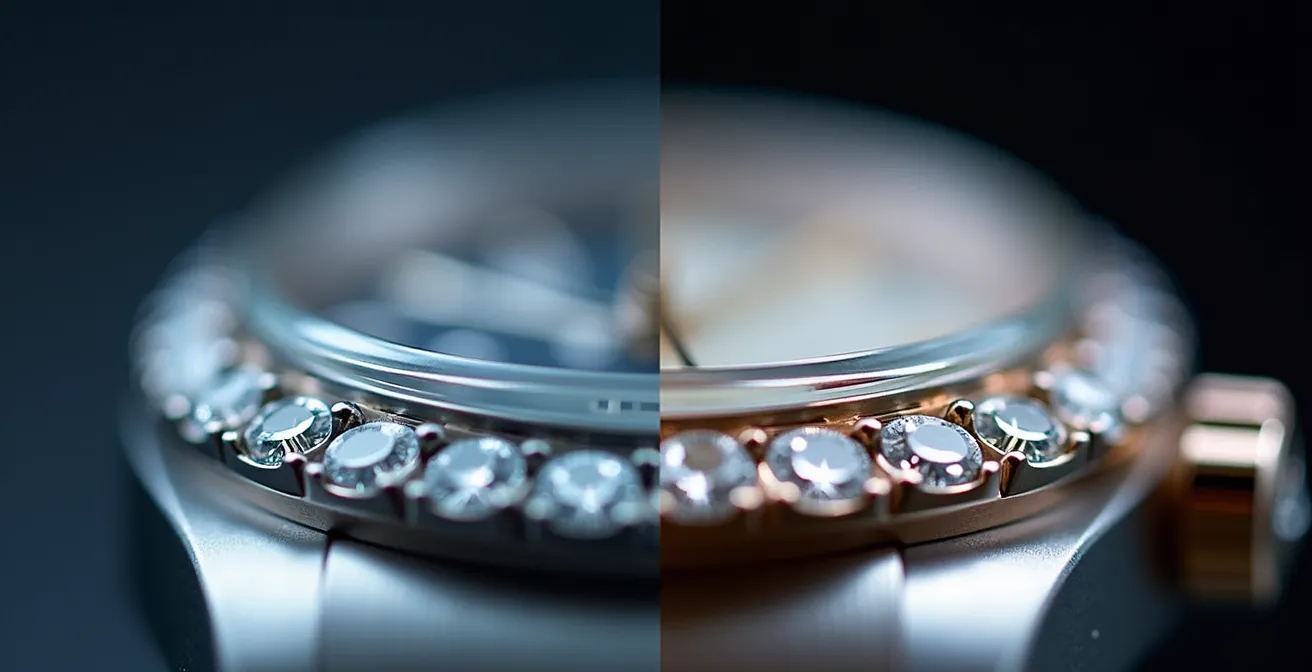
As the detailed image above highlights, the precision of the setting and the brilliance of the stones are tangible markers of quality that a trained eye—and a proper valuation—can quantify. This meticulous detail is what separates a decorative piece from a true high-jewellery asset.
Can You Wear a Full Diamond Watch with Jeans and a T-Shirt?
Stylistically, the “high-low” mix of wearing a spectacular piece of jewellery with casual attire is a modern trend. However, from a risk management perspective, this practice requires careful consideration, especially in urban environments like London. The primary risk is not fashion-related; it’s situational awareness and liability exposure. A full diamond watch is a conspicuous display of wealth that can attract unwanted attention, regardless of what it’s worn with.
The risk of theft is real and increasingly violent. According to data from the Metropolitan Police, 5,180 high-value watches worth over £3,000 were stolen in London between 2022 and early 2024. Security experts warn of a rise in “follow-home” robberies, where thieves target individuals in luxury districts or restaurants and attack them later. Wearing such a piece for a casual outing—a trip to the supermarket or a walk in the park—dramatically increases your risk profile compared to wearing it at a secure, private event.
While police operations have had some success, for instance, making 31 arrests in Soho where 40% of watch robberies occur, the onus is on the owner to mitigate risk. Your insurance policy will likely contain a “reasonable care” clause. While it won’t dictate your wardrobe, consistently placing a high-value asset in vulnerable situations could be questioned in the event of a claim. The prudent approach is to assess the environment. A casual dinner at a high-end, secure restaurant is one thing; a crowded public space is another. The question isn’t “can you?” but “should you, given the environmental risk?”
How to Clean Lotion out of a Diamond-Set Watch Without Loosening Stones?
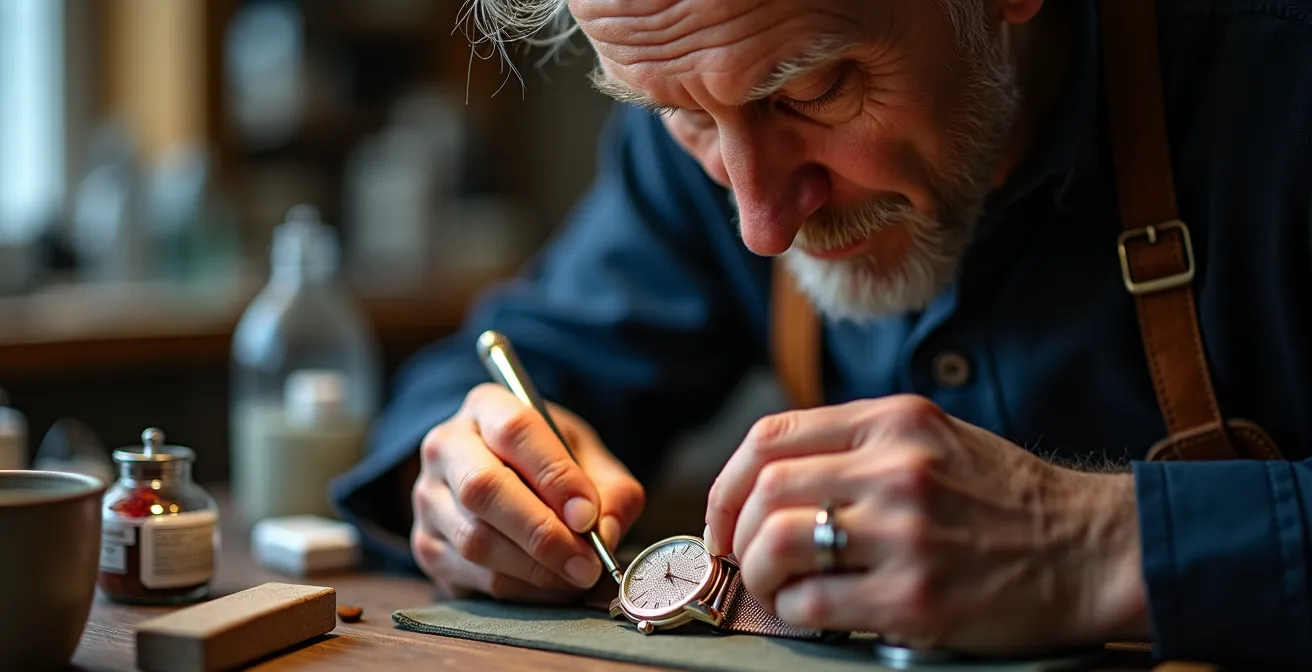
Proper maintenance is a cornerstone of protecting any high-value asset, and high-jewellery watches are no exception. Lotions, perfumes, and daily grime can accumulate within the intricate settings of a diamond watch, dulling its brilliance and, more critically, potentially damaging the metal over time. The key is to use a method that is effective but gentle enough to not compromise the integrity of the settings. Aggressive cleaning is a primary cause of loosened stones, leading to costly repairs and potential loss.
For at-home cleaning, professionals recommend a simple, non-invasive approach. Avoid harsh chemicals or abrasive materials at all costs. An ultrasonic cleaner, for instance, should never be used at home on a gem-set watch; the vibrations are powerful enough to dislodge stones from their settings. Instead, a specific, methodical process should be followed to ensure the safety of the asset.
Regular professional checks are also essential. Given the UK’s damp climate, which can accelerate tarnishing or affect certain metals, an annual inspection is a prudent investment in the longevity of your piece. This is not just about aesthetics; it’s about asset preservation. A certified jeweller can check for any loose prongs or signs of wear that you might miss, preventing a small issue from becoming a major loss.
Your Action Plan: Safe Cleaning and Maintenance
- Gentle Cleaning Method: Use a very soft-bristled toothbrush (a baby toothbrush is ideal) with a drop of mild washing-up liquid in a bowl of lukewarm water. Gently brush the set areas and rinse briefly before patting dry with a lint-free cloth.
- Professional Services: For a deep clean, use a certified jeweller. In the UK, a professional clean from an NAJ-certified expert typically costs between £30 and £60 and restores the piece’s lustre safely.
- Annual Setting Health Check: Schedule an annual inspection with your jeweller. They can perform a “setting health check” to ensure all stones are secure, a critical step for preventing loss.
- Avoid Damaging Tools: Never use ultrasonic cleaners at home on gem-set pieces unless specifically advised by the manufacturer. The vibrations can be too powerful for delicate settings.
- Climate Consideration: Be aware that the UK’s damp climate can affect metal settings over time. More frequent inspections are a wise precaution compared to ownership in a drier climate.
How Often Should You Update the Valuation of Your Luxury Timepiece?
An out-of-date valuation is one of the most common and dangerous gaps in high-value asset protection. Possessing a valuation certificate from the time of purchase is not sufficient. The market for luxury watches and precious materials is volatile. The value of gold, platinum, and high-quality diamonds fluctuates, as does the market demand for specific brands and models. Insuring a £100,000 watch with a five-year-old valuation is akin to insuring it for £70,000 or less in today’s terms. In the event of a total loss, you would be significantly underinsured and face a substantial financial shortfall.
For specialist insurers, a current valuation is a mandatory requirement for adequate coverage. While standard home insurance might accept a valuation that is 3-5 years old, this is often for lower-value items. For high-jewellery timepieces, the standard is much stricter. Jewellery experts and high-value insurers agree that valuations for significant pieces should be updated more frequently. According to UK specialists at Laings, valuations are recommended every 3-5 years for luxury watches, with the timeline shortening as the value increases.
For high-value collections, an annual review is best practice. The valuation document itself must be robust, preferably from an NAJ IRV member, including detailed descriptions, high-quality photographs, and a clear statement of value for insurance replacement purposes. This document is the bedrock of your policy.
The table below outlines the typical valuation requirements for UK-based collectors, demonstrating how the stringency increases with the asset’s value. This illustrates why a one-size-fits-all approach to valuation is inadequate for a serious collection.
| Insurance Provider | Valuation Frequency | Value Threshold | Documentation Required |
|---|---|---|---|
| Standard Home Insurance | 3-5 years | £1,500+ | Receipt or basic valuation |
| Specialist Insurers (Chubb, Hiscox) | 2-3 years | £5,000+ | NAJ IRV certified valuation |
| High-Value Collections | Annual | £100,000+ | Full appraisal with photographs |
How Does Colour Grading for Rubies Differ from Diamonds?
When a high-jewellery watch incorporates coloured gemstones, the valuation process becomes exponentially more complex than for a diamond-only piece. While diamonds are graded on a standardised, globally accepted scale (the GIA’s 4Cs), the world of coloured stones is far more subjective and nuanced. For diamonds, the absence of colour is what determines value (a D-colour is a perfect score). For a ruby, sapphire, or emerald, it is the presence, quality, and saturation of colour that is paramount.
The grading of a ruby, for example, focuses on three key components: hue (the primary colour), tone (the lightness or darkness of the colour), and saturation (the intensity of the colour). The most prized rubies possess a pure, vibrant red hue, often described as “pigeon’s blood,” with a medium tone and strong saturation. Unlike diamonds, there is no simple alphabetised scale. Value is determined by a combination of these factors, plus the stone’s origin (a Burmese ruby commands a premium over a Thai ruby of similar quality) and whether it has been heat-treated—a common practice that must be disclosed.
This complexity has a profound impact on valuation and insurance. An appraisal for a coloured gemstone watch must be conducted by a specialist with deep expertise in that specific type of stone. They must detail not just the 4Cs but also the origin and any treatments. This subjectivity also creates a wider gap between retail price and wholesale value, making a professional insurance appraisal even more critical. As one expert analysis on appraisal types highlights, the disconnect can be vast. The Precious Metals Refinery, in their analysis of jewellery appraisal types, provides a stark example:
A 1-carat round diamond with I color and I2 clarity would retail for about $2000; however, its wholesale value is $360
– Precious Metals Refinery, Jewelry Appraisal Types Analysis
This principle is even more pronounced with coloured stones, where a slight variation in hue can mean a tenfold difference in value. An insurance policy must be based on a formal appraisal that captures these subtleties to ensure you are covered for the stone’s true replacement value, not just its carat weight.
Key Takeaways
- A watch becomes ‘high jewellery’ when its value is primarily determined by its gemological content and craftsmanship, fundamentally changing its insurance risk profile.
- Regular, professional valuation (every 2-3 years for high-value pieces) by a certified expert, such as a UK NAJ IRV member, is non-negotiable to maintain adequate coverage.
- Risk management is an active process for the owner, encompassing situational awareness when wearing the piece, adherence to a strict professional maintenance schedule, and understanding the specific vulnerabilities of your asset.
Why Are Coloured Gemstones Often Rarer Than Diamonds?
While diamonds, particularly large, high-quality ones, are rare, many of the finest coloured gemstones are significantly rarer from a geological standpoint. For every 10,000 diamonds mined, there may be only one high-quality ruby, sapphire, or emerald. This natural scarcity is the primary driver of their value. Gem-quality diamonds are found on every continent, but the specific geological conditions required to produce a top-quality Burmese ruby or Colombian emerald exist in only a handful of locations worldwide. This limited supply, coupled with growing global demand, has caused the value of fine coloured gemstones to appreciate at a faster rate than diamonds in recent years.
This rarity profoundly impacts the watch’s status as an investment-grade asset. A high-jewellery watch set with a suite of perfectly matched, unheated Ceylon sapphires is not just a timepiece; it is a portable collection of exceptionally rare geological specimens. Its value is tied to a market that is even more specialised and opaque than the diamond market. Recent auction results in London and Geneva have shown that watches featuring exceptional coloured stones often fetch prices far exceeding comparable all-diamond pieces, especially if they have strong provenance.
From an insurance perspective, this rarity presents a unique challenge. Replacing a 2-carat D-flawless diamond is difficult but possible. Replacing a 5-carat unheated “pigeon’s blood” Burmese ruby is a monumental task that could take years, if it’s even possible at all. Therefore, a policy for such a piece must be handled by a specialist insurer who understands this market. The coverage might include a higher agreed-value percentage (e.g., 150% of the appraised value, as offered by some specialist policies) to account for the difficulty and cost of sourcing a replacement in a volatile market. The presence of rare coloured gems firmly moves the watch from the category of luxury good into the realm of a unique, often irreplaceable, art asset.
The ultimate protection for your collection begins with understanding its true nature. The next logical step for any serious collector is to secure a comprehensive, up-to-date valuation from a certified specialist and discuss a tailored insurance solution that reflects the unique risk profile of your high-jewellery assets.
Frequently Asked Questions on High-Jewellery Watches
What makes coloured gemstone watches more valuable than diamond pieces?
Recent London auction results show top-quality coloured gemstone watches often exceed all-diamond pieces in investment value due to rarity and provenance.
How has London historically influenced the coloured gemstone trade?
London became a global hub for coloured gemstones through the British East India Company’s trade routes, establishing lasting preferences for Burmese rubies and Ceylon sapphires.
Which UK museums showcase iconic coloured gemstone watches?
The Victoria & Albert Museum houses notable examples from British aristocratic collections, demonstrating the historical significance of coloured stones in high jewellery watches.