
‘Swiss Reliability’ is not a marketing term; it is a tangible engineering framework designed to withstand the specific operational hazards faced by medical and aviation professionals.
- It actively counters physical shocks through systems like Incabloc, protecting the mechanism’s integrity during turbulence or accidental drops.
- It guarantees performance in high-magnetic environments, such as a UK hospital’s MRI suite, thanks to standards like ISO 764.
- It provides a verifiable promise of resilience through rigorous, independent certifications (COSC, ISO 6425) that test the watch to its limits.
Recommendation: When selecting a professional timepiece, look beyond the brand and assess its certified resistance to the specific failure points you encounter daily.
In the cockpit, during a critical instrument cross-check, or in the operating theatre, timing a vital procedure, a professional’s focus is absolute. In these moments, the equipment you rely on is not an accessory; it is an extension of your skill. A timepiece, in this context, must be an unwavering instrument of precision and durability. For decades, ‘Swiss Made’ has been the benchmark, but this is often perceived through a lens of luxury and status.
This perception, however, overlooks the fundamental reason why these instruments are trusted in life-or-death situations. The true value for a doctor or pilot in the UK is not in the prestige, but in the rigorous, system-level engineering designed for failure point mitigation. It’s about understanding that ‘reliability’ is a deliberate design choice, engineered to counteract specific, real-world threats to mechanical integrity.
But if the core value isn’t the brand name, what is it? The key lies in shifting perspective from viewing a watch as a single object to understanding it as a system of engineered resilience. This isn’t about vague notions of ‘quality’, but about specific, certified solutions to problems like physical shock, extreme magnetic fields, pressure variations, and the simple, relentless passage of time.
This analysis will deconstruct the concept of ‘Swiss Reliability’ into its core technical pillars. We will examine the specific systems and standards that ensure a watch performs flawlessly not just on a calm day, but in the hostile environments where professionals work. We will explore the engineering that justifies its place as a mission-critical tool.
To fully grasp the engineering that underpins this professional-grade reliability, this guide breaks down the key systems and certifications. The following sections explore each component, from internal shock absorbers to the rigorous external standards that a true professional watch must meet.
Summary: Deconstructing Swiss Mechanical Resilience
- What Is the Incabloc System and Why Does It Matter if You Drop Your Watch?
- Why Your MRI Scanner or Induction Hob Might Stop Your Non-Swiss Watch?
- Do Swiss Movements Really Last Longer Between Services than Japanese Ones?
- Why Buying a Mainstream Swiss Brand Guarantees Repairability in 2050?
- What Does +6/-4 Seconds Per Day Actually Mean for Your Punctuality?
- What Torture Tests Must a Watch Pass to Earn the Chronometer Title?
- What Are the ISO 6425 Requirements That Define a True Professional Diver?
- Is Paying Extra for a COSC Certified Chronometer Worth It for Daily Wear?
What Is the Incabloc System and Why Does It Matter if You Drop Your Watch?
For any mechanical watch, the most vulnerable component is the balance staff—a minuscule axle, often thinner than a human hair, on which the balance wheel pivots. A sudden shock, from a drop or a hard knock, can easily bend or break this pivot, causing the watch to stop instantly. This is a primary failure point that Swiss engineering addressed decades ago with the development of shock protection systems, the most famous of which is the Incabloc system.
Invented in 1934 and becoming an industry standard through the 1950s, the Incabloc system is a masterpiece of micro-mechanical engineering. It mounts the delicate jewel bearings of the balance wheel within a tiny, lyre-shaped spring. When the watch experiences a shock, the entire assembly can move laterally and vertically, absorbing the energy and protecting the fragile pivots from damage. Once the shock has passed, the spring precisely re-centres the assembly, ensuring the watch continues to function accurately. This is a classic example of engineering redundancy built for a specific, predictable failure.
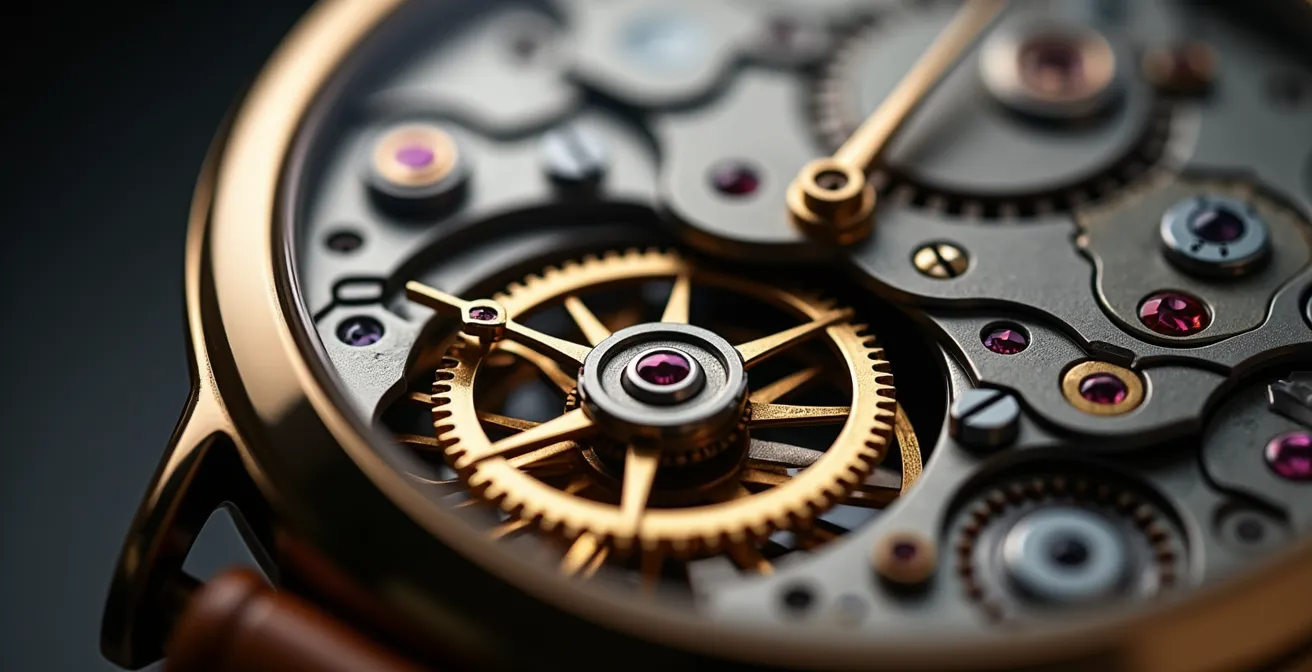
As the illustration above demonstrates, this is not a theoretical benefit. For a pilot experiencing turbulence or a doctor rushing through a hospital corridor, the Incabloc system provides a tangible layer of security. It transforms the watch from a fragile instrument into a robust tool, capable of withstanding the physical rigours of a demanding professional environment without compromising its core function of timekeeping.
Why Your MRI Scanner or Induction Hob Might Stop Your Non-Swiss Watch?
Physical shocks are a visible threat, but an equally potent and invisible danger for any mechanical watch is magnetism. The hairspring, the beating heart of the movement, is typically made of a metal alloy. When exposed to a strong magnetic field, it can become magnetised, causing its coils to stick together. This shortens its effective length, making the watch run extremely fast, or in severe cases, stop altogether. This is a critical failure point in modern professional environments, particularly in healthcare.
A typical NHS hospital environment presents a significant magnetic risk. For instance, an MRI scanner operates with incredibly powerful fields, with data from the Hull University Teaching Hospitals NHS Trust indicating scanners operate between 1.5 to 3 Tesla. That is up to 60,000 times the strength of the Earth’s magnetic field. While no watch should enter an active MRI room, the residual magnetism in the surrounding area can still be sufficient to affect a standard, unprotected movement. Even common household items present a risk; the European market for induction hobs, which generate magnetic fields, is projected to grow at a rate of over 4.5%, increasing exposure.
To combat this, Swiss standards like ISO 764 (“Horology — Magnetic resistant watches”) are crucial. A watch certified to this standard must resist a magnetic field of 4,800 A/m (or 60 Gauss) and maintain its accuracy within +/- 30 seconds per day. This is achieved through two main strategies: using amagnetic alloys for components like the hairspring (e.g., silicon) or shielding the entire movement in a soft-iron inner case (a Faraday cage). The following table, based on NHS data, puts these environmental threats into perspective.
| Environment | Magnetic Field Strength | Impact on Standard Watch |
|---|---|---|
| Earth’s Natural Field | 25-65 microtesla | No impact |
| UK Induction Hob | 20-100 microtesla at 30cm | Potential magnetization |
| NHS MRI Scanner Room | 0.5-3 Tesla | Severe magnetization risk |
| Airport Security Scanner | Up to 100 microtesla | Minor risk |
For a doctor in the UK, this isn’t an abstract concern. A watch that can be trusted around medical equipment is a necessity. This certified resistance to environmental hostility is a core tenet of Swiss professional watchmaking.
Do Swiss Movements Really Last Longer Between Services than Japanese Ones?
The debate between Swiss and Japanese movements often revolves around longevity and service intervals. While both produce exceptionally reliable movements, their underlying design philosophies can differ, impacting the serviceability lifecycle. It’s less a question of which is “better” and more about which is designed for sustained, long-term performance as a professional tool.
Historically, many high-end Swiss movements were designed with the watchmaker in mind. They are engineered to be disassembled, cleaned, lubricated, and reassembled multiple times over many decades. Components are often robust and finished to a high degree, not just for aesthetics, but to reduce friction and wear. This philosophy treats the watch as a generational instrument, with serviceability being a primary design consideration. The goal is to replace individual worn parts—a single gear or spring—to restore original performance.
In contrast, some highly efficient Japanese manufacturing philosophies, particularly in more accessible price brackets, prioritize precision automation and production at scale. The movements are incredibly reliable out of the box, but can sometimes be designed for module replacement rather than individual component repair. For a heavily worn movement after a decade of use, it can be more cost-effective to replace the entire calibre rather than service it piece by piece. This is a perfectly valid and efficient approach for a consumer product, but it differs from the “forever tool” ethos.
For a professional, the Swiss approach often provides greater peace of mind. Knowing that your specific movement can be serviced by a skilled watchmaker almost anywhere in the world, and that individual parts will be available, reinforces its status as a permanent piece of equipment, not a disposable one. Recommended service intervals of 5-10 years for modern Swiss movements are not a sign of weakness, but a planned maintenance schedule to ensure the instrument operates within its tight tolerances for a lifetime.
Why Buying a Mainstream Swiss Brand Guarantees Repairability in 2050?
For a tool intended to last a lifetime, its initial performance is only half the story. The other half is the guarantee of future support. The structure of the Swiss watch industry, dominated by a few major conglomerates like Swatch Group, Richemont, and LVMH, provides a unique and often overlooked advantage: an institutional commitment to long-term parts availability and service.
When you purchase a watch from a major brand within these groups, you are buying into an ecosystem. These companies maintain vast catalogues of parts for movements, both current and discontinued, for decades. A pilot who buys an Omega Speedmaster or a doctor who invests in a Rolex Submariner today can be reasonably confident that in 2050, an authorised service centre will have the parts and the institutional knowledge to repair it to factory specifications. This is a critical aspect of the serviceability lifecycle.
This contrasts sharply with smaller, independent brands or watches produced outside of this established ecosystem. While they may offer excellent products, their ability to guarantee parts and service 30 years from now is dependent on their own survival and business strategy. For a professional, this introduces an element of risk. The equipment may be superb, but its long-term viability is less certain.
This industrial structure is a form of failure point mitigation on a macro scale. It mitigates the risk of your investment becoming an unserviceable museum piece. It ensures that the watch remains a functional, reliable tool for the entirety of a professional career and beyond. This guarantee of longevity and repairability is a quiet but powerful component of ‘Swiss Reliability’, transforming the purchase from a simple transaction into a long-term service agreement.
What Does +6/-4 Seconds Per Day Actually Mean for Your Punctuality?
A specification of +6/-4 seconds per day, the tolerance for a COSC-certified chronometer, can seem abstract. For most people, a few seconds’ deviation is irrelevant. However, for a professional relying on their watch for critical calculations or coordination, understanding the tangible impact of this deviation is essential. This is not about being late for a meeting; it’s about the integrity of time-based professional judgements.
Let’s consider an aviation scenario. A pilot might use their watch as a backup for calculating fuel burn over a specific leg of a flight. If the watch is running at the maximum allowable deviation of +6 seconds per day, over a 30-day period it will have gained 3 minutes. While modern flight management systems handle primary calculations, in an emergency or backup scenario, this seemingly small deviation could introduce errors into manual calculations. The COSC standard provides a tight, guaranteed boundary on that potential error.
In a medical context, a doctor might time the administration of a drug or monitor a patient’s vitals over a set period. A consistent, known deviation is manageable, but an uncertified watch can have erratic daily rates, gaining 20 seconds one day and losing 15 the next depending on its position or state of wind. The certified performance of a chronometer guarantees that the rate will be stable and predictable within that +6/-4 second window, regardless of conditions.
Therefore, the value of this specification is not that the watch is “perfectly accurate.” The value is the guarantee of a maximum-bounded error. A professional can trust that the instrument’s deviation will not exceed a known, small margin. This transforms the watch from a simple time-teller into a calibrated instrument with a documented tolerance, which is the very definition of a professional tool.
What Torture Tests Must a Watch Pass to Earn the Chronometer Title?
The term “Chronometer” is not a marketing buzzword; it is a protected title awarded only to watch movements that have passed a rigorous and standardised series of tests. The most respected of these certifications is issued by the Contrôle Officiel Suisse des Chronomètres (COSC). This process is a systematic attempt to find and verify the absence of failure points under a variety of common stresses.
To earn the title, every single uncased movement must be submitted to the independent COSC laboratories for 15 consecutive days and nights. During this period, the movement is subjected to a battery of tests designed to simulate real-world wear and environmental changes. The movement’s timekeeping rate is measured and recorded in five different physical positions: dial up, dial down, crown left, crown right, and crown up. This ensures that gravity’s effect on the regulating organ is minimal and consistent, regardless of how the wearer’s arm is positioned.
Furthermore, the tests are conducted at three different temperatures: 8°C, 23°C (room temperature), and 38°C. This cycle tests the stability of the movement’s components, especially the balance wheel and hairspring, as they expand and contract with temperature changes. A movement that passes must maintain its accuracy across this 30°C range. Throughout the entire process, COSC measures seven distinct criteria, including the famous average daily rate of -4 to +6 seconds. Any movement that fails even one of the seven criteria on any of the 15 days is rejected.
This is not a spot check; it’s a gruelling ordeal. It is a proactive search for weaknesses. For a pilot moving between a cold cockpit and a warm terminal, or a doctor in a climate-controlled hospital, this certification provides a guarantee that the watch’s performance will not degrade due to positional or thermal variations. It is a certificate of certified performance under stress.
What Are the ISO 6425 Requirements That Define a True Professional Diver?
While often associated with recreational diving, the ISO 6425 standard for “Divers’ watches” represents one of the most comprehensive sets of requirements for a mission-critical timepiece. It is a holistic standard that addresses multiple potential failure points simultaneously, making it a benchmark for any professional operating in a demanding physical environment, not just underwater.
A watch cannot simply claim to be “ISO 6425 compliant.” Every single watch must be individually tested to earn the “Diver’s” marking. The standard mandates a suite of tests far exceeding basic water resistance, including:
- Water Resistance: The watch must be resistant to 125% of its rated water pressure. A 200m watch is tested to 250m.
- Legibility: The time and a running indicator (usually the seconds hand) must be legible in total darkness from a distance of 25cm.
- Magnetic Resistance: It must meet the ISO 764 anti-magnetism standard, withstanding a field of 4,800 A/m.
- Shock Resistance: It must pass the ISO 1413 shock resistance test, equivalent to being dropped from one meter onto a hardwood floor.
- Resistance to Saline Water: The watch must be immersed in a salt solution for 24 hours and show no signs of corrosion or functional degradation.
- Unidirectional Bezel: It must have a timing bezel that only rotates counter-clockwise to prevent accidental extension of a measured time, a critical safety feature.
These requirements create an instrument with immense engineering redundancy. For a pilot or doctor, the direct application of deep-sea diving might be limited, but the implications are profound. A watch that meets this standard is certified to be legible in all conditions, robust against shocks, resistant to common magnetic fields, and sealed against environmental ingress. It is, by definition, a tool built to survive environmental hostility.
Your Mission-Critical Timepiece Audit
- Identify Failure Points: List the primary environmental threats in your daily work (e.g., magnetic fields from equipment, risk of physical impact, temperature shifts).
- Check Certifications: Inventory your watch’s stated certifications (e.g., “Chronometer,” “Diver’s 200M,” ISO 764). Do they explicitly address your identified risks?
- Assess Real-World Resilience: Cross-reference the certification standards (like COSC’s temperature tests or ISO 6425’s shock resistance) against your specific professional context. Is the level of protection adequate?
- Evaluate Legibility & Ergonomics: In simulated low-light or high-stress conditions, can you read the time at a glance? Is the crown or bezel easy to operate with or without gloves?
- Verify Serviceability: Confirm the brand’s long-term service policy. Is there a clear path for maintenance and repair in the UK to ensure its reliability over a full career?
Key Takeaways
- True reliability is not a brand promise, but a result of specific engineered systems like Incabloc for shock protection and soft-iron cages for magnetic resistance.
- Professional-grade standards like COSC and ISO 6425 are not marketing features; they are independent verifications that a watch performs under physical and environmental stress.
- The long-term value for a professional lies in the serviceability lifecycle, guaranteed by the structure of the mainstream Swiss industry, ensuring a tool lasts a career.
Is Paying Extra for a COSC Certified Chronometer Worth It for Daily Wear?
After examining the individual components of Swiss reliability—shock protection, magnetic resistance, and long-term serviceability—we return to a crucial question. Is the premium for a COSC-certified chronometer justified for a professional’s daily use? The answer becomes clear when we stop focusing on the marginal gain in daily accuracy and instead see the certification for what it is: the final, holistic guarantee of resilience.
For a civilian, the difference between a watch running at +10 seconds a day and one running at +2 seconds a day is academic. For a professional, however, the COSC certificate is not a receipt for a few saved seconds. It is documentary proof that the heart of their instrument has already been subjected to a 15-day ordeal of positional and thermal stress and has not failed. It is an independent validation of the movement’s stability and quality control before it ever leaves the factory.
This is the pinnacle of failure point mitigation. You are not paying for slightly better timekeeping. You are paying for the statistical reduction in the likelihood of failure under duress. The value is the confidence that the instrument will perform predictably, whether in the controlled environment of an office or the dynamic environment of a cockpit or emergency room. It is the assurance that the tool has been pre-screened for the very weaknesses that could compromise it in a critical moment.
Therefore, for a doctor, a pilot, or any professional for whom precision and reliability are non-negotiable, the extra cost is an investment in certainty. It completes the system of trust that begins with robust components and a serviceable design. It is the final seal of approval on a tool built not for telling time, but for depending on it.
Therefore, the next time you select a professional timepiece, your evaluation should prioritise certified resilience against the specific environmental hostilities of your role. It is an investment in an instrument engineered to perform when it matters most.