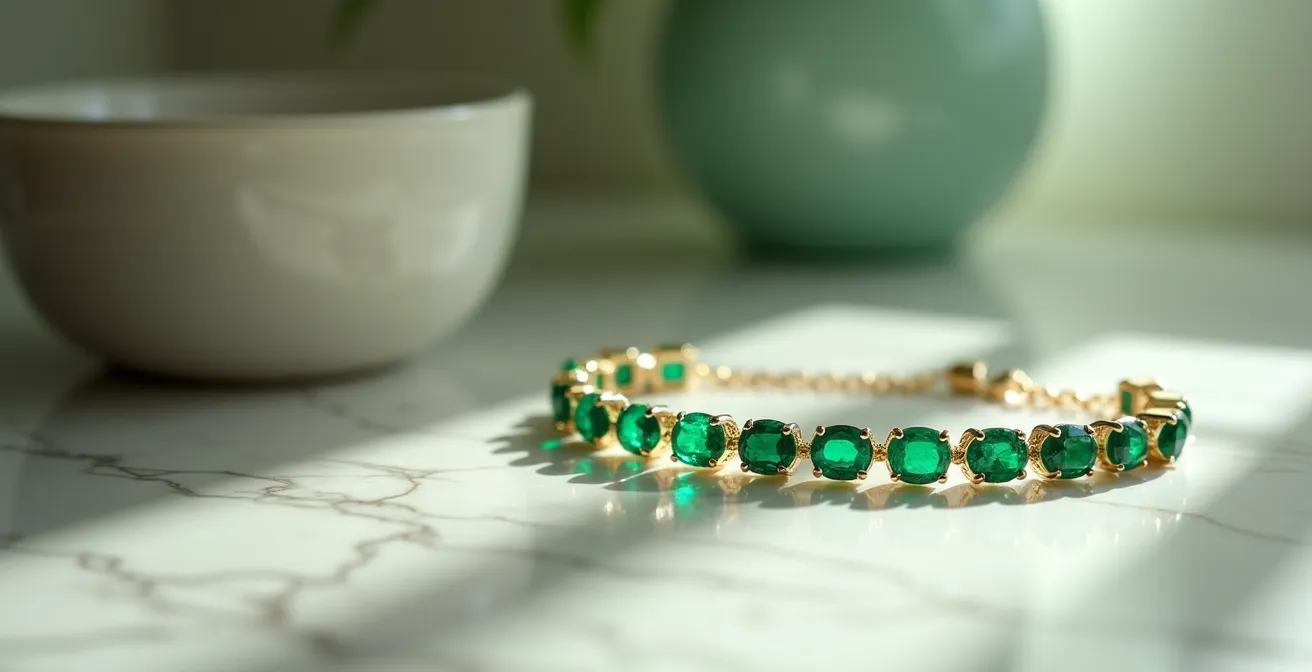
The secret to modernising an heirloom emerald necklace isn’t hiding its grandeur, but amplifying it through intentional, contemporary contrast.
- Forget old-fashioned rules; pair opulent emeralds with sharp, modern necklines and even crisp, unbuttoned shirts for a high-fashion edge.
- Balance is non-negotiable. The statement necklace must dominate, meaning earrings should be minimal and other jewellery must play a supporting role.
Recommendation: Treat your inherited emerald not as a relic, but as the powerful cornerstone of a versatile fine jewellery capsule, ready for any event on the British social calendar.
That magnificent emerald necklace, nestled in its velvet box, is more than just a piece of jewellery. It’s a legacy, a concentration of family history, and a significant asset. But for the modern woman who inherits such a treasure, it also presents a daunting challenge: how do you wear a heavy, potentially old-fashioned piece without it wearing you? The fear of looking dated, overly formal, or like you’re playing dress-up in your grandmother’s jewels is very real.
The standard advice often falls flat. Pairing it with a “simple black dress” can feel more funereal than fashionable. Waiting for the “perfect” black-tie event might mean it never leaves the safe. As a stylist who specialises in modernising vintage looks for the red carpet, I can tell you the old rulebook is obsolete. The key to unlocking the power of your heirloom emerald doesn’t lie in downplaying it, but in a far more exciting strategy: intentional contrast. It’s about the dynamic play between the old and new, the opulent and the understated, the hard facets of the gem and the soft textures of modern fabrics.
This guide is your new rulebook. We will move beyond generic tips and delve into the specific techniques that make a vintage piece feel utterly current in a sophisticated, British context. We’ll explore the architectural necklines that frame a necklace, the art of minimalist earring pairings, and even how to wear it with daring colours without looking festive. We’ll also cover the crucial, non-negotiable aspects of security and care that protect your investment. By the end, you’ll see your emerald necklace not as a challenge, but as the most powerful and versatile piece in your collection.
This article provides a complete framework for transforming your heirloom into a wearable work of art. The following sections break down every aspect of styling, from the foundational choice of neckline to building a complete jewellery wardrobe around your statement piece.
Summary: A Stylist’s Masterclass on Wearing Heirloom Emeralds
- Which Neckline Best Showcases a Drop Emerald Necklace?
- Should You Wear Big Earrings with an Emerald Necklace?
- Can You Wear Emeralds with a Red Dress or Is It Too Festive?
- Why Does a Heavy Emerald Necklace Need a Double-Locking Clasp?
- Why Must Emerald Necklaces Be Stored Flat and Separate from Diamonds?
- Why a Satin Strap Might Be More Elegant Than Gold for Evening Wear?
- How to Layer Necklaces of Different Lengths Without Tangling?
- How to Build a Fine Jewellery Capsule That Works for Every Occasion?
Which Neckline Best Showcases a Drop Emerald Necklace?
The foundation of styling a statement necklace is its frame: the neckline. Forget the standard V-neck. To make an heirloom piece feel modern, you need to think architecturally. The goal is to create a clean, intentional space that both supports and contrasts with the jewellery. Today’s trends, which favour bold statement pieces, provide the perfect canvas for showcasing oversized emeralds and intricate vintage settings.
Consider these modern options favoured by stylists and seen on the London fashion circuit:
- The Asymmetric One-Shoulder: This creates a powerful, diagonal line that feels inherently contemporary. It offers an unconventional frame that draws the eye directly to the necklace’s drop, a perfect blend of modern sophistication and classic glamour.
- The Sharp Square ‘Portrait’ Neckline: Popularised by British designers like Emilia Wickstead, a crisp square neckline provides a strong, geometric frame. This deliberate shape contains the opulence of the emerald, making it feel curated and intentional rather than overwhelming.
- The Open-Collar Shirt: For a masterclass in high-low dressing, nothing beats the contrast of a magnificent emerald necklace against the crisp, clean fabric of a simple white shirt, unbuttoned to just the right point. This androgynous edge is celebrated in London’s style circles and instantly modernises the piece.
- The Sheer Overlay: A truly high-fashion technique involves layering the necklace *over* a high-necked top made of fine organza or mesh. This creates a “floating” effect, turning the necklace into a piece of suspended art and adding a layer of ethereal texture.
Even for traditional events with strict dress codes like Royal Ascot, a high boat-neck can elegantly frame a shorter emerald collar while adhering to protocol, proving that modern styling is about thoughtful selection, not just rule-breaking.
Ultimately, the best neckline is one that feels deliberate. It respects the importance of the necklace while firmly placing it in a 21st-century context.
Should You Wear Big Earrings with an Emerald Necklace?
This is one of the most common questions, and the answer is a firm but nuanced “no.” When wearing a piece as significant as a statement emerald necklace, the primary rule is to establish a clear hierarchy. The necklace is the protagonist; every other piece of jewellery is in a supporting role. Wearing large or dramatic earrings creates two competing focal points, which can look busy and dated, effectively cancelling out the impact of both pieces.
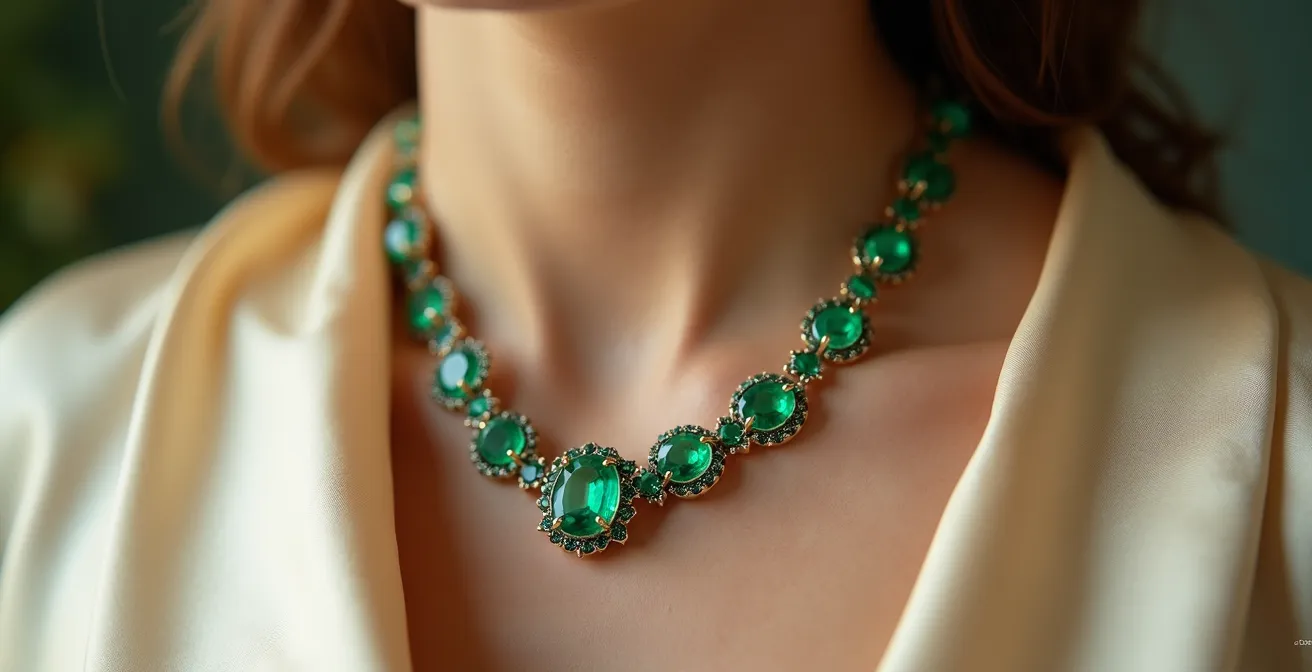
The modern, sophisticated approach is to opt for minimalism on the ears. This allows the décolletage to remain the undisputed centre of attention. Tiny diamond or gold studs, or even a single, small emerald stud, are perfect. They add a whisper of sparkle without creating visual competition. For those with multiple piercings, a “curated constellation” of tiny, delicate studs can add a contemporary edge, especially when paired with an updo for a London gallery opening or fashion event.
The key is to avoid anything with a significant drop or volume. A drop earring, for instance, creates a second vertical line that competes directly with the line of the necklace, confusing the eye. The choice of earring should be strategic and context-dependent, especially for events on the British social calendar.
The following table breaks down the compatibility of different earring styles, providing clear guidance for any occasion.
| Earring Style | Compatibility | British Event Suitability |
|---|---|---|
| Minimalist Studs | Excellent – Lets necklace dominate | Perfect for Royal Ascot, formal galas |
| Curated Constellation | Very Good – Multiple tiny studs add sparkle | Modern London parties, fashion events |
| Drop Earrings | Poor – Creates competing vertical lines | Not recommended for formal occasions |
| Button/Cluster | Good – Sits flat against lobe | Suitable for charity balls, weddings |
| Ear Climbers | Good with updo hairstyle | Contemporary events, gallery openings |
By keeping the earrings minimal and considered, you ensure your heirloom emerald necklace is showcased with the confidence and clarity it deserves.
Can You Wear Emeralds with a Red Dress or Is It Too Festive?
The combination of red and green immediately brings to mind festive, Christmassy connotations, a major concern for anyone wanting to look chic and sophisticated. However, avoiding this pairing entirely is a missed opportunity for a truly powerful and regal statement. The key lies in nuance and understanding colour theory. As stylists know, the shade is everything.
The ‘Christmas’ effect comes from primary red and green. A deep burgundy or wine-red dress with a forest-green emerald reads as regal and luxurious, a combination favoured by European royalty.
– JR Colombian Emeralds Style Guide, Emeralds and Color Theory
By shifting the hue away from a bright, primary red to a deeper, more complex shade like burgundy, claret, or wine, the entire mood changes from festive to opulent. These rich, jewel-toned pairings are incredibly sophisticated and work beautifully for autumn and winter black-tie events in London. The fabric also plays a crucial role; a matte crepe or rich velvet in a wine-red shade will absorb light and further tone down any overtly festive associations.
Context is also paramount. While a burgundy gown with emeralds is perfect for a winter charity ball, the red-green combination should be avoided entirely for summer garden parties or daytime events like Wimbledon, where lighter colours like navy, cream, or pastels are more appropriate. It’s also worth noting the rising importance of gemstone provenance in the UK; recent market research shows that 66% of UK consumers are willing to pay a premium for sustainably sourced coloured gemstones, adding another layer of value to a high-quality emerald.
For navigating this tricky but rewarding colour combination in England, follow these seasonal guidelines:
- Winter black-tie events: A deep burgundy velvet or silk gown with emeralds creates a look of sophisticated warmth.
- Christmas parties at London hotels: This is the one time to lean into the festive combination, but do it intentionally with luxurious fabrics.
- Summer garden parties: Avoid red-green combinations entirely in favour of lighter, fresher palettes.
- Autumn galas: Wine-red crepe or wool fabrics are perfect for toning down the festive feel while embracing rich colour.
So, yes, you can absolutely wear emeralds with red. You just need to choose your red, and your moment, with precision and confidence.
Why Does a Heavy Emerald Necklace Need a Double-Locking Clasp?
While the aesthetic aspects of styling are paramount, the security of a heavy, valuable heirloom is non-negotiable. A significant emerald necklace is not only a financial asset but an irreplaceable piece of family history. The clasp is its single point of failure, and for a heavy piece, a standard spring-ring clasp is woefully inadequate. It’s a matter of both security and craftsmanship.
In London’s premier jewellery districts like Bond Street and Hatton Garden, the presence of a robust, secure clasp is a primary hallmark of a high-quality piece. For any heavy or high-value necklace, a double-locking mechanism is the professional standard. The most common and trusted type is a box clasp, which clicks securely into place, combined with a secondary “figure-eight” safety latch that folds over the top. This redundancy provides peace of mind, ensuring the necklace cannot accidentally come undone, especially when navigating a crowded event like Royal Ascot or a bustling gala.
Beyond simple security, the clasp on a well-made piece is integral to its design and longevity. A superior clasp is engineered to handle the specific weight of the necklace, preventing undue strain on the links and settings over decades of wear. For bespoke pieces, jewellers can even create “invisible” clasps that are integrated seamlessly into the design, but these will always feature a robust internal locking mechanism.
Ensuring the security of your heirloom is a critical responsibility. This checklist outlines the features to look for and the maintenance required.
Your Checklist for Clasp Security on a Valuable Necklace
- Assess the current clasp: Identify if you have a simple spring ring or a more robust box or lobster clasp.
- Look for a secondary lock: Check for a “figure-eight” or fold-over safety latch. This is the gold standard.
- Check for strain: Examine the links connecting to the clasp. Are they stretched or worn? This indicates the clasp may be inadequate for the necklace’s weight.
- Consult a trusted jeweller: Ask for an assessment of the clasp’s integrity relative to the necklace’s value and weight.
- Schedule an annual inspection: Just like a fine watch, the clasp mechanism on a valuable necklace should be professionally checked and serviced annually to ensure its integrity.
By paying close attention to this small but vital component, you are protecting your legacy for generations to come.
Why Must Emerald Necklaces Be Stored Flat and Separate from Diamonds?
Proper care for an heirloom emerald necklace goes far beyond simple cleaning; it’s about preservation. Two fundamental principles must be understood: emeralds are relatively soft compared to other gems, and gravity is not their friend. Storing your necklace correctly is the single most important thing you can do to protect its value and structural integrity.
The primary reason for separating emeralds from other jewellery, especially diamonds, comes down to simple physics. On the Mohs scale of mineral hardness, diamonds rank a perfect 10. Emeralds, while durable enough for careful wear, sit between 7.5 and 8. This means that a diamond can easily scratch, chip, or abrade the surface of an emerald. As gemological science confirms, a diamond’s hardness of 10 versus an emerald’s 7.5-8 makes accidental contact a significant risk. Storing them together in a soft pouch where they can rub against each other is a recipe for disaster.
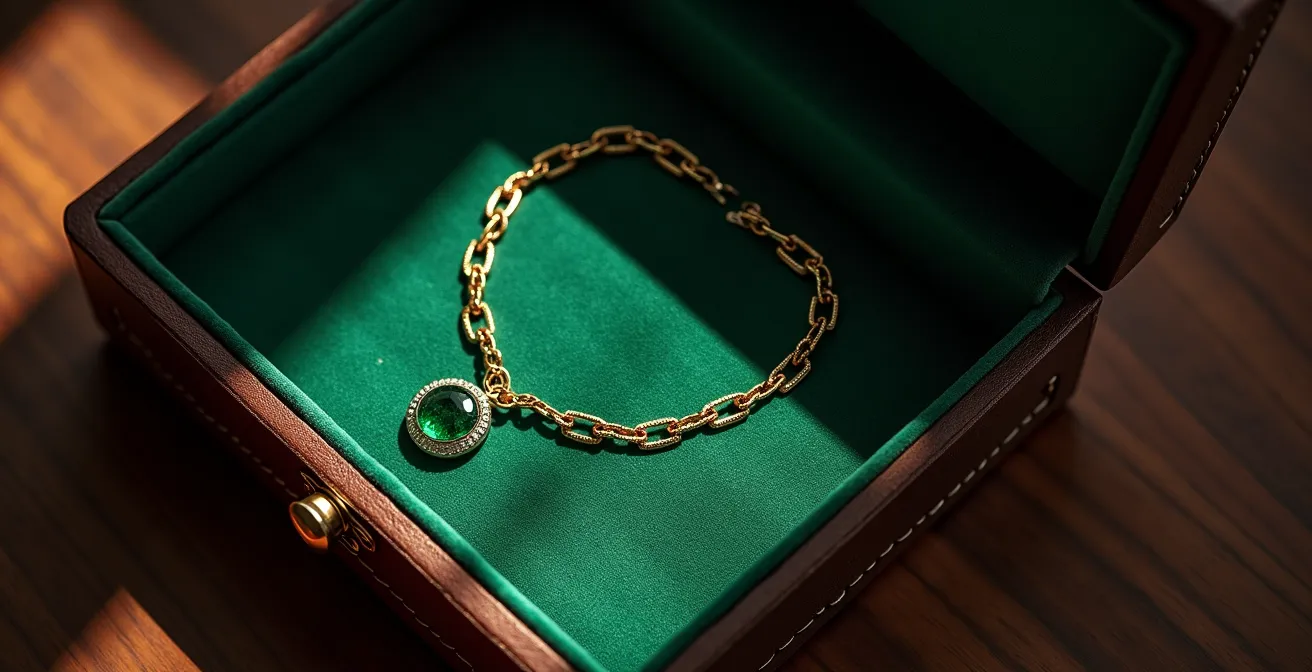
Furthermore, many emeralds contain natural inclusions, charmingly called ‘jardins’ (French for ‘gardens’), which are part of their unique character. While beautiful, these inclusions can be points of weakness. A sharp knock from a harder gemstone could potentially cause a fracture along an inclusion line. This is why high-end English brands like Smythson or Asprey offer luxurious leather-bound cases with soft, individual compartments. These are not just for show; they are designed to provide absolute protection.
The second rule—storing the necklace flat—is equally important, especially for heavy, articulated pieces. Hanging a heavy necklace puts constant, gradual stress on the delicate links, settings, and prongs that hold each stone. Over years, this gravitational pull can cause the links to stretch and weaken, increasing the risk of breakage. Laying the necklace flat in a dedicated, cushioned compartment removes this stress entirely, preserving its original structure.
By treating your emerald with this level of respect, you ensure its beauty and integrity will last for generations.
Why a Satin Strap Might Be More Elegant Than Gold for Evening Wear?
For a truly modern, high-fashion take on a vintage emerald piece, consider removing the traditional gold or platinum chain altogether. Replacing it with a simple, luxurious ribbon of satin or velvet is a bold styling move that creates a powerful statement through the power of contrast. This “soft-meets-hard” approach is a favourite among designers and stylists for its ability to instantly update a classic piece.
A soft ribbon creates a modern, high-fashion contrast against the hard, cold facets of the emeralds. This ‘soft-meets-hard’ styling feels intentional and contemporary.
– Emily Amey Jewelry Design
This technique works by juxtaposing textures and expectations. The softness and warmth of the fabric provide a beautiful counterpoint to the cool, geometric brilliance of the gemstones. It strips away the formality of a metal chain, making the piece feel more personal, artistic, and less like a “set.” It’s a nod to “English eccentricity,” allowing the wearer to put their own unique stamp on an heirloom.
This trend has been prominent at recent London Fashion Week shows, where British designers have showcased emerald pendants on everything from deep racing-green velvet ribbons for winter balls to delicate, dusty rose satin for summer weddings. The beauty of this approach also lies in its versatility. A ribbon is adjustable by nature; you can tie it to sit as a tight choker high on the neck, or wear it longer as a pendant, offering a flexibility that a fixed-length chain cannot match. This allows you to adapt the single piece of jewellery to a variety of different necklines and occasions.
Choosing a fabric strap is a confident declaration that you are not just wearing your jewellery, but truly styling it. It’s a sophisticated move that proves an heirloom can be both timeless and perfectly on-trend.
How to Layer Necklaces of Different Lengths Without Tangling?
While a statement emerald necklace is powerful enough to be worn alone, layering it with other, more delicate pieces is a quintessentially modern styling technique. The key is to create a multi-layered look that feels effortless and curated, not chaotic and tangled. This requires a strategic approach where your emerald heirloom is the undisputed star of the show.
First, always treat the emerald necklace as the ‘anchor’ piece in your layering composition. It is the heaviest and most significant element, both visually and physically. The other necklaces must be chosen to complement, not compete. Opt for whisper-thin, simple chains—in gold or platinum to match the emerald’s setting—that can be layered *underneath* it, sitting closer to the collarbone. This creates a beautiful tiered effect where the delicate chains lead the eye down to the main event.
Varying textures, not just lengths, adds sophistication. Pair the faceted brilliance of the emerald with the smooth, liquid shine of a simple snake chain or the soft lustre of a small string of pearls. To prevent the dreaded tangle, a small, inexpensive device called a necklace separator or layering clasp is a stylist’s secret weapon. This small bar has multiple clasps, allowing you to attach 3-4 necklaces and keep them perfectly spaced and untangled throughout the day or evening. The growing popularity of such versatile styling is reflected in the fine jewellery market, as the global emerald jewelry market is expected to reach $3.37 billion by 2029, driven by a desire for personalised and adaptable luxury.
Another professional technique, particularly for daytime or more casual looks, is the ‘over-knitwear’ method. Layering your necklaces over a fine-gauge cashmere or merino wool knit provides a soft, textured background that also acts as a natural separator, helping to keep the chains from tangling.
With these techniques, you can confidently integrate your statement piece into a dynamic, layered look that feels both personal and impeccably styled.
Key Takeaways
- Modernity Through Contrast: The most effective way to style a vintage emerald is by creating intentional contrasts—pairing its opulence with modern architectural necklines and minimalist supporting jewellery.
- Hierarchy is Everything: Your statement necklace is the focal point. All other jewellery, especially earrings, must be understated to avoid a dated, cluttered look.
- Preservation is Paramount: The physical properties of emeralds (softer than diamonds) and the weight of a heavy piece demand specific care. Always store it flat and separate from harder gems.
How to Build a Fine Jewellery Capsule That Works for Every Occasion?
Viewing your heirloom emerald necklace in isolation is the biggest mistake you can make. Instead of seeing it as a difficult one-off piece, you should reframe it as the statement cornerstone of a versatile, curated fine jewellery capsule. A well-built capsule wardrobe for your jewellery allows you to move seamlessly between occasions, from a professional setting to a black-tie gala, with a few key, high-quality pieces. Your emerald is the anchor of this collection.
The “English Core Four” is a simple framework for building such a capsule, balancing heritage with modern wearability. It consists of four essential roles that, when filled, provide a complete jewellery solution. Your inherited necklace perfectly fills the most important role. A modern British jewellery portfolio often mixes heritage giants like Garrard or Boodles with contemporary London-based designers like Annoushka or Jessica McCormack for a collection with both investment value and personal style.
This approach ensures every piece has a purpose and that your most valuable items are not just stored away, but are integrated into a practical and elegant system. Your emerald necklace isn’t for a once-in-a-lifetime event; it’s the centrepiece for all of your most important lifetime events.
The following framework illustrates how your emerald necklace fits into a complete, high-functioning jewellery capsule suitable for the modern English woman.
| Capsule Role | Recommended Piece | British Brand Examples | Investment Range |
|---|---|---|---|
| Statement Cornerstone | Emerald necklace for galas | Garrard, Boodles | £5,000-50,000+ |
| Everyday Signature | Signet ring or gold hoops | Monica Vinader | £200-1,000 |
| Professional Piece | Classic watch | Bremont | £2,000-10,000 |
| Heritage Piece | Inherited brooch or pearls | Vintage/Family | Priceless |
By adopting this capsule mentality, you transform a daunting heirloom into the proud, powerful centre of your personal style. It’s the ultimate way to honour its legacy while making it entirely your own.