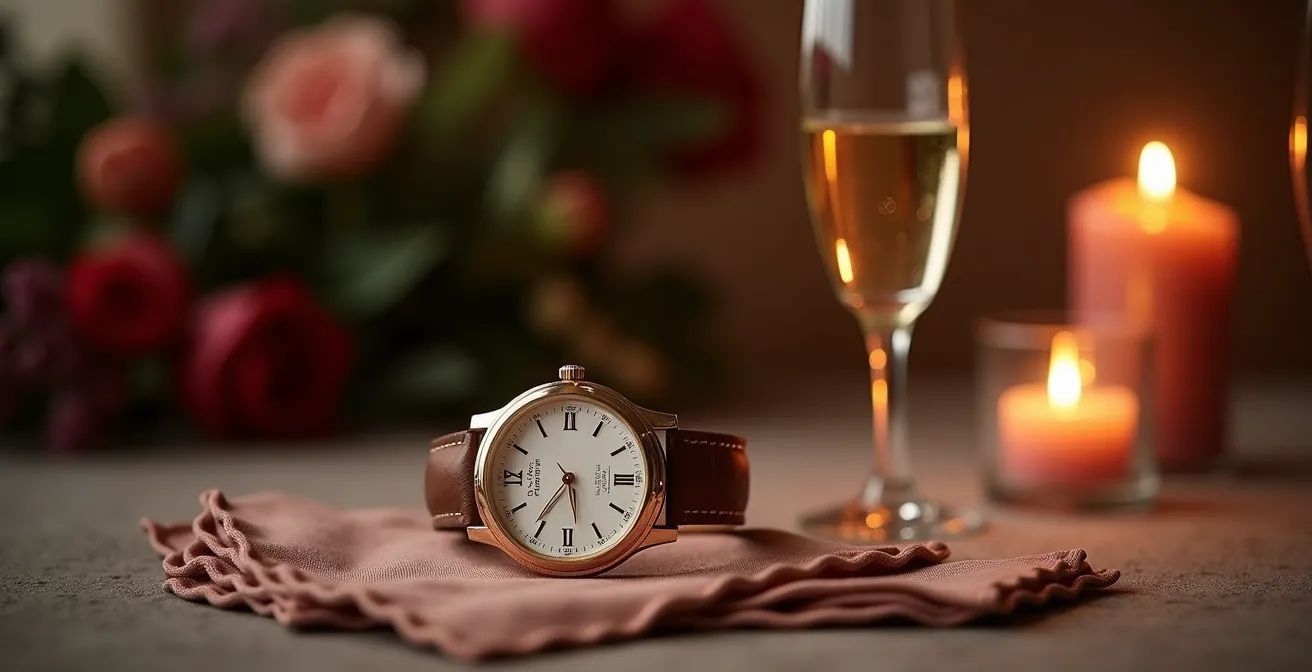
A vintage cocktail watch is the secret to looking effortlessly chic at a modern wedding, functioning as sophisticated jewellery rather than just a timepiece.
- It excels on slender wrists due to its inherent, delicate proportions, creating perfect visual balance.
- Styling it with modern elements, like a simple satin strap or even casual streetwear, creates a sophisticated, fashion-forward statement.
Recommendation: Focus on proportional harmony and textural contrast to make the watch a deliberate, stylish centrepiece of your outfit, not an afterthought.
The invitation arrives, glossy and promising, with two intimidating words: “Black Tie.” Immediately, the familiar question arises—how do you look appropriate, yet uniquely fabulous? The standard advice often circles around classic jewellery: a simple necklace, perhaps diamond studs. You’re told to match the metal of your earrings to your clutch clasp, a safe but uninspired formula. But what if you’re craving an accessory with more character, a piece that whispers a story of glamour from a bygone era?
This is where we move beyond the expected. What if the key to unlocking a truly memorable look isn’t another necklace, but a vintage cocktail watch? This isn’t about telling time; it is about embracing a piece of functional jewellery that signals confidence and a deep appreciation for elegant design. It’s an intentional choice that separates the stylish from the merely well-dressed. Making this vintage-inspired piece feel current and not costumey is the art we are here to master.
This guide is your personal stylist’s handbook. We will deconstruct the mystique of the cocktail watch, transforming it from a curious antique into your most powerful modern accessory. We will explore precisely what defines it, how to wear it with unwavering confidence at a lively wedding, and even how to integrate its quiet luxury into your everyday style. Prepare to make your timepiece the talking point of the evening.
In this guide, we’ll delve into the distinct characteristics of these elegant timepieces and provide actionable advice for making them a stunning part of your ensemble for any special occasion. Discover the nuances of styling, care, and wearing your watch with poise.
Summary: A Guide to Styling Your Cocktail Watch with Modern Flair
- What Distinguishes a Cocktail Watch from a Standard Dress Watch?
- Can You Wear a 1950s Cocktail Watch for a Night of Dancing?
- How to Clean Hairspray and Perfume off a Gold Cocktail Watch safely?
- Why a Satin Strap Might Be More Elegant Than Gold for Evening Wear?
- Why Cocktail Watches Are the Perfect Solution for Very Slender Wrists?
- Where Should You Put Your Hands When You Don’t Have a Drink or Bag?
- How to Rock a Tiny Vintage Cocktail Watch with Modern Streetwear?
- When Does a Watch Become High Jewellery and How Does That Affect Insurance?
What Distinguishes a Cocktail Watch from a Standard Dress Watch?
A cocktail watch is not simply a smaller version of a man’s dress watch; it is a different creature entirely, born from a specific moment of social liberation. Its origins trace back to the early 20th century, a time when women began to embrace new freedoms. Evening events, from operas to dances, became stages for self-expression through fashion. This was an era of glamour, not minimalism, and accessories were designed to be noticed. The cocktail watch was conceived as a piece of jewellery that happened to tell time, often disguising its face beneath a covering of jewels.
The defining features are its delicate size and decorative intent. While a classic dress watch prioritises legibility and understated elegance, a cocktail watch prioritises sparkle and design. The cases are typically tiny, often no wider than 18mm, but the bracelets and case designs are anything but subdued. They are crafted to be statement pieces, featuring ornate details, precious stones, and intricate metalwork. As the experts at Time and Tide Watches note, it’s about a certain theatricality.
A modern cocktail watch definitely isn’t directly interchangeable with a dress watch, even if the case is 18k gold and set with diamonds. There needs to be some dramatic flair, some distinct character, and preferably a dash of colour.
– Time and Tide Watches, Watch Education Feature
Essentially, while a dress watch complements an outfit, a cocktail watch is often a central piece of the jewellery story. It’s designed for the soft, dramatic lighting of an evening affair, where its sparkle and intricate form can be truly appreciated as a work of art on the wrist.
Can You Wear a 1950s Cocktail Watch for a Night of Dancing?
Absolutely, but with a touch of glamorous caution. A vintage cocktail watch from the 1950s is surprisingly robust and was, after all, designed for social evenings that included dancing. The key to wearing it with confidence is preparation. These pieces are not just accessories; they are wearable antiques that deserve a little care before a big night out. The great news is that many are still very wearable, and their appeal has transcended gender and strict formal dress codes.
Before you fasten that delicate clasp, think of it as preparing a classic car for a rally. You want to ensure it’s not only looking its best but is also secure for the journey. This means checking the integrity of the bracelet and clasp, as a dance floor is the last place you want to realise a pin has come loose. For a piece of significant value or sentimental worth, a pre-event check-up with a specialist is a wise investment in your peace of mind.
Your Pre-Wedding Checklist for Vintage Watch Safety
- Professional Service: Have your vintage watch serviced by a specialist. For those in the UK, London’s Hatton Garden or Clerkenwell watchmaking hubs are excellent resources.
- Security Check: Personally inspect the clasp mechanism and all bracelet links for security and strength a day before the event.
- Insurance Update: Consider specific insurance coverage for your vintage piece, especially before wearing it to a major event like a wedding.
- Movement Practice: Practice elegant movements that protect the watch while dancing—avoiding sharp gestures or impacts.
By taking these simple, practical steps, you can fully enjoy the party without a nagging worry in the back of your mind. You’ll be free to dance the night away, your watch glittering on your wrist, a fabulous and functional testament to timeless style.
How to Clean Hairspray and Perfume off a Gold Cocktail Watch safely?
After a wonderful evening of celebration, your beautiful gold cocktail watch may carry subtle traces of the night—namely, a sticky residue from hairspray or a film from your favourite perfume. These products contain alcohol and chemicals that can dull the lustre of gold and, over time, potentially damage delicate vintage parts. Cleaning requires a gentle touch, treating the watch not as a rugged tool but as the fine jewellery it is.
The golden rule is to avoid harsh chemicals and submersion in water, especially with vintage pieces whose water resistance is likely compromised. Your goal is to gently lift the residue without scratching the metal or allowing moisture to seep into the watch mechanism. A simple, methodical approach using materials you likely already have is all that is needed to restore its shine.
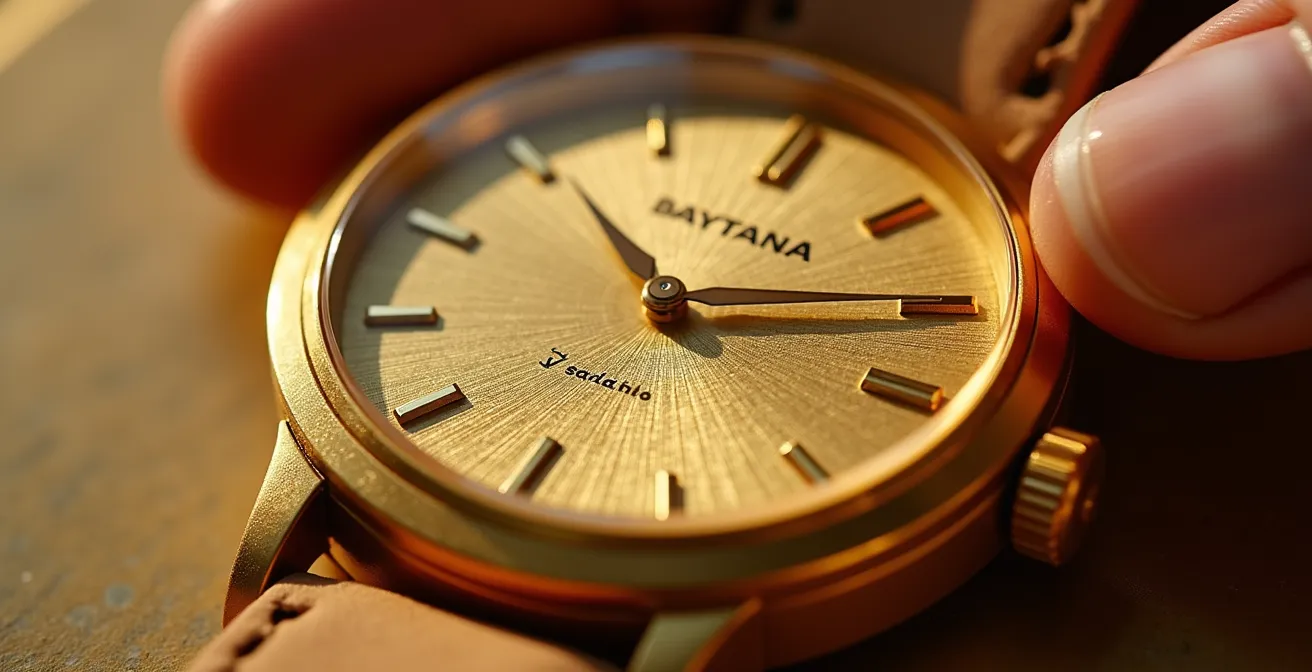
As this detailed view shows, the intricate surfaces of a vintage watch can trap residues. First, take a very soft, lint-free cloth, like a microfibre cloth used for eyeglasses. Dampen a small corner of the cloth with a tiny amount of warm water, ensuring it is damp, not wet. Gently wipe the case and bracelet, paying special attention to crevices. For stubborn spots, a soft-bristled brush (like a baby’s toothbrush) can be used with minimal pressure. Immediately follow up by polishing the entire piece with a dry section of the cloth to remove any moisture and restore its brilliant shine.
Why a Satin Strap Might Be More Elegant Than Gold for Evening Wear?
While a full gold bracelet on a cocktail watch is a classic statement of luxury, a satin strap offers a different, arguably more contemporary and sophisticated, form of elegance. The choice between them comes down to understanding the play of light, texture, and colour in an evening ensemble. A gold bracelet is about brilliant reflection; a satin strap is about deep, luxurious absorption.
A polished gold bracelet creates a high-shine, dramatic effect, reflecting light with every movement of your wrist. It’s bold and unapologetically glamorous. However, a satin or fabric strap interacts with light in a much softer way. It absorbs light, which contributes to an aura of understated, quiet luxury. This subtlety can be incredibly powerful, especially when paired with the right outfit. It allows the watch case itself to be the primary point of sparkle, creating a more focused and intentional look. Furthermore, a fabric strap introduces a textural contrast that a metal bracelet cannot, adding a layer of visual interest that feels very modern and fashion-forward. A black satin strap against a crepe gown, for instance, speaks volumes about a confident and refined personal style.
As this comparative analysis from a recent study on the resurgence of cocktail watches shows, the choice of strap fundamentally alters the watch’s character.
| Feature | Satin/Fabric Strap | Gold Bracelet |
|---|---|---|
| Light Interaction | Absorbs light for subtle elegance | High shine, reflects light dramatically |
| Versatility | Can match dress color/accessories | Limited to metallic coordination |
| Comfort | Lightweight, adapts to wrist | Heavier, rigid structure |
| Modern Appeal | Contemporary, fashion-forward | Classic, traditional luxury |
| Texture Pairing | Complements crepe, velvet, silk | Best with smooth, structured fabrics |
Ultimately, choosing a satin strap is a deliberate styling decision. It signals a move away from traditional displays of luxury towards a more personal and nuanced expression of elegance, making it a perfect choice for the modern wedding guest who values detail and sophistication.
Why Cocktail Watches Are the Perfect Solution for Very Slender Wrists?
Finding a watch that doesn’t overwhelm a slender wrist can be a genuine challenge. Many contemporary watch trends favour large, bulky cases that can look and feel disproportionate on a petite frame. This is precisely where the cocktail watch shines, offering a perfect solution rooted in the very principles of its design: proportional harmony. These watches were intentionally created to be delicate, jewellery-like adornments, making them ideally scaled for a finer wrist.
Their petite proportions create a look of effortless elegance rather than a feeling of being weighed down by a heavy piece of hardware. The design delivers a delicate charm that complements any outfit, allowing for a personalized statement of style. This natural balance is the key. Instead of a large watch face dominating the wrist, a small cocktail watch sits gracefully, drawing attention without demanding it. This allows it to be stacked beautifully with fine bangles and rings, creating a cohesive and curated jewellery look.
To maximise this effect, consider these styling tips specifically for smaller wrists:
- Look for navette or carré (square) shaped cases, as their elongated or angular lines can visually lengthen the wrist.
- Opt for watches with integrated bracelets that drape naturally like jewellery chains, rather than rigid, structured links.
- Explore vintage pieces from classic British makers like Smiths, who were renowned for their delicate and well-proportioned designs.
- Embrace layering by pairing your watch with other fine chain bracelets to create a rich, textured, and personalized stack.
For those with slender wrists, the cocktail watch isn’t just an option; it’s the ultimate expression of perfectly scaled luxury. It honours your proportions and serves as a testament to the idea that true style is about balance, not size.
Where Should You Put Your Hands When You Don’t Have a Drink or Bag?
At a wedding reception, there are inevitable moments when you find yourself without a prop—no champagne flute, no clutch, no canapé. It’s in these moments that body language becomes paramount, and the seemingly simple question of “what to do with my hands?” arises. For someone wearing a statement accessory like a cocktail watch, these moments are not awkward pauses but opportunities. An elegant hand posture can subtly frame and showcase your beautiful timepiece.
The goal is to find a pose that feels natural and poised, not stiff or staged. It’s about conveying relaxation and confidence. As a stylist, I always advise clients that how you hold yourself is as important as the clothes you wear. Your posture completes the look. The right hand placement can draw the eye to your wrist, making your watch an intentional focal point. As noted in a comprehensive guide to cocktail attire, the small details truly matter.
Polished shoes, styled hair, and subtle fragrance go a long way. Don’t overlook the small details.
– The Venue at White Oaks Farm, Guide to Cocktail Attire
Instead of letting your arms hang awkwardly or tucking your hands in pockets, consider adopting one of these elegant, camera-ready stances popular in British society circles:
- The ‘Duchess of Cambridge’ Pose: Gently rest one hand over the other at waist level. It’s a classic, graceful pose that naturally brings your watch into a visible, yet understated, position.
- The ‘Royal Observer’: Hold one wrist with the opposite hand in front of you. This is a very direct way to display your timepiece while looking contemplative and engaged in your surroundings.
- The ‘Curator’s Clasp’: Lightly clasp your hands behind your back. This opens up your posture, projects confidence, and works beautifully with backless or detailed gowns.
- The ‘Gallery Stance’: Keep your arms relaxed at your sides, with one hand gently holding the opposite forearm. It’s a casual yet composed posture perfect for conversation.
How to Rock a Tiny Vintage Cocktail Watch with Modern Streetwear?
The true sign of a style icon is the ability to mix high and low, vintage and modern. A delicate cocktail watch, once confined to evening gowns, finds its most exciting new life when paired with the unexpected: modern streetwear. This act of styling dissonance—pairing a hyper-feminine, glamorous piece with casual or even masculine-leaning basics—is the secret to a genuinely cool, fashion-forward look. It demonstrates a confidence that transcends dress codes.
This high-low mix has been championed by fashion insiders for years. One of the most sought-after timepieces, the Cartier Panthère, is a perfect example. As highlighted by an analysis in Who What Wear, its appearance on Zendaya’s character in the film *Challengers* cemented its status as a cultural and fashion touchstone, often paired with simple, sporty, and modern looks. It proves that the power of a cocktail watch lies in its versatility.

To achieve this coveted London or Shoreditch aesthetic, think in terms of contrast. The delicacy of the watch is amplified when worn against a chunky knit or the clean lines of a simple t-shirt. It becomes a flash of unexpected sparkle, a point of intrigue. Here are some UK-centric ways to style it:
- Pair a delicate gold cocktail watch with an oversized, luxurious knit from a British brand like &Daughter for a look of relaxed opulence.
- Wear your watch against a simple, crisp white t-shirt and tailored trousers. The contrast between the casual top and the formal watch is the essence of this style.
- Stack your vintage piece with modern, heavy chain-link bracelets from popular London-based designers like Monica Vinader.
- Let the watch be your single point of glamour when wearing an otherwise minimalist, monochrome outfit for a fashion-forward Shoreditch aesthetic.
By treating your cocktail watch as a versatile piece of jewellery, you unlock its full potential, proving that true glamour feels just as at home on a city street as it does at a black-tie wedding.
Key Takeaways
- A cocktail watch is ‘functional jewellery’ designed for flair, not just timekeeping, distinguished by its decorative and glamorous nature.
- Modern elegance can be achieved by creating contrast, whether by pairing a vintage watch with contemporary fabrics like a satin strap or with casual streetwear.
- Proper care, understanding its value, and ensuring adequate insurance are essential for preserving this timeless and often valuable accessory.
When Does a Watch Become High Jewellery and How Does That Affect Insurance?
There’s a point where a cocktail watch transcends its function as a timepiece and enters the realm of “high jewellery.” This distinction is not merely semantic; it carries significant financial and practical implications, especially concerning insurance. Understanding this transition is crucial for any owner of a fine watch, particularly within the thriving UK market. London’s luxury watch market is a serious business; an industry report shows a projected value of over £1.35 billion in 2024 alone, underscoring the value held on people’s wrists.
So, when does the line get crossed? A watch typically becomes high jewellery based on a combination of factors:
- Materials: The piece is crafted almost entirely from precious metals (like platinum or high-karat gold) and is extensively set with high-quality gemstones (D-flawless diamonds, Burmese rubies, etc.).
- Craftsmanship (Métiers d’Art): The watch features exceptional artisanal skills, such as intricate gem-setting, enamelling, or engraving, that elevate it to a work of art.
- Brand Provenance: It comes from a renowned high jewellery house like Cartier, Van Cleef & Arpels, or Piaget, where the brand name itself carries immense value.
- Rarity and Exclusivity: The piece is a limited edition, a unique creation, or has a significant historical provenance.
Once your watch falls into this category, it almost certainly exceeds the single-item limit on a standard home insurance policy. Relying on your household contents insurance is a significant risk. For such a piece, you must arrange for specialist jewellery or watch insurance. This will require a formal, up-to-date valuation from a certified appraiser. This policy will cover a wider range of risks, including accidental damage, loss, and theft, often with worldwide coverage—essential for a piece you might wear to a destination wedding. Treating your high jewellery watch with this level of administrative care is the final, crucial step in responsible ownership.