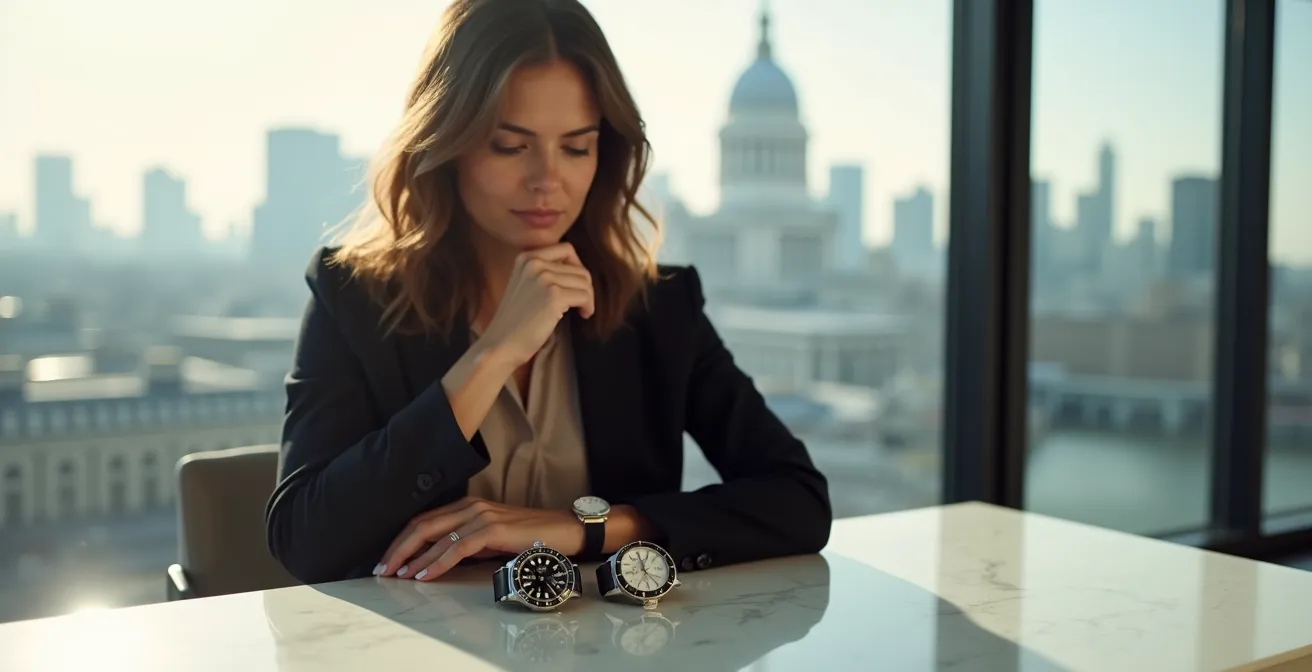
Choosing the right watch is an investment in your personal brand, where ‘cost per wear’ trumps fleeting trends.
- Focus on versatile ‘unisex’ case sizes (36-39mm) which often provide better presence and long-term value.
- Prioritise automatic movements and Tier 1 brands (like Rolex or Cartier) for strong value retention and a lower true cost over a decade.
Recommendation: Before you buy, measure your wrist, analyse your existing jewellery, and calculate the true 10-year cost of ownership.
The modern professional woman faces a unique paradox of choice. You own several watches: the delicate one for weddings, the chunky digital one for the gym, the trendy fashion piece that felt essential last season. Yet, when dressing for a day that might pivot from a board presentation in Canary Wharf to after-work drinks in Soho, none feel quite right. The search for the elusive “one watch” – a single, perfect timepiece that exudes competence at work and effortless style on the weekend – often ends in compromise or confusion.
Conventional wisdom offers vague advice: “choose a classic design” or “stick to neutral metals.” This approach overlooks the most critical factor for a pragmatic buyer: value. Not just resale value, but the strategic value a watch brings to your personal brand and the financial intelligence of a ‘cost per wear’ calculation. We often forget that a high-quality timepiece is a working asset, not a disposable accessory. It should be as thoughtfully considered as any other significant investment.
But what if the key wasn’t about finding a watch that simply ‘matches’ everything, but about selecting a strategic piece that elevates everything? This guide reframes the selection process. We will move beyond aesthetics to analyse a watch as a long-term investment in your style and career. We will dissect the pragmatic considerations of size, weight, and mechanics, and uncover why one truly great watch is not only more versatile but, in the long run, significantly cheaper than a drawer full of mediocre ones.
This article provides a complete framework for making a savvy, informed decision. From measuring your wrist correctly to understanding the investment tiers of the UK pre-owned market, you will gain the confidence to select a timepiece that is a true partner for every facet of your life.
Summary: A Strategic Guide to Choosing Your Ultimate All-Rounder Watch
- How to Measure Your Wrist Correctly to Avoid the ‘Borrowed from Boyfriend’ Look?
- Rose Gold, Silver, or Two-Tone: Which Matches Your Existing Jewellery Box?
- Why Modern Women Are Increasingly Choosing Automatic Movements Over Quartz?
- How to Choose a Watch Weight That Won’t Interfere with Typing All Day?
- Do Women’s Watches Hold Their Value as Well as Men’s Models?
- Why Smaller Case Sizes Are Making a Comeback for the Modern Gentleman?
- Is a £300 Cashmere Jumper Cheaper Than Five £60 Synthetics?
- Why a Statement Timepiece Is the New Power Suit for Female Executives?
How to Measure Your Wrist Correctly to Avoid the ‘Borrowed from Boyfriend’ Look?
The single most common mistake in buying a watch is choosing the wrong size. A watch that is too large can overwhelm a petite wrist and look unprofessional, while one that is too small can feel insubstantial. Getting the proportions right is the foundation of a versatile timepiece. It’s not just about comfort; it’s about commanding the right level of presence. The goal is a watch that looks intentional and tailored to you, not like a temporary loan from a significant other.
According to a detailed analysis of women’s watch preferences, the 30-34mm case diameter remains the undisputed sweet spot for most UK buyers, offering a perfect balance of elegance and readability. For those with particularly slender wrists (under 14cm in circumference), smaller ‘petite’ sizes between 26-29mm are ideal. However, the study also notes a growing trend among professional women for larger, 35-40mm ‘boyfriend’ style watches, specifically chosen for a bolder, more confident boardroom presence. This isn’t an accident; it’s a strategic choice. Before you decide which camp you fall into, you need accurate measurements.
Your Action Plan: 5 Steps for Perfect Watch Sizing
- Measure your wrist circumference with a flexible tape at the wrist bone, then add approximately 1cm for comfort and movement.
- Check the ‘lug-to-lug’ distance of your chosen watch. This measurement, from the top strap attachment point to the bottom one, should not extend beyond the width of your wrist.
- Consider the case thickness. A watch over 12mm thick might catch on shirt cuffs and be cumbersome when typing, defeating the purpose of an all-day companion.
- Test the ‘finger rule’ once the watch is on. You should be able to comfortably fit one index finger under the fastened bracelet when your arm is hanging down.
- Account for natural wrist swelling. For the most accurate sizing, measure your wrist in the morning and again in the evening, as it can fluctuate slightly throughout the day.
With these precise measurements, you can confidently choose a size that aligns with the statement you want to make, whether it’s one of understated elegance or powerful authority.
Rose Gold, Silver, or Two-Tone: Which Matches Your Existing Jewellery Box?
The choice of metal is far more than a simple colour preference; it’s a strategic decision that dictates your watch’s versatility. The ultimate ‘one watch’ must seamlessly integrate with the jewellery you already own and love, from silver rings to a gold family heirloom. Mismatched metals can look discordant and unintentional. As a guiding principle, Von Doren Watch Specialists advise choosing a bracelet material that is the same as the case for a cohesive look, and matching leather straps to other elements in your outfit, like a belt or handbag.
To go deeper, consider your dominant style profile. A pragmatic approach is to align your watch metal with your professional persona and existing accessories. For the classic British professional, nothing beats the understated elegance of stainless steel. It’s durable, discreet, and works with almost everything. For a more traditional or ‘old money’ aesthetic, yellow gold speaks of heritage and sophistication, though it can feel more appropriate for special occasions.
Modern creatives and fashion-forward professionals in cities like London and Manchester are often drawn to the contemporary luxury of rose gold. It’s warmer than yellow gold and feels fresh and distinctive. However, the smartest choice for the true ‘one-watch’ investor is often two-tone (a mix of steel and gold). Once considered dated, it has made a major comeback precisely because of its transitional power. A two-tone watch acts as a bridge, effortlessly tying together both silver and gold jewellery, maximising its ‘cost per wear’ by removing any and all accessorising conflicts.
Why Modern Women Are Increasingly Choosing Automatic Movements Over Quartz?
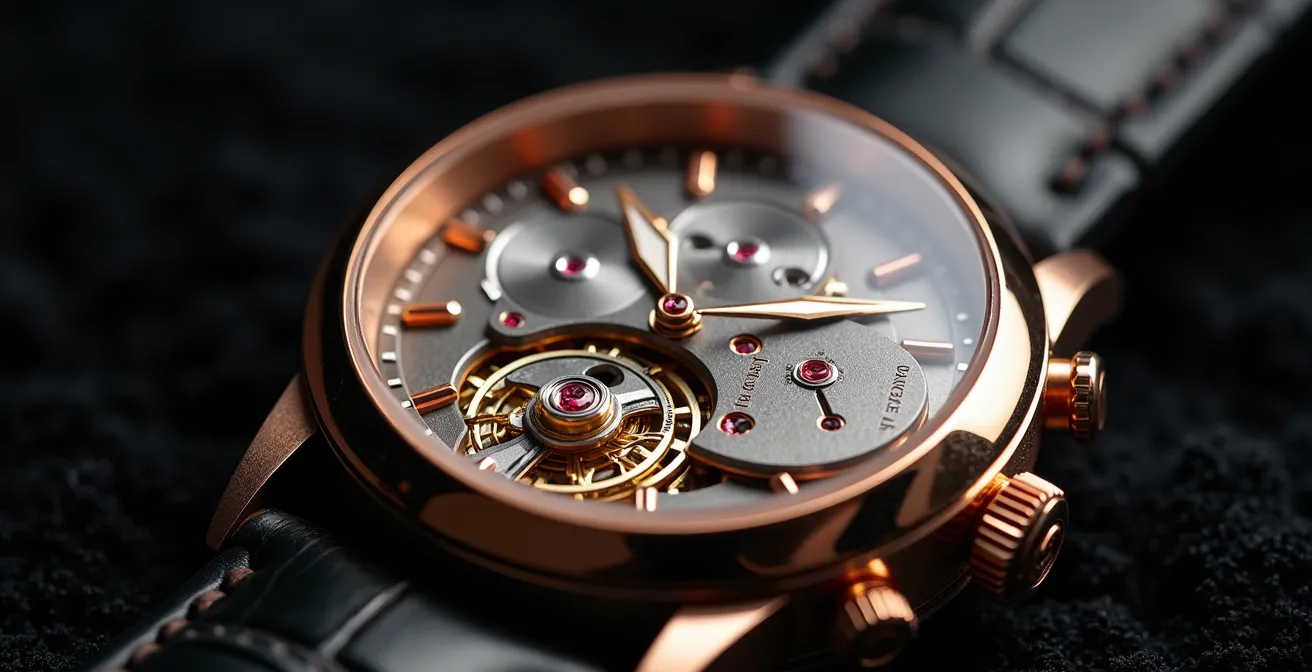
Beneath the watch face lies its heart: the movement. For decades, the convenience of battery-powered quartz movements made them the default choice. However, a significant shift is underway. Market analysis reveals that the women’s luxury mechanical watch segment is projected to see a 7% annual growth from 2024 to 2029. This isn’t just a trend; it’s a conscious choice by savvy consumers to invest in craftsmanship over convenience. Choosing an automatic movement is a statement that you value longevity, engineering, and the quiet ritual of owning a piece of micro-mechanical art.
A quartz watch tells time; an automatic watch tells a story. Powered by the motion of your own body, an automatic movement contains hundreds of tiny, intricate components working in harmony. There are no batteries to replace, only a mechanism that, with proper care, will outlive you. This connects to the core ‘cost per wear’ argument. While the initial investment is higher, the long-term value proposition is far superior.
From a pragmatic UK buyer’s perspective, the true cost difference is revealing. A simple comparison breaks down the financial and intangible benefits:
- Servicing Costs: An automatic watch requires servicing every 5-7 years, costing approximately £300-£600 for reputable Swiss brands in London. A quartz watch needs a new battery every 2-3 years at a cost of £20-£50.
- Long-Term Value: A quality automatic watch can retain 70-100% of its value (or even appreciate), while a quartz equivalent typically retains only 40-60%.
- The Daily Ritual: For many, the act of winding a mechanical watch or simply feeling the rotor spin is a mindful, tactile moment—a small ‘digital detox’ in a hyper-connected world.
- Patriotic Choice: For those looking to invest in British craftsmanship, brands like Bremont and Christopher Ward offer excellent mechanical alternatives with a local story.
The decision to opt for an automatic movement is a vote for sustainability and enduring value over disposability. It’s the choice of an investor, not just a consumer.
How to Choose a Watch Weight That Won’t Interfere with Typing All Day?
A critical but often overlooked factor in selecting a daily-wear watch is its weight. A timepiece that feels beautifully substantial in the boutique can become an irritating burden after eight hours at a keyboard. For the professional woman, comfort is not a luxury; it’s a prerequisite for productivity. An ideal watch should have enough presence to feel significant, but not so much that it distracts you from your work or feels heavy by the end of the day.
A comfort study conducted among London finance professionals found that watches weighing under 100 grams were overwhelmingly preferred for all-day desk work. This makes material choice a crucial part of the equation. While stainless steel is a classic, it is also relatively heavy. For instance, the popular Tudor Black Bay 36 in steel weighs around 130g. In contrast, the iconic Cartier Tank Must in steel is a featherweight 51g, making it exceptionally comfortable. An even smarter choice for reducing weight without sacrificing durability is titanium. The Tudor Pelagos 39, made from titanium, has a significant 39mm presence but weighs only 106g, placing it in the ‘excellent’ comfort category for all-day wear.
Beyond the raw weight, the study highlighted another key feature for desk-bound professionals: the clasp. The most highly-rated watches for comfort were those featuring a micro-adjustment system in the clasp. Brands like Rolex (with its ‘Easylink’ system) and Tudor (with its ‘T-fit’ clasp) allow for small, tool-free adjustments to the bracelet length. This enables the wearer to loosen the watch slightly as their wrist naturally swells throughout the day, ensuring perfect comfort from the first morning email to the last evening report.
Do Women’s Watches Hold Their Value as Well as Men’s Models?
For a pragmatic buyer, a luxury watch is an asset. Therefore, its ability to retain value is a critical part of the purchase decision. The pre-owned luxury watch market is booming, with recent UK market analysis valuing it at a staggering £1.5 billion, and women represent a rapidly growing segment of savvy buyers. The long-held belief was that men’s sports models were the only true “investment” pieces. While they do dominate the headlines, the reality is that select women’s (and unisex) models from top-tier brands offer outstanding value retention.
The key is to understand that not all brands are created equal in the secondary market. The market is highly stratified, and choosing the right brand is paramount. For women’s watches, certain models have proven to be exceptionally safe stores of value, often retaining close to or even exceeding their original retail price over time. This makes them a far more intelligent purchase than a ‘fashion’ watch that becomes virtually worthless the moment you leave the store.

Navigating this market requires an understanding of investment tiers. The following breakdown provides a clear guide for the UK market, focusing on brands and models that have a proven track record.
| Tier | Brands/Models | Value Retention | UK Market Liquidity |
|---|---|---|---|
| Tier 1 | Rolex Datejust 31mm, Cartier Panthère | 70-100%+ | High – Sells within days |
| Tier 2 | Tudor Black Bay 36, Omega Constellation | 60-80% | Medium – Sells within weeks |
| Tier 3 | TAG Heuer, Longines | 40-60% | Lower – May take months |
Choosing a watch from Tier 1 or Tier 2 isn’t just about owning a luxury item; it’s about making a sound financial decision. You are purchasing an asset with high liquidity that can be sold with minimal loss—or even a profit—years down the line, drastically lowering its ‘true’ cost of ownership.
Why Smaller Case Sizes Are Making a Comeback for the Modern Gentleman?
While this article focuses on women’s watches, a parallel trend in menswear offers a crucial insight for the savvy female buyer. For years, the men’s watch world was dominated by oversized, aggressive designs. However, there is a strong and sophisticated return to smaller, more classic case sizes. This is not just a fashion trend; it has created a lucrative ‘unisex’ category that women should pay close attention to.
Analysis of UK luxury watch sales shows the 36-39mm ‘sweet spot’ has become the fastest-growing segment overall. Crucially, models in this range, such as the Rolex Explorer 36mm and the Tudor Black Bay 58 (39mm), are now purchased almost equally by men and women. For a woman seeking a versatile watch with a strong presence but without the overt chunkiness of a 42mm+ piece, these models are the perfect solution. They offer a powerful, contemporary look that is neither explicitly masculine nor feminine.
The 36-39mm sweet spot offers a perfect blend of presence and elegance, without being explicitly feminine or masculine.
– Marie Claire UK Watch Expert, Best Watches for Women – First Time Buyers Guide
The strategic advantage goes beyond aesthetics. As the same UK market analysis points out, these ‘historically male’ references often demonstrate stronger and more consistent resale values than many traditional, smaller ladies’ models from the same brands. By opting for a 36mm Rolex or a 39mm Tudor, a woman is not just buying a versatile watch; she is buying into a more liquid and stable segment of the investment market. It’s a pragmatic choice that delivers both a powerful wrist presence and a superior financial outcome.
Is a £300 Cashmere Jumper Cheaper Than Five £60 Synthetics?
This question gets to the very heart of the ‘cost per wear’ philosophy. Intuitively, we know that a high-quality item that lasts for years is better value than multiple cheap items that need constant replacement. This logic is universally accepted for clothing and accessories, yet it is often forgotten when it comes to watches. The allure of a £500 ‘fashion watch’ can be strong, but it’s a financial trap. Its value evaporates upon purchase, and its lifespan is limited. A single, high-quality luxury watch, while having a much higher initial cost, is almost always the cheaper option over the long term.
The numbers are stark. Let’s apply the cashmere jumper analogy directly to the watch world, comparing the purchase of multiple fashion watches over a decade to the investment in a single, quality timepiece from a Tier 2 brand like Tudor. This is not a hypothetical; it’s a realistic financial calculation for a UK-based consumer.
A 10-year cost analysis paints a very clear picture of the true cost of ownership.
| Approach | Initial Cost | 10-Year Total Cost | Final Asset Value | True Cost |
|---|---|---|---|---|
| 5 Fashion Watches (£500 each, replaced every 2 years) | £500 | £2,500 | £0 | £2,500 |
| 1 Tudor Black Bay (£3,500) | £3,500 | £4,100 (incl. servicing) | £2,800 (at 80% retention) | £1,300 |
The “True Cost” column reveals the reality. Over ten years, the strategy of buying a single, high-quality watch costs almost half as much as the seemingly ‘cheaper’ approach of buying disposable fashion watches. The luxury watch is not an expense; it’s an asset that holds a significant portion of its value. By focusing on the initial price tag, many consumers miss the far more important calculation of the total cost of ownership minus the final asset value. This is the essence of making a pragmatic, investment-minded decision.
Key Takeaways
- Measure twice, buy once: A perfect fit is non-negotiable. Aim for a case size between 30-39mm, ensuring the lug-to-lug distance doesn’t overhang your wrist.
- Calculate the true ‘cost per wear’: A quality automatic watch from a Tier 1 or Tier 2 brand is a better long-term financial asset than multiple fashion watches.
- A watch is a professional signal: The model and brand you choose communicate unspoken messages about your values, from reliability to intellectual curiosity.
Why a Statement Timepiece Is the New Power Suit for Female Executives?
In today’s more relaxed corporate environment, the traditional ‘power suit’ has lost some of its authority. In its place, a carefully chosen timepiece has emerged as the ultimate subtle signifier of success, competence, and taste for female executives. A survey of London executives reveals that women now plan to spend an average of £7,000 on a luxury watch, surpassing the average spend for men. This reflects a growing recognition of a watch as a potent tool for professional branding. It communicates volumes without saying a word.
This is not about ostentatious displays of wealth. In fact, the trend among British professionals leans towards ‘stealth wealth’—pieces from respected but less ubiquitous brands like Jaeger-LeCoultre and Grand Seiko that signal a deep appreciation for horology and design, speaking to a discerning intellect. The watch on your wrist becomes a part of your professional narrative, a shorthand for your values.
A Cartier Tank signals ‘old money’ and sophistication; a steel Rolex Datejust signals success and reliability; a Nomos Tangente signals a focus on design and intellect.
– British Executive Style Guide, The Escapement Room
Choosing your ‘one watch’ is therefore the final piece of your professional armour. It’s the accessory you wear every day, the one that is visible in every handshake and every board meeting. It should be a reflection of your ambition and your attention to detail. By applying the pragmatic principles of sizing, versatility, and long-term value, you are not just buying a watch; you are making a strategic investment in how you are perceived. It is the most hardworking item in your wardrobe, a constant and reliable companion that enhances your authority from the boardroom to weekend brunch.
Armed with this strategic framework, the next step is to begin researching the models that align with your personal brand, professional goals, and long-term financial strategy. This considered approach will ensure your final choice is one you will value for decades to come.