The secret to making a £5,000 diamond look like it’s worth £10,000 is to master a wholesaler’s ‘Hierarchy of Compromises’, focusing every penny on visible sparkle rather than paper specs.
- Prioritise an ‘Excellent’ Cut above all else; it’s the engine of a diamond’s brilliance and can’t be compromised.
- Save significantly by choosing an ‘eye-clean’ SI1 clarity stone over a flawless one—a difference only visible under magnification.
- Use ‘Strong Blue’ fluorescence in lower colour grades (J-L) as a smart hack to make the stone appear whiter and save up to 15%.
Recommendation: Always buy a GIA-certified diamond and insist on seeing high-resolution images or videos to confirm it’s ‘eye-clean’ before purchasing.
The pursuit of the perfect diamond often feels like a battle between your budget and your aspirations. You have a figure in mind—say, £5,000—but the diamonds that truly catch your eye carry a price tag that seems to belong in a different league entirely. The conventional advice is to diligently study the “4 Cs”—Cut, Colour, Clarity, and Carat. While essential, this knowledge alone won’t bridge the gap between what you can afford and what you desire. Most guides offer a democratic overview of these four factors, leaving you to wonder where the real trade-offs lie.
This isn’t about simply understanding the 4 Cs. It’s about weaponising that knowledge. As a wholesaler, my job isn’t to sell the ‘best’ diamond on paper; it’s to find the stone with the maximum visual impact for a specific price point. This requires a ruthless and strategic approach—a hierarchy of compromises. It means knowing which ‘flaws’ are completely invisible to the naked eye and which attributes are non-negotiable engines of sparkle. It’s about understanding the difference between what a certificate says and what your eyes actually see.
Forget the balanced approach. We’re going to deconstruct the 4 Cs and reassemble them into a purchasing strategy. You will learn to identify the “smart money diamond”: a stone that might look average on its GIA report but performs like a superstar in the real world. This is how you find a diamond that looks double its price. We will focus on the safe corners to cut, the insider hacks like fluorescence, and the one ‘C’ that you must never, ever compromise on.
This guide breaks down the professional strategies for maximising your investment. By following this hierarchy, you can confidently navigate the market and find a stone that delivers the wow-factor of a £10,000 diamond, while keeping your budget firmly intact.
Contents: A Wholesaler’s Diamond Buying Strategy
- Why Should You Never Pay for Flawless Clarity if You Can’t See It?
- Why Is ‘Cut’ the Only ‘C’ You Should Never Compromise On?
- Can Strong Blue Fluorescence Actually Make a Diamond Look Better?
- Is a Lab-Grown Diamond a Real Diamond or a Fake?
- GIA vs EGL: Why Does the Lab on the Certificate Matter for Price?
- Do Watch Brands Use the Same Quality Diamonds as High Jewellery Houses?
- How Does ‘Unworn’ vs ‘Mint’ Condition Affect the Asset Value of a Watch?
- What Design Features Make a Piece of Jewellery ‘Heirloom Quality’?
Why Should You Never Pay for Flawless Clarity if You Can’t See It?
Clarity is the first and most crucial area for a strategic compromise. It refers to the presence of internal (inclusions) or external (blemishes) imperfections in a diamond. The GIA scale ranges from Flawless (F) down to Included (I3). For a buyer on a budget, the high-clarity grades like VVS (Very, Very Slightly Included) and IF (Internally Flawless) are a trap. You are paying a massive premium for a level of perfection that is utterly invisible without a jeweller’s loupe. This is the classic mistake of buying the paper, not the diamond.
Your goal should be to find a diamond that is ‘eye-clean’. This means no inclusions are visible to the naked eye from a normal viewing distance. The ‘smart money’ is almost always in the VS2 (Very Slightly Included 2) and SI1 (Slightly Included 1) grades. According to diamond pricing analysis, SI1 diamonds are much more affordable than anything in the VVS, IF, and F ranges. At the VS2 grade, around 85-90% of stones are eye-clean. This drops to roughly 50% for SI1 diamonds, which is why you must insist on seeing high-quality, magnified images or a video of the actual stone before you buy.
The price difference is not subtle. For example, a market analysis shows that for a 1-carat G-colour diamond, the cheapest GIA-certified VS2 stone can be 26% more expensive than the cheapest SI1. By choosing a carefully selected, eye-clean SI1, you are releasing a significant portion of your budget. This freed-up capital can then be reallocated to the factors that create visible sparkle and size, namely Cut and Carat weight. Never forget that vendor images often show diamonds at 40x magnification, making tiny, harmless crystals look like dramatic flaws. Don’t fall for it. Trust your eyes, not the over-magnified image.
Why Is ‘Cut’ the Only ‘C’ You Should Never Compromise On?
If clarity is where you compromise, Cut is where you stand your ground. The cut of a diamond is the single most important factor determining its beauty. It does not refer to the diamond’s shape (round, pear, oval), but to its proportions, symmetry, and polish. A well-cut diamond acts like a perfect series of mirrors, capturing light, bouncing it around internally, and reflecting it back out to your eye as brilliant sparkle, fire, and scintillation. A poorly cut diamond, regardless of its colour or clarity, will look dull and lifeless because it ‘leaks’ light from the bottom.
This is the one ‘C’ with no room for negotiation. You must insist on a cut grade of ‘Excellent’ from the GIA (or ‘Ideal’ from AGS). Anything less—Very Good, Good, Fair—and you are actively sabotaging your investment. The reason is simple: a superior cut can make a diamond appear larger, mask a lower colour grade, and hide certain inclusions. It is the engine of a diamond’s visual value. Shockingly, industry analysis reveals that less than 10% of diamonds on the market are cut for optimal brilliance. The majority are cut to retain carat weight from the rough stone, creating what we in the trade call ‘dead weight’—carat you pay for that adds nothing to the diamond’s face-up size or sparkle.
The difference is not theoretical; it’s immediately obvious. An exceptionally cut diamond explodes with light, while a mediocre one has dead spots and looks glassy.
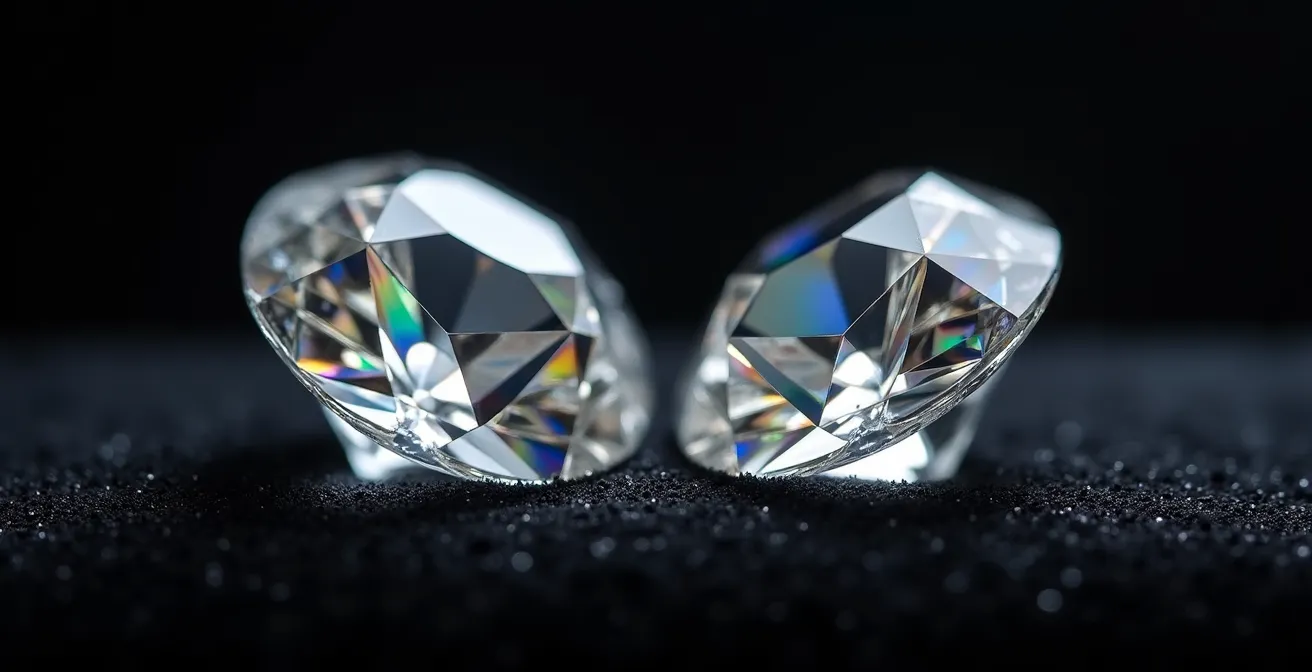
As the image above demonstrates, the light performance between an excellent cut and a poor cut is night and day. By refusing to compromise on cut, you ensure that every other strategic compromise you make (like choosing a lower clarity or colour) is supported by a foundation of maximum brilliance. This is the cornerstone of making your £5,000 budget perform like £10,000.
Can Strong Blue Fluorescence Actually Make a Diamond Look Better?
Fluorescence is one of the most misunderstood and unfairly maligned characteristics in diamonds. It’s also a wholesaler’s secret weapon for getting incredible value. Fluorescence is the glow a diamond emits when exposed to ultraviolet (UV) light. About a third of all diamonds exhibit some degree of it, most commonly blue. For years, the market has penalised diamonds with ‘Strong’ fluorescence, creating a significant price discount. This presents a massive opportunity for a savvy buyer.
In diamonds with lower colour grades (GIA grades J, K, L), a medium to strong blue fluorescence can actually be beneficial. The blue hue helps to cancel out the faint yellow tones in the diamond, making it appear one or even two colour grades whiter to the naked eye. So, you can buy a J-colour diamond that looks more like a G or H, and you get it at a discount. This is the definition of a “smart money diamond.” The key is to ensure the fluorescence doesn’t cause a hazy or oily appearance, which happens in a very small percentage of cases and is easily identified by viewing the stone.
The financial advantage is compelling. By embracing fluorescence, you are not only getting a visually whiter stone but also benefiting from a market inefficiency. Here is how the typical discounts break down, particularly in lower colour grades:
| Fluorescence Level | Effect on J-L Color Diamonds | Typical Price Discount |
|---|---|---|
| None | No color improvement | 0% (baseline) |
| Faint | Minimal improvement | 0-2% |
| Medium | Noticeable whitening effect | 3-7% |
| Strong Blue | Can appear 1-2 grades whiter | a 5-15% discount |
For a buyer targeting maximum visual value, a GIA-certified, J-colour, SI1-clarity diamond with an Excellent cut and Strong Blue fluorescence is one of the best value propositions on the market. You get a stone that faces up white, is eye-clean, sparkles intensely, and costs a fraction of a D-colour, VVS-clarity stone with no fluorescence. This is how you play the game.
Is a Lab-Grown Diamond a Real Diamond or a Fake?
Let’s be unequivocally clear: a lab-grown diamond is not a ‘fake’ diamond like a cubic zirconia. It is a real diamond. It has the exact same chemical, physical, and optical properties as a diamond mined from the earth. The only difference is its origin. One was formed over billions of years deep within the earth’s mantle; the other was created in a matter of weeks in a highly controlled laboratory environment using technologies like HPHT (High Pressure/High Temperature) or CVD (Chemical Vapour Deposition). To any gemologist, they are identical.
The primary reason a budget-conscious buyer should consider a lab-grown diamond is the staggering price difference. In the UK, a lab-grown diamond can cost 60-75% less than a natural diamond of the same size and quality. This isn’t a small saving; it’s a complete game-changer. For a £5,000 budget, you could be looking at a 1-carat natural diamond or a significantly larger, higher-quality 2-carat lab-grown diamond. As a stark example, UK jeweller Rachel Boston demonstrates that a piece featuring a 2-carat GIA-certified lab-grown diamond might cost around £6,000, whereas the same piece with a 2-carat natural diamond would be closer to £26,000.
The conversation then shifts from ‘real vs. fake’ to ‘value vs. tradition’. The main argument against lab-grown diamonds is their resale value. Because they can be produced in unlimited quantities, their long-term value is uncertain and likely to decrease as production becomes more efficient. However, it’s crucial to be realistic about the resale value of natural diamonds as well. A natural diamond ring will typically only retain about 40-50% of its retail value upon resale. The idea of a diamond as a liquid financial investment is largely a myth for the average consumer. You are buying a symbol of love, not a bar of gold. The choice becomes: do you want a smaller, traditional, and rare stone, or a larger, physically identical stone for the same price, with the understanding that its monetary value is in the wearing, not the selling?
GIA vs EGL: Why Does the Lab on the Certificate Matter for Price?
A diamond certificate, or grading report, is the blueprint of your stone. It’s the impartial, third-party verification of the 4 Cs that underpins your entire investment. However, not all certificates are created equal. The name of the grading laboratory on that report is critically important, and buying a diamond with a certificate from a less reputable lab is one of the easiest and most costly mistakes a consumer can make.
The Gemological Institute of America (GIA) is the gold standard. It is the most respected, consistent, and stringent grading laboratory in the world. When a GIA report says a diamond is a G colour and SI1 clarity, you can trust that it is. Other top-tier labs include AGS (American Gem Society), known for its scientific approach to cut grading. In the UK and Europe, you will also frequently encounter IGI (International Gemological Institute), which has become the standard for grading lab-grown diamonds and is widely respected.
The danger lies with less-rigorous labs, a notorious example being EGL (European Gemological Laboratory), which has had various international franchises with inconsistent standards. These labs are often known for ‘soft’ grading. An EGL report might grade a diamond as G colour and SI1 clarity, but if that same stone were sent to the GIA, it might come back as an I colour and SI2 clarity—a difference of two grades in both categories. The seller profits from this discrepancy, as they can sell you an ‘I/SI2’ diamond at the price of a ‘G/SI1’. This is why a GIA-certified diamond will always command a higher price than a similarly graded EGL stone—because the GIA grade is trustworthy. Never compare diamonds graded by different labs; it’s like comparing apples and oranges.
Your Action Plan: Verifying a Diamond’s Credibility
- Source confirmation: Ensure the diamond is accompanied by a grading report from a trusted lab like GIA, AGS, or IGI. These institutions have stringent, independent assessment guidelines.
- Physical match: Check that the certificate number on the report matches the microscopic laser inscription on the diamond’s girdle. A jeweller can help you with this.
- Online verification: Go to the grading lab’s official website and enter the certificate number into their online database to confirm the report is authentic and hasn’t been altered.
- Detailed comparison: Compare the details on the verified online report (measurements, inclusions plot, etc.) with the actual diamond to ensure they are one and the same.
Do Watch Brands Use the Same Quality Diamonds as High Jewellery Houses?
The term ‘diamond-set’ can mean very different things depending on the context. The diamonds used by luxury watch brands on bezels and dials are typically not the same quality as the centre stones selected by high jewellery houses like Graff or Cartier for engagement rings. The priority for a watchmaker is different; it’s about uniformity and consistency across dozens or even hundreds of tiny stones, rather than the individual brilliance of a single, large diamond.
Watch brands predominantly use what are called ‘melee’ diamonds. These are small stones, often weighing between 0.01 and 0.05 carats. When setting a watch bezel, the primary goal is to have all the diamonds perfectly match in size, shape, and colour to create a seamless, brilliant surface. Individuality is suppressed in favour of the collective effect. As a result, the clarity and colour grades for melee are typically in the VS-SI and F-H range—good quality, but not the exceptional D-F colours and VVS-VS clarities often sought for a significant centre stone.
High jewellery, on the other hand, is a celebration of the individual stone. A diamantaire at a top house will assess a diamond for its unique personality, looking for exceptional ‘Fire, Life, and Brilliance’. The value is concentrated in the quality and rarity of that single diamond. For watches, a large part of the value comes from the meticulous craftsmanship required to set hundreds of tiny stones perfectly. This distinction is crucial for understanding the value proposition of a diamond-set luxury item.
| Aspect | Watch Brand Diamonds | High Jewellery Diamonds |
|---|---|---|
| Typical Size | 0.01-0.05ct (melee) | 0.50ct+ center stones |
| Priority | Matching & consistency | Individual excellence |
| Clarity Range | VS-SI | VVS-VS |
| Color Range | F-H | D-F |
| Value Focus | Setting craftsmanship | Stone quality |
How Does ‘Unworn’ vs ‘Mint’ Condition Affect the Asset Value of a Watch?
In the world of pre-owned luxury watches, vocabulary is everything, and the distinction between ‘Unworn’ and ‘Mint’ has significant financial implications. These terms describe the condition of a watch, which is a primary driver of its asset value, especially for collectible models from brands like Rolex, Patek Philippe, or Audemars Piguet. Misunderstanding this can cost a buyer thousands.
‘Unworn’ is the highest possible grade. It means the watch is in the exact same condition as when it left the factory. It has never been worn on a wrist and should have no signs of handling. It often comes as a ‘full set’, meaning it includes the original box, papers, warranty card, and any tags or bezel protectors. An unworn watch is essentially a new watch being sold on the secondary market, often because it’s a hard-to-get model with a long waiting list at authorised dealers. This condition commands the highest premium.
‘Mint’ or ‘Near-Mint’ is the next tier down. A mint condition watch may have been worn carefully a handful of times. It might show minuscule signs of wear, but only under close inspection with a loupe. Crucially, a mint watch has never been polished. Polishing, while it can remove scratches, also removes a microscopic layer of metal. For a collector, this is a cardinal sin as it can alter the sharp, original lines of the watch case and lugs, permanently diminishing its originality and value.

Any condition below mint—such as ‘Excellent’ or ‘Very Good’—implies more visible wear and, often, that the watch has been professionally polished to restore its appearance. While this might look good to a casual observer, an experienced buyer will spot the softer edges and know that its value as a collectible asset has been compromised. Therefore, when buying for value, the preference is always for an unpolished watch, with ‘Unworn’ being the pinnacle.
Key Takeaways
- Never pay for flawless clarity; an eye-clean SI1 diamond offers the same visual appeal for a fraction of the cost.
- Cut is the only non-negotiable ‘C’. Always demand a GIA ‘Excellent’ cut grade for maximum brilliance and visual value.
- Use Strong Blue fluorescence in J-L colour diamonds as an expert-level strategy to gain a whiter appearance and a significant price discount.
What Design Features Make a Piece of Jewellery ‘Heirloom Quality’?
Beyond the immediate sparkle of a diamond, ‘heirloom quality’ refers to the combination of design and craftsmanship that allows a piece of jewellery to endure for generations. It’s about creating something timeless that can be passed down, retaining both its physical integrity and its sentimental value. This quality is not accidental; it is the result of deliberate choices in materials, construction, and design philosophy.
The first feature is the choice of metal. While gold is traditional, platinum is often considered the superior choice for a setting intended to last a lifetime. It is denser, stronger, and more durable than gold. Its natural white lustre will not fade or change colour over time, and it holds diamonds more securely. When using gold, a substantial weight and solid construction (not hollow) are essential for longevity. A flimsy setting is the enemy of an heirloom.
Secondly, in the United Kingdom, the presence of a British hallmark is a non-negotiable sign of quality and authenticity. Mandated by law, a hallmark is a series of marks stamped onto precious metals to certify their purity. It’s a permanent record of the piece’s origin and composition, independently verified by an Assay Office. For a future generation, this hallmark is an indelible guarantee of the metal’s value, a feature that cheap, unverified jewellery will never have. It is, in essence, the piece’s first chapter of provenance.
Finally, the design itself must be timeless. This means avoiding overly trendy motifs that will quickly look dated. Classic designs—like a simple solitaire, a three-stone ring, or elegant halo settings—have remained popular for a century for a reason. They possess a balanced proportion and a universal appeal that transcends fleeting fashions. Heirloom quality is the intersection of robust materials, verified authenticity, and enduring design.
By applying this wholesaler’s mindset—prioritising cut, being strategic with clarity and colour, using fluorescence to your advantage, and demanding quality craftsmanship—you can acquire a truly remarkable diamond that far exceeds the expectations of your budget. The next logical step is to begin searching for stones with these specific, high-value characteristics from a reputable vendor who provides GIA certificates and high-quality imagery.