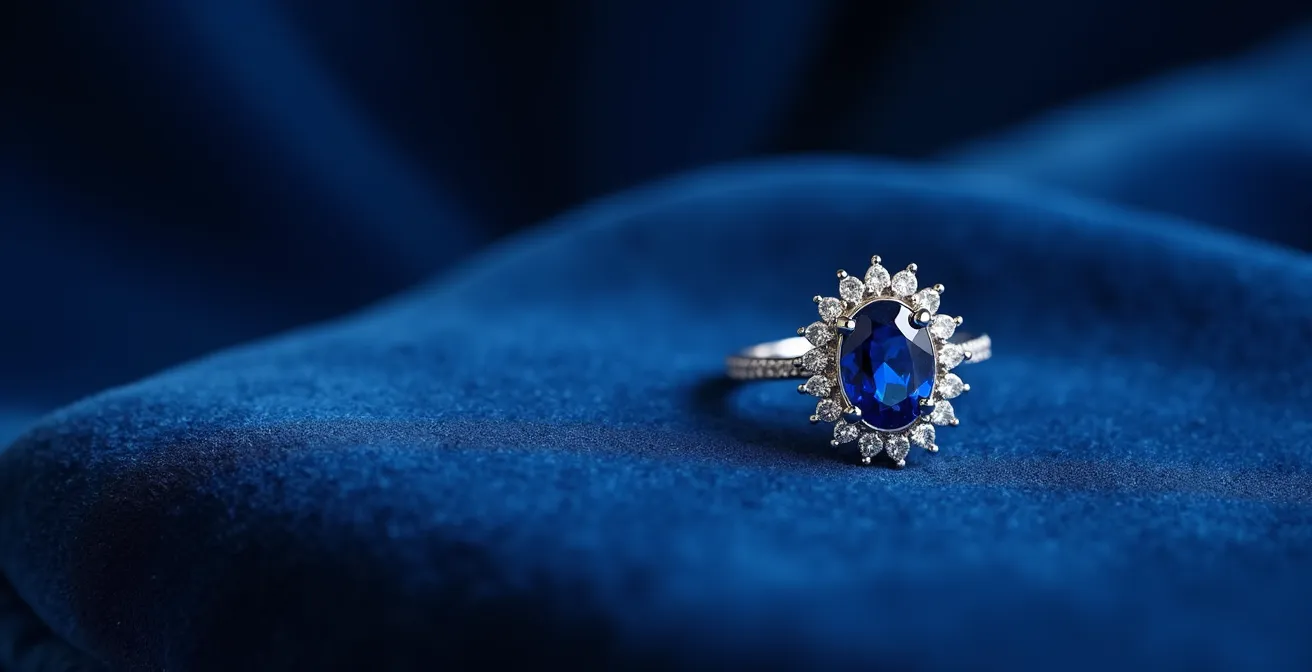
Princess Diana’s engagement ring was more than a royal jewel; it was a strategic design blueprint that engineered a global shift in the sapphire market by perfectly showcasing the gem’s potential.
- The choice of an oval cut and halo setting were technical decisions that maximised the sapphire’s colour and brilliance, setting a new standard for value.
- This single piece revived the sapphire’s status, cementing it as a prime, statement-making alternative to diamonds for a new generation.
Recommendation: Look beyond a gem’s carat weight and consider how its cut, colour, and setting work together as a system to create its true visual impact and market value.
When Prince Charles proposed to Lady Diana Spencer in 1981, the engagement ring he presented was, by royal standards, an unconventional choice. It wasn’t bespoke, but a stock item from the catalogue of crown jeweller Garrard. This detail caused a minor stir, allowing commoners to, in theory, own the same ring as a future queen. Yet, this accessibility was the very thing that began its journey into legend. The ring—a 12-carat oval Ceylon sapphire haloed by fourteen diamonds—transcended its controversial origins to become one of the most famous pieces of jewellery in history. Its influence, passed to a new generation through Catherine, Princess of Wales, did more than just inspire copies; it fundamentally reshaped the global sapphire market.
Most analyses focus on the “Kate Middleton effect” or the ring’s soaring value. But this view misses the crucial point. The ring’s enduring power lies not just in its famous wearers, but in its masterful design. It served as a powerful lesson in aesthetic engineering, demonstrating how specific choices in cut, colour, and setting could amplify a gemstone’s inherent beauty and, consequently, its market desirability. It was a blueprint for value, proving that a sapphire wasn’t just a secondary choice to a diamond, but a commanding centrepiece with its own distinct allure. This article deconstructs that blueprint, exploring the specific design elements of Diana’s ring and tracing their profound and lasting impact on the perception, pricing, and popularity of sapphires worldwide, particularly within the UK.
This analysis will explore the strategic design and cultural impact of this iconic piece. We will dissect why the oval cut is a royal favourite, compare the market values of different sapphire blues, and understand the technical brilliance of the halo setting. Prepare to see this famous ring not just as a beautiful object, but as a market-defining asset.
Summary: The Enduring Blueprint of the Royal Sapphire
- Why Do Royals Prefer Oval Cut Sapphires Over Round Cuts?
- Cornflower vs Royal Blue: Which Shade Commands the Highest Price?
- Why Is Sapphire the Best Alternative to Diamond for Engagement Rings?
- Why Does a Halo Setting Enhance a Dark Sapphire Better Than a Diamond?
- What Can We Learn from the Queen’s Sapphire Brooches?
- How to Adopt the Green Dial Trend Without Dating Your Collection?
- Why a Gold Sovereign Is the Traditional Christening Gift That Beats Cash?
- Did You Know Sapphires Come in Every Colour Except Red?
Why Do Royals Prefer Oval Cut Sapphires Over Round Cuts?
The choice of an oval cut for Princess Diana’s ring was far from arbitrary; it reflects a long-standing royal preference rooted in both aesthetics and impact. Unlike the standard round brilliant, the elongated shape of an oval-cut stone has a flattering effect, making the wearer’s finger appear longer and more slender. As noted by experts at Laings UK Jewellers, this visual elegance is highly desirable for individuals constantly in the public eye. They state, “The oval cut, known for elongating the finger, aligns with the aesthetic goals of formal portraiture and public appearances, a key aspect of royal life.” This function goes beyond simple beauty, becoming a tool for crafting a graceful and stately public image.
This preference, however, is not just about appearance but also about maximising the gem’s presence. An oval cut often appears larger than a round stone of the same carat weight due to its greater surface area. This optical advantage means the gem has a more significant visual impact. The market has responded unequivocally to this royal endorsement. The value of Princess Diana’s ring, originally purchased for £28,000, is now estimated to be over £300,000, a figure that reflects not just its history but the desirability of its specific design. The combination of royal provenance and visual appeal created a powerful market driver.
Case Study: The Garrard 1735 Collection
The enduring commercial power of this design is perfectly illustrated by Garrard itself. The jeweller launched the ‘1735’ collection, directly inspired by the ring’s iconic silhouette. Sara Prentice, Garrard’s Creative Director, explained the design principle: “With the 1735 collection, we wanted to capture the elegant classicism of Princess Diana’s ring. The prominent cluster of diamonds has the effect of amplifying the vibrant hue of the coloured stones.” By creating new pieces in sapphires, emeralds, and rubies based on this blueprint, Garrard demonstrated that the oval-cut cluster is not just a historical design but a commercially viable and highly desirable formula in the modern luxury market.
This fusion of aesthetic function and market power is the first key to understanding the ring’s influence. The oval cut wasn’t just a choice; it was a strategic decision that has since become synonymous with timeless, regal elegance.
Cornflower vs Royal Blue: Which Shade Commands the Highest Price?
While Diana’s ring popularised the blue sapphire globally, within the gem trade, not all blues are created equal. The specific hue, tone, and saturation of a sapphire are the most critical factors in determining its value. The two most coveted shades are “Cornflower Blue” and “Royal Blue.” The former is a lighter, velvety blue with a soft, almost glowing quality, famously associated with sapphires from Kashmir. The latter, as seen in Diana’s Ceylon sapphire, is a deeper, more vivid and saturated blue. While both are highly prized, their market dynamics differ, especially in the UK.
Historically, the rarest and most valuable sapphires were the legendary gems from Kashmir, whose supply was exhausted over a century ago. According to market analysis, a top-quality cornflower blue sapphire from Kashmir can command over $50,000 per carat due to its extreme rarity and unique velvety appearance. However, “Royal Blue” sapphires, particularly those from Burma (Myanmar) and Ceylon (Sri Lanka), command immense respect and high prices for their intense, vibrant colour. The “Diana effect” significantly boosted the appeal of this deeper Royal Blue, making it the benchmark for an engagement ring sapphire in the public imagination.
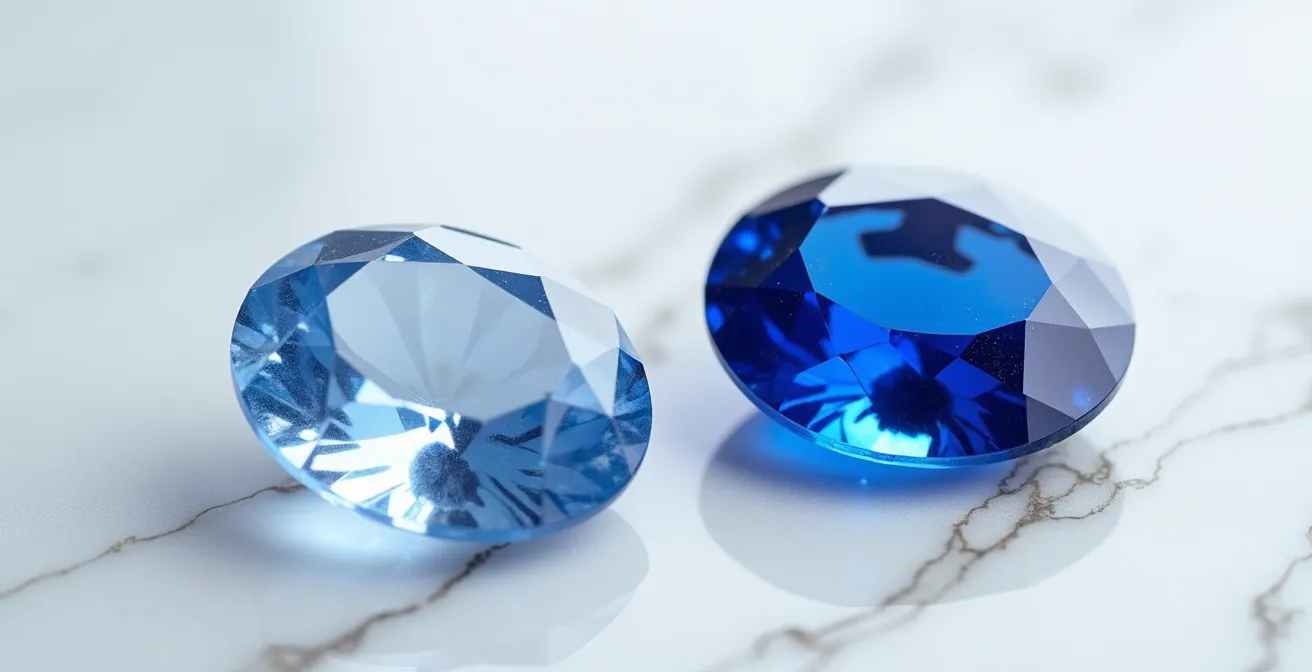
The following table breaks down the price differences, showing how origin and the specific “brand” of blue impact value in the high-end market. While Cornflower Blue from Kashmir remains the collector’s ultimate prize, a high-quality Royal Blue from a premium source carries enormous prestige and value.
| Sapphire Colour | Price per Carat (8-10ct) | Origin Premium |
|---|---|---|
| Royal Blue (Burma) | $10,000-18,000 | Highest premium |
| Royal Blue (Ceylon) | $5,000-8,000 | Moderate premium |
| Cornflower Blue | $5,000-8,000 | High demand in UK |
| Light Blue | $300-800 | No premium |
Why Is Sapphire the Best Alternative to Diamond for Engagement Rings?
Before Princess Diana’s ring, coloured gemstones for engagements were relatively niche. While not unheard of in aristocratic circles, the dominant cultural narrative, fueled by decades of marketing, was that an engagement ring meant a diamond. The global visibility of Diana’s choice shattered that monopoly. It positioned sapphire not just as *an* alternative, but as the *best* alternative, for reasons of durability, individuality, and historical weight.
A key practical reason for its suitability is its exceptional hardness. As part of the corundum mineral family, sapphires rank a 9 on the Mohs scale of hardness, second only to the diamond at 10. This makes them incredibly durable and resistant to scratches, an essential quality for a piece of jewellery intended for daily wear over a lifetime. This technical resilience provides the logical foundation for its use, assuring buyers that they are not sacrificing practicality for colour.
Beyond durability, the choice of a sapphire has become a powerful statement of personal style. It signals a move away from convention and an appreciation for colour and history. This shift in perception is particularly pronounced in Britain. As the London-based jewellers at Queensmith observe, the legacy of the ring has reshaped consumer attitudes. They explain, “In the UK, choosing a sapphire is no longer a compromise but a conscious statement of individuality and appreciation for history, directly influenced by the enduring style of Diana and Catherine, Princess of Wales.” The ring gave people “permission” to desire colour, transforming the engagement ring from a status symbol defined by a single stone into a more personal expression of identity.
Why Does a Halo Setting Enhance a Dark Sapphire Better Than a Diamond?
The third element of the ring’s design blueprint is arguably its most technically brilliant: the halo setting. Surrounding the deep blue sapphire with fourteen smaller, highly brilliant diamonds was not merely a decorative choice. It was an act of aesthetic engineering designed to solve a fundamental challenge of coloured gemstones: maximising their vibrancy, especially in less-than-ideal lighting. The halo creates a “light funnel” effect, a principle that is particularly effective for a darker centre stone like a Royal Blue sapphire.
The diamonds act as a collection of tiny mirrors. They catch ambient light from every angle and redirect it towards the centre stone, and also back to the observer’s eye. This creates a ring of intense sparkle that, by contrast, makes the sapphire’s colour appear deeper and more saturated. It also adds overall brilliance to a gem that, unlike a diamond, is prized for its hue rather than its fire. This effect is especially crucial in the United Kingdom, where overcast skies are common. The halo setting ensures the ring remains vibrant and eye-catching even in diffuse, low-light conditions.
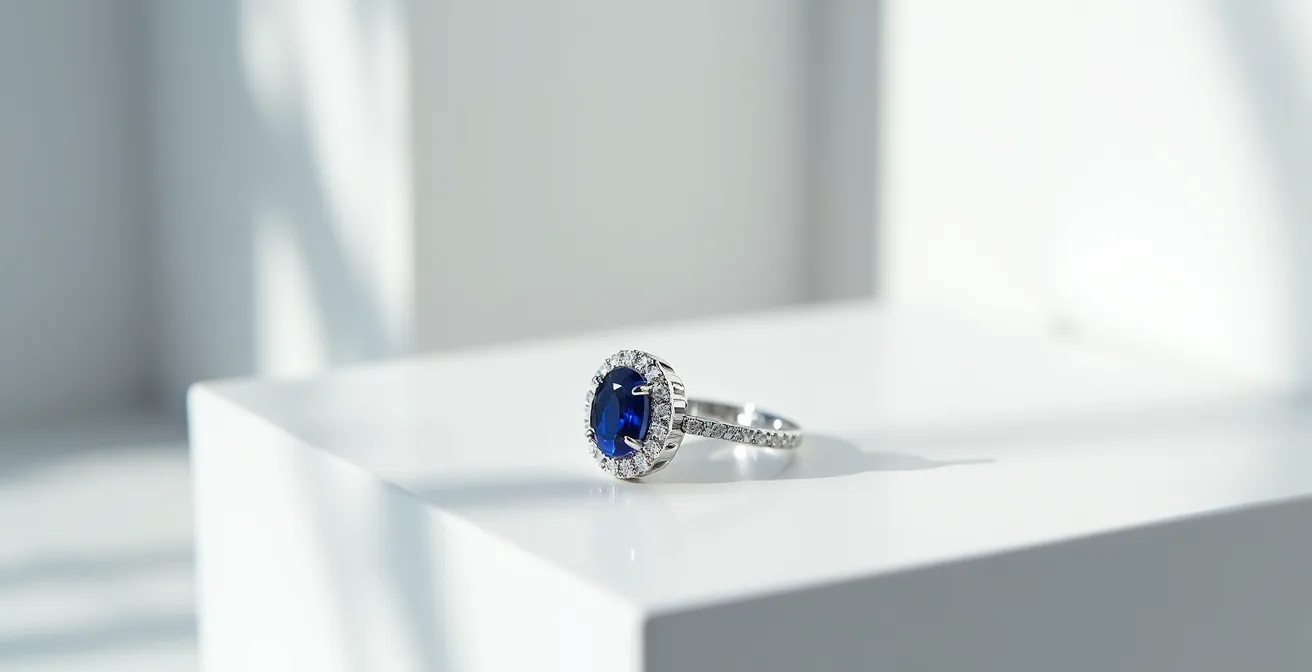
The success of this design has made the halo the default setting for high-end coloured stone rings. The technical principles behind it are now a standard part of a master jeweller’s toolkit.
Action Plan: Maximising Sapphire Brilliance with a Halo Setting
- Position Diamonds for Light Capture: Set the surrounding diamonds at precise angles to catch and reflect ambient light from all directions, funnelling it towards the centre.
- Create High Contrast: Use the bright white of the diamonds to create a high-contrast visual border, which makes the sapphire’s blue appear more intense and saturated.
- Utilise White Metal: Employ white gold or platinum for the setting to further enhance the colour contrast and avoid introducing any warm tones that could dull the blue.
- Select Colourless Diamonds: Ensure the halo diamonds are of a high colour grade (D-F, or colourless) to maximise their reflective properties and not detract from the sapphire’s hue.
- Elevate the Centre Stone: Set the sapphire slightly higher than the halo, allowing light to enter the gem from its sides and pavilion, increasing its internal glow.
What Can We Learn from the Queen’s Sapphire Brooches?
The influence of royal sapphires extends far beyond a single engagement ring. The extensive collection of Queen Elizabeth II, particularly her sapphire brooches, demonstrates a deeper function of royal jewels: they are not just personal adornments but powerful heritage assets used for continuity, diplomacy, and communication. These pieces show how sapphires have been woven into the fabric of the British monarchy for centuries, with each piece carrying a story that adds to its gravitas.
A prime example is the way the Queen curated and expanded her collection over time. She commissioned a tiara and bracelet in 1963 to match a Victorian suite of sapphires given to her by her father as a wedding present. This act of completing a set created in 1850 shows a conscious effort to honour the past while adapting it for the present, reinforcing a sense of unbroken lineage. The jewels become a physical link across generations of monarchs, carrying history forward.
Case Study: The Diplomatic Power of the Prince Albert Brooch
Perhaps no piece better illustrates the role of a jewel as a heritage asset than the Prince Albert Brooch. This magnificent sapphire and diamond cluster was given to Queen Victoria by Prince Albert the day before their wedding in 1840. It became one of her most treasured possessions. Queen Elizabeth II inherited it and wore it strategically at numerous significant state and family occasions, from meetings with world leaders to the christening of Prince Charles. By wearing a piece so steeped in the history of a successful and long-reigning monarch, the Queen could wordlessly convey messages of stability, tradition, and the enduring strength of the monarchy. It was an instrument of soft power, its deep blue a symbol of unwavering duty.
These brooches teach us that the value of royal sapphires lies not only in their material worth but also in their accumulated narrative capital. They are emblems of a national story, and wearing them is a deliberate act of historical and political communication.
How to Adopt the Green Dial Trend Without Dating Your Collection?
The principle of leveraging heritage to create timeless value, so evident in royal sapphires, can be seen in other areas of British luxury, such as watchmaking. A recent trend in horology is the green dial. While trends can be risky for collectors who fear their investment may quickly look dated, the key is to choose a shade of green that is itself a heritage asset. In the UK, that colour is British Racing Green.
Unlike a fleeting, fashion-forward green, British Racing Green has deep roots in the nation’s automotive and sporting history, dating back to the Gordon Bennett Cup in 1903. It evokes a legacy of engineering excellence and competitive spirit, from vintage Bentleys to modern Aston Martins. By choosing a watch with a dial in this specific, muted, and sophisticated shade, a collector isn’t just buying into a trend; they are investing in a piece of cultural history. This imbues the watch with a perennial style that transcends seasonal fads.
As Town & Country Magazine notes, “British Racing Green has deep roots in UK automotive and sporting heritage, making it a perennially stylish choice rather than a fleeting fashion.” The strategy is to connect the colour to a story that is already timeless. This is precisely the same mechanism that gives a royal sapphire its gravitas. The value is locked in by the narrative. For discerning collectors in the UK, anchoring a modern purchase in established heritage is the surest way to build a collection of lasting worth.
- Choose heritage-inspired timepieces that use British Racing Green as a foundational colour, not an accent.
- Select watches from established British brands like Bremont that explicitly link their green dials to national heritage, such as aviation or military history.
- Pair green dial watches with classic accessories in complementary earth tones, echoing the traditional style of Jermyn Street.
- Invest in limited editions that reference specific moments in British automotive or military history, cementing their collectible status.
Why a Gold Sovereign Is the Traditional Christening Gift That Beats Cash?
Continuing the theme of tangible heritage assets, the British Royal Family’s influence extends to traditions of wealth and gifting, perfectly embodied by the Gold Sovereign. For generations, giving a Sovereign coin at a christening has been a time-honoured practice in the UK, far surpassing a simple cash gift. Like a royal sapphire, a Sovereign is an object that carries history, value, and a direct link to the monarchy.
First minted in its modern form in 1817, the Sovereign is a piece of living history. Produced by The Royal Mint, it features a portrait of the reigning monarch on its obverse, creating a direct physical connection to the Crown. As legal tender with an intrinsic value tied to its 22-carat gold content, it represents a stable and enduring store of wealth. This dual identity—as both currency and precious metal—is what makes it a uniquely powerful gift. It’s a way of bestowing a piece of national heritage and a foundation for future prosperity upon a child.
Furthermore, the Gold Sovereign holds a unique and highly advantageous position within the UK’s financial system. As a testament to their historical significance, in the UK, Gold Sovereigns maintain special status as VAT-free and Capital Gains Tax-exempt for UK residents. This tax treatment makes them an exceptionally efficient vehicle for wealth preservation and transfer. Gifting a Sovereign is not just a sentimental gesture; it’s a financially astute decision that connects a family’s personal milestone to the grander narrative and stability of the British monarchy, much like the royal jewels themselves.
Key Takeaways
- Princess Diana’s ring was a “design blueprint” whose oval cut, royal blue colour, and halo setting became a formula for value.
- The ring’s technical design, especially the “light funnel” effect of the halo, was engineered to maximise the sapphire’s beauty in all lighting conditions.
- Beyond a single ring, royal jewels function as “heritage assets,” used for diplomatic communication and to symbolise continuity, adding narrative value to their material worth.
Did You Know Sapphires Come in Every Colour Except Red?
Perhaps the most profound and lasting impact of Diana’s ring was that it opened the public’s eyes to the potential of a major gemstone family. While it made blue sapphire the star, it inadvertently shone a spotlight on the entire corundum species. What many people still don’t realise is that sapphires come in every colour of the rainbow—yellow, pink, green, purple, orange—with one single exception. A red corundum is not called a sapphire; it is called a ruby. They are, mineralogically speaking, the same stone, differentiated only by colour.
This wide array of “fancy sapphires” has become a booming market in its own right, offering a world of choice for those seeking the durability and prestige of a sapphire but with a more unique hue. The rise of the blue sapphire created a halo effect (pun intended) for its colourful siblings. The most famous and rarest of these is the Padparadscha sapphire, a breathtakingly beautiful stone with a unique pinkish-orange hue, reminiscent of a sunset. Its name is derived from the Sinhalese for “lotus flower.”
The market for these fancy sapphires is sophisticated, with certain colours commanding prices that can rival high-quality diamonds. In the UK auction market, values for exceptional stones are strong. For example, data from gem market analysts shows that Padparadscha sapphires, the rarest fancy sapphire variety, command prices starting at $2,500+ per carat and can escalate dramatically for top-tier specimens. Diana’s ring may have been blue, but its legacy is a full spectrum of colour.
| Sapphire Variety | Color Description | Price Range (per carat) | UK Market Demand |
|---|---|---|---|
| Padparadscha | Pinkish-orange | $2,500-30,000 | Highest among collectors |
| Teal/Peacock | Blue-green | $800-1,500 | Rising in bespoke market |
| Colour-Change | Blue to purple shift | $1,000-5,000 | Specialist interest |
| Yellow | Golden to canary | $500-800 | Moderate |
Ultimately, the story of Diana’s ring is a lesson in how a single, thoughtfully designed object, when worn by the right person at the right time, can create waves that redefine an entire industry. To truly appreciate modern jewellery trends and values, start by understanding the blueprint this iconic sapphire provided.