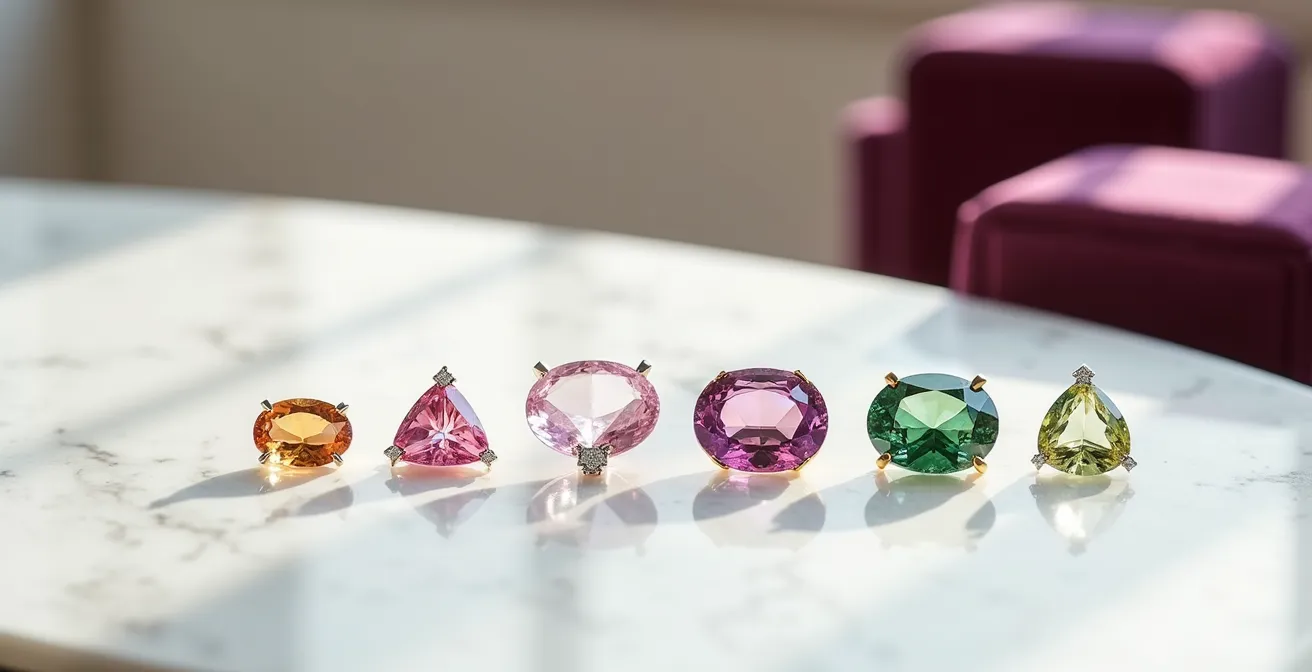
While we picture sapphires as deep blue, the fascinating truth is their vast colour range is caused by ‘impurities’ accidentally trapped within their crystal structure.
- Minute traces of elements like iron, chromium, and titanium act as nature’s paintbrush, creating every shade imaginable.
- The only colour a corundum stone can’t be is red—at that point, by definition, it becomes its famous sibling, the ruby.
Recommendation: When you next look at a sapphire, go beyond its beauty and try to appreciate the unique geological story that its specific colour tells.
When you hear the word “sapphire,” a single, iconic image likely comes to mind: a deep, velvety blue gem, perhaps adorning the hand of royalty or sparkling in a museum display. For decades, this blue has been the undisputed king of the sapphire world. Many are now aware that sapphires can also be found in other shades, like delicate pink or sunny yellow. But this understanding often stops at a simple acknowledgment that “other colours exist.” It misses the truly spectacular story happening at a microscopic level.
The real secret of the sapphire family lies not just in what colours it can be, but *why*. The vast and surprising palette of “fancy sapphires” is a lesson in chemistry and geology, a story of how accidental chemical guests create breathtaking beauty. As a gemologist, I can tell you that a sapphire is a kind of chemical storybook. The stone itself, a mineral called corundum, is naturally colourless. Its entire spectrum of colour is born from trace elements—tiny amounts of other minerals that were incorporated into the stone’s crystal lattice as it formed deep within the Earth millions of years ago. To appreciate a sapphire fully is to understand that its hue is a fingerprint of its unique geological journey.
This guide will take you beyond the blue. We will explore the most coveted and misunderstood members of the sapphire family. We will delve into the science that dictates their colour, clarify the fine line that separates a sapphire from a ruby, and give you the knowledge to appreciate these gems not just for their beauty, but for the incredible natural phenomena they represent.
Summary: Unlocking the Full Spectrum of Sapphire
- What Is a Padparadscha Sapphire and Why Is It So Hard to Find?
- Where Is the Line Drawn Between a Dark Pink Sapphire and a Light Ruby?
- Why Are Yellow Sapphires a Great Affordable Alternative to Yellow Diamonds?
- How Does a Colour Change Sapphire Shift from Blue to Purple?
- Why Are Green Sapphires Often Called the ‘Stone of Tranquility’?
- Rose Gold, Silver, or Two-Tone: Which Matches Your Existing Jewellery Box?
- What Are Star Sapphires and Why Do They Have Astersim?
- Why Is the ‘Jardin’ in an Emerald Not Considered a Flaw?
What Is a Padparadscha Sapphire and Why Is It So Hard to Find?
Among the pantheon of fancy sapphires, one reigns supreme in rarity and romance: the Padparadscha. Its name, derived from the Sinhalese word for “lotus blossom,” perfectly captures its ethereal colour—a delicate, yet vibrant, blend of pink and orange. For a novice, the colour might be hard to place, sitting somewhere between a sunset and a tropical fruit. For a gemologist, it represents a near-impossible balancing act of nature. This unique hue is created by a very specific and rare combination of two trace elements within the corundum crystal: chromium (which imparts a pink or red hue) and iron (which provides a yellow hue).
The rarity comes from this precise recipe. Too much chromium and the stone is simply pink; too much iron and it becomes an orange or yellow sapphire. The Padparadscha must exhibit both colours in a harmonious balance. This natural scarcity makes it one of the most valuable sapphires on the market. The UK public became acutely aware of its value and beauty with the engagement of Princess Eugenie in 2018. Her ring, featuring a stunning Padparadscha, drew global attention. This royal connection solidified its status, and as a result, values have soared. For instance, London jeweller Hirsh noted that Princess Eugenie’s padparadscha engagement ring value demonstrates the incredible premium these stones command, with unheated examples easily exceeding £100,000 for a quality stone of a few carats.
Finding a natural, untreated Padparadscha is the ultimate prize for collectors. The majority of these gems originate from Sri Lanka, though deposits have also been found in Madagascar and Tanzania. Due to their rarity, gemological certification is absolutely essential to confirm that the colour is natural and falls within the tightly defined “Padparadscha” range.
Where Is the Line Drawn Between a Dark Pink Sapphire and a Light Ruby?
This is one of the most classic and contentious questions in gemology, and it strikes at the very heart of how we classify gems. To a novice, seeing a vivid pink sapphire next to a pale ruby can be confusing; they can look almost identical. The scientific answer is that there is, chemically, no difference. Both ruby and pink sapphire are the same mineral—corundum—and both get their colour from the same trace element: chromium. The distinction is not one of chemistry, but of commerce, culture, and gemological consensus.
The line is drawn based on colour, specifically the dominance of the red hue. Think of it as a spectrum. At one end, with very little chromium, you have a pale pink sapphire. As the concentration of chromium increases, the colour deepens through rose, magenta, and fuchsia. At a certain point, the colour becomes so saturated that its primary hue is considered red, not pink. At that moment, it ceases to be a pink sapphire and becomes a ruby. The Gemological Institute of America (GIA) is the leading authority on this, and their standards are used across the industry. The GIA classification standards reveal that pink sapphires encompass shades from light red to light purple, which fall outside the specific, more saturated colour ranges designated for ruby.
This subtle distinction has enormous implications for value. A “vivid pink sapphire” and a “light red ruby” of the same size and quality can have vastly different prices, purely based on that classification. The term “ruby” often carries a higher commercial value and historical prestige. This is why you will see fierce debate in jewellery districts from London’s Hatton Garden to Bangkok over where that precise line should be drawn for a particular stone.
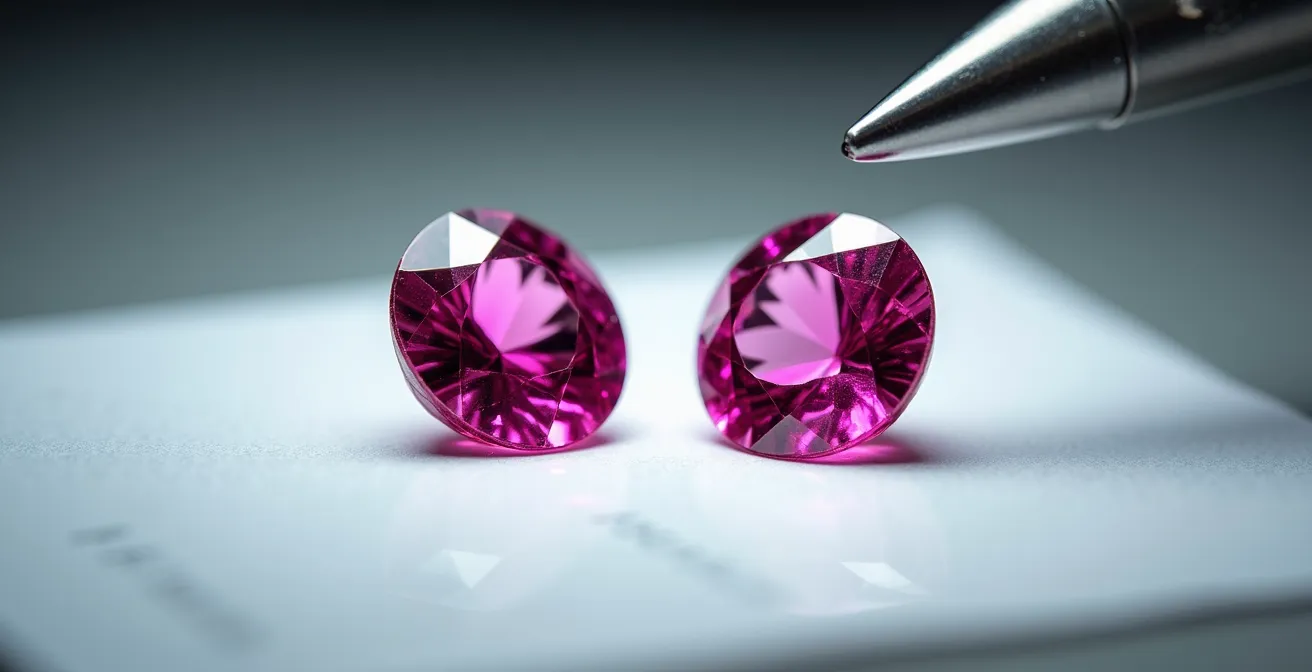
Ultimately, the dividing line is less of a sharp boundary and more of a carefully defined zone. For a buyer, it’s a reminder that names in the gem world are powerful, and understanding the subtle science behind them is key to making an informed choice. Whether it’s a pink sapphire or a ruby, the beauty comes from that magical touch of chromium in the corundum crystal.
Why Are Yellow Sapphires a Great Affordable Alternative to Yellow Diamonds?
For those who love warm, sunny colours in their jewellery, the yellow diamond has long been the pinnacle of luxury. However, a novice collector might be surprised to learn that the yellow sapphire offers a strikingly similar aesthetic for a fraction of the cost, making it an exceptionally smart and beautiful alternative. While both stones dazzle with a brilliant yellow hue, their fundamental chemistry and market dynamics are worlds apart. A yellow diamond is carbon, its colour typically caused by nitrogen impurities, whereas a yellow sapphire is corundum, coloured by traces of iron.
The most compelling argument for yellow sapphire is its incredible value proposition. A high-quality 1-carat yellow diamond can command prices well into the tens of thousands of pounds, while a yellow sapphire of equivalent size and beauty can often be acquired for a few hundred. This price difference is not an indicator of lesser beauty, but rather of different mineral rarity. Both gems are durable and suitable for everyday wear, though the diamond (at 10 on the Mohs scale of hardness) is slightly harder than the sapphire (at 9). This makes sapphire the second-hardest natural mineral on earth, more than tough enough for an engagement ring or signature piece.
This comparative analysis highlights the key trade-offs. While a diamond offers superior sparkle or ‘brilliance’ due to its higher refractive index, a well-cut yellow sapphire possesses a bright, lively fire of its own. It’s a choice between the ultimate symbol of luxury and a more accessible, yet equally stunning, natural treasure.
The table below breaks down the comparison, with prices in GBP providing a clear picture for the UK market, based on a recent market analysis of these two yellow gems.
| Characteristic | 1ct Yellow Diamond | 1ct Yellow Sapphire |
|---|---|---|
| Price Range (GBP) | £8,000-£24,000 | £350-£500 |
| Hardness (Mohs) | 10 | 9 |
| Brilliance | Superior sparkle | Good sparkle |
| Size for same weight | Larger (lower density) | Smaller (higher density) |
| Color stability | Permanent | Stable if untreated |
How Does a Colour Change Sapphire Shift from Blue to Purple?
Among the most magical and intriguing of all gems are the rare colour-change sapphires. To a novice, watching a stone shift from a cool blue under daylight to a warm purplish-red under a lamp feels like a magic trick. The explanation, however, lies in the fascinating physics of light and the gem’s unique chemical composition. These sapphires are true chameleons, and their ability to change colour is known as the “alexandrite effect,” though it is a distinct phenomenon in sapphires caused by different elements.
The secret ingredient is typically the presence of both chromium and vanadium as trace elements within the sapphire’s crystal lattice. These elements are unusual in how they absorb light. Different light sources have different colour temperatures and emit different wavelengths. Natural daylight (or fluorescent light) is rich in blue wavelengths. The vanadium in the sapphire absorbs other parts of the spectrum but allows the blue light to pass through to your eye, so the stone appears blue. In contrast, incandescent light—like that from a candle or a traditional light bulb, often described as a “pub-fire” glow in the UK—is rich in red wavelengths. Under this light, the chromium in the stone becomes the dominant factor, reflecting reddish light and causing the gem to appear purple, violet, or reddish-pink.
This dramatic shift is a prized characteristic. The more distinct the change, the more valuable the sapphire. Sapphires that show a weak or muddy transition are less desirable than those with a clear and dramatic shift from a distinct blue to a distinct purple or red. Testing this phenomenon is a key part of the buying experience in any reputable London jeweller’s shop.
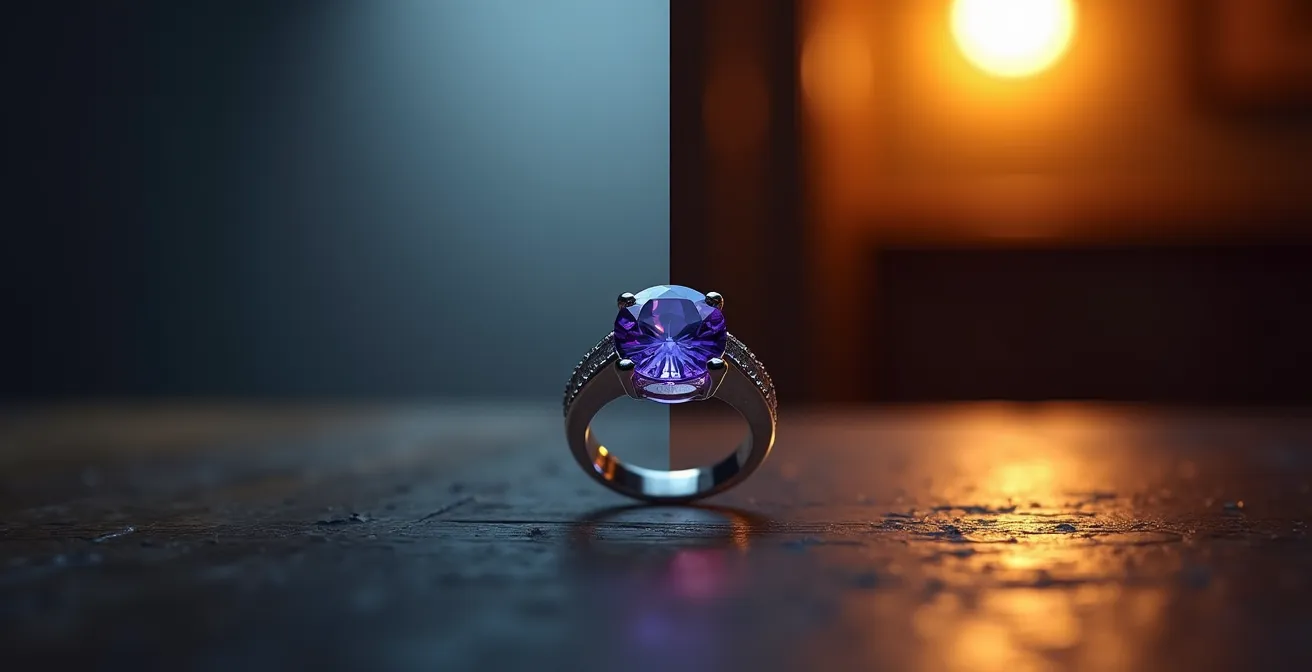
If you ever have the chance to see one, here is how you would typically test its quality. Following these steps ensures you see the full range of the gem’s personality and verify the strength of its unique chameleon-like ability.
Your Checklist for Testing a Colour-Change Sapphire
- Request the jeweller to demonstrate the stone under shop LED lighting to establish its initial base colour.
- Move near a window to observe the stone in natural London daylight (often overcast) to see its cool-toned appearance.
- Ask to view it under a classic incandescent bulb to witness the shift to its warm ‘pub-fire purple’ hue.
- Compare the intensity of the shift; stronger, more dramatic shifts command higher prices on the London market.
- Request to see documentation of the colour-change phenomenon from UK-certified gemological labs.
Why Are Green Sapphires Often Called the ‘Stone of Tranquility’?
While blue, pink, and yellow sapphires have established identities, the green sapphire remains one of the more understated and enigmatic members of the family. Often overlooked by the novice buyer, these gems possess a deep, calming beauty that has earned them the moniker ‘Stone of Tranquility’. Their colour can range from a light minty green to a deep, forest or olive green, and this hue is rarely a ‘pure’ green. It is almost always a complex interplay of other colours.
The science behind green sapphires is fascinating because their colour is often the result of a partnership between different trace elements or colour zones. As the experts at Blue Nile point out, the colour is not from a single “green” chromophore. Instead, it’s a visual blend. As they explain in their guide, “Green sapphires usually have added tones of blue or yellow, which are the shades that create the green color you see when looking at these gems.” This can happen in two ways: either through the combined effect of iron and titanium trace elements interacting within the crystal lattice, or through ‘colour zoning’, where microscopic layers of blue and yellow sapphire are stacked so closely together that the human eye blends them into a single, unified green.
Green sapphires usually have added tones of blue or yellow, which are the shades that create the green color you see when looking at these gems.
– Blue Nile, Sapphire Colors and Features Guide
This connection to the natural world—evoking forests, seas, and meadows—is likely the source of its association with tranquility, wisdom, and calmness. In the UK, green sapphires have found a niche within the ‘slow fashion’ and wellness movements. Jewellery designers champion them as a sophisticated and earthy alternative to more mainstream gems, appealing to those who value a connection to nature and a sense of calm in a hectic world. Their subtle, complex beauty rewards a closer look, revealing a depth that is both soothing and profound.
Rose Gold, Silver, or Two-Tone: Which Matches Your Existing Jewellery Box?
Once you’ve chosen a beautiful fancy sapphire, the next crucial decision is selecting the metal for its setting. This choice is far from trivial; the right metal can elevate a sapphire’s colour, while the wrong one can wash it out or clash with its undertones. For a novice building a jewellery collection, the goal is versatility and harmony. The key is to consider both the specific colour of your sapphire and the predominant metal in your existing jewellery box to ensure your new piece integrates seamlessly.
The general rule is to use contrast or harmony. Cool-toned sapphires, like blues, greens, and teals, are often stunning in white metals like platinum or white gold. The neutral, bright backdrop makes their colour pop and gives them a crisp, modern feel. Conversely, warm-toned sapphires—such as yellow, orange, and Padparadscha—are beautifully complemented by yellow or rose gold. These warm metals enhance the fire within the stone, creating a rich, harmonious look. For a stone like a colour-change sapphire, which has both cool and warm personalities, a platinum or white gold setting is often preferred as it provides a neutral stage for its dramatic shift.
In the UK, matching your metal choice to a specific ‘style profile’ is a popular approach. Whether you favour antique elegance or modern minimalism, there’s a sapphire-metal combination that fits. When purchasing in the UK, always look for the official hallmark stamped on the metal, which guarantees its purity—for example, ‘950’ for platinum, or ‘375’ and ‘750’ for 9ct and 18ct gold respectively.
This table, based on popular UK style trends, offers a practical guide to pairing fancy sapphires with the perfect metal.
| Style Profile | Sapphire Color | Metal Choice | UK Hallmark |
|---|---|---|---|
| The Antique Elegance | Peach Sapphire | Rose Gold | 375 or 750 (9ct/18ct) |
| The Modern Londoner | Teal Sapphire | Platinum | 950 Plat |
| The Countryside Charm | Yellow Sapphire | Yellow Gold | 375 or 750 |
| The Contemporary Classic | Color-Change | White Gold/Platinum | 750 WG or 950 Plat |
What Are Star Sapphires and Why Do They Have Astersim?
Beyond the world of transparent, faceted gems lies a category of sapphires known as ‘phenomenal’ gems. The most famous of these is the star sapphire, a stone that displays a captivating, star-like pattern that seems to glide across its surface when moved under a light source. To a novice, this effect appears mystical, but like all things in gemology, it is the result of a unique interaction between light and the stone’s internal structure. This phenomenon is called asterism.
The star is not caused by the chemical impurities that create colour, but by physical inclusions within the stone. Specifically, asterism occurs when the corundum crystal contains a high concentration of tiny, needle-like inclusions of a mineral called rutile (a form of titanium dioxide). For the star to appear, these rutile ‘needles’ must be oriented in parallel groups that intersect at specific angles, aligned with the sapphire’s underlying crystal structure. When a single, direct light source (like the sun or a spotlight) hits the domed, cabochon-cut surface of the stone, the light reflects off these intersecting needles, creating the luminous, moving star. Most star sapphires exhibit a six-rayed star, reflecting the hexagonal symmetry of the corundum crystal.
Because they rely on inclusions, star sapphires are typically translucent or opaque rather than transparent. Their beauty lies not in clarity, but in the strength and sharpness of the star. A great example of how even experts can misunderstand sapphires is the story of the Black Star of Queensland. Discovered by a 12-year-old boy in the 1930s, the 733-carat rough stone was used by his father as a doorstop for years, dismissing it as a worthless black crystal because he didn’t know sapphires could be any colour but blue, let alone exhibit a star.
Key takeaways
- Sapphire’s colour is not inherent; it is a direct result of trace element ‘impurities’ like iron and chromium in the corundum crystal.
- A ruby is not a different mineral from sapphire; it is simply corundum with a high enough concentration of chromium to be classified as red.
- Inclusions are not always flaws. In phenomenal gems like star sapphires, specific inclusions (rutile needles) are what create the beautiful star effect.
Why Is the ‘Jardin’ in an Emerald Not Considered a Flaw?
In the world of gemstones, the term ‘inclusion’ often has a negative connotation, suggesting a flaw that reduces value. However, seasoned collectors and gemologists know this isn’t always the case. The perfect example is the emerald, whose natural inclusions are so common and characteristic that they have an affectionate, poetic name: the ‘jardin’, French for ‘garden’. These tiny fissures and crystals are seen as proof of the gem’s natural origin and a part of its unique character. A completely flawless natural emerald is so rare as to be almost mythical.
This mindset—of appreciating inclusions as part of a gem’s identity—can be applied to sapphires as well, though the rules are different. While a sapphire’s value is heavily dependent on high clarity, not all inclusions are created equal. As we saw with star sapphires, some inclusions (rutile silk) are the very source of the gem’s beauty. In transparent sapphires, some minor inclusions are acceptable and can even be a positive sign. For example, very fine, evenly distributed ‘silk’ can give a blue sapphire a soft, velvety appearance that is highly prized. Subtle colour zoning, when oriented skillfully by a gem cutter, can add depth and character.
The critical distinction is between inclusions that add character and flaws that compromise the gem’s beauty or durability. This is where a gemologist’s eye is crucial. Large, dark mineral crystals that are highly visible, internal fractures that threaten the stone’s structural integrity, or dense clouds that make the stone look hazy will significantly lower its value. The goal is to find a stone that is ‘eye-clean’—meaning no inclusions are readily visible to the naked eye—but understanding that microscopic identifying marks are a part of a natural gem’s story is key to appreciating them.
Your Guide to Sapphire Inclusions: Acceptable vs. Value-Reducing
- Acceptable: Light ‘silk’ (rutile needles) that creates a velvety appearance without harming transparency.
- Acceptable: Subtle colour zoning that adds character and can be cleverly used by the cutter.
- Acceptable: Minor, microscopic mineral crystals that do not reach the surface or affect durability.
- Value-reducing: Large fractures or cracks that affect the stone’s structural integrity and could worsen over time.
- Value-reducing: Dense, milky clouds that significantly reduce the stone’s transparency and brilliance.
Now that you are armed with this gemological knowledge, you can approach the world of coloured gemstones not just as a buyer, but as an informed connoisseur. The next time you see a sapphire, look closer. See beyond the sparkle and appreciate the incredible story of chemistry, pressure, and time that is captured within it.