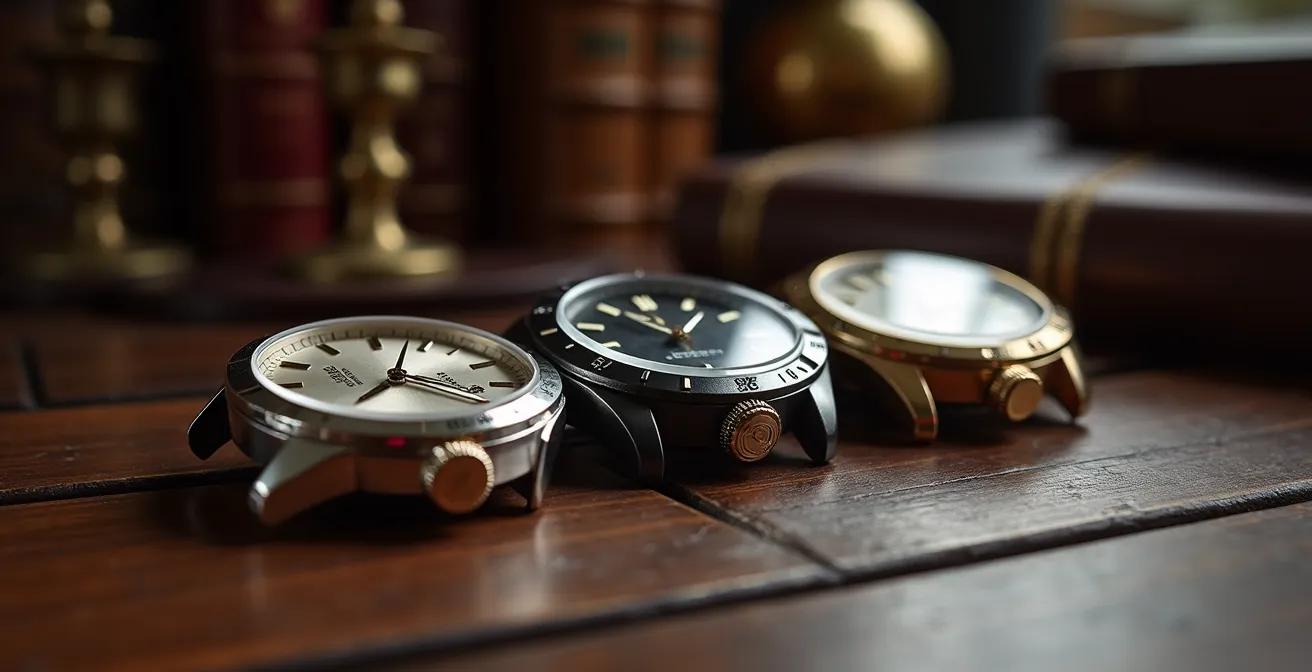
Scratch resistance is not the whole story; the toughest watch for real-world clumsiness is defined by the trade-off between a material’s hardness and its toughness.
- Ceramic is incredibly hard (high Vickers rating) but brittle, leading to potentially catastrophic and expensive replacements if dropped.
- Rolex’s 904L steel offers superior corrosion resistance, but its true value for a clumsy owner lies in its high toughness and ability to be re-polished to a factory finish.
Recommendation: For daily wear and tear in the UK, Grade 5 Titanium offers the best overall balance of lightness, scratch resistance, and impact durability, while specialised steels provide a more cost-effective and repairable alternative.
There is a unique pain reserved for the owner of a new luxury watch: the moment you spot the first scratch. It’s a gut-wrenching discovery that transforms a pristine object of engineering into a marked veteran of daily life. For the clumsy wearer, this isn’t a matter of ‘if’, but ‘when’. The market responds with a chorus of material promises: the un-scratchable allure of ceramic, the aerospace-grade strength of titanium, the timeless heft of steel. Brands tout proprietary alloys and finishes, each claiming to be the ultimate shield against the inevitable knock against a door frame or a scrape on a desk.
But these marketing narratives often oversimplify the complex science at play. The common wisdom suggests a simple hierarchy, but it fails to address the critical trade-offs that define a material’s true resilience. Is a material that resists fine scratches but shatters on impact truly ‘durable’? Is a heavier steel that can be polished back to perfection a better long-term investment than a lighter metal that hides marks better? The conversation often revolves around surface-level properties, ignoring the deeper scientific principles that govern how a material behaves under stress.
This article moves beyond the platitudes. Instead of simply listing pros and cons, we will adopt the perspective of a materials scientist. The true measure of durability isn’t just about preventing a scratch; it’s about understanding the relationship between hardness (a material’s ability to resist scratching, measured in Vickers) and toughness (its ability to absorb impact without fracturing). This distinction is the key to making an informed choice that protects your investment not just from minor abrasions, but from the costly consequences of a genuine accident.
We will analyse the elemental composition of these metals, the real-world costs of repair and maintenance in the UK, and the environmental factors that can alter a watch’s appearance over time. By dissecting the science, we can finally determine which material offers the most robust and practical defence for your timepiece in the real world.
To navigate this complex topic, we have broken down the analysis into key areas. This guide will explore the specific properties and real-world implications of the most common luxury watch materials, from the nuances of steel alloys to the risks of ceramic and the practicalities of leather straps.
Summary: A Scientific Look at Watch Case Durability
- Is Rolex’s 904L Steel Really Better Than Standard Surgical Steel?
- Why Do Bronze Watches Patina and How Can You Control the Colour?
- Is a Titanium Watch Too Light to Feel Luxurious on the Wrist?
- Can You Shatter a Ceramic Watch Case if You Drop It on Tiles?
- How Long Does Gold Plating Last Before the Steel Shows Through?
- Saffiano, Epsom, or Lambskin: Which Leather Survives the Daily Commute?
- ISO standards for dive watches
- How to Store Your Luxury Timepiece Collection to Prevent Humidity Damage?
Is Rolex’s 904L Steel Really Better Than Standard Surgical Steel?
The debate between Rolex’s proprietary ‘Oystersteel’ (a 904L grade steel) and the industry-standard 316L surgical steel is often shrouded in marketing mystique. From a material science perspective, the primary difference lies in the alloy composition. 904L steel contains a higher concentration of chromium, molybdenum, and nickel. While its Vickers hardness rating is very similar to 316L, meaning it is not inherently more scratch-resistant, its real advantage is twofold: superior corrosion resistance and enhanced polishability. The higher nickel and chromium content provide exceptional resistance to acids and chlorides, making it particularly resilient to saltwater and sweat—a tangible benefit for long-term wear.
For a clumsy owner, however, the most significant benefit is how it responds to servicing. Because of its specific composition, 904L steel can be polished back to its original mirror or satin finish with remarkable fidelity. Minor scratches and scuffs that would accumulate on any steel watch can be effectively erased during a service, restoring the timepiece to a like-new state. This repairability is a crucial aspect of long-term value. While the initial scratch may be just as likely to occur on 904L as on 316L, the former’s ability to be ‘reset’ is a major advantage.
This superior performance comes at a cost, both in manufacturing and maintenance. The material is more difficult to machine, and servicing, especially involving deep scratch removal, is more expensive in the UK. A full polish on a 904L steel case requires specialised expertise and equipment, commanding a premium over standard steel watches.
The following table, based on data from UK-based service centres, illustrates the typical cost difference for polishing and restoration services.
| Service Type | 904L Steel (Rolex) | 316L Steel (Other Brands) |
|---|---|---|
| Basic Polish | £150 | £100-120 |
| Full Service + Polish | £600-800 | £275-400 |
| Deep Scratch Removal | £200-300 | £150-200 |
Ultimately, 904L steel is not ‘better’ because it scratches less, but because it offers a higher degree of chemical resilience and an unparalleled potential for aesthetic restoration, albeit at a higher service cost.
Why Do Bronze Watches Patina and How Can You Control the Colour?
Bronze watches are unique in that they are designed to change. The distinctive patina—the dark, aged layer that develops on the surface—is a result of oxidation. When the copper in the bronze alloy reacts with oxygen, moisture, and other environmental elements like carbon dioxide and salts, it forms a complex layer of copper oxides, sulphides, and carbonates. This is not a defect; it is a feature that tells a story of the watch’s life and its owner’s environment. A watch worn in the damp, salty air of the Cornish coast will develop a vastly different, often greener, patina than one exposed to the urban humidity of London.
Not all bronze is created equal. The specific alloy used by a manufacturer dictates the colour and speed of patination. For instance, many modern watchmakers use alloys like CuAL8 (copper-aluminium bronze). The inclusion of aluminium helps stabilise the alloy, slowing the oxidation process and guiding the patina towards a warmer, more consistent brown hue, actively preventing the more aggressive green “bronze disease” that can affect other copper alloys. This gives the owner a degree of predictability over the watch’s aesthetic evolution.
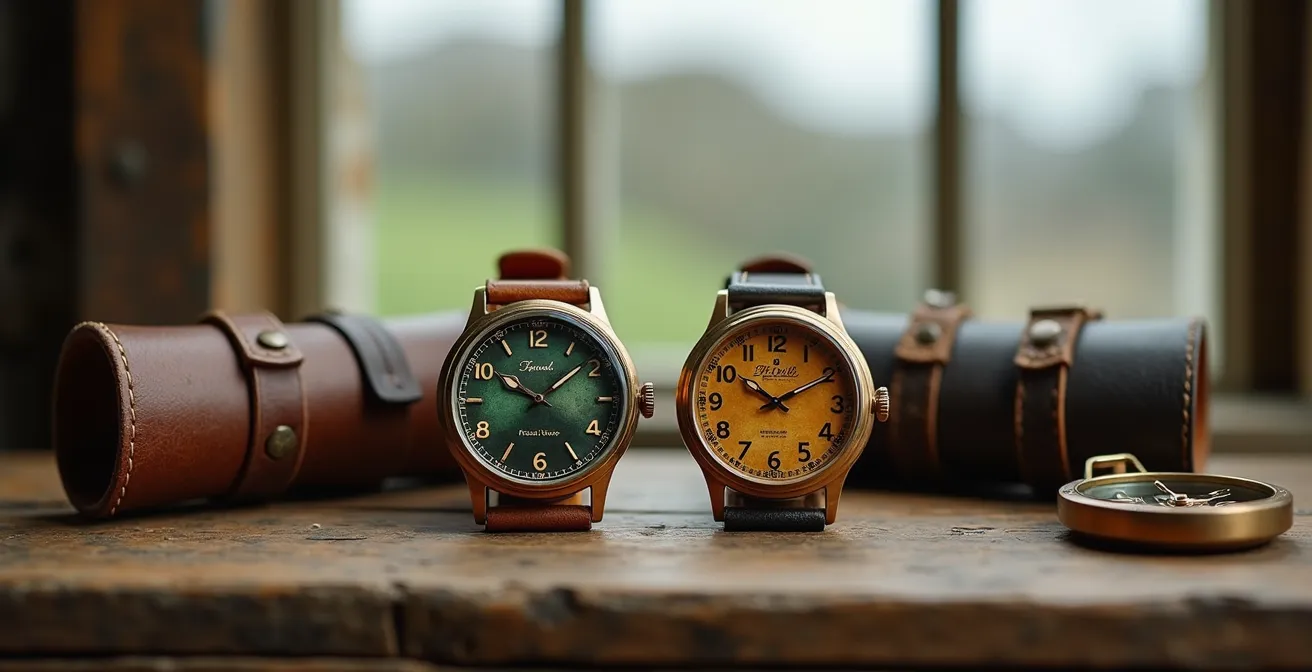
As the image illustrates, the environment plays a starring role. However, the owner is not merely a passive observer. You can actively influence this chemical process. Exposing the watch to salt water or ammonia vapours can accelerate the development of a deeper, more dramatic patina. Conversely, a simple cleaning with a mild acid like white vinegar or lemon juice can strip the oxide layer away, effectively resetting the watch to its original bright, coppery lustre. This allows you to ‘curate’ the look of your watch over time.
Your Action Plan: Controlling Bronze Patina with UK-Sourced Products
- Wear daily in typical British humidity for 2-3 weeks to encourage natural, even darkening.
- To accelerate the process, create a solution with coarse sea salt (available from any UK supermarket) and water, and apply it sparingly.
- For a greener patina, carefully expose the case to ammonia vapours using a 5% household solution (found at retailers like B&Q) in a sealed container for a short period.
- To completely reset the patina, gently clean the case with a soft cloth dipped in white vinegar (from Waitrose or Tesco) and rinse thoroughly.
- Once the desired patina is achieved, apply a thin layer of mineral oil (available at Boots) to the case to seal it from the air and significantly slow further oxidation.
The beauty of bronze lies in this interaction, offering a dynamic and personal ownership experience that stands in stark contrast to the static nature of steel or ceramic.
Is a Titanium Watch Too Light to Feel Luxurious on the Wrist?
The perception of luxury in watches has long been tied to heft. The substantial weight of a solid gold or platinum timepiece conveys a sense of value and importance. This is where titanium presents a paradox. It is a premium, high-performance material, yet its most notable characteristic is its lack of weight. A full titanium watch and bracelet can be startlingly light, leading some to question whether it can truly feel ‘luxurious’. The answer lies in shifting the definition of luxury from simple mass to advanced material science and practical comfort.
Titanium’s low density is its greatest asset. High-end watchmaking typically uses Grade 5 titanium (Ti-6Al-4V), an alloy containing 6% aluminium and 4% vanadium. This is significantly harder and more corrosion-resistant than the commercially pure Grade 2 titanium. In fact, Grade 5 titanium offers a hardness on the Vickers scale that is substantially higher than 316L or 904L steel, making it more resistant to everyday scratches. This means that while it feels lighter, it is structurally more robust in terms of surface durability. For the clumsy wearer, this is a winning combination. Studies show that titanium watches are approximately 43% lighter than their steel counterparts, a difference that translates to exceptional wrist comfort over a long day.
Furthermore, titanium is hypoallergenic and has extremely low thermal conductivity, meaning it feels comfortable against the skin and doesn’t get excessively cold in the British winter or hot in the summer. The modern definition of luxury is increasingly focused on technical performance and user experience. In this context, titanium’s lightness is not a bug, but a feature—a deliberate choice for a comfortable, durable, and technologically advanced timepiece. The feeling of luxury comes not from the weight, but from the knowledge that you are wearing a piece of advanced engineering that perfectly balances strength and wearability.
For those who prioritise comfort and scratch resistance over the traditional feeling of heft, a titanium watch represents a more evolved and practical form of luxury.
Can You Shatter a Ceramic Watch Case if You Drop It on Tiles?
This question gets to the heart of the great material science trade-off: hardness versus toughness. Modern watch cases made from zirconium dioxide ceramic are celebrated for their incredible hardness. With a Vickers hardness rating that can exceed 1,200 HV, they are virtually impervious to the scratches and scuffs of daily wear. A ceramic watch can look brand new for years, as materials like steel, dust, or sand are simply not hard enough to mark its surface. For anyone frustrated by the micro-scratches that inevitably appear on a polished steel bezel, this is a revolutionary property.
However, this extreme hardness comes at a price: low toughness. While steel or titanium will dent or deform upon a sharp impact, ceramic has very little ability to absorb that energy. Instead of bending, it can fracture. Dropping a ceramic watch from waist height onto a hard, unforgiving surface like Victorian bathroom tiles or a stone floor can indeed cause the case to chip or even shatter. It’s a rare occurrence, but the risk is real, and the consequences are severe. Unlike a scratch on a steel case that can be polished out, a fractured ceramic case cannot be repaired. The entire case middle must be replaced.
This replacement is an expensive proposition. As one UK owner tragically discovered, the cost can be staggering. The incident below underscores the financial risk associated with ceramic’s brittleness.
Yep, IWC have the middle case in stock. Total cost was – c£2,200 middle case – c£550 full service – c£150 new hands and pusher Covered by insurance thankfully. I have since sold the watch as I couldn’t be bothered with the carryon should it happen again.
– PistonHeads Forum Member, UK Watch Forum
As this testimony reveals, an IWC ceramic case replacement in the UK costs approximately £2,200 for the part alone, often necessitating a full service on top. This makes a single moment of clumsiness a multi-thousand-pound event. Therefore, a ceramic watch is a calculated risk. It offers unparalleled protection against 99% of daily wear, but it carries a small but catastrophic risk from a significant impact.
It is the perfect material for the careful owner, but a potentially heartbreaking choice for the genuinely accident-prone individual who isn’t prepared for the replacement cost.
How Long Does Gold Plating Last Before the Steel Shows Through?
Gold-plated watches offer the luxurious aesthetic of solid gold at a fraction of the price, but their durability is a common concern. The longevity of gold plating is not a matter of time, but of thickness and wear. The plating is a micro-thin layer of gold electrically bonded to a base metal, usually stainless steel. Its lifespan is directly proportional to its thickness, which is measured in microns (one-thousandth of a millimetre).
A “flash” plate of 1-2 microns may only last a year or two with regular wear before the base steel begins to show through, particularly on high-friction areas like the edges of the case and the clasp. A higher-quality plating of 5 to 10 microns can last for many years, even a decade or more, if cared for properly. The key is to minimise abrasion. Constant rubbing against shirt cuffs, desks, and other surfaces will slowly wear away the gold, molecule by molecule. It is a war of attrition. Deep scratches are a particular problem, as they can cut straight through the thin gold layer to expose the steel beneath, and these cannot simply be polished away without removing the surrounding plating.
When the inevitable wear does occur, re-plating is a viable option. Specialised workshops, many of which are concentrated in London’s Hatton Garden, can professionally strip the old plating and apply a new, often thicker, layer. This process can fully restore the watch’s appearance, but it is a specialist service with a significant cost.
Your Action Plan: Guide to Re-Plating a Watch in the UK
- Research reputable UK-based watch re-plating specialists, focusing on workshops in areas known for jewellery expertise like Hatton Garden in London or the Jewellery Quarter in Birmingham.
- Request detailed quotes from at least three different certified workshops to compare costs and services.
- Specifically ask about the micron thickness options available. A quality service will offer choices, typically ranging from 5 microns for good durability to 10 or even 20 microns for a very long-lasting finish.
- Verify whether the service uses traditional electroplating with genuine gold or a PVD (Physical Vapour Deposition) coating. While PVD can be more durable, it may not perfectly match the colour of original gold.
- Plan for a turnaround time of approximately 2 to 4 weeks and budget between £200 and £500, depending on the watch’s complexity, surface area, and the desired gold thickness.
Ultimately, a gold-plated watch requires a more mindful ownership approach than a solid steel one, trading some robustness for its accessible luxury aesthetic.
Saffiano, Epsom, or Lambskin: Which Leather Survives the Daily Commute?
A watch strap is not just a functional component; it’s a major aesthetic element that is constantly exposed to the rigours of daily life. For a commuter, especially on the London Underground, the strap faces a barrage of challenges: friction from clothing, accidental scuffs against bags and turnstiles, and exposure to rain and humidity. The choice of leather is therefore critical to its longevity and appearance.
At one end of the spectrum is lambskin. Prized for its incredible softness and supple feel, it offers unparalleled comfort. However, it is the least durable option. Its delicate surface is highly susceptible to scratches, scuffs, and water damage. A single unexpected downpour can leave permanent marks. It is a luxury choice best reserved for occasional wear rather than the daily grind.
In the middle are embossed calfskin leathers like Epsom. Originally popularised by Hermès, Epsom leather has a pressed, cross-hatch grain that gives it a rigid, structured shape. This texture makes it significantly more resistant to scratching and scuffing than smoother leathers. It is also relatively lightweight and holds its colour well over time. While not fully waterproof, it can withstand light moisture and is easy to clean, making it a very practical and resilient choice for daily wear.
At the most durable end of the spectrum is Saffiano leather. Invented by Prada, this is a calf leather finished with a distinctive cross-hatch texture that is machine-pressed into the surface and then treated with a wax coating. This process makes the leather almost completely resistant to scratches, stains, and water. It is incredibly tough and very easy to maintain; a simple wipe with a damp cloth is usually all that’s needed. While it may not have the soft, natural feel of lambskin, its extreme durability makes it the undisputed champion for surviving the daily commute and maintaining a pristine appearance.
| Leather Type | Water Resistance | Scuff Resistance | Maintenance Need |
|---|---|---|---|
| Saffiano | Excellent | Excellent | Low |
| Epsom | Very Good | Very Good | Low-Medium |
| Lambskin | Poor | Poor | High |
For a hassle-free, robust strap that can handle the challenges of daily travel in the UK, Saffiano leather is the clear winner from a materials perspective.
ISO standards for dive watches
For a watch to be legally marketed and sold as a “diver’s watch,” it cannot simply have a high water resistance rating. It must meet a stringent set of criteria defined by the International Organisation for Standardisation, specifically ISO 6425. This standard is not a mere guideline; it is a comprehensive gauntlet of tests that ensures reliability and safety in life-critical underwater situations. It represents a guarantee of performance far beyond what a typical “water-resistant” watch offers.
The standard covers numerous requirements. For example, the watch must have a time-preselecting device, such as a unidirectional rotating bezel with markings at least every 5 minutes, which is protected against accidental rotation. The dial must be legible in total darkness from a distance of 25cm, with clear indications for hours, minutes, and the running of the watch (usually via a luminous second hand). It must also possess magnetic resistance (to 4,800 A/m), shock resistance (surviving an impact from a 3kg hammer), and chemical resistance to salt water.
Crucially, the water resistance test itself is far more demanding than a standard rating. A watch rated to “200m” is typically only tested statically at that pressure. However, ISO 6425 requires dive watches to be tested at 125% of their rated depth. This means a watch rated for 200 metres is actually submerged and tested at a pressure equivalent to 250 metres. This 25% safety margin is a fundamental part of the standard, ensuring the watch can perform reliably well beyond its stated limits. Following the pressure test, the watch is also subjected to a condensation test to ensure no moisture has entered the case.
When you see “ISO 6425” or “Diver’s” on a watch, it signifies that each and every timepiece has undergone this battery of tests, offering a level of assurance that a simple depth rating cannot match.
Key Takeaways
- Hardness vs. Toughness: The core principle is that scratch-resistance (hardness) and impact-resistance (toughness) are a trade-off. Ceramic is hard but brittle; steel is tough but scratches more easily.
- Material Science Matters: The specific alloy (e.g., 904L steel, Grade 5 titanium, CuAL8 bronze) dictates properties like corrosion resistance, polishability, and patina colour far more than the base metal alone.
- Cost of Clumsiness: The real cost of a material is revealed upon damage. Steel is relatively inexpensive to polish, but a shattered ceramic case can cost thousands of pounds to replace in the UK.
How to Store Your Luxury Timepiece Collection to Prevent Humidity Damage?
Choosing a durable watch case is the first line of defence, but preserving its value and function requires a proactive long-term strategy, especially in the UK’s notoriously damp climate. Humidity is the silent enemy of a luxury watch collection. It can accelerate the patina on a bronze watch uncontrollably, tarnish silver components, encourage mould growth on leather straps, and, most critically, compromise the water-resistance gaskets over time, potentially leading to moisture ingress and costly movement damage.
The ideal storage environment for watches is one with a stable relative humidity, typically between 40% and 50%. Achieving this in a British home, which can range from dry centrally-heated air in winter to high ambient humidity in summer, requires a tailored approach based on your property type and the value of your collection. A simple, well-made watch box is the foundation, but it is often not enough on its own. For most collections, supplementing a standard box with desiccants is a cost-effective solution.
For those living in particularly damp environments, such as older Victorian terraces or basement flats, or for collectors with highly valuable pieces, more robust solutions are necessary. An electronic dehumidifier can control the ambient humidity of an entire room, while specialised climate-controlled watch boxes and winders offer the ultimate peace of mind by maintaining a perfect micro-environment. These advanced systems are an investment, but they provide a level of protection that passive methods cannot, safeguarding not just one watch, but an entire collection from the slow, insidious damage of humidity.
Your Action Plan: UK Humidity Control Solutions by Property Type
- For typical Victorian terraces with fluctuating humidity, use renewable silica gel packs (from retailers like Ryman, costing £5-10) inside your watch box and change or recharge them monthly.
- For damp-prone basement flats or ground-floor conversions, invest in a small electronic dehumidifier (from £50-150 at Argos) to regulate the humidity of the entire room where the collection is stored.
- For period properties with poor insulation, consider a dedicated humidity-controlled watch box from a brand like Rapport London (£300-£800) for a targeted, high-performance solution.
- For well-insulated modern apartments, a basic watch box combined with small silica gel packs is generally sufficient to counteract ambient humidity.
- For a high-value, irreplaceable collection, the ultimate protection is a professional-grade climate-controlled winder or safe from a specialist like WOLF (£1000+), which actively manages both humidity and security.
Now that you understand the science behind watch materials and long-term care, the next logical step is to assess your own lifestyle and risk tolerance to choose the timepiece that offers the right balance of durability, aesthetic, and peace of mind for you.